Saturday, November 04, 2006

Babel

Alejandro González Iñárritu's informal trilogy of alinear ensemble dramas - Amores Perros, 21 Grams and the new release Babel - center on accidents and traumas that unite disparate strangers. Taken together, they insist that we discover ourselves in times of crisis as opposed to peace, that the only true and honest moments occur when our perceptions about the world collide with harsh reality. Call it the Accidental Trilogy.

Though all three of these films have their merits, I remain unmoved by Iñárritu's passion for non-chronological storytelling. It makes some measure of sense as structural metaphor - we see the stories unfold in a jumble to simulate the fog of interconnectedness in which we all live. Our actions all directly impact others and yet we remain blissfully unaware of the far-reaching consequences of everyday decicions, operating under the illusion of randomness. Iñárritu jumps around, always showing us the how's of any given situation but leaving all the other important answers - who? why? - for the end, because that's how we live. We don't get to know everyone we meet up with during our daily adventures. We just encounter them and proceed from there.

Theoretically, the notion is sound, if a bit cerebral and High Modernist for a 21st Century filmmaker. In practice, Iñárritu doesn't really get the most out of the technique. His films tend to feel as if they are about to reveal some grand, transcendent truth about human life, but they never quite get there. Amores Perros makes the best, if most gimmicky, use of the chaotic structure. 21 Grams always felt to me like a great movie buried beneath a bunch of pointless, busy and intrusive over-direction. Babel employs Iñárritu's favored method with the most grace and subtlety of the three but nevertheless fails to turn its handful of interesting short stories into something more than the sum of its parts. All the tangential elements feel as if they're going to come together, they seem on the verge of coming together, but they never truly come together. Unfortunately, it's a well-made, interesting miss.


What's most impressive about Iñárritu's direction this time out is his ability to maintain intensity over the course of a 2.5 hour film. Babel darts between four different sets of characters, all of them in the midst of a crisis situation. It's the anti-Crash. Paul Haggis' miserable disgusting failure focuses on a variety of interconnected stories in which the mundane details of a typical day in Los Angeles (or what was meant to signify a typical day) paint a broad picture of race relations in modern America.

(He goes so far as to suggest that secret, unspoken, burning desires guide our everyday actions. For example, that we Angelinos get into car crashes not out of carelessness but a need to meet n' greet our faceless neighbors.)

In Babel, Iñárritu examines abstracts like Hope and Dread by putting his characters into severe distress and then watching them claw their way out. These are not everyday frustrations and annoyances, the kind of encounters to which any of us in the audience can theoretically relate, but wrenching and life-altering tragedies. The latter approach yields a more compelling and watchable, if emotionally draining, finished product.

In Morocco, two brothers (Boubker Ait El Caid and Said Tarchani) fire their father's new rifle off a mountaintop. When they connect with a bus full of tourists and realize that the game has suddenly turned deeply serious, they ditch the gun and run home to feign ignorance. The bullet has entered with the chest of the unsuspecting Susan (Cate Blanchett), an American on vacation with her husband Richard (Brad Pitt) as an escape from troubles at home.

In trying to save his wife's life, Richard will confront a number of perplexing obstacles. The nearest hospital is 4 hours away and Susan is in no shape to travel. The local ambulance cannot be found. The other tourists on the bus don't feel safe in a Moroccan village after dark. Even the American embassy won't help - there are concerns that this might have been a terrorist attack, which could cause diplomatic complications.

Pitt's pretty solid in these sequences. It's a demanding role, developing a character who spends the entire film in a cold sweat. With his wife unconcious most of the time and the locals speaking in halted, broken English, he's at the center of almost all the Moroccan material, which makes up a little under 1/2 of the movie. Along with Fight Club and 12 Monkeys, it's one of his rare worthwhile performances. (He's fun in stuff like Ocean's Eleven, but generally the guy's coasting on his looks and charm and you can tell.)

The film's other two stories take place in Mexico and Japan. Iñárritu does eventually explain the connections between these stories to the "main" action in Morocco but they're both pretty thin and not particularly meaningful.

Richard and Susan's blonde moppets (Nathan Gamble and Dakota Fanning's clone sister Elle) have been left behind in San Diego, in the care of the family's faithful Mexican nanny Amelia (Adrianna Barraza). When Mom and Dad are delayed in-country by that regrettable stray bullet, Amelia is forced to take her charges across the border into Mexico for her son's wedding. The intial portion of their trip provides the film's lone upbeat, happy scenes, with Amelia's nephew Santiago (Gael Garcia Bernal) driving the kids on a whirlwind tour of Baja California followed by the actual wedding, but the journey back into the United States proves more problematic.

Meanwhile, in Japan, a deaf-mute teenaged girl (Rinko Kikuchi) and her befuddled father (Kôji Yakusho) come to terms with one another in the wake of her mother's suicide. Thematically, Chieko and her search for a human connection mirrors the film's other sections, which all focus on communication breakdowns, but Iñárritu properly connects this story to the others at the very end. When the explanation finally comes, it's fairly far-fetched and not exactly the momentous turnaround the movie seems to anticipate.

Over the course of the four narratives, Iñárritu and co-screenwriter Guillermo Arriaga (who collaborated on the entire trilogy) develop a number of provocative ideas. As a part of their larger examination of the collision between perceptions and reality, they spend time probing the stereotypical, simplistic and frequently damaging perceptions people hold about one another, particularly Americans as they regard foreigners.

Susan and Ricahrd's kids are afraid at first to go to Mexico, because their parents have told them it is a dangerous place. (Santiago agrees, pointing out that it's full of Mexicans.) Despite Susan's worsening condition, Richard has a hard time convincing his fellow busmates to stick around in a remote Moroccan village. They are afraid the Muslim locals will rob or murder them whilst they sleep.

Unfortunately, Iñárritu takes on so much in the film, working on a canvas that's so broad and filling it with so many scattered insights, a lot gets lost in the shuffle.

The Japanese sequences would probably work better as a stand-alone film. The connection to the main story about the bus shooting doesn't really do anything to advance our understanding of Chieko and her encroaching isolation. Her story closes out Babel and brings Iñárritu's Big Themes into the clearest relief.

What character could better express feelings of separation from humanity, an inability to make oneself understood, than a girl who cannot hear or speak? And what more clear invocation of raw human pain could be imagined than a girl desperately trying to find love after being abandoned by a beloved parent? Kikuchi's fantastic in the role - clearly one of the best female performances of the year - and her chemistry with Yakusho felt lived-in and palpable. Their final scene together ranks among the film's best, and ends the film on a moment of significant power.

Like The Prestige, The Black Dahlia and several other moderate 2006 disappointments thus far, Babel gets a whole lot right. Cinematographer Rodrigo Prieto (who shot the entire trilogy, along with 8 Mile and The 25th Hour) ably gives the various segments unique visual styles and color patterns. Again, I found the Japanese segments to be the most accomplished. That final shot works as well as it does in part because of the contrast between the blackness of the night sky and the vibrant neon lights of Downtown Tokyo.

Most of the performances, in addition to the standouts I already mentioned, are warm and vivid. Gael Garcia Bernal, who has already demonstrated his considerable ability in Y Tu Mama Tambien and Bad Education, had a huge year in 2006 with Science of Sleep, the exceptional direct-to-DVD The King and now Babel. His reckless chatterbox Santiago is the film's most funny and immediately likable character.

But taken as a whole, Babel is essentially a roiling mass of ideas in search of a movie, a humane vision of the meaning behind the randomness of our lives that's too big for one film to contain. I don't want to knock the film, really, because I admire its outsized ambition. But it's a bit too disjointed and messy to strongly recommend either. I left the movie feeling confused and a bit let-down, like I had seen something worthwhile but also incomplete.

Thursday, November 02, 2006

Pardon My Zinger

John Kerry is not a funny man. Anyone who was alive and conscious during the 2004 election could tell you that. He was not my #1 (or even #2 or #3) choice for the Democratic nomination for President, but JK has a number of good qualities - he's an intelligent, courageous war hero with decades of political experience and a solid reputation as a strong leader. He's just woefully unfunny.

Which is fine with me. I don't think we need a funny guy in the White House. In fact, I'd rather the Commander in Chief not be constantly cracking wise. Schtick is undignified in a world leader. We've got a real joker in the office right now and he's not doing so good. (Why do I have a feeling that some of the time he was supposed to spend thinking about Iraq exit strategies were actually goofy nickname brainstorming sessions?)

So, yeah, Kerry's attempted burn of GWB (in essence, calling him stupid) backfired. Here's Keith Olbermann with the background:

Senator Kerry, as you well know, spoke at a college in Southern California. With bitter humor, he told the students that he had been in Texas the day before, that President Bush used to live in that state, but that now he lives in the state of denial.

He said the trip had reminded him about the value of education — that quote "if you make the most of it, you study hard, you do your homework, and you make an effort to be smart, you can do well. If you don't, you can get stuck in Iraq."

Okay, a few points. First, no matter what the lying Republican liars say, this joke has nothing to do with the troops in Iraq. Admittedly, it's not a funny joke and the meaning is somewhat muddled. But Kerry's referring to George Bush, not the troops in harm's way. "If you make the most of things [unlike Bush] and you do your homework [unlike Bush] and you make an effort to be smart [unlike Bush," things will work out. If you don't, you can get stuck in Iraq [like BUSH!]"

Does anyone out there really believe John Kerry thinks our troops are stupid? That they didn't do their homework? The guy's a veteran! So, I wish he had phrased it a bit more clearly, but Kerry's not actually saying anything wrong. If telling bad jokes were a crime, Jackie Martling would be doing 40 to life in Sing Sing by now.

What irks me is that Kerry has now apologized to any members of the military whom he may have offended. Why! WHY! That's just what they want, John! To put you on the defensive, to make it look like you said something wrong because you are fundamentally unserious about the war! This is the case they've been making against the Left for years now, and the only reason such a stupid argument keeps working is that gullible fools such as John Kerry keep falling for the rhetorical trap.

John Kerry says: "George Bush is a dumbass who got our troops bogged down in an unwinnable quagmire."

George Bush says: "On behalf of the troops, I find that deeply offensive."

John Kerry says: "Oh, well, I apologize. Never mind."

WRONG!

John Kerry should say: "I find everything the President does to be deeply offensive, and that's worse than finding my comments offensive because his actions have real-world ramifications. My poorly-worded joke may have hurt someone's feelings inadvertedly. George Bush's poorly-considered policies have led to the deaths of thousands of Americans."

How hard is that? Really, how hard?

Cenk Uygur has it exactly right at HuffPo. Not only should Kerry have turned this non-scandal into an opportunity to criticize the president but he could have used it as a rhetorical trap of his own.

John Kerry's joke about the president -- which was twisted for propaganda purposes by the Republicans -- was an ... opportunity! It was an opportunity for Democrats to bring up every error that Bush and his Republican enablers in Congress have made -- and then demand an apology to the troops for those actions.

Anytime a reporter asked about Kerry's remarks, every Democrat should have started the sentence with the words, "Let me tell you who has to apologize to the troops, these Republicans in the administration and Congress for what they have done..."

Precisely what I'm saying. Republicans come out swinging, making a big issue out of Kerry's joke, and then Democrats turn it around on them and take advantage of the publicity to challenge Republicans on Iraq. Which is their weakest issue going into the elections!

I think the fact that Kerry's statement isn't even a provable falsehood, but a mere gaffe, makes this even easier. If any Democrat is asked about John Kerry's quote, they could just respond that the poor guy misspoke and that we don't go after George Bush every time he butchers a sentence. There are literally thousands of examples of our President mangling his words and thus distorting his overall meaning. But people let it slide bcause they understand that he's an idiot and it's mean-spirited to attack an idiot for their unavoidable idiocy.

John Kerry is not an idiot. He's just not funny. It's a key difference.

Monday, October 30, 2006

Not Another Atene Movie

Can this clip possibly be real? The story goes that Brian Atene, second-year student at Julliard, sent this audition tape to Stanley Kubrick when the great director was preparing to shoot Full Metal Jacket. But, I mean...come on...


I AIN'T NEVER GONNA WALK AGIN'! NOT EVEN ON CRUTCHES!

Classic...

[This video appears courtesy of my friend Kaz and the good people at The Panopticist.]

This is Not a Blog

Hey, John Boehner, why is a raven like a writing desk?

STEPHANOPOULOS: Let me just ask one more question on this. Your own senators, I said Mike DeWine, thinks Rumsfeld has to go. Do you agree?

BOEHNER: I think Donald Rumsfeld is the best thing that’s happened to the Pentagon in 25 years.

Boehner went on to say that Yoko Ono was the best thing to ever happen to The Beatles, to lavish priase on Mad Cow Disease and all it has done for the British beef industry and to warmly embrace the BTK Killer before injecting himself with Hepatitis C and pouring a 2-liter bottle of Mountain Dew over his head.

The actual TV appearance, of course, was to announce that Boehner will be leaving the Republican Party for the growing grassroots movement known as the Slighty Silly Party, where he and Kevin Phillips Bong will campaign jointly for the local positions of Sargeant-at-Arms and Assistant Public Swimming Pool Inspector, respectively, in the small German hamlet of Bremen.

The Bloodening!

Every Halloween, I try to come up with a cool list of horror films. I watch intensely gory or scary movies all year, just because I'm sick like that, so during this one night a year that the normals set aside to sample such forbidden pleasures, I get a rare opportunity to apply my knowledge.

These are, in my view, horror films that don't enjoy an appropriate level of noteriety. It's not that I don't think The Exorcist, The Texas Chainsaw Massacre, Nightmare on Elm Street, Child's Play and The Shining are great films. (Well, Child's Play is actually kind of lame.) But everyone, movie fans or not, knows about them and rents them on Halloween. Let's see if we can't find something new...

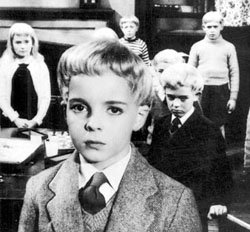
Village of the Damned (1960)

That woeful John Carpenter remake kind of robbed the movie of its sterling reputation. But Wolf Rilla's chilling sci-fi/horror classic is still creepy to this day. It's something about the flat, emotionless child performances. We're so used to seeing kid actors trained to be full of energy and, let's face it, obnoxious that really restrained, subtle performances from the very young are always deeply unsettling. (See The Sixth Sense, The Bad Seed and The Omen for other examples.)


The central conceit has become something of a pop culture joke. On one strange day, all the residents of a small English village fall into a deep sleep. When they awake, many of the town's women find themselves impregnated. 9 months later, they give birth to eerie, ultra-intelligent children who seem to possess a kind of hive mind.

Stir of Echoes (1999)

Box office juggernaut The Sixth Sense overshadowed David Koepp's adaptation of a Richard Matheson ghost story back in '99. Looking back years later, though, I still admire the intelligence and creativity behind Shyamalan's film, but I find Stir of Echoes more rewatchable. What lingers about the film is the intense, unstudied naturalism of Koepp's writing. The uncertain blue-collar family at its center feels so real that the intrusion of ghostly apparitions and madness into their lives becomes more personal and threatening. This is not some paranormal fantasy world where anything is possible, but a recognizable modern American town.

The Black Pit of Dr. M (1959)

I know it's a Spanish-language black and white horror film from the '50s, but please don't let that stop you from checking this one out. (The original title: Misterios de Ultratumba!) I swear, this is one of the most diabolically clever and atmospheric horror movies ever made. Fernando Mendez's clever spin on the Faust legend contains just about every permutation of classic horror cinema - reanimated corpses, midnight deadlines, seances, ghosts, carriage rides through fog-covered swamps, an isolated spooky manor and a brutal slaying. A death bed promise leads Dr. Masali (Rafael Bertrand) to exchange his immortal soul for knowledge about the afterlife in a film that's ceaselessly inventive and immensely entertaining.

The Virgin of Nuremberg (1963)

I'm not sure this actually qualifies as a true giallo. It's a mystery, but the setting is Germany, not Italy. Plus it's a bit early. I've always thought of giallo as a late '60s and '70s phenomenon. But director Antonion Marghariti certainly infuses his film with the same grotesque, expressive style as the famous masters of Italian horror, filling the frame with vibrant red blood against deep black backgrounds, sweeping his camera past baroque dining halls and into ghastly torture chambers.


A disfigured Holocaust survivor haunts a German castle, bringing women into the basement's torture museum and visiting on them all manner of horrors. (In the film's most famous sequence, a woman's face is gnawed off by a rat). An obvious metaphor for the complicity of all those Italians and Germans who looked the other way at the atrocities of the Nazis, The Virgin of Nuremberg has a lot to say amidst all the revealing bodices and carefully-shot bloodletting. Plus it features Christopher Lee in a small supporting role as a creepy butler!

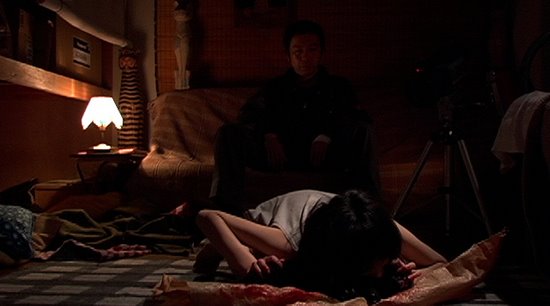
Marebito (2004)

Like most movie fans, I'm a little sick of J-horror at this point. I can only watch so many movies about eerie, uncanny, wet little children with hair in their faces before it's just not that shocking any more. (Okay, Ju-On adds the fact that the kids make cat noises, but it's still wearing a bit thin).


Takashi Shimizu's Marebito, the story of a fear-obsessed cameraman who journeys to an underworld beneath the streets of Tokyo, plays with a lot of the same elements as other J-horror films but inverts them in new, more provocative and ambiguous ways. It may be the first film I have ever seen that's equally inspired by the writings of Jules Verne and H.P. Lovecraft.

The Last Man on Earth (1964)

The second film on this list inspired by the work of Richard Matheson, The Last Man on Earth is an Italian take on the short story "I am Legend." This story also was the basis for The Omega Man, that Charlton Heston camp classic of the '70s. But this version is much better, with Vincent Price as Dr. Robert Morgan, trapped in his suburban home after a worldwide plague turns the rest of the population into flesh-hungry zombies. Price is at his scenery-chewing best here, but what makes Last Man on Earth really memorable are the zombies, who unlike most of the walking undead, speak in dulcet, clear baritones.

Ravenous (1999)

Antonia Bird's brilliant cannibal western works simply as a terrific snowbound gorefest. A group of disaffected soldiers, mainly veterans of the Mexican-American war, are set upon by a ferocious man-eating cavedweller (Robert Carlyle). But it's also a large-scale metaphor for Manifest Destiny and the conquest of America by European whites.


Cannibalism in Bird's film has a supernatural element - the old Indian stories about devouring one's enemies and absorbing their strength is taken quite literally and at face value. Carlyle's fiend becomes exceptionally hard to kill, and only others willing to ingest human flesh themselves will have a chance to destroy him. Interesting little observations and dialectics like this run just under the surface of every scene in Ravenous, making it surprisingly dense for a film that's superficially about a bunch of soldiers eating one another. (The key to the entire film is the opening scene, in which Guy Pearce's disgruntled vet eats and then vomits up a rare steak in a tent with other military officers.)

Ravenous was a flop upon its initial release (in 1999, the last truly great year for movies), probably because it's difficult and idiosyncratic and, yes, violent. But it's time this stunning achievement had a serious critical and popular reappraisal.

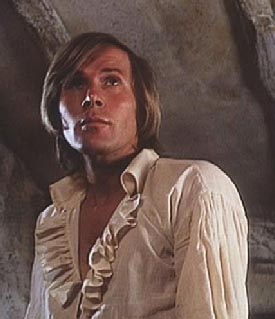
Captain Kronos, Vampire Hunter (1974)

Brian Clemens, one of the creators of the original "Avengers" TV show, wrote and directed this swashbuckling vampire adventure that's arguably the most fun film ever produced by Britain's legendary Hammer studios. Goofy-looking German actor Horst Janson and his hunchbacked assistant Dr. Hieronymous Grost (John Cater) and the busty Caroline Munro scour the countryside looking for vampires, who suck out their victim's youth and beauty along with their blood.


Working from a template that has been used and reused thousands of times, Clemens brings his considerable wit to the exercize, making Captain Kronos a near-perfect blend of swordfighting action, gory horror and dry comedy.

Wisconsin Death Trip (1999)

Half-documentary and art film, James Marsh's Wisconsin Death Trip focuses on the true and grisly events that took place in Black River Falls, Wisconsin from 1890 to 1900. Using actual newspaper clippings from the time (read in the voice-over by Ian Holm), recreations and photographs from the period, Marsh paints an occasionally funny and always fascinating portrait of a town poised on the edge of madness.

Something must have happened in Black River Falls to create such bizarre behavior, everything from elaborate suicides to young children going on murder sprees. Individual cases seem to have some kind of rational explanation (for example, a woman who habitually smashes shop windows was has an addiction to cocaine), but other stories seem to reflect a general malaise or uncertainty. The modern clashes with the Victorian, the immigrant clashes with the native, but can any of these conflicts alone explain the sudden uptick in remarkable and horrifying police reports?

The Brood (1979)

Interestingly, David Cronenberg's big crossover titles tend towards dramas and psychological thrillers - like A History of Violence, The Dead Zone or Crash - when most of his work more closely resembles The Brood. This is dark, violent, wrenching horror in which the source of the fear comes from within the protagonist, and thus can't be "faced down" or conquered. Nola Carveth (Samatha Eggar) is under the care of a mysterious psychiatrist (Oliver Reed) for a strange disorder that has in some indirect way led to brutal attacks. Her husband (Art Hindle) is suspicious about the doctor's methods and does some investigating, uncovering a truly far-fetched and seriously messed-up diagnosis with a lot of intriguing ramifications. I'll grant that this is not among Cronenberg's all-time best, but more people are familiar with Scanners and Videodrome and some of the others, so I thought I'd highlight this less-known early entry. (Also, Rabid and Shivers are both essential viewing for horror fans.)

Friday, October 27, 2006

Back Off, Man...I'm a Mad Scientist...

Two weeks before an election? They come with this?

Defense Secretary Donald H. Rumsfeld said Thursday that anyone demanding deadlines for progress in Iraq should "just back off," because it is too difficult to predict when Iraqis will resume control of their country.

During an often-combative Pentagon news conference, Rumsfeld said that while benchmarks for security, political and economic progress are valuable, "it's difficult. We're looking out into the future. No one can predict the future with absolute certainty."

He said the goals have no specific deadlines or consequences if they are not met by specific dates.

"You're looking for some sort of a guillotine to come falling down if some date isn't met," Rumsfeld told reporters. "That is not what this is about."

"Back off"? This is how our elected officials explain themselves to us? "Back off"?

"Hey, Don, since none of your plans have worked out yet and things are getting worse by the day, shouldn't we at least begin thinking about when to leave Iraq?"

"BACK OFF, dude! Man, I am so tired of being questioned and bothered all the time just because my poor decision-making has directly led to thousands upon thousands of unnecessary deaths! Why don't all of you bitches raise up off my nutsack?"

I can't believe this guy still has his job. He must have photos of George Bush snowballing Karl Rove or something. He knows where the several dozen other guys Dick Cheney "accidentally" shot in the face are buried. He's promised to share the golden treasure with the rest of the Bush administration once he's unlocked the secrets of the Declaration of Independence map. There must be some rational explanation.

If you steal $10 from the register at a Barnes & Noble, you lose your job, but this guy has managed to lead thousands of men to the slaughter while achieving not a single one of our stated military or security objectives while remaining gainfully employed. Then he goes on TV and tells us all to "back off." Must be nice, if you can get away with it...

Rumsfeld often spars with reporters at Pentagon briefings, but Thursday his criticism of journalists seemed more pointed than usual.

"That's a rather accusatory way to put it," he said in response to one question about reducing troop levels.

Members of both parties say next month's congressional elections have become a referendum on the war in Iraq. Control of Congress could hinge on whether voters believe the Bush administration is on the right path or if there should be a change in course and significant reduction in U.S. troop levels there.

Rumsfeld's comments on the benchmarks further muddied the waters on whether there is agreement between the Iraqis and the U.S. on how quickly progress must be made there.

"They're still in discussions," he said.

I don't get how the Rethuglicans think sending Rummy out to yell at us is going to help them win in the upcoming elections. If they even care about actually getting votes, that is. It seems pretty much fait accompli that the shit is going to be rigged in their favor. (Democratic candidate Jim Webb can't even get his full name on the ballot!) Still, this kind of angry petulant squawking from a guy no one really respects any more can't be a winning strategy, can it?

"Vote Republican. Then sit down and shut the fuck up. Dummy."

Wednesday, October 25, 2006

The Road to Guantanamo

Asif Iqbal, a British Muslim detained for three years after being arrested in Afghanistan, recounts his misadventures in The Road to Guantanamo. Along with the other two members of the so-called Tipton Three, he had gone to Pakistan for a wedding in the immediate aftermath of 9/11 and, once there, decided to go to Afghanistan to help with the refugee crisis.

The Northern Alliance had captured and mistreated Asif and his friends, and he recalls feeling an intense sense of relief upon being turned over to the American Armed Forces. Now, Asif had no love lost for American policy, but he still knew what America stands for. "Oh, Americans, they're all right," he thought. Of course, Asif was wrong.

The three years that followed, spent largely in the infamous Guantanamo Bay base in Cuba, were filled with cruel degradation and torture. Asif, Ruhal Ahmed and Shafiq Rasul were guilty of no crime, but because they were Muslims and they had been found in Afghanistan, American and British intelligence agencies simply assume that they must know something. What begins as an unfortunate misunderstanding escalates into an elaborate and tragic farce. When an interrogator orders Shafiq to give up Osama bin Laden's location, he almost has to laugh even though he's in pain and terrified. The notion that this kid can be of any help to the American intelligence community is laughable on its face.


Michael Winterbottom's harrowing film alternates between footage of the Tipton Three recounting their own experiences with expertly-shot re-enactment footage. The balance works well, giving the film authenticity but also raw, visceral power. Talking head interviews with these guys about what happened would be compelling, but Winterbottom's intentionally trying to provoke a response. He wants to show the people of America and Great Britain what's being done in their name, and he wants us to feel it, and just giving us more interviews would be pulling punches.

Instead, he gives us a chance to get to know Asif, Ruhal and Shafiq on their travels in the weeks before their arrest. (They are portrayed in the dramatic footage by Afran Usman, Farhad Harun and Riz Ahmed.) In Pakistan so Asif can be married, these old friends treat the trip as a sort of last weekend together before entering their adult lives. (They are joined by a fourth friend, Monir, who disappeared in the chaos of a war zone.)

The friends goof around Karachi for a while and then wander into a mosque, where an imam is talking about the aftermath of the American bombing in Afghanistan.

So they do a very silly thing and pay some guys to sneak them across the Pakistan-Afghanistan border. They say they want to help, but they probably also yearned for adventure and were curious as to what they'd find. These are idealistic and fairly devout young Muslims, but Winterbottom makes it clear still that this was not the wisest decision, nor was it carried out with sane or proper planning.

But certainly the punishment did not fit the crime. The Northern Alliance finds them in Afghanistan and ships them around the country in the back of pick-up trucks along with fleets of other prisoners. Many die from the intense heat or from dehydration. Unfortunately, things do not improve once they are handed over to the British forces in the country.

Before long, the friends find themselves in Guantanamo. Their story sounds a bit suspicious. Devout Muslims, British Nationals, who found themselves lost, wandering around Taliban-controlled villages in Afghanistan in the midst of a battle against invading American ground forces.

Wave after wave of cruel interrogations follow. Odd accustaions are made - video-taped meetings with Osama bin Laden, shadowy connections to supposed 9/11 mastermind Mohammad Atta - and eventually withdrawn. Some of the techniques used against these guys would certainly seem to qualify as torture. Binding their hands and feet, chaining them to the floor, flashing bright lights on and off in their face and playing death metal and hideously loud volumes for hours at a time doesn't sound very pleasant. Nor the intense, bitter cold nights spent outside with nothing but a thin blanket. Nor the bans on speaking, moving around and praying. Nor the constant verbal abuse and humiliation.

But these guys stories are illuminating for reasons beyond the legal and moral ramifications of their treatment. They exemplify the exact cross-section of the Muslim population that we should have appealed to after 9/11 but which we actually turned violently against us. Moderates. Muslims who understood that their faith was not incompatible with secular, Western society. Isn't that the message we in the West would like to get across to the people of the Muslim world?

Asif, Rahul and Shariq were devout. They took their Pakistani and Muslim roots seriously. And yet they did not hate or resent Western civilization. Far from it. Asif went to Pakistan to get married, not to move there forever. He wanted to start his life in Birmingham, where he had grown up. He speaks English. When he's in his cell fantasizing about a nice, hearty meal, he's dreaming of Stuffed-Crust Pizzas from Pizza Hut. When we arrest him and torture him and forbid him to face Mecca and say a prayer a few times a day, we let him know that our government has declared war on his people and his way of life. And we send every other like-minded individual out there the same message.

A Muslim from England could watch Road to Guantanamo and quite reasonably think, "hey, this happened to those guys...it could happen to me..." He'd be absolutely right. Intentionally or not, our governments have declared war on suspicious Muslims because they're dark and suspicious. Because a few people from their part of the world attacked us five years ago or some such thing, I can't even remember why any more. Why on Earth would any of them ever trust us again?

Tideland

In 1998, while writing for UCLA's student newspaper The Daily Bruin, I attended an advance critics' screening of Terry Gilliam's Fear and Loathing in Las Vegas. The film did not go over well. Several VIP guests left during the show. My fellow reviewers, scheduled to interview Gilliam and stars Johnny Depp and Benicio del Toro the next day, shifted around in their seats and checked their watches and generally made their impatience known. I enjoyed it more than the rest, but like everyone else, I found the film a convoluted, even frustrating experience. And I'd read the Hunter Thompson novel on which it was based. It took four or five more viewings, theatrically and on DVD, before I truly appreciated the scope and intelligence of Gilliam's adaptation.

Gilliam's style, at this point, has become deliberately disorienting. He fills shots with clutter and busy, tangential motion. He shoots from odd, imprecise angles. His actors mutter over one another and drift off, making it extremely difficult or impossible to follow conversations. In Fear and Loathing, he used this technique to capture the anarchic, unrestrained nature of Raoul Duke and Dr. Gonzo's drug abuse. Of course you'd see rooms spinning and filled with alcoholic lizards if you're only perspective is provided by a guy sniffing ether off of an American flag.

Gilliam takes an even more chaotic approach with Tideland, a dark twist on the children's fantasy adventure in which no sane, objective reality exists. Gilliam's adaptation of Mitch Cullin's novel borrows heavily from Lewis Carroll's Wonderland stories but with one crucial difference. Alice begins her journey in our world, studying in the park, before she wanders off in pursuit of a White Rabbit. Jeliza-Rose (Jodelle Ferland), the unfortunate orphan at the center of Tideland, starts off the film already insane and living amidst ranting madmen. If this is a play on the Wonderland story, she's not the Alice character. We in the audience are Alice's stand-ins, curious visitors from the Outside. Jeliza's just another freak in the freak kingdom.


Making a film that exists in an irrational universe without any sane characters provides for some unique complications. The story of Tideland, such as it is, has absolutely no narrative momentum. There is no beginning, middle and end. Situations unfold and then resolve themselves. Or maybe they don't. And nothing has any sort of real impact on any of the characters, good or bad, because they are all living in strange, imaginary lands of their own creation where actions have no consequences and events have no meaning. The movie is occasionally exciting, always beautiful and sometimes intriguing, but not really all that entertaining. Those of us still in command of our mental faculties may look for something more concrete to hold on to than a 2 hour story about talking doll heads and squirrel hunting.

Jeliza-Rose lives in urban squalor with her junkie parents. She spends her days preparing needles for her rock musician father (Jeff Bridges) and chain-smoking, pregnant mother (Jennifer Tilly), then indulging in her complex, melodramatic fantasy life once they've passed out. Though she's clearly the most together, rational member of Tideland's cast of merry whackjobs, Jeliza-Rose may in fact be schizophrenic, providing voices for a series of bodiless Barbie heads in the service of looping, inane conversations.

When Mom O.D.'s, father and daughter hit the road bound for the prairie, where Noah's deceased mother owned a dilapidated house. With Dad distracted by heroin and, eventually, his own death, Jeliza-Rose befriends the creepy beekeeper Dell (Janet McTeer) and her slow, epileptic brother Dickens (Brendan Fletcher). United as a dysfunctional family unit, they all begin to creep deeper into madness.

Gilliam's films have always been about the collision of dreams and reality. With Tideland, however, I think it's safe to say that reality has ceased to concern him. Nothing in the film feels possible, even the introductory material with Noah and Jeliza-Rose arriving in the countryside. Single houses plopped down in the middle of wheat fields? Overturned, burned-out school buses set next to railroad tracks leading nowhere? How do they all find food? Where do they get fresh water? It's as if the entire film were one of Noah's drug-induced fantasies, like his planned camping trip to the Danish Jutland as an escape from the responsibilities of adult life.


Rather than the friction between the imaginary and the real, Gilliam here explores the tension between innocence and decay. No matter how hard Jeliza-Rose tries to shut it out, death lingers behind her every thought and every delusion. It dawns on her very slowly that dress-up games and good cheer aren't enough to cheat nature's laws, no matter how much you believe they can.

It's here, I suppose, that the constant literary references come into play, though they still come off as unnecessary and forced. The power of the imagery in Tideland is more than enough to Gilliam's ideas about a child's ability to process trauma. (One shot that sticks in my mind is Jeliza-Rose's house sinking like a ship beneath an ocean of brown wheat.)

He doesn't need to keep referring back to not only "Alice in Wonderland" but the entire Western canon of beloved children's literature. As in his last effort, career-low The Brothers Grimm, Gilliam falls back on "references" and obvious allusions far too often. In that film, it was little nods to dozens of fairy tales, and here it's more about classic books and bedtime stories, but the effect is the same.

McTeer's Dell, the film's lone "villain," recalls at different times The Wicked Witch of the West, Captain Hook and Miss Havisham from "Great Expectations." (Granted, not usually listed as a children's book, but consider that her brother is named "Dickens.") When we meet her, she's quoting Carroll's Caterpillar - "I say what I mean is not the same thing as I mean what I say." Other sequences borrow ideas from C.S. Lewis, Roald Dahl and Pinocchio. I'm sure there were some sidelong references that I missed, too, because the entire film feels informed by these famous novels, myths and fables.

As in all of those stories, Jeliza-Rose sees the worst and darkest of nature and humanity through a child's eyes. Not only the death of her mother (and soon after, her father), but all manner of corruption and depravity. She witnesses the aforementioned drug abuse as well as child abuse, neglect, starvation, homicidal impulses, jealousy, greed, the destructive force of nature, incest, child molestation and intense, searing loneliness and spins all these experiences into a deeply personal, twisted mythology. She lives with her father's rotting corpse and turns it into a game.

Gilliam co-wrote the screenplay with his Fear and Loathing partner Tony Grisoni and the result is the same mesh of light and dark sensibilities. Deadly serious material infused with comedy but also a sense of frivolity, as if even the most horrifying traumas will eventually fade away and disappear into the past. Nicola Pecorini, another Fear and Loathing vet, plays similar tricks with lenses and lighting to distort the imagery and confound the viewer.

Overall, it's an interesting experience but not necessarily a captivating film. I found my attention wandering frequently. His most entertaining films feature characters with warped perspectives, much like Tideland, but we're generally granted access to the character's insanity. In 12 Monkeys, Cole's time travel makes him seem crazy to psychiatrists, but we know what he's talking about, because we've seen his grim underground future world.

Tideland puts the viewer in a fairly sensible place - a large wheat field - and then fills it with absolute loons with whom it's impossible to relate. We recognize the dismal horror of their lives, and their peculiar deviations from the norm, but they don't grant us any access to their inner lives. Jeliza-Rose remains completely enigmatic from the first shot to the last. What is she thinking, drifting around this empty house, listening to the flies and ants pick at her father's decaying body? Is she thinking, maybe, she should try to find a phone and call Protective Services? Or was that just me?

Down on Skid Row

Tonight on "Crushed by Inertia," we'll meet a man who is so poor he refuses to even live in a house!

The LAPD says it has opened its first criminal investigation into the dumping of homeless people on skid row after documenting five cases in which ambulances dropped off patients there Sunday. Police said the patients, who had been discharged from a Los Angeles hospital, told them they did not want to be taken downtown.Los Angeles Police Department officials, who photographed and videotaped the five alleged dumping cases, called it a major break in their yearlong effort to reduce the number of people left on skid row by hospitals, police departments and other institutions.

Homelessness in Los Angeles is completely out of control and no one seems to care. I mean, no one in Los Angeles seems to care about any of the other people around them. We've raised blocking the world out to the level of an art form. The company that makes those Bluetooth earpieces really ought to design some electronic interface that fits snugly over the eyeballs, to prevent the user from having any inadvertant eye contact with strangers. That thing would sell like gangbusters if you had a stand set up at the Grove or Westside Pavillion.

So if everybody's walking around trying to ignore their fellow mindless consumers, imagine their attitude towards the guy trying to grab 20 winks in that alcove.

When I first moved here in the mid-'90s, there were lots of homeless people around in most of the city's nieghborhoods. Generally, and I didn't do any kind of official sampling, but they struck me as the sort of people you'd expect to see on the street. Namely, people with relatively severe mental problems.

I got to know a few of the bums roaming around Westwood by nam during my tenure at UCLA. They were basically local celebrities among students. Rumors used to abound about some of them - that they were from a wealthy family and just wandered off on occasion to live on the street, or that they had once been students at UCLA before dropping out and just drifting around the off-campus apartements. (There was one guy I met named "Ocean" whom I'm pretty sure fit into this latter category).

My point is, the homeless problem in Los Angeles isn't necessarily new, but it strikes me as worsening over the past few years. Now there are homeless people everywhere I go in town, and many of them seem like capable, non-insane individuals who have been let down by a cruel and unconcerned society.

There's a guy who lives in his van in the parking lot behind the video store where I work. (I suppose there weren't any spots left down by the river.) Sometimes, he has romantic trysts in there with the loud, schizophrenic girl who wanders the block talking to herself about evil plastic surgeons and talking mannequins. Tonight I spotted them back there talking while, in a tent behind the trendy boutique not 20 feet away, a bunch of eager young fashionistas and B-level celebrities ate cupcakes and drank and had their photos taken repeatedly and pretended to care about people with breast cancer. Ah, home sweet home.

Though police have documented other cases of hospitals dropping off recently discharged patients in the district, "this is the most blatant effort yet by a hospital to dump their patients on skid row against their will," LAPD Capt. Andrew Smith said.Officials at Los Angeles Metropolitan Medical Center strongly denied that they had improperly handled the patients.

Dumping has emerged as a major political issue in Los Angeles, with Mayor Antonio Villaraigosa and other critics saying that the practice exacerbates the ills of a district that already has the largest concentration of homeless people in the West.

I'm not 100% on this Villaraigosa character. His solution to the failure of LAUSD is "put me in charge of the whole thing!" There still isn't any goddamn bullet train to Vegas and I've been waiting for that shit for a full decade now. And when asked about hospitals dumping homeless patients in Skid Row to fend for themselves, he's worried that it's ruining the otherwise-lovely Skid Row neighborhood.

Wrong answer, Antonio. This is disgusting because it treats human beings like so much trash, requiring disposal. Not because it might prevent the Gentrification Squad from opening up a new Coldstone there.

"What, they have homeless guys being bused to Skid Row? But there's already a ton of homeless guys there! We need to start spreading that shit around more. I demand that you immediately re-dump them in Palos Verdes!"

Police said they were investigating whether the patients were falsely imprisoned during their transfer and also whether the hospital violated any laws regarding the treatment of patients.

How lovely...

Sunday's investigation began about noon, when an LAPD sergeant saw a patient being left in front of the Volunteers of America homeless services center on San Julian Street. He immediately called an LAPD videographer, who over the next few hours recorded four more ambulances arriving at the facility and leaving patients who had been discharged from Los Angeles Metropolitan. The hospital is on Western Avenue near the 10 Freeway.

Yes, we certainly couldn't let the homeless people remain in beautiful, scenic Koreatown! They could mar the otherwise delicate, etherial beauty of a neighborhood populated entirely by check cashing places, bail bondsmen and massage parlors.

Police also recorded interviews with the patients as well as with James Frailey, a 30-year-old attendant with ProCare, a private ambulance company.

Frailey told police that the hospital had hired his company "on a regular basis" to move discharged patients from the medical center to skid row and that other private ambulance companies also take patients to the area. He said the hospital appeared to have made "no prior arrangements" for the patient he transported Sunday, according to police records.

One patient the LAPD interviewed on videotape, 62-year-old Marcus Joe Licon, told officers that he "never wanted to go" to skid row and asked that he be dropped off at his son's house. According to LAPD records, Licon said he was at the hospital because of problems with his knee and was released after they gave him "some painkillers and some medication."

Okay, let's review. Individuals go to this hospital complaining of ailments. After a cursory treatment, the hospitals essentially kidnap homeless patients and forcibly ship them to pre-approved downtown shelters. Have I got that right?

There is no law against sending patients to skid row after they have been discharged. But the city attorney is looking at whether hospitals that engage in dumping could be penalized for violating the federal Emergency Medical Transfer and Active Labor Act, which requires medical facilities to screen and stabilize all patients and penalizes them for releasing or transferring patients who are medically unstable.

Oh, I forgot that bit. So they're kidnapping homeless people still in need of medical care and forcibly shipping them to downtown shelters. That's the essential story here?

Jeff Isaacs, chief of the criminal division of the city attorney's office, said hospitals also could face more serious criminal charges if they were found to have forced people to go to skid row. "If these people are being taken against their will, we are talking about false imprisonment and in some cases elder abuse," Isaacs said.

Ah, yes, let's throw a bit of Elder Abuse on top there, just to cleanse the palatte. Great name for a death metal band, that...

My point here isn't just that kidnapping old homeless people is wrong. I'd hope an entire blog post wouldn't be needed for a revelation of that caliber. I'm just befuddled by the lack of concern we all have for homeless people. It's not just giving a guy on the street $1 or $2. It's just not something that's discussed. Aside from local newspapers (which offer news about homeless issues only when there's some new legislative proposal or shocking abuse such as the one in this article), homelessness gets no attention whatsoever.

It's just further proof that all these sermonizing nutjobs of the Religious Reich Right are full of shit. They're not real Christians, these guys on the radio and TV condemning gay marriage, abortion rights and stem cell research.

I'll repeat that point because it's one of the most important central conceits behind this entire post/blog. These phony Republican Christians aren't real Christians. Real Christians hate poverty. It was their savior's Public Enemy #1. He wasn't creating miracles that protect womb babies, he was magicking up fishes and loaves of bread that he'd...get this...proceed to just hand out for free to hungry people!

So a person who looks at the state of America today and decides that the biggest problems are stem cell research and the possibility they might pull the plug on Terri Schiavo isn't a real Christian. He or she's a moralizing Elmer Gantry-esque opportunist and should be immediately called out on his or her bullshit.

David Kuo, that former Bush administration official who has written a book about this very issue, appeared on Bill Maher's show this week. He discussed his early discussions with George Bush about planned anti-poverty initiatives and lamented that the President never bothered to actually fund these initiatives. He's definitely a guy with his priorities straight. Still, I can't help but think that he's still full of shit.

Come on, Kuo...At one time, you believed the President seriously cared about poor people? Really? George Bush has always had the appearance of complete and total self-involvement. I believe he walks through life without ever pausing for a moment to consider things from any other perspective than his own. He ignores outside opinions, he shelters himself from criticism and scrutiny, he spends all day with a few key advisors, he's uninquisitive and he's downright hostile when questioned.

Born-again or no, I'd have a hard time imagining that guy taking up any kind of altruistic cause. If Bush started a campaign to get the nation's most adorable kitten out of a tree, I'd suspect he had devious ulterior motives.

Amanda at Pandagon has an interesting post up about the connection between religion and morality. She argues, in typically compelling fashion, that the conventional wisdom of morality deriving from religious teachings is backwards. A moral secularist makes an individual decision based on weighing the potential outcomes and considering them from the perpsective of right vs. wrong. He or she arrives at a final decision about what to do based on a defensible, logical position.

Religion pretty much removes this kind of consideration from the process. A person just does whatever the Invisible Space Man tells them to do. Something is RIGHT if the Space Man says it's right, and wrong if the Space Man told Moses or James Dobson that it was forbidden.

This is not to say that there aren't any moral religious types. I've known a few. Also, there are plenty (plenty!) of irreligious scumbags. I've known more than a few. But by removing any reliance on reasonable judgements about right and wrong from moral considerations, fundamentalism ends up encouraging self-serving or mypoic decision-making.

Gay marriage strikes me as an obvious example (and it's one mentioned at Pandagon, of course). Clearly, the moral stance on gay marriage is "let gay people get married." It's the only reasonable resolution to this question. They're both consenting adults. Their union doesn't cause any direct or indirect harm to anyone else, or even impact anyone else's life in any sort of verifiable way. Let 'em get married.

But if you actually read the Bible, Jesus in no way implies that gays shouldn't be afforded the same rights and privileges as anyone else. Never. Not once. He's down with everybody. You sense he probably hung out with some gay guys. He never has sex in the Bible, so for all we know, JC himself might have been a bender. Who knows?

Homphobic individuals who want to ostracize or punish gays, probably out of deep-seated guilt about their own homosexual urges, yearn for an opportunity to enshrine their prejudice in the law. So they latch on to God as an excuse for their intolerance. In a weird, twisted way, it makes sense...God's all-powerful and all-knowing, so he's the ideal excuse for violating the central principle of American life - equality.

It's an option that's not open to atheists. If I wanted to morally oppose gay marriage, I'd have to actually think of a reason why it's immoral. That's hard to do. Impossible, actually, because two men or two women having sex and going in together on insurance isn't immoral. Much easier to blame it on Invisible Space Man. Or his Invisible Space Offspring.

Anyway, it's clear that Christians in America aren't taking their religion at face value any longer. Their Scripture is all about poor people. That's the constant refrain. Take care of the less fortunate. Show the most kindness to those who have the least.

That's not really Christianity any more, at least not around here. It has become a bunch of these excuses for hate - hatred of Muslims, hatred of coastal liberals, hatred of gays, hatred of immigrants, hatred of minorities - rather than a moral code. I'm not crazy about any version of the Jesus Thing, personally, but that's just because it's not my thing. If it works for you, that's great, but the thing isn't supposed to just be about Christmas trees and chocolate bunnies and Mel Gibson movies and shooting abortion doctors in front of their small children. It's about helping the less fortunate, instead of strong-arming them and shipping them off to holding facilities on Skid Row in private ambulances.

Tuesday, October 24, 2006

The Pennsylvania Avenue Film Festival

Okay, so last week, I wrote a post about Dick Cheney entitled White Hunter, Black Heart. Which I thought was pretty clever...Because of the Dick Cheney hunting connection and, you know, the evil connection.

I thought it might be kind of fun to try and come up with a full roster of films, one each to correspond with the present Presidential administration. Does this make sense to anyone but me?

George Bush's, I think, would be Throne of Blood. Too easy. (I also would have accepted The Legend of Drunken Master or The Jerk.) After that, it gets a bit harder...

Karl Rove? The Brain That Wouldn't Die might work. Or The Puppet Master.

Condi Rice has taken me a while. It's hard not to go right for blaxploitation titles or something, but I needed a title that reflected her gross incompetence as a diplomat more than her race. Perhaps The Beguiled? The Uninvited Guest? The Nutty Professor? The Front? Guess Who's Coming to [State] Dinner? Okay, that last one is a stretch.

Donald Rumsfeld is in charge of the military, but doesn't have a title, so even though it would be tempting to use The Bad Lieutenant or The Adventures of Private Snafu or The Life and Death of Colonel Blimp, it's just not appropriate for Rummy.

There's The War Lover, though, with Steve McQueen. I think that would do nicely. Liar Liar, of course, would be tempting for any of these guys. (Now, if we were doing paintings whose names apply to the Secretary of Defense, I don't think you could do much better than "Rum Sodomy and the Lash.")

I know he's not in the President's actual administration, but I came up with Fat Man and Little Boy for Dennis Hastert.

Mark Foley? You've Got Mail.

Tony Snow? Stop Making Sense.

Alberto Gonzales? The Torture Chamber of Baron Blood. (This is actually a fairly awesome Mario Bava movie.)

Michael Chertoff? Flirting With Disaster.

Anyone else want to give it a try? Go for it in the comments. And don't limit yourselves to Bush administration people only. Any politicians wil do.

Monday, October 23, 2006

She Called Me a Hipster Doofus!

If you've ever used the word 'emo' as an adjective...you might be a hipster.
If your haircut obscures more than 85% of your face...you might be a hipster.
If you refer to the LA Weekly as "the paper"...you might be a hipster.
If you quote Pitchfork album reviews as part of casual conversation...you might be a hipster.

What is a "hipster"? The word gets thrown around all the time. I've used it myself. But it's one of those odd categories that doesn't seem to hold up to any kind of real scrutiny. Like "alternative" rock. People used it for a few months before realizing that it was a stupid, vague formulation that didn't actually mean anything.

The funny thing about "hipsters" is that no one professes to BE a hipster. Everyone claims to hate hipsters. It's always a category used to refer to other people, not one's self. And yet, "hipsters" always seem to be in the places that the people who hate and judge hipsters go - trendy rock shows, buzzy low-budget, foreign or revivial movie screenings, overpriced eateries.

For example, today I was talking about Marie Antoinette with a few friends and one of them offered the observation that it's not "like most hipster indie films." And I tried to think of what indie films, or any films, would be considered hipster-friendly. I came up with a few...

Fight Club strikes me as sort of the Rosetta Stone of modern hipster cinema. Takashi Miike movies would qualify. City of God. But, of course, I like all these movies, and I don't consider myself a hipster. No one considers me a hipster who isn't extremely misguided. There are dogs higher up the LA social ladder than me. (At least one...Paris Hilton's dog...) Suri Cruise already has way more friends in this town than I do. Let me just put it this way...The last time I attended an actual party was 2 wars ago.

One more?

"But seriously, folks, I'm lonely and unpopular. Even Mark Foley won't answer my e-mails. My car broke down and I showed up at Leatherface's house and he hid in the basement and pretended not to be home. I went to a plastic surgeon to see if he could help me and he prescribed physician-assisted suicide. I'm not well liked, I tells ya, not well liked."

Okay, glad I got that out of my system.

My point is, I'm not sure what we all mean when we say "hipster" and I'm going to make an attempt to find out. I'm just trying to determine what amount of hipster taste and behavior actually causes one to become a hipster. (Or in LA Weekly's parlance, a "scenester." Ugh.)

I think there are some key preconditions if one is to even be considered for hipstertude.

(1) Good-looking

This one is not entirely 100% hard and fast. Some groups of hipsters, I'd imagine, would want one extremely ugly or overweight person in their clique to prove their cred as being non-superficial and unconventional. "Yeah, I'm cute but I hang out with this ugly, fat person. So what? Don't judge me!"

Also, if there were hybrid goth/hipsters, I'm assuming that some of them would be not so attractive because, let's face it, even good-looking goths are still ugly on the inside.

(2) Not anti-intellectual

To me, this is the key hipster ingredient. Most Americans are fiercely anti-intellectual. I don't necessarily think most Americans have open animosity towards universities and scholars or anything (although many do), but I do think that there's a widespread resentment and mistrust of experts and those who excel at academic pursuits.

America's declining appreciation for learning and education has been continuing since before my lifetime, but things have deteriorated significantly in the past decade or so.

We can no longer be considered a nation of readers. The best-selling books are pretty much universally trash. When an actual quality book cracks the NYT best-seller list, it's a genuine event. Let me just make this perfectly clear...Among the most popular series of books for adult readers in this country concern the adventures of an adolescent wizard-in-training.

So this is where the "hipster" clashes with the American population at large. The hipster is considered to be well-read. He or she reads an esoteric and diverse collection of new and old writing on a regular basis, as well as a few of the more "of the moment" magazines. (Vice? Giant Robot?) Also there's art galleries, the aforementioned films and even poetry readings.

(3) A Non-Conforming Conformist (or a Conforming Non-Conformist)

I think the reason no one wants to self-identify as a hipster despite being a hipster is that we all understand the logic behind this critique. A hipster spends a good deal of time and energy trying to develop unique, defensible and idiosyncratic tastes. The whole point is to be unpredictable, to be the original fan that discovers something cool and new that everyone eventually likes. All hipsters chase that dream, of listening to a CD or seeing a film and knowing that this will be the NEXT BIG THING.

Of course, because everyone chases this same goal, everyone essentially becomes the same. Any awareness of the people around you directly leads to some pull towards conformity. It's inevitable. (Naturally, if one person like something a lot, it stands to reason that others will discover it and like it as well. We're not all so different.)

So beyond these three essential traits, I guess the rest of what fits into the definition of "hipster" depends on the individual using the word.


If you'd like to determine whether or not you might quality as a hipster, I've prepared a brief quiz:

1. Who's the hottest Hollywood starlet?

(a) Lindsay Lohan
(b) Scarlett Johansson
(c) Natalie Portman
(d) Zooey Deschanel

2. What do you think of Madonna adopting a baby from Malawi?

(a) It's great that she's helping out The Black! Plus her last album ruled!
(b) She's insane. But "Holiday" is a pretty solid song.
(c) Madonna totally ruined the otherwise-masterful Dick Tracy
(d) Oh, did she do that? I don't pay attention to that stuff.

3. What's your favorite band?

(a) Panic at the Disco! No, wait, Fall Out Boy! Oh, I can't decide!
(b) Radiohead
(c) Rush
(d) I'm still digesting the new Joanna Newsom. I'll let you know how I feel in a few weeks.

4. Who's your favorite post-structuralist philosopher?

(a) You mean that old Greek guy? Pluto?
(b) Roland Barthes, FTW
(c) Jean Baudrillard, because he wrote about Disneyland
(d) I've grown so tired of Derrida...Let us never speak of him again...

5. What's the naughtiest place you've ever had sex?

(a) Moonlite Bunny Ranch
(b) On the beach
(c) In line for Star Wars: Episode I: The Phantom Menace
(d) Will Oldham's barn

If you answered (a) for more than two questions, you're a typical American, which means you're a dumbass. Stop reading my blog because your obnoxious, sneering anonymous comments get on my nerves.

If you answered (b) for more than two questions, you're a relatively unadventurous person of mainstream taste.

If you answered (c) for more than two questions, you're a fanboy. Guess what? Joss Whedon sucks.

If you answered (d) for more than two questions...I think you might be a hipster.

If your answers were really all over the map, then perhaps you truly are the Holy Grail of all non-conformists...an actual free-thinker. Unfortunately, if you really were that cool, you probably still wouldn't be reading this because you'd have something far more interesting and unconventional to do than checking out blogs.

Sunday, October 22, 2006

The Prestige

Christopher Nolan's new period thriller The Prestige centers around a magic trick called The Transported Man. The soft-spoken but brilliant illusionist Alfred Boden (Christian Bale) steps into a closet on one side of a stage and instantly reappears in a second clsoet several yards away.

How is this accomplished? Illusion expert Cutter (Michael Caine), who designs such tricks for other performers, suggests the use of a double. His chief protege, Boden's rival Rupert Angier (Hugh Jackman), isn't so sure.

Angier's curiosity about The Transported Man develops into an obsession, fueled both by his professional ambition and his personal contempt for Boden, whom Angier blames for the death of his wife (Piper Perabo) during a failed escape act. That the secret turns out to be glaringly obvious, I suppose, is the point. What makes these tricks entertaining aren't the feats of engineering that make them physically possible but the showmanship of the illusionist.

In fact, all of the magic tricks demonstrated in the film, with one notable exception, have relatively straight-forward explanations. The bird cage disappears because it's collapsable. The locked water tank has a trick panel. Therefore, it stands to reason that the film's secrets and explanations would also be simplistic. Like a magician, Nolan informs the viewer from the start that he plans to fool you, then he sets up a seemingly impossible situation that defies explanation.

Unfortunately, this synchronicity doesn't make The Prestige any more entertaining. Though wildly imaginitive and handsomely produced, the film is nevertheless a disappointment, a worthwhile effort undone by an obvious conclusion and a severe, solemn demeanor that's ultimately confining.


Jonathan and Christopher Nolan's script is based on a novel by Christopher Priest that I can only assume must be convoluted and broad. Simultaneously, we see two narratives, set years apart, unfold.

Angier has died while performing his own version of The Transported Man, and Boden has been sentenced to death for his enemy's murder. Whiel in prison, he must decide whether or not to sell his secrets to a wealthy enthusiast in exchange for his daughter's safety and well-being.

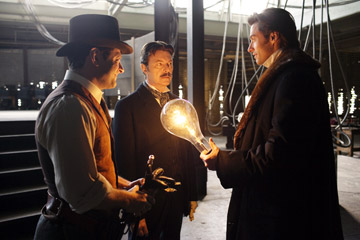
While awaiting his execution, Boden reads his alleged victim's diary. In Angier'sjournal, the dead illusionist discusses his obsession with Boden's trick and a search for answers that eventually leads him to Colorado Springs and the laboratory of Nikola Tesla (David Bowie). Of course, Angier only figured out the Colorado connection because his lovely assistant (Scarlett Johansson) previously stole Boden's diary.

So the whole movie consists of these two men reading one another's private journal. It's an elegant structure that allows Nolan to explore a few key questions about the conceptualization of "magic tricks," their significance and their practice, and also the competitive drive that leads to these sorts of rivalries.

Cutter explains the three "acts" inherent in every magic trick during a monologue at the film's outset. First comes "The Pledge," in which the magician shows the audience a normal object and offers it for scrutiny. Then comes "The Turn," when the magician makes that ordinary object do something extraordinary. Finally comes "The Prestige," which Cutter tells us is the part of the trick in which you see something you've never seen before.

But of course, that's not all that happens at the end of a magic trick. We don't just see something magical. We see the moment of magic decisively end and the circumstances return to normal. The woman isn't sewn in half...She gets out of the box and stands up, to demonstrate that she's no worse for wear. The rabbit doesn't just disappear...It pops back out of the hat.

Algier says that he performs magic to see the looks of shock and pleasure cross the faces of his audience. He eventually figures out how to replicate (but not how to explain) Boden's act using a lookalike, but his solution leaves him below the stage when the audience applauds for his talentless double. This simply won't do - The Prestige must allow him to face his audience and receive his fanfare.

Naturally, there's an egotism to this, Algier's intense need for approval and praise, but Nolan seems to insist that a self-aggrandizement and egotism are necessary preconditions for a successful magician. The magic act is not just a physical illusion - allowing materials to take on properties they should not naturally possess - but an illusion of control. Algier is pretending to manipulate reality to suit his own needs, as if he has the power to flip a switch and turn reality off and then back on again.

It's a God-like power, to remove and reapply the conditions for life on Earth, that becomes momentarily invested in a man. Thus, he gives the humans in his audience the brief, fleeting feeling of having power over their environment and circumstances themselves. For a moment, they are free to physical constraints, seeing a person defy the laws of the universe through feats of wonder and amazement.

Later, when Algier goes to meet Tesla and ask for the inventor's help in understanding Boden's illusion, Nolan conflates this idea with the notion of scientific inquiry. The magician and the scientist have the same ends but come at them from opposite perspectives. The scientist, displeased with our present understanding of the universe, completes experiments and develops hypothesis to explain the unknown. The magician, displeased with our present understanding of the universe, prepares illusions and develops trickery to create deeper and more universal unknowns.

Both Tesla and Algier ultimately seek to sidestep the laws of nature. One does so by illuminating and the other by obscuring, but the ultimate irony in a film filled with ironies comes when we realize that the end results of both tactics are near identical.

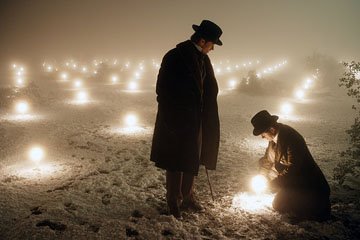
Collaborating again with Batman Begins cinematographer Wally Pfitzer, Nolan has once more created a haunting, moody urban landscape of soft light and deep shadow. The Prestige renders the London of the late 19th century with exquisite, if austere, taste - all milky-white fog on dark black cloaks. The scenes in Colorado Springs, set in and around Tesla's electrified mountain compound, recall the training sequences from Nolan's Batman but with apocalyptic undertones. Rather than scaling a mountain in order to face fears from the past, Algier ascends to Tesla's laboratory to witness the uncertain birth of the future, the day that the impossible becomes the commonplace.


Bowie's brilliant in these scenes, not only giving Tesla a subtly realistic accent but depicting the raging fire of the man's obsession more vividly than either of the two main actors. Don't get me wrong, Bale acquits himself well. As he did with Bruce Wayne (the two roles are occasionally similar), Bale provides Boden with a burdensome intellect hidden behind a shy, timid demeanor. He speaks less and knows more than anyone else in the film, and he genuinely seems to suffer from his inability to share the nuances of his genius with the world. Alas, his career as a magician depends upon an unwillingness, under any circumstances, to share his secrets. The idea being, I guess, that once an audience knows how a trick is performed, they no longer have any use for the individual who actually pulled it off.

Michael Caine, as always, does nice work, but he's stuck in the film's most thankless, expository role. Johansson, who for some reason can't keep up her British accent for more than a few words at a time, fails to make an impression at all beyond looking good in an old-fashioned boustier.

Jackman is fine, although he felt a bit out of depth in the role at times. It's his anger over his wife's death and his devotion to the Transported Man that drive the entire film's action, but he occasionally seemed whiny and petulant rather than passionate or intensely driven. I feel bad for saying this, because I like the guy and he's pretty good in this film, but he doesn't really project the gravitas or authority of Christian Bale, Michael Caine or especially Bowie's Tesla. It's hard watching Jackman in those scenes because his Angier just doesn't seem to belong. He's the preening staged phony in a world of authentic wizards, not the serious contender for Top Magic Gun.

My biggest misgiving about the film, though, isn't the Jackman performance but the overly-tidy conclusion. We get a few new pieces of information right near the end but they're both blatantly telescoped more than once during the film's opening hour. One plot twist, the explanation for Boden's version of The Transported Man illusion, actually seemed to anger some in the theater where I viewed the film earlier today. Nolan repeatedly includes clues in both the dialogue and the camera work that just give this secret away too early and too forcefully. (I suspected it might be misdirection while watching the movie..."Maybe this is all part of the trick, and I'm supposed to think it's going to end this way...The ending couldn't really be that blatantly obvious, could it?" Alas, it was.)

The second twist, the explanation for Angier's version of the same trick, seems to violate the central idea behind the movie. A film that has been plotted so gracefully for 2 hours gets a bit sloppy, conceptually. That I could forgive. After all, it's a film about magic - the whole point is to render the impossible possible. But though it creates an interesting paradox, this conclusion seemed excessively cruel. In a Being John Malkovich-style bit of ambiguity, one character is led to distrust the very nature of his own existance. The "trick" has overwhelmed his life, leaving him a perplexed and uncertain shadow of his former self.

For a film that's dour throughout, that's still a murky and downbeat way to finish. My biggest knock on Nolan as a filmmaker might be his total and complete lack of anything resembling a sense of humor. He's exceptionally talented but his films are also kind of suffocating. A total lack of levity after a while begins to feel (to me, anyway) like a lack of humanity.

That's doubly surprising when you consider that The Prestige is really several love stories intertwined. Boden and Algier, of course, devote the better part of their lives and careers on topping and outwitting one another. A serious, long-term rivalry indicates at least a committed level of concern with another individual's behavior and abilities.

Both men also fall in love for Johansson's buxom magician's assistant Olivia. Also, let's not forget that Algier had a beloved dead wife and Boden has a beloved living one (Rebecca Hall). Likewise, Nolan explores the passionate love these men share for their work. Tesla is willing to sacrifice not only his life and that of his assistant Alley (Andy Serkis, finally playing a human in a movie) on his electrical experiments, but his honor and reputation as well. Boden's wife insists that he loves magic more than he loves her, and some days he even agrees with her. And there's the love of Boden for his daughter, that drives him to divulge even his darkest, most treasured secret.

In a film with this many intense relationships and love affairs, in this kind of a fascinating historical setting, and with this level of actors, the movie should be more lively. More gripping. More elaborate. Even...more fun?

In purely technical terms, The Prestige represents some of Nolan's finest work. There are some truly remarkable, inspired sequences, in particular those surrounding Tesla's experiments. It's probably one of the best-looking films of the year. But, like Sam Mendes' similarly well-shot Road to Perdition, I'd have a hard time recommending it to most people because it's just kind of sealed off and cold, impressive but not awesome.

Friday, October 20, 2006

The Pen is Mightier Than the Butcher Knife

We already knew OJ Simpson was a great athlete, pitchman and, of course, a brilliant actor. But did you know he's also a soon-to-be-highly-esteemed novelist? From Keith Olbermann:

The “Enquirer” says has signed [The Juice] up to write a book called “If I Did it,” a hypothetical account of the murders of his ex-wife Nicole and her friend, Ron Goldman. If, you know, the murders happened to have been committed by, say, O.J. Simpson. Reportedly he would make a non-hypothetical $3.5 million for the book.

Why do I picture OJ pitching this idea using his best Jon Lovitz impression...

"I want to write a book about murdering my wife all those years ago. But it's, um, fictional. Yeah, that's right...A work of fiction. For I have always desired to be a renowned novelist. Yeah, a novelist, that's the ticket."

Seriously, though, I guess now that Johnny Cochran's dead, OJ's had to give up his day job...Murdering people and getting away with it...So he has to pursue some new avenues of income. Why not recount the crimes he famously got away with in grisly detail?

Among the highlights, gruesome, detailed, and say the “Enquirer” “realistic” description of the murders themselves. Simpson’s book, just another in a long literary tradition of books by people wrongly accused of killing someone they loved who’s speculating, in print, at length and graphic detail about how they would have brutally stabbed the person they loved, hypothetically.

The sad irony of the whole situation is that, even though OJ got away with murder, he's extremely famous for getting away with murder, which is still pretty unfortunate. Think about it this way...How many Americans, living amongst us in total anonymity right this moment, have gotten away with a murder in their lives? Considering the amount of unsolved murders going down in major Americna cities, it's probably a lot. Unless my theory is correct and they're all the work of one man...

So those people just kill someone and then get on with their lives. OJ, on the other hand, is the international poster boy for Wife Murdering.

It wouldn't necessarily have to be so bad, I guess, but I think OJ is playing it from the wrong angle. He's trying to do this coy have it both ways kind of thing, fuel the public's interest in his infamy and his murder case while keeping up this ridiculous "innocent" charade. He hsould go full-out, one way or the other. Either disappear from public view, spending the rest of your life in comfortable obscurity while pretending to search for your dead wife's "real killers" OR just embrace being the celebrity who killed his wife and her new boyfriend and then lied about it to everyone.

I mean, he knows he's guilty. We all know he's guilty. Why not just say so? Double jeopardy rules would prevent from being charged for the crime. I say, he should become America's first open advocate for wife murdering. He should head up the grassrootes Homicidal Ex-Spouse Movement. First, you write a book about how you murdered your wife and it changed your life in all manner of amazing and subtle ways. Second, you start appearing on talk shows to publicize said book, arguing that states should be allowed to repeal homicide laws as they apply to angry ex-spouses. Write a few op-eds. You never know...the idea might take off. I know an awful lot of angry ex-spouses, and I bet most people would figure they could take out their hated former wife or husband first should such a law ever actually pass.

See, in that scenario, OJ would just be able to write his book for real and not have to hide behind the "fiction" label like some Bizarro-World James Frey. What's funny about our bullshit culture is that people will act offended that OJ wrote a book about killing his wife, then they'll go out and buy copies by the pallet. These two things will happen within days of one another.

Slither & An American Haunting

With Halloween only a week away, the new horror releases are coming in fast. I'm doing my best to keep up, because I'm committed like that, but it's a constant struggle. What I'm saying is, I haven't bathed in 4 days...

Slither

The illustrious screenwriter of Scooby Doo 2: Monsters Unleashed, James Gunn, got his start with Lloyd Kaufman's underground Troma company. The uninitiated aren't missing all that much; Troma specializes in the sort of schlocky Z-grade campfests that seemed shocking long ago, before mainstream studios regularly opened films like The Devil's Rejects and The Hills Have Eyes on 2,000 screens.

Gunn's major studio directorial debut, Slither sits halfway between these two worlds, marrying the perverse irony of Troma to an old standby Hollywood formula, the small-town-invaded-by-creepy-monsters-horror-comedy. All these years later, Gremlins remains the flagship of the genre, though admittedly it's weighted more to the comedy side of the equation.

Unlike Joe Dante's holiday classic, Slither is not entirely successful as either a horror film or a comedy. The make-up effects and monsters are more disgusting than scary and the jokes are rarely amusing.

Yet the movie kept my interest and proved significantly less predictable than most American horror films. On the small-town-horror-comedy-o-meter, I'd rank it a 6...Not as good as Tremors, but a lot better than Eight Legged Freaks. Around the same level as Arachnophobia, if that's any help to you.


Like I said...disgusting...The tiny unnamed hamlet at the center of Slither has been invaded by an alien species that reproduces like a disease. Thousands of tiny worms enter human hosts, bending them to the will of a single, conscious entity from outer space. Kind of like The Borg, but more gooey. Over the course of a few days, the alien wrecks total havoc on the town, replicating itself inside most of the cities' residents and chasing around the beautiful wife (Elizabeth Banks) of its initial victim (Michael Rooker).

Clearly inspired by David Cronenberg's bloody slug-based sex comedy Shivers and the Alien movies, Gunn's put a lot of thought into the monster's replication cycle. Local cop Bill Pardy (Nathan Fillion, of "Firefly" infamy) and his ragtag band of deputies and hangers-on stumble upon all manner of gruesome affronts to all that is holy. In the film's showcase sequence, they discover a woman stuffed to the size of a barn with baby alien worms, voraciously eating dead rodents in order to satisfy the millions of tiny lives within her massive gullet. It's just as gross as it sounds.

The make-up effects are really great, visceral and evocative. They give good ooze, is what I'm saying. Gunn adds in some nice little touches as well. It's clever how, after the initial scenes shwoing the spread of the infection, the movie transitions into a Romero-esque zombie film. And unlike the similar-in-appearance "shit weasels" from Dreamcatcher, these aliens mercifully prefer to enter hosts orally.

Just being creatively gross is enough to please the 15 year old demographic, the target audience for a killer worm from space movie. So, as far as Gunn's likely concerned, mission accomplished. Still, the movie has the right attitude and Gunn demonstrates the techinical acumen to turn in a better horror flick than this mediocre effort. It's just that the script isn't really funny and the characters suck.

The only person to make an impression at all is Gregg Henry as the town's boorish and cowardly mayor. Everyone else pretty much blends into the background. Plus, there's just not a single memorable line or big laugh in the entire film. It's frequently amusing but never inspired.

Now that Hollywood studios have completely given themselves over to producing this kind of cult cinema, there's a few principles they should keep in mind.

(1) People watching these movies don't even care about the illusion of a real story, so the 45 minutes or so of exposition that's standard in most horror movies can be trimmed considerably.

(2) If you're already releasing a gory, R-rated horror film, you might as well throw some tits in there. I mean, if Elizabeth Banks doesn't want to show off her body, that's fine, get some other actress in there in a smaller role who will. There are, like, three different "tease" scenes Gunn includes to toy with his male audience, threatening to show nudity (and even possibly getting a brief shot of a nipple in there somewhere) but never actually going through with it. Hey, genius, the movie's already R! Maybe they're just waiting for the DVD.

(3) The final after-the-credits shot that sets up your movie for a sequel is sooooo played.

An American Haunting

I've seen some ludicrous movies make use of the "based on true events" tag line before, but An American Haunting may be the most ludicrous. What begins as a 19th Century remake of Poltergeist takes a very strange turn in the Third Act, defying not just the film's internal logic but the entire Western mythology surrounding ghosts. I don't believe any movie in which the spirit world actively intervenes in human affairs could be considered based on reality, but the leap of faith required by An American Haunting would make Michael Landon hesitate.


I hate horror movies that open with bookends. In fact, scratch that, I hate movies with bookends. Scenes at the beginning and end in which secondary characters reflect on the film's main action are pretty much guaranteed to be drawn out and pointless. An American Haunting is no different. Some dumb broad walks in on her daughter having some kind of a mid-nightmare fit. She then finds some yellowed, old letter said daughter brought down from the attic. The entire movie is contained within this letter. This sequence stole five minutes of my life and I want them back.

Okay, so, the action described in this letter (which looks like it's only a page long but eats up 85 minutes of screen time) takes place in 1817 in Tennessee. (This must be the part that's sort of but not really at all based on a true story). John Bell (Donald Sutherland) is having a land dispute with an ornery old neighbor, rumored around town to be a witch. When she's displeased with the final court settlement, she places a curse on John and his willowy daughter Betsy (Rachel Hurd-Wood).

Writer/director Courtney Solomon throws in just about every haunted house cliche ever invented. We get slamming doors and windows, nightly thunderstorms, little girl ghosts with hair covering their faces, eerie whispering, horrifying visions, possessed objects, shattered mirrors, extinguished candles, self-activating fireplaces. You name it, Solomon's attempted to make it scary once more.

This movie's a considerable improvement on Solomon's only previous film, the humiliating debacle that was Dungeons & Dragons. Thank God, at no time does Jeremy Irons appear and instruct the Bell children to fetch him the Rod of Power. Still, as a director, he's extremely klutzy and fairly amateurish.

He returns to the same completely retarded shot over and over again during all the film's "haunting" scenes. The camera woozily swoops around the room in what appears to be the Ghost's POV, catching goofy reaction shots from each character present at the time. Worse yet, he frequently switches between color and black-and-white photography, back and forth, in the middle of scenes. I honestly have no idea what possible impact Solomon thinks this kind of jarring, obnoxious stunt will have on the viewer. It's somewhat disorienting, but not in the kind of way that enhances the intensity or meaning of the shot. Just in the way that makes you stop and think to yourself, "Did that just switch to black-and-white and then back? Why the hell would he do that?")

I will say that the period is fairly well-evoked, considering the obvious budget constraints. Dungeons & Dragons just looked cheap, whereas American Haunting looks spare but authetnic. And the performances from Donald Sutherland and Sissy Spacek as his tormented wife are pretty strong, off-setting the rest of the film's occasionally campy enthusiasm.

But even if the film were less generic and more interesting, my enjoyment would still have been marred by that weird, impractical ending, which I will give away in the next paragraph.

SPOILER ALERT SPOILER ALERT SPOILER ALERT

The bothersome ghost turns out to be a portion of young Betsy's soul that escaped her body when she was raped by her father, John. I could see this making sense if Betsy were unconscious for the entire film. Her body's still alive but her soul is loose in the house, running amok and making trouble for her naughty father. But she's very much awake and self-aware and possessed of a soul. In fact, for most of the film, she's the one being tormented by the ghost, not her father.

So she's haunting herself? Her soul actually was divided in two without her noticing? The paranormal manifestations are actually the result of unconscious psychokinetic powers? I'm sorry but I just don't get how a living person can be a ghost.

And then when we go back to the bookmark, Betsy's ghost turns up again to warn a mother in our time that her daughter's likewise being felt up. Huh? So now Betsy's actually dead, but her ghost still looks like a little girl and haunts the same house, just in case some new resident unfortunately encounters a sexual predator? Weak...