Monday, December 18, 2006

How Dare You Object to My Dominion Over You?

I'll admit it. I've been obsessing about religion in the public square ever since finishing Dawkins' "God Delusion" book last week. I can't help it. I'm not exactly won over to Dawkins' more extreme perspective, becoming more adamant about total and complete secularism. I strive to be as easy-going and permissive as possible, and I like cookies, which Christian celebrations seem to involve frequently.

But it's hard to read that book at this time of year in America and not take a step back for a moment to consider the madness swirling all around you.

As someone who really doesn't celebrate Christmas in any significant way, I can tell you that you all get very strange and intense by mid-December. Today at the DVD store, the vibe wasn't so much what I would deem "merry." More like "frantic."

"I need eight copies of the Judy Garland box set. What do you mean you only have four! Well, how soon can you get them? Can't you do it any faster? What if I throw in my blonde but learning-disabled middle daughter to sweeten the pot, that do anything for you? No questions asked..."

And everyone has lists. Long hand-written lists, scrawled hastily on legal pads, the backs of business cards, sometimes even the customer's hands. One lady came in the other day with a list that was at least 6 typed pages, all put together. This is your Christmas list? You really owe all of these people a personally selected, hand-wrapped gift at the ass end of every year, just for being themselves?

Then I thought, what if you had the entire population of a mid-sized European nation as your Secret Santa? It would be expensive, sure, but imagine the windfall coming your way every December 25th! If only tasteful collections of foil-encased See's Candies were accepted as a substitute for U.S. Currency, you'd be all set for the next year!

So, I don't mean to harp on the whole Christmas thing, but this Mark Steyn column just demands commentary. I didn't want to do it, you see. Steyn's fervent and outspoken cockknockery went and demanded it.

I passed through Shannon Airport in Ireland the other day. They've got a "holiday" display in the terminal, but guess what? It says "Merry Christmas." The Emerald Isle has a few Jews, and these days rather a lot of Muslims, and presumably even a militant atheist or two, but they don't seem inclined to sue the bejasus out of every event in the Yuletide season.

"The bejasus?" Is he purposefully spelling that wrong so as not to offend Jesus by taking his name in vain? (Is adding a "be-" to the front of a name taking that name in vain? That's one of those borderline blasphemies.)

This is the first paragraph of Steyn's column. He doesn't make a point in it, nor does he in any of the paragraphs that follow. He goes on to cite a few cases where random people have objected to overtly religious celebrations of Christmas in public, but never really gets around to connecting these incidents into anything I would call "an argument." He just gets upset whenever others fail to give his holy beliefs their proper deference, and thought he'd write a column about why Christians and their made-up bullshit are far far more important than all the mud peoples and their made-up bullshit.

By contrast, the Associated Press reports the following from Riverside, Calif.:

"A high school choir was asked to stop singing Christmas carols during an ice skating show featuring Olympic medalist Sasha Cohen out of concern the skater would be offended . . . "

Steyn blathers on for a while about this news story, an isolated incident (based around a misunderstanding) that doesn't really warrant national attention nor provide insight into a larger problem. Sasha Cohen is a figure skater who is Jewish. She is touring the country, skating for crowds during Christmas tree lighting ceremonies. At this one stop in Riverside, members of the "city staff" (presumably employees from the mayor's office or city hall?) felt that the Jewish Ms. Cohen may be offended if the local high school choir sang explicitly Christian Christmas songs. So they asked the choir not to sing "God Rest Ye Merry Gentlemen."

Of course, it turns out Ms. Cohen, like most reasonable people, doesn't care and wasn't offended. In fact, it turns out that she's doing this whole Christmas tree tour thing, so she probably likes Christmas, or at least thinks it's tolerable. So, like I said, the story is just a big misunderstanding. Of course, Steyn goes on and on about it. I guess it briefly gives him a chance to feel good about himself, because he's part of an American Christian majority.

First, he has an extended, painful bit of theoretically "comic" business in which he conflates the figure-skating Sasha Cohen with the Borat-inhabing Sascha Baron Cohen. Teh Hilarious ensues...NOT!

I hasten to add this Sasha Cohen is not the Sacha Baron Cohen of the hit movie ''Borat.'' The Olympic S. Cohen is a young lady; the Borat S. Cohen is a man, though his singlet would not be out of place in a louche Slav entry to the ice-dancing pairs. Likewise, the skater-puts-carols-on-ice incident seems as sharply satirical of contemporary America as anything in ''Borat,'' at least in its distillation of the coerciveness of "tolerance."

This paragraph is great, in part because it alerts us that Steyn isn't remotely funny. ("His singlet would not be out of place in a louche Slav entry to the ice-dancing pairs"?) It's also great because he claims that a choir being asked not to sing Christmas Carols to a Jew is as inappropriate as the right-wing intolerance on display in Borat. Which even a mendacious windbag like Steyn must realize is a total lie. (Perhaps he's counting on his target demographic having skipped the Borat movie?)

Borat reveals the underlying feelings of superiority, self-satisfaction and intolerance that dwell deep within Steyn and his fellow warmongering right-wing fucktards. This AP story from Riverside is about a zealous city employee who went overboard in an attempt to care for a visiting celebrity. Not equivalent in any way to a gentleman suggesting we execute gays. Sorry, Mark.

Nonetheless, the Special Events Commissar and her Carol Cop swung into action and decided to act in loco Cohenis and go loco.

Hilarious! Who writes his material? I mean, comparing liberals to Communists, referring to excitable types as "loco." It's so fresh. Gonna play real well in Cheboygan. I hear Marky's got a dynamite 10 minutes on feminazis, too.

Many of my fellow pundits find themselves fighting vainly the old ennui when it comes to the whole John Gibson "War On Christmas" shtick, but I think they're missing something: The idea of calling a cop to break up the singing of "God Rest Ye Merry, Gentlemen" would strike most of the planet as insane.

Except for, you know, that sizable portion of the planet where no one has heard of "God Rest Ye Merry Gentlemen." But those people are mostly brown, so fuck 'em.

The Rubidoux High School Madrigals should have riposted by serenading the officer with the beloved Neal Sedaka classic, "Oh, Fool, I Am But A Carol" (I quote from memory).

Another zinger! This guy is good!

Yes, I think we can all agree that it's unnecessary to have a high school choir stop singing "God Rest Ye Merry Gentlemen" because there's a Jewess in the building. In fact, I've always kind of liked that song, at least more than most Christmas carols. It's very British and old-fashioned and for some reason, I've always found the vocals a little creepy. Like, the words are really upbeat and happy, but the singers sound kind of wary of the whole thing. Maybe these aren't necessarily good tidings of comfort and joy...

But...um...so fucking what? You got a point for me in here anywhere, Marky Mark?

Now it's true there are Jews who don't dig Christmas.

What? It has nothing to do with digging Christmas. Observant Jews don't celebrate Christmas. It has nothing to do with them, and sometimes some of them get perturbed if you act like it does, just as Mark might get perturbed if, everywhere he went for a month, strangers tried to get him fired up in anticipation of the big Puerto Rican Day Parade.

But to say that Jews don't dig Christmas is to be deliberately obtuse. That would be like saying that Steyn doesn't dig the Eight Pillars of Islam. His opinion about their value is insignificant because it's not his fucking religion.

There was some story out of Seattle the other day about a rabbi who objected to the "holiday trees" at the airport and threatened a lawsuit unless they also put up an eight-foot menorah. So the airport goes, "Oh, dear, you're threatening a lawsuit? OK, we'll take down the trees." And in an instant the trees were history. Not "history" in the sense of a time-honored tradition legitimized by its very antiquity. But "history" in the sense of the contemporary American formulation of something you toss in the landfill in the interests of "diversity."

Notice how we've just dashed on to the next random anecdote, without Steyn ever providing any sort of real conclusion to the previous anecdote? Kinda weird, right? (Also, how does he know what all these individuals at the Seattle airport said the other day? Was he there? Did he interview them all asking for verbatim quotes? It feels like this whole story is just kind of made up.)

Oh, also, check out that bolded sentence. Do any of us really believe that a tradition can be legitimized by its very antiquity? Isn't that actually a ludicrous assertion if you break it down? I mean, the traditions that have been going on the longest aren't necessarily the ones that we keep doing. (Like, say, slavery.) If something is a tradition that is being upheld, it must be because it has some other legitimacy besides antiquity. Who keeps doing things just because they've always been done? Am I wrong about this?

Think about the Constitution. All Americans, with the exception of George W. Bush and Richard Milhous Cheney, see the value in upholding the legal tradition set forth in that document. But not because it is old and yellowed. I mean, obviously there is some kind of meaning in the fact that these laws and principles have stayed with us for so long. But we continue to use it as a guide for our society because it makes sense to us, because it's consistant with the way we live our lives today. I mean, duh. If Steyn, a professional columnist, can't do better in arguing for public displays of Christianity than "well, it has always been that way," he's proper fucked.

This isn't about religion.

Um, yeah, Mark, it is. What's it about, then, if not religion? Horticulture?

Jesus is doing just fine in the United States.

Wait, you forgot to tell us what this is about. It's religion, isn't it?

(I don't want to get too philosophical here, but wouldn't Jesus always be doing about the same, in the United States and everywhere else? If you're a Christian, do you believe there are really periods in history where Jesus is "doing just fine" and other times when he's in trouble? I mean, he's already died and come back to life. What more can happen to him?)

Forty years of ACLU efforts to eliminate God from the public square have led to a resurgent, evangelical and politicized American Christianity unique in the Western world.

I'll say. Our homegrown fundie whackjobs are certainly unique, I'll give them that.

What the rabbi in Seattle and the cops in Riverside are doing is colluding in an assault on something more basic: They're denying the possibility of any common culture.

Common culture...What a fucking joke. Mark wants us all to share in a common culture, provided it's modeled entirely on his own favored personal culture. Why can't everybody agree to get along and see things from another perspective, by uniting to embrace my view of the world to the exclusion of all others?

America is not a stamp collection with one of each. It's an overwhelmingly Christian country with freedom of religion for those who aren't. But it's quite an expansion of "freedom of religion" to argue that "those who aren't" are entitled to forbid any public expression of America's Christian inheritance except as part of an all-U-can-eat interfaith salad bar. In their initial reaction, Seattle Airport got it right: To be forced to have one of everything is, ultimately, the same as having nothing. So you might as well cut to the chase.

Mark's a big fan of the tyranny of the majority. Apparently, freedom of religion means he won't, personally, come to your house and break your menorah into 100 little waxy pieces, but that's about it. Again, whenever people go on and on about American's Christian heritage, I wince, secure in the knowledge that the writer is either ignorant of American history or deliberately misleading his or her audience.

Again, check out that amazing bolded sentence. "To be forced to have everything is, ultimately, the same as having nothing." Consider that for a second...

Mark thinks that a holiday you can't lord over non-celebrants is a holiday not worth having. Christmas has no meaning for him if it isn't flaunted. Hasn't he seen "How the Grinch Stole Christmas"? When the Grinch steals all the trees and toys and decorations from Whoville, what is the Whos' response? Do they say, "Oh, without the ability to broadcast our faith to everyone who doesn't give a rat's ass, we might as well just return to our everyday, drab routines and forget this whole Christmas thing."

Of course not. They go right on celebrating like always, because one or two Grinches can't possibly destroy the holiday spirit flowing within them. Mark Steyn, on the other hand, would plot to attack the Grinch using biological weaponry, hoping that the monster's weak heart, estimated to be three sizes too small, might give out completely after a fatal dose of antrhax.

What, after all, is the rabbi objecting to? There were no bauble-dripping conifers in the stable in Bethlehem. They didn't sing "God Rest Ye Merry, Gentlemen," either. That's, in effect, an ancient pop song that alludes to the birth of the Savior as a call to communal merry-making: No wonder it falls afoul of an overpoliced overlitigated "diversity" regime. Speaking of communal songs, they didn't sing "White Christmas" round the manger. A Jew wrote that. It's part of the vast Jewish contribution to America's common culture.

First off, why wouldn't they sing a song written by a Jew in the manger? They were all Jews, jackass! If they sang any songs at all, it would be ones written by Jews. They didn't sing "White Christmas" in the manger because it would be historically anachronistic. How could Bing remember the white Christmases he used to know at the First Christmas?

I actaully agree with what Steyn's saying in this paragraph, but he's being disingenuous all the same. He doesn't really like Christmas because it's a shared, common, American holiday. He likes it because it's Christian and he's Christian, and he wants to reinforce the dominance over this nation of individuals who think like him. That's what this is about. Letting the lesser mortals (non-white non-Christians) know their place, repeatedly and often. If he wanted to forge a common culture, he wouldn't employ divisive rhetoric about Christianity being the "majority religion," with others bedgrudingly permitted to differ.

(If it's such a fucking common culture Steyn appreciates, where is the influence of the millions of Hindus, Muslims, Buddhists, non-believers and Wiccans living in America? Are we going to give their holidays some airtime as well, or does "common culture" mean solely that those belonging to non-Christian faiths are encouraged to contribute their own original Christmas songs?)

Seattle Airport could certainly put up a menorah.

It could be a fire hazard, actually, so that's not necessary. But I'm sure they appreciate your permission, Mark.

And maybe a commemoration of Eid, and Kwanzaa, and something for solstice worshippers, and perhaps something for litigious atheists.

Hey, why not, man? Didn't you just say you wanted us to share a common culture? Or did you mean "culture where we all share Jesus in common"? How does he not notice that he contradicts himself like that? Your bullshit appreciation for other cultures is undermined when you immediately turn around and make a joke out of their beliefs.

But to do that is to turn society into a kind of greater airport departure lounge -- to say it's no more than an assemblage of whoever happens to be in it at any particular time.

Right...Because that's not what a society is...I got ya...

Successful societies (unlike plastic trees) have deep roots: Nobody should be obliged to believe Jesus is the son of God, but likewise nobody should take such umbrage at trees and tinsel and instrumental versions of "Silent Night" that he would deny the reality of the land he lives in to the vast majority of his fellow citizens.

Bear in mind, none of Mark's examples actually found individuals objecting to trees, tinsel or instrumental versions of "Silent Night" (the protest of which has become a fictionalized right-wing meme.) Based on a possibly-Christian city employee telling a high school choir to stop singing and a rabbi trying to get a menorah set up in an airport, Mark has extrapolated this massive anti-Christmas insurgency full of Scrogges rendered physically ill by the very notion of Noel.

Because the logic of that leads not to a diverse secular society but to an atomized ersatz non-society. And, as those other touchy types the Islamists well understand, once you put reality up for grabs, all kinds of pathologies suddenly become viable.

Oh, Christ...Just...Just...Oh, Christ...

Hell is for Heroes

I suppose we train high school teachers to indoctrinate students, so it's not surprising that a few of them don't know where to draw the line...

Before David Paszkiewicz got to teach his accelerated 11th-grade history class about the United States Constitution this fall, he was accused of violating it.

Shortly after school began in September, the teacher told his sixth-period students at Kearny High School that evolution and the Big Bang were not scientific, that dinosaurs were aboard Noah’s ark, and that only Christians had a place in heaven, according to audio recordings made by a student whose family is now considering a lawsuit claiming Mr. Paszkiewicz broke the church-state boundary.

History class! History! I'm assuming this is an AP class, because they mention that it's "accelerated." Davey, you guys don't have time to talk about the Big Bang. That's time you could be spending on the concept of mercantilism, the Embargo Act of 1807 or even The Ostend Manifesto. I'm not sure you appreciate the difficulty of this test, dude...

Honestly, though, I really really wish someone would try to teach me about how the Big Bang is not a scientific theory. If it's not scientific...where did it come from? Does David think that some scientist just made it up one day, and that all the other scientists have been going along with the ruse for several decades now, concocting an entire fraudulent branch of the sciences around this one fictional precept in a nefarious attempt to invalidate and eventually replace sincerely-held religious belief everywhere? Really?

“If you reject his gift of salvation, then you know where you belong,” Mr. Paszkiewicz was recorded saying of Jesus. “He did everything in his power to make sure that you could go to heaven, so much so that he took your sins on his own body, suffered your pains for you, and he’s saying, ‘Please, accept me, believe.’ If you reject that, you belong in hell.”

Boo-ya! That's certainly what you want to hear from your AP US History teacher!

"The Supreme Court's decision in Munn v. Illinois upheld the principle that state governments could regulate railroad and grain elevator companies. Oh, and I condemn you to Hell."

I mean, I know I'm kind of sensitive to the whole outspoken religiocity thing, but that's definitely crossing a big line. You don't force impressionable young people to sit in a history class for an hour every day with a wannabe Benny Hinn ranting about damnation and whipping them with his jacket. It's just not right.

I had a loopy evangelical teacher for AP Spanish back in high school. We'll call him Fred S. Fred never used to like me because he was the faculty advisor to the Christian Club, and I used to write angry editorials for the student newspaper objecting to the Christian Club's activities. It's not that I hate Christians or the idea of them wanting to form a club. Our school had lots of clubs, most of which I did not belong to or concern myself with, and that was that. But Irvine High's Christian Club was, for some reason, possibly owing to Fred S.'s own intense faith, extremely aggressive.

Their big issue was that they wanted to pray around the flagpole each morning during Zero Period. To me, this seemed a clear violation of my rights as a secular student. I had to get to school during zero period every day (ironically, because I worked on the school newspaper), so I'd have to walk right past this creepy prayer circle. Not that the law must intercede to spare me an inconvenience, but the fact is that the only reason they wanted to pray in that exact spot was because they wanted to push my nose in it. The whole point was to attract attention - both declaring "the right" to pray right there on school property, like a dog foolishly urinating on all the nearby ground available in a futile attempt to claim dominance, and in a blatant attempt to proselytize. "Hey, you, kid walking to class. Want to join our cool club? Come pray with us!"

That stuff was annoying, and I hated having Fred S. for Spanish because he would bring this kind of petty shit into the classroom. Once, we had to write an in-class essay (in Spanish, of course). I don't even remember the prompt. Anyway, working my way to whatever actual point I was attempting to make, I wrote a stray sentence about the Earth being several million years old. (Looking back, I'm amazed my mastery of Spanish was such that I was capable of forming such a sentence, but there you go...) So I get the paper back, and it's full of comments in red ink. My first thought is, "Oh God, my Spanish is every bit as bad as I assumed! Que lastima!"

But then I start reading some of the comments (all in English), and I realize he's just pissed off because I implied that the world is millions of years old. And the Bible disagrees! How infuriating. Judge me on my Spanish, asshole, because that's the only opinion of yours I care about in the slightest. And I only cared about that because I didn't want to have to take Spanish in college. (I ended up taking two years of Spanish at UCLA anyway. Still can't put more than 3 sensible words together, however.)

Okay, so I got kind of distracted. My point is, I saw the experience with Fred S. as an inappropriate incursion of religion into the classroom. But it was extremely mild compared to this Paszkiewicz moron's behavior. Fred never told me I was going to Hell. Just that I was wrong about everything.

Predictably, the school board and the entire town seems to be taking the side of the Jesus freak teacher over that of the high school junior. Because, as we all know, Christians hate meek, oppressed underdogs and always prefer to side with the established power. That's how JC would have wanted it.

“I think he’s an excellent teacher,” said the school principal, Al Somma. “As far as I know, there have never been any problems in the past.”

So, the school's principal doesn't think that a teacher telling his students they will go to Hell if they don't accept Jesus is a problem. Okay...But I suppose it is possible that, evangelical fervor aside, the guy's a decent history teacher.

In this tale of the teacher who preached in class and the pupil he offended, students and the larger community have mostly lined up with Mr. Paszkiewicz, not with Matthew, who has received a death threat handled by the police, as well as critical comments from classmates.

Greice Coelho, who took Mr. Paszkiewicz’s class and is a member of his youth group, said in a letter to The Observer, the local weekly newspaper, that Matthew was “ignoring the First Amendment to the United States Constitution, which gives every citizen the freedom of religion.” Some anonymous posters on the town’s electronic bulletin board, Kearnyontheweb.com, called for Matthew’s suspension.

Oops, never mind. He clearly didn't explain to Greice that the First Amendment doesn't guarantee a teacher the right to preach to his students. Granted, it would be wrong to jail Mr. Paszkiewicz for beliving in Jesus, or for speaking or publishing information about his religious beliefs. But does the First Amendment grant you the right to a daily audience of listeners to whom you are paid to preach? Afraid not. Does it protect you from direct criticism for inappropriate things you might say in class? Um...not exactly. I'd say anyone who could conflate the 1st Amendment's "Freedom of Religion" with an inherent right to insult the dignity of high school juniors and keep one's job doesn't deserve a passing grade in a class on the US Constitution.

And calling for the kid's suspension just for complaining about a teacher? What kind of educational environment does that foster? What is this, Joseph Stalin Memorial High School? (The best part about going to Stalin High? Once you've matriculated, you're a Stalin Grad. No, hey, come back...come back...I'm sorry...Forget I said anything...)

On the sidewalks outside the high school, which has 1,750 students, many agreed with 15-year-old Kyle Durkin, who said, “I’m on the teacher’s side all the way.”

All the way! How dare this kid object to being told publicly by an authority figure that he's going to burn in Hell! Buck up, heathen!

While science teachers, particularly in the Bible Belt, have been known to refuse to teach evolution, the controversy here, 10 miles west of Manhattan, hinges on assertions Mr. Paszkiewicz made in class, including how a specific Muslim girl would go to hell.

Oh, yeah, Principle-brah...I can tell that this guy must be one hell of a teacher. He certainly seems to connect to his students. He really knows how to reach them. As an SAT tutor, I've found that there are few more useful educational tools than cheap taunts and idle threats.

The class started on Sept. 11, and Matthew quickly grew concerned. “The first couple of days I had him, he had already begun discussing his religious point of view,” Matthew, a thin, articulate 16-year-old with braces and a passion for politics and the theater, recalled in an interview. “It wasn’t even just his point of view, it went beyond that to say this is the right way, this is the only way. The way he said it, I wasn’t sure how far he was going to go.”

On the second day of taping, after the discussion veered from Moses’s education to free will, Matthew asked why a loving God would consign humans to hell, according to the recording.

I guess this is probably AP Government, as opposed to US History. In either case, I don't see how all this God talk fits into the subject at hand. I mean, you'll wind up discussing the notion of God all the time in such a class, if only because it comes up so often in all the documents you'll be reading, but not in an evangelical "God is love" kind of way. In a "these philosophers were religious while these were not" kind of way.

Anyway, people tape lectures all the time, so I can't see how anyone could think this kid had done anything wrong, anything deserving of suspension or punishment. Is it really so wrong to question the tactics and motives of a person who yammers away at you non-stop for 5 hours each week?

Some of Matthew’s detractors say he set up his teacher by baiting him with religious questions. But Matthew, who was raised in the Ethical Culture Society, a humanist religious and educational group, said all of his comments were in response to something the teacher said.

“I didn’t start any of the topics that were discussed,” he said.

Baiting him with religious questions...Of all the ridiculous...Implying that Matthew, out of nowhere, interrupted class to ask religious questions, and that the kindly (and purely by coincidence, evangelical) teacher had no choice but to stop discussing the planned lesson for the day and entertain this or that theoretical construct. I mean, how well does it reflect on the teacher in the first place, if he could be so easily duped by one of his 16 year old charges?

Frank Viscuso, a Kearny resident, wrote in a letter to The Observer that “when a student is advised by his ‘attorney’ father to bait a teacher with questions about religion, and then records his answers and takes the story to 300 newspapers, that family isn’t ‘offended’ by what was said in the classroom — they’re simply looking for a payout and to make a name for themselves.” He called the teacher one of the town’s best.

You would think people would feel embarrassed trotting out these lame, scripted arguments every time a secular person tries to make a point about personal freedom. How on Earth does Mr. Viscuso imagine that Matthew's family is going to earn some kind of crazy windfall off of this case? They're going to get $10 million from the school board, tax free, or something?

I mean, perhaps Mr. Viscuso genuinely disagrees with the family on principle. He thinks a public school's advanced government class is the perfect place to discuss deeply-felt opinions on the afterlife. Fine. Let him write a letter to the editor arguing that point. But people just cavalierly throw these kinds of charges out all the time with no evidence, or even any reason for suspicion of greed on the part of the plaintiff.

Mr. Viscuso would be wise to recall that the purpose of these kinds of civil lawsuits is not to spread around cash settlements. It's a preventative measure. If school boards have to worry about being sued by angry parents, they then have an extra incentive to make sure students are not aggreived and given cause for complaint. This is also why it's stupid for people to get all fired up about massive settlements in tobacco and fast food industry lawsuits. The purpose isn't that fat people and the cancer-striken deserve millions of dollars. It's that the threat of millions of dollars in losses motivates big companies to be extremely careful about product safety and honesty in advertising. (I'm not saying it always works, but this is at least the principle on which the system operates).

It just pisses me off, because it seems like every other Christian in this town is just knee-jerk siding with the teacher because he's on their team. The atheists are the Other and we all have to join together to ensure their defeat. But really, I have a feeling that most of the Christians in this town would probably recoil if directly confronted with Paszkiewicz's actual behavior. Sure, some moralizing pompous fucks think it's okay to insult someone and threaten them if it means you convert another member to the flock, but most Christians can sense when it's just not an appropriate time for evangelizing, and particularly when that evangelizing humiliates or makes a spectacle out of a young person. I mean, come on, that's obvious.

Sunday, December 17, 2006

My Super Ex-Girlfriend

Despite the massive worldwide popularity of the comic book genre, audiences tend to only see superhero films based around established characters. Sure, there are exceptions. Pixar's The Incredibles concocted not just a single original hero but an entire universe of costumed vigilantes. The Wachowski Brothers' Matrix films translate manga-style storytelling and a sci-fi comic book aesthetic into cinematic forms. But for every success, there are probably 10 failures, from Meteor Man to Mystery Men to this year's Tim Allen belly flop Zoom!

So even though it has a premise that's more clever than most high-concept summer comedies, and even though it has a solid cast and a few genuinely inspired touches, Ivan Reitman's My Super Ex-Girlfriend was essentially doomed from the start. It should be about 50-60% more funny than it is, granted, but I didn't actively dislike the film. I actually found it kind of charming in spots, and at the very least consistantly diverting. However, even I, a Hollywood outsider, could have predicted that this thing wasn't going to make any money.

Balanced precariously between superhero spoof and romantic comedy, My Super Ex-Girlfriend appears scientifically designed to appeal to no one. The pre-teens and professional nerds who would get excited about Uma Thurman playing a sexy superhero don't want to go see a comedy with Luke Wilson about relationships. (Really, the very notion of combining a geek movie with a movie about relationships is kind of cruel. You trying to make these dateless wonders feel inadequate?) Conversely, the couples looking for a good date movie aren't going to want to see juvenile, sketch-comedy-style shenanigans riffing on the comic books they most likely have not read. Coming out in the midst of a crowded summer movie season, Reitman's modest little genre mash-up didn't have a chance of finding an audience, even though it's the director's best film since 1993's Dave. (Not to damn the guy with faint praise or anything...)


Screenwriter Don Payne started off with a killer concept. Matt Saunders (Luke Wilson), an unlucky-in-love Manhattanite, asks out a mysterious brunette, Jenny Johnson (Thurman), on the subway, not realizing that she's the city's famed superhero, G-Girl.

For the first hour, the film is essentially a comic remake of Superman II. Matt and Jenny get to know one another even as she must keep her nightly hero work a secret. Jenny flirts with the idea of revealing her secret identity to the man in her life while her arch-nemesis, Professor Bedlam (Eddie Izzard), plots to steal her powers by using a magnetic space rock. Once Matt breaks up with the controlling and neurotic Jenny, she loses her mind and begins using her powers to torment him, providing him with no alternative but to collaborate with Bedlam on his latest diabolical scheme, to steal away G-Girl's powers forever.

Reitman's been making these kinds of mainstream effects comedies for a long time now (at least since Ghostbusters in '84), and though this movie's rarely inspired, it's largely professional. Possibly owing of budget concerns, Reitman doesn't overplay the fantasy element of the story, getting lost in elaborate set design or intricate backstory. Like Raimi's Spider-Man movies, My Super Ex-Girlfriend takes place in a relatable, real world New York City that happens to have its own superhero. Even the effects work, most significantly a skyscraper blaze that G-Girl extinguishes using tornado power, is soft and underplayed, as opposed to the typically garish, in-your-face style of these kinds of movies.

To his credit, Reitman has assembled a funny cast, one worthy of better material than Payne's leaden dialogue and predictable turnabouts. The Amazonian Thurman inhabits the dual role of Jenny and G-Girl perfectly, as mousy and retreating in one persona as she is forceful and imposing in the other. It's unfortunate that Payne, tasked with inventing a superhero and her secret identity from scratch, didn't have more fun with it or get more creative. The "G" in G-Girl may as well stand for generic. (In fact, we never really find out what it actually stands for.) She got her powers from a meteor, she has powerful wind-breath and laser eyes and she can fly...Whoop de doo. When I called this a thinly-veiled remake of Superman II, I wasn't kidding. G-Girl's personality, powers and weaknesses are nearly identical to the Man of Steel's.

Izzard's Professor Bedlam has a few funny moments, and a surprisingly proficient American accent, but never actually gets to do anything villainous. It's therefore difficult to see him as a threat, or even a villain, and his presence becomes almost completely extraneous by the end of the film. Rainn Wilson (no relation to Luke) deftly plays the polar opposite of his Dwight Shrute character from the American version of "The Office" - here he's a cold, narcissistic womanizing lout. Unfortately, like Bedlam, he's all talk. We see him make a couple of cheap passes at some women, but that's about all there is to an essentially thankless "best friend" role. The delicious Anna Faris, as Matt's rebound girlfriend Hannah, and Wanda Sykes, in a cameo as an uptight office manager, are similarly underutilized.

The film just never builds up any steam. The inspiration was there some of the time. A few scenes unfold with comic potential, including a clever bit of business at a crowded restaurant wherein Jenny essentially refuses to turn into G-Girl and save the day as a way of punishing Matt. But these sequences just sort of peter out, after which we're treated to five or ten minutes of predictable, uninteresting plot developments. A funny premise, good casting and a couple of amusing throwaway lines just aren't enough to sustain an audience's interest for 90 minutes, no matter how breezily likable the rest of the film might be. Does Ivan Reitman not realize that, or does he simply not care any more? It doesn't take a whole lot of effort, after all, to top Evolution.

Digging on Swine

Very interesting post and discussion over at Pandagon that starts out discussing vegetarianism but winds up exploring all kinds of dietary laws, rules, taboos and prohibitions. It's all pretty fascinating stuff, aided by the fact that the site has a lot of well-spoken, informed commentators discussing the topic at hand.

I was particularly intrigued by the speculation about Jewish dietary laws. My mother always used to explain the Jewish ban on pork (observed by no one in my family) in strictly utilitarian terms: "Pig meat was easily contaminated in the time before refrigeration, so the elders just taught everyone to avoid it by saying that it was God's will." My father tried to instill a sense of spirituality in my brother and I, but my mother was secular humanist from Day One. (It's odd. She was perfectly willing to indulge her children in delusions like the Tooth Fairy, but never bothered to entertain the whole God notion for us, even briefly. That's not a complaint, just an observation.)

Anyway, her explanation always made sense to me. In fact, it's the theory suggested by Jewish philosopher Maimonides. But it's certainly not the only suggestion. My old rabbi (yes, there was a time when I actually had a rabbi) said that Jewish laws were in place to remind Jews to think about God all the time. Each time you purposefully have to avoid eating certain foods or wearing certain clothing or whatever, you are reminded of the commitment you have made to God.

I'm tempted to say, based on my experience in studying world religion, that it's all based in a human psychological need to distinguish a group identity, an Us separate from The Other. We are the ones who don't eat the dirty animals and don't get intimate with our wives during their special time of the month, while the goyim are the filthy savages who don't observe God's law.

The Pandagon commenters offer up all sorts of other theories, many of which I had not previously considered. Amanda suggests that Jews did not eat pigs because their bodies and behaviors are very much like our own. Nearly-hairless, sensitive pink skin, remarkably similar organ systems and so forth. (Pig anatomy shares much in common with human anatomy, we frequently use pig parts in procedures on human patients.)

My favorite theory came from commentor Apikoros, who quotes from an old, unnamed rabbi:

“What do we get from cows”
We get milk. (and meat)

What do we get from goats?
We get milk. We get wool. (and meat)

What do we get from sheep?
We get milk. We get wool. (and meat)

What do we get from chickens?
We get eggs. (and meat)

What would we get from pigs?
Meat. Just meat.

It is immoral to herd an animal strictly for slaugher.

Now, I'm not saying this article makes any sense. How could your plans for their carcass possibly concern an animal being raised for the slaughter? They're being killed one way or another, whether or not you'd prefer to borrow eggs or wool from them in the years leading up to the Big Day. I mean, why is it kinder to hold a chicken captive for a few years, systematically steal and devour its unborn young and then whack its head off, rather than just whacking its head off right away?

This would be like a condemned man on Death Row taking solace in the fact that, once he's removed from the gas chamber, his liver will be removed and used to teach jittery, inept first-year medical students how to properly hold and manipulate a scalpel.

So, no, it's not a substantial argument. I'm just saying that this sounds like ass-backwards, primitive thinking of the Ancient Hebrew variety. They were always coming up with this kind of weird, convoluted shit, which gives you some insight into how they ended up wandering aimlessly around the desert for a few generations.

Saturday, December 16, 2006

Yippie-Ki-Meh!

Hey, the brand new trailer for Die Hard 4: Live Free or Die Hard is online and it's...adequate.

Actually, it's kind of bad. Very, and I hate to say this, Ratnerian. It has a distinctively Ratneriffic quality that I found distasteful. I know that the series is bound to update its look for the times. This is the third decade in which Bruce Willis will be starring as Detective John McClane, so you can't expect the movies to look or feel alike necessarily. (And in the case of Die Harder and several extended portions of Die Hard With a Vengeance, you can't expect them to be any good.)

But still, this doesn't look like the style has been updated to fit in the contemporary aesthetic. It just looks like any possible Die Hard-ness has been drained out in favor of Michael Bay's standard acrobatic cars routine. Why these directors have such an obsession with flinging CG cars around, I have no idea. John Landis flung real cars around in The Blues Brothers 25 years ago, and that wasn't even an action movie.


Okay, so those are my reservations. I still think there's a good chance this movie will kick ass, and that it's just a bad, misleading trailer. The director is Len Wiseman, the guy who did those Underworld movies and tagged their star, Kate Beckinsale. I still haven't seen the first film, but the second one looked really cool and atmospheric, and had a few solid, well-shot action scenes. Granted, it was a lot more effects-heavy than any Die Hard movie ought to be, but still, I think the guy probably has the chops to pull off a summer action comedy. That is, if the script's any good, Willis is still up to the task and all the million other things that could potentially go wrong don't. The premise, in which hackers hold the United States hostage by threatening to shut down our economy electronically, sounds a bit dicey for this series, but then again it has a solid cast (that includes Jeffrey Wright and Maggie Q.)

Talkbackers on Aint it Cool have expressed problems with the trailer's lone line of dialogue, Justin Long's character asking McClane if he's "ever done anything like this before?" I don't see how you can object to that joke, when every other Die Hard movie contains those same kind of cheesy allusions to the other movies. Remember Die Harder? "What are the chances of the same thing happening to one guy twice?"

There seems to be a bit of pushback against this new wave of '80s action-nostalgia. In addition to a Die Hard sequel and a Miami Vice adaptation, we've got a new Rocky movie set to open with plans for a Rambo update to follow, a live-action Transformers film, a "Terminator" TV series on the way, talk of reviving the Robocop franchise, the possibility of an additional Beverly Hills Cop film and Jean-Claude Van Damme's return in Rush Hour 3. (Obviously, there's always rumors flying about a new Indiana Jones film, but that has been going on forever and isn't really part of this new trend.) I guess this is all to be expected.

People my age grew up with these movies and they are now becoming increasingly influential in the motion picture industry. We like Transformers and Eddie Murphy and Sylvester Stallone movies, goddammit. (So they're reviving Beverly Hills Cop...How about giving Cobra or Over the Top a shot at a sequel?)

I think the next few years will be fun, personally, if a bit bloated and over-the-hill and ridiculous, and even bittersweet. This is the last hurrah for my boyhood screen heroes, really the last generation of burly, lunky Hollywood action stars. After these guys, the action heroes started to look more like Keanu Reeves and Christian Bale, comic book adolescents who obtain power using their creativity, scientific know-how and sweet computer hacking skills rather than via protein shakes and squat thrusts. It's the end of an era, and it's only right that we send out the '80s action film in an orgiastic fireball of sophomoric blood-drenched testosterone.

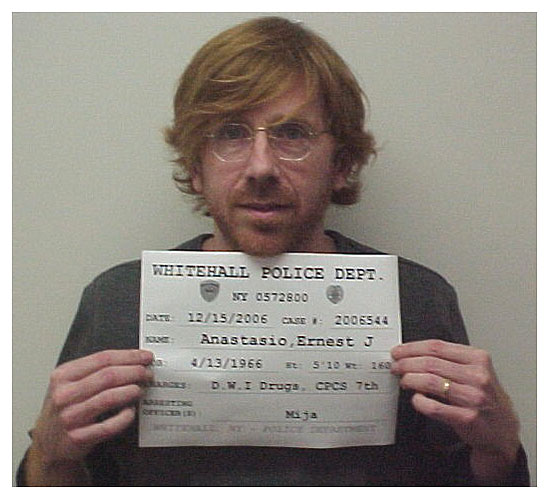
Ernest Goes to Jail

Shocking news tonight as a former member of the jam rock supergroup Phish has been charged with possession of illegal substances. No word yet on whether the arresting officer was a makisupa policeman, looking merely to pinch a little something off of Trey's formidable stash. We'll keep you updated as more details come in.

Trey Anastasio was accused of driving under the influence of drugs in an upstate New York town near the Vermont border early Friday.

Oh, Trey, Trey...First you start writing all kinds of maudlin weepy ballads (what my friend would term "vagina music"), then you leave Phish to start doing lame Gordon Sumner-esque adult-contempo solo tours and now this...What happened to you, man? You used to be cool?

The biggest shock of all in this is that Trey's real first name is Ernest. Ernest Anastasio.

The former Phish frontman was pulled over by an officer who saw his car failing to keep to right side of the road at about 3:30 a.m., Whitehall village police said.

A search turned up quantities of the painkillers hydrocodone and Percocet, as well as the anti-anxiety drug Xanax, that had been prescribed for someone else, police said.

Percocet and Xanax? What, is Trey entangled in a loveless marriage in mid '70s Cleveland? That might be the lamest combination of drugs any rock star has been caught with, ever. Even Nicole Ritchie had a little weed in her system, and she's goddamn 70 pounds.

Anastasio, who was driving with a suspended New York license, was charged with third-degree aggravated unlicensed operation, seventh-degree criminal possession of a controlled substance and driving while intoxicated-drugs, police said.

Trey's got to have some money, right? He's 42 years old. He can't get his driver's license sorted out or, failing that, just hire a car service or something? Phish was, for several years, among the highest-grossing touring acts in America. Several hundred thousand people showed up to see them play on an Indian Reservation one year. Jay-Z took the stage with them in Brooklyn! And this guy's driving himself around the Vermont border with a suspended driver's license?

Anyway, here's the saddest photo I've seen all day.


Very True Hollywood Story. So that's the AFTER photo. For the BEFORE, here's Trey back in better days, covering The Beatles' "While My Guitar Gently Weeps" with his old band.

I Deny the Holy Spirit

The Blasphemy Challenge wants people to upload 30 second videos of themselves denying the Holy Spirit. The first 1000 people to do so get a free copy of The God Who Wasn't There, the atheism documentary, on DVD. I'd do it, because the entire notion of a Holy Spirit that pays attention when we say shit like "I deny the Holy Spirit" is really, really dumb, roughly akin to believing in a chronically obese elf who lives on the ever-thinning ice of the North Pole, quietly performing worldwide NSA-style surveillance enabling him to gather usable, up-close intelligence on the habits of nice and children, along with their relative preference vis-a-vis choo-choo trains vs. kewpie dolls.

The big deal is this passage from The Gospel of Mark.

"Whoever blasphemes against the Holy Spirit will never be forgiven; he is guilty of an eternal sin." - Mark 3:29

Of all the horrible shit you could possibly do, this is the only thing Jesus can't forgive. Seriously. Even the Mel Gibson defense doesn't work for denying the Holy Spirit. If Nicole Ritchie, moments before driving in the wrong direction on an LA freeway, had denied the Holy Spirit, she'd be damned to eternal hellfire instead of 30 days in county.

Apparently, the Holy Spirit just finds your lack of faith deeply, deeply disturbing, and It won't stand for it. I mean, Jesus has pretty strong, visceral feelings about dead baby rape, but he'll still forgive you. "You shouldn't rape dead babies," Jesus was known to say on occasion among close friends and apostles. "I probably shouldn't even have to give you a little allegory for you to understand this rule. I mean, it's a dead baby. Why would you want to rape it? Now let's go magic up some fish for those lepers!" Rumor has it, he was going to put it into the Sermon on the Mount, but dropped it to spare the feelings of his good friend Lazarus, who had infamously once raped a baby and who showed up to The Mount at the last minute. That just goes to prove my point. Jesus drew a line: Dead baby rape = okay if you're really sorry, denying the Holy Spirit = fire + brimstone.

Anyway, it only takes a moment and you have the added bonus of damning your eternal soul. I wonder if this could automatically get you out of listening to missionaries and evangelicals for the rest of your life. "Sorry, I can't come to Bible Study with you...I denied the Holy Spirit just, like, two weeks ago. Yeah, oops. It was just kind of a spur of the moment, hair up my ass kind of thing."

At Pharyngula, PZ has highlighted some funny responses from the believers to the video. Here are a few favorites:

So athiests think their immortal soul is worth a free DVD. Intersting; sad, VERY sad, but interesting none the less.

This person demonstrates a breathtaking ability to miss the point. Atheists don't think anything about their immortal soul because they typically don't believe in any such thing. Your sentence is a complete non-sequiteur, along the lines of saying "Americans think that a teleportation machine is worth 400,000 boxes of oatmeal raisin cookies."

I cannot convince people who have made up their mind already, but I will say that I am a witness of the working of the Holy One. You aren't required to believe me, though. It's your ball, and it's in your court now.

You hear these kinds of arguments all the time from 3 different kinds of people: goony film nerds, ghost hunters and God fearers. The "well, I've seen the evidence but I can't show it to you" argument.

Among film nerds, it's always some random cut of a movie that probably doesn't exist but that the person you're talking to has magically seen. "Seriously, man, there's a 7 hour version of Magnificent Ambersons where Joseph Cotton stalks, cooks and eats a live deer. I've seen it!"

For ghost hunters, it's always about this one experience - back when they were a skeptic just like you - that changed their lives forever. "And as I was walking up the hall, towards the music room of Benchley Manor, I could clearly see the undead form of Lady Benchley, pleasuring herself with Lord Pennington-Smythewood's antique clarinet! And she had on the same jewel-encrusted broach as she does in the locket we found in the secret panel of a hope chest in the attic!"

For fundies, it's always the Holy Moment when THE LORD GAWD interrupted their tedious little lives and showed them THE TRUTH ABOUT EVERYTHING. This commenter on YouTube has witnessed the presence of God. For seriously. It happened. So here's my question...Why doesn't God go and visit Muqtada al Sadr? "Hey, you...Stop sending out members of your militia to destabilize already-violent Baghdad neighborhoods! You have to listen to me, I'm God. I mean, Allah. Praise be my name, or something." God has way more important people to talk to than this schmuck.

Sorry to disappoint you all, but just because you are making your silly video's, that is NOT blaspheming the Holy Spirit. The only way to blaspheme the Holy Spirit is to die in your sin, without repenting and putting your faith in Christ. You must first KNOW that Jesus Christ IS God, and that he IS the way, the truth and the life, and THEN deny him as God AND die in your sin without repenting and putting your trust in the saviour.

Hmmm...He/she may have us there. I'm pretty sure it doesn't count as blasphemy either, if you don't already believe in Jesus to begin with. But doesn't this contradict the Book of Mark? He doesn't say "whoever blasphemes against the Holy Spirit that already agreedt o believe in the Holy Spirit will never be forgiven."

lmao..the fact you even comment on the holy spirit proves you believe! If you really believed there's no such thing, you wouldn't be talking about it.

Truly, you have a dizzying intellect...

Why? I doubt many people would care if you believe in a god or not, so a generic claim like 'I deny the holy spirit' doesn't mean shit. What's important is the reason behind your claims. When you grow up enough to stop antagonising Christians for the hell of it, come back and explain your 'logical thinking.' Atheism isn't a fashion accessory.

No, atheism is not a fashion accessory. Now, Christianity on the other hand, that is most definitely a fashion accessory.

The use of quotation marks around 'logical thinking' here strikes me as very telling.

Atheism, really any of the agnostic/naturalist/academic belief systems, relies on what to me feels like a fundamental humility. You recognize that the Great Questions are always going to be just that - questions - and you resign yourself to accepting the best and most current information that those who study our world professionally can provide.

For example, I can grasp only the most basic conceptualization of something like String Theory. I know enough to understand that multi-dimensional models of the universe explain some issues but also create more unanswerable questions and that's about it. But I can't possibly understand this information the way an astrophysicist would, so I would have no choice but to defer my opinion on the subject to the expert should the situation arise.

This is essentially a humble stance, and sensible, educated people take them all the time. I look up to authorities in pretty much all aspects of life - novelists, journalists, scholars, scientists, activists, artists, world leaders, engineers. The list goes on an don.

I see this as running against the devout religious worldview. Fundamentalists and their ilk have only one source of authority. The Big Man in the Sky. And the great thing about God is that he's absent. He never talks to anyone any more, and his Book is full of all kinds of weird anachronisms, counter-intuitive messages and contradictory advice. So religious people get to act pretty much however they want. They don't defer to experts, their own leaders or even one another. It's a free-for-all.

And that's how you get religious people who hold the very notion of 'logical thinking' in contempt. They have a Righteousness on their side that defeats even the powers of Logic, much in the way that a thin slip of paper can surreptitiously cover a sturdy rock in the popular game. It's like being the Bully's Little Pal. Sure, you have to follow this guy around and pretend to be his best friend, but the moment he's not around, you run the schoolyard. You don't take shit from nobody, despite being the same little weasel they all once picked on.

Friday, December 15, 2006

Lady in the Water

[NOTE: This really isn't a twist movie like M. Night Shyamalan's others, but I still feel like I should put a spoiler warning up here at the top. If you haven't seen this awful piece of shit yet, don't. DON'T! But if you must see it, and don't want to know the immensely lame developments of the Third Act, read no furhter.]

Does M. Night Shyamalan ever doubt his storytelling prowess, even for a moment? Do you think he ever genuinely stops to consider his ideas impartially, or does he just take as a given that his ceaselessly imaginitive, Miltonian brain could not possibly create a thought lacking for greatness in any way?

Directing Hollywood films requires a healthy ego and an aggressive attitude. They don't just turn over $50 million to anybody and tell them to take 4 months and make some art. This is a high-pressure job that attracts some exceedingly loathsome, devious, self-obsessed individuals. The history of filmmaking is, in some ways, a series of anecdotes about sinister, intoxicated men pushing other people around in order to realize their personal, often perverse, visions. But even for a colleague of Warren Beatty and James Cameron, Night may be pushing the whole asshole-auteur thing a bit far.

If Lady in the Water is about anything, it's about M. Night Shyamalan's love for his own imagination, and his naked hostility at anyone who would dare question the magic and wonder of his inner world. So enamored has he become with his gift for invention, Night has seemingly forgotten all about the fundamentals of storytelling and filmmaking. His most smug, self-satisfied work, thus, becomes easily his least proficient.

There has already been a book published about the making of this film, because surely this is an ego trip of legendary proportions that should be prserved for posterity as a warning if nothing else. Night submitted the script for Lady in the Water to the suits at Disney, who offered to make the film with him while offering reservations about the story itself. (Watching the film, one can only sympathize with anyone, studio executive or no, having to provide constructive criticism and notes to its author..."Maybe you could rewrite this exchange so it isn't so overblown and terrible? Wouldn't it be interesting if, between pages 30 and 90, something happened?")

Hearing his masterpiece slighted so barbarically (they only offered him $40 million to make a movie!) caused Night to have what sounds like a mental breakdown, after which he severed ties with his old studio and skipped across Burbank to the WB. The result is, if not the worst film of 2006, certainly the silliest. I mean, really...This insipid bedtime story makes that dancing penguin cartoon look like Rules of the Game.

Night, listen to me carefully...We're going to have a little filmmaking intervention here, like Bobby D bringing Martin Scorsese the Jake LaMotta book that inspired Raging Bull when the director was in detox...You're in narcissistic personality disorder detox...

First, stop obsessively sniffing your own farts. Now then...Unbreakable 2: Breakable...Let's get it done.


Lady in the Water is complicated in the least interesting way possible. Essentially, Night has refashioned his mediocre science-fiction hit Signs into a fairy tale with significantly diminished results. That film focused on a preacher who had lost his faith (Mad Mel Gibson) and his family, who survive an alien attack only by discovering, at exactly the right moment, that "fate" has dealt them each a crucial role to play.

The premise here in unchanged but expanded. Lady in the Water exists in a world governed solely by fate. Individuals have been mysteriously drawn to an apartment building where a fated meeting between a mystical creature and humanity's savior will occur. Unbeknownst to them, they will each play a part in saving the world.

When you get right down to it, the entire concept has a creepy undertone. Free Will no longer exists in the Shyamalan universe. Destiny runs all. In Signs, this notion of fate was rendered as explicitly religious: fate is just another word for God, who knows what we are going to do even before we do it and thus plans all of our lives out ahead of time. Lady in the Water replaces the theology with a bogus, New Age-y spirituality, but the message is otherwise the same.

Cleveland Heep (Paul Giamatti) is a lonely, broken man who works as a Super for an apartment complex called The Cove. He's known and liked by everyone in the building, but doesn't say much, largely keeping his head down and staying out of the way. One night, he finds a strange, pale girl (Bryce Dallas Howard) swimming in the pool. This is Story (ugh), a magical water nymph who has come to The Cove looking for a writer.

Night claims that he made Story (ugh) up on the spot as a bedtime story for his children. I completely believe this account. The mythology surrounding Story might be the most ludicrous ever set to film, at least since Labyrinth. Okay, here we go...

Once upon a time, humans and nymphs (also called narfs) lived together in the sea. But then, humans started wanting to own things, so they went on to land and started building little huts that look like the heads of penises. So humans now live on land and fight wars and feel unhappy, and the nymphs keep trying to send us messengers to let us know how to save ourselves. But mean wolf-like creatures named scrunt (triple ugh) try to stop them, for some reason.

I don't know why humans had to go on land in order to start acquiring things. If we lived in the sea, wouldn't we just get greedy and possessive about ocean merchandise? I could see us all trying to buy the flashiest periscope bling or the longest harpoons. Also, I have no idea why this opening sequence was gendered, but the nymph species is all female and the human species all male. (Consider the title as well, and the fact that, as I pointed out before, all the human huts look like cocks.) This seems kind of peculiar and patriarchal to me. Are women not also human beings, who make war and seek ownership? And are men incapable of being in touch with the natural world, and therefore wise and enlightened?

The mythology gets far, far more complicated. There are keys to find, Queen Nymphs to crown, monkey soldiers to conscript (seriously...), hidden keys to obtain, and of course the occupants of the building have to figure out how they figure into Story's perilous return voyage to her home, The Blue World.

Unfortunately, Night doesn't bother to actually show us anything of interest. All we get talky scenes set in and around this apartment building, populated entirely by stock characters and crudely drawn racial stereotypes. From the extended, bickering Mexican family to the burnout circle of stoners, Night clearly hasn't put in a lot of time on developing relatable, original characters this time around, and that's a shame because the film has no action or style to distract from their banter. His technique of keeping most of the really juicy action just off-screen and tantalizing us with the barely-viewed details worked well in suspenseful genre movies like The Sixth Sense and Signs; it's creepier not to know what's waiting around the corner.

A sentimental (not to mention juvenile) fantasy like Lady in the Water needs to give us a bit more than a blurry shot of a wolf and an animated sequence before the credits. It's unclear why Cleveland or his neighbors would even believe Story and her ridiculous assertions about scrunts and tartuteks and whatever the fuck else she's being chased by, because you really don't see much of anything except an empty apartment building. The entire film, beginning to end, takes place in a few apartments and by the pool.

Instead of any action, really any movement at all, Night gives us insufferable scenes in which Cleveland's Korean neighbor Young Soon-Choi (Cindy Cheung) translates for him the entire Narf legend, which her mother learned as a child. Night's written some other films, so he knows what a lazy screenwriting device these Korean neighbors are, and how uninteresting these thick blocks of bland exposition would be for an audience looking for thrills and escapism. He surely also knows that the story here (lower case) has no tension, because Young's mother could just relate the entire Korean legend all at once and reveal all the plot's riddles. When the only thing keeping your narrative afloat is the whim of an old Korean lady with nothing much to do, you know your script has some structural flaws.

Mainly, it's offensive. These are exoticized Orientals who know some obscure mythology that's not even real, that this guy just made up and has now assigned to their culture. Also, despite being described as "a college student," Young speaks in this Rosie O'Donnell-esque pidgin accent. This intelligent young woman has lived in America for years, and she doesn't say any plurals or properly conjugate her verbs? ("Cleveland, why you no tell me you coming over? I need go get grocery from store!")

Giamatti, a great, lively actor, here is forced to sit around while a sub-"Mad TV" Asian caricature rattles on and on about the nuances of this retarded Hans Christian Anderson knockoff. One truly hideous, insane scene finds Giamatti forced to beg an old lady to tell him what's going to happen to him next. Young explains that, if her mother starts to see Cleveland as a little boy, she will open up and tell him the story. So he splashes milk all over his face, talks in weird baby-talk and curls up in the fetal position on the couch. Not funny, just strange. Perhaps Night is a Narf, unable to get to close to human beings and therefore unable to carefully observe their behavior for duplication in writing.

Okay, so I've talked a lot about why the film's almost unbearable to sit through, but I haven't really supported my initial claim that the film is Night's awkward tribute to himself. This really lies in the contrast between two of the film's most thin, generic characters: cynical film critic Harry Farber (Bob Balaban) and optimistic dreamer Vick Ran (played by the writer/director himself).

Cleveland eventually discovers that Story has come to The Cove in order to inspire Vick Ran. In a plot development ripped off directly from Bill and Ted's Excellent Adventure, Story has learned that Vick Ran will one day write a book that will change the course of human history. His book, entitled "The Cookbook," will inspire a young boy who will one day grow into America's greatest President and a World Leader of grand significance. In perhaps the most unintentionally hilarious dialgoue exchange in 2006 cinema, Cleveland inquires as to the subject of Vick Ran's writing. Here is the response, spoken by M Night himself...

"I guess it's about all these cultural problems we've been having. Leaders and stuff..."

Well, that's just great writing. Bravo. Ben Hecht's got nothing on this guy. (Can I also ask what he means by "cultural problems"? Violent video games? Abortion? Blogofascism? It sounds like something a budding authoritarian would say. "I am writing a book about my final solution to The Cultural Problem!")

But before Cleveland figures out that M. Night Shyamalan is the greatest writer in the history of the world and the savior of all mankind, he first considers professional writer and critic Farber for the job.

Night has written Farber as a thin-skinned, elitist, bitter prig, a man who thinks he knows everything and who pre-judges everyone he meets and everything he sees. This can only be read as a direct response to the critics who savaged Night's previous film, thehalf-baked, overreaching allegory, The Village. That film was rightly ridiculed as a bloated, unconvincing waste of time, but apparently Night feels that it was a beautiful piece of art that deserved to sail through the world criticism-free. Apparently, those who found fault with his movie, and in writing no less, could only have done so out of a smug sense of superiority and personal vindictiveness.

Even if that were true, this depiction of critics as evil incarnate comes off as petty, and Night ruins the only scare scene in his whole fucking movie to get a cheap laugh off at the death of one such hated critic. Dude, have some fucking pride, okay? This whole film feels like Christopher Hitchens flipping off the audience on Bill Maher's show, like a self-styled Great Man unable to deal with the inevitable backlash his sneering bravado has wrought. Using your movies to haughtily snipe at your critics makes you look ridiculous, not bold. (Not being an authentic, paid film critic, I didn't really take the swipe personally, mind you. I'm perfectly open to mean-spirited, satirical depictions of film critics in theory. I mean, I love that show "The Critic," and it wasn't exactly a glowing portrait of the profession, what with all the fat bald loser jokes.)

So, yeah, just like his real-world counterpart, it's up to Night's character in the movie to ignore those stupid, blind critics and save the world using only the power of his writing. And , if we recall that, in the Shyamalan Universe of Signs, "fate" is actually divine ordination, then God himself is calling upon Vick Ran to educate the people. Really. The movie tries to make this point. Without getting too deconstructionist on you, consider the connections to Islamo-Judeo-Christian mythology:

The Universe's spiritual awareness sends a creature named Story to communicate a great Truth to a writer (called "a vessel" in the film itself!) Kind of like how Abraham, Moses and Mohammad were handed down God's Word. Expand this formulation just a bit and you get what I think is Night's real point - he is God's prophet on Earth. Not just his character in the film, but director M. Night Shyamalan. His movies express The Great Truth of the Universe to the people. And here I thought they were just genre flicks.

This movie offended every one of my senses. Even cinematographer Chris Doyle, who usually can be counted on to liven up even the most dreary of films, only gets the opportunity to craft a few distinctive shots. (I mean, most of the action takes place around a community swimming pool!) Even the special effects suck. This wolf, made of sticks and twigs and covered in moss, looks like a blurry, CG-enhanced dog. Worse yet, they lack any kind of genuine, tactile physical presence, they don't feel like they're really occupying space next to the tenants. In one scene, Giamatti faces one down in the countyard, and the scene isn't remotely scary in part because it just looks too fake.

Wednesday, December 13, 2006

R.I.P. Peter Boyle

Legendary character actor Peter Boyle, who used to hang out with John Lennon, starred in one of my all-time favorite films (Paul Schrader's Hardcore) and hosted one of the first episodes of "Saturday Night Live," died yesterday at the age of 71. The Associated Press' eulogy leads off, naturally, with his long-term stint on popular sitcom "Everybody Loves Raymond" as obnoxious loudmouth Frank Barone. He capped of his career with most beloved, popular character, which would be rewarding for any artist, but particularly one so prolific.

Barone in many ways was the pure embodiment of Boyle's persona, a character who was either written specifically with him in mind or tailored for him once he was cast. Like the sneering bundle of rage in Boyle's breakthrough 1970 film Joe, Barone covers up his insecurities through mean-spirited, cutting remarks. (Joe conflates hippies, communists, Jews and homosexuals into one faceless Army of Others to be opposed at all costs.)

Like his lawyer, Carl Lazlo, from the underseen Hunter Thompson adaptation Where the Buffalo Roam, many Boyle characters have a Wild Man side to their personalities, an irrepressible id that causes problems when unleashed. His cagey unpredictability is one of the things that made Boyle so much fun to watch on screen, both in the comedies for which he became best-known and the dramatic work in films like Taxi Driver, and particularly his turn as a bitter elderly racist in Mark Forster's otherwise-forgettable Monster's Ball.

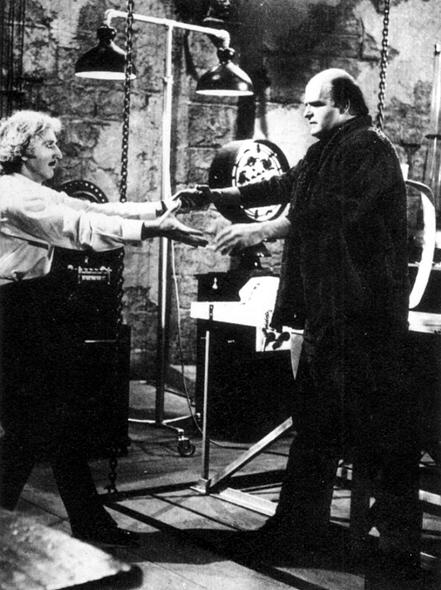
I first recognized Boyle's considerable gifts as a young person in two separate comedies, though I didn't realize until years later that they were the work of one man. Obviously, like everyone else, I love Mel Brooks' Young Frankenstein, easily the crown jewel on the guy's filmography.

Boyle's turn as The Monster not only earns some of the biggest laughs, but also ranks as one of the most heartbreakingly humane versions of Shelly's unholy creation. Like Boris Karloff, Boyle sees the monster as an emotional person frustrated by his physical, sensory and communicative limitations. Unlike De Niro's sinister mutant or Christopher Lee's braindead fiend, Boyle's monster has a real heart and a soul, not to mention graceful dancing skills and perfect pitch.


My other early favorite among the guy's films was the 1989 comedy The Dream Team, which I saw repeatedly owing largely to a childhood obsession with the films of Michael Keaton. I have not seen The Dream Team in many years, so I can't guarantee that it would hold up to my current sensibilities, but I used to think it, and Boyle's performance as an escaped mental patient, was fall-down, laugh-out-loud funny.

Considering some of the guy's early work, I'm taken with not only how many great films the guy made but how many different shades he managed to bring out of essentially the same persona. His work in Joe, teamed with his memorable turn as fast-talking street philosopher Wizard in Martin Scorsese's Taxi Driver, typecast him for much of the '70s and '80s as a caustic, savvy scumbag.

In Schrader's Hardcore, a deliriously sleazy descent into the underbelly of the late '70s LA porn scene, Boyle plays Andy Mast, a detective of questionable morals hired by an uptight Calivinist from Pennsylvania (George C. Scott) to track down a wayward daughter. Mast, as written, plays pretty similar to a lot of other private eyes in '70s films. Lou Harper by way of Elliott Gould's Phillip Marlowe, only with a more keen and passionate interest in smut. But Boyle additionally gives the guy a boyish innocence - despite his bullying, almost cruel sense of humor, he's genuinely committed to solving the case and protecting his client.

(One scene finds Scott and Boyle arguing. The client has showed up as his detective's home to find the man seducing an underage girl rather than working on his case. As they exchange insults, Scott roars at Boyle to "get out of here!" Boyle begins to leave, then stops dead in his tracks. "Wait a minute, you can't tell me to leave. This is my own apartment!" I'm not sure Schrader knew that scene was funny when he wrote it, but Boyle certainly figured it out.)

Okay, I'm a big fan, but I can see that I'm starting to ramble. So I will ujust real quickly go through other Boyle performances I have greatly enjoyed.

Friends of Eddie Coyle (1973): Boyle's fantastic as a stoolie in this terrific Boston noir starring Robert Mitchum. I saw it a year or so ago on TCM, but it's frustratingly unavailable on DVD. (It's clearly a precursor to Scorsese's The Departed, so perhaps the success of that film will inspire interest in a new print of this one?)

"Dueling Brandos" (1975): I've always loved this sketch from when Boyle hosted an early episode of "Saturday Night Live." He and John Belushi trade off doing solid Brando imitations in between bursts of that creepy Deliverance "dueling banjo" music. I think they redid it years later when Ray Romano hosted...Of course, not as funny...

Outland (1981): Boyle had actually started his career playing tough guys, and he got one more shot in Peter Hyams' so-bad-it's-pretty-good sci-fi action film.

Johnny Dangerously (1984): See aforementioned obsession with Michael Keaton comedies. Boyle palys a character named Jocko Dundee. I mean...need I say more?

Two by Steven Zaillian

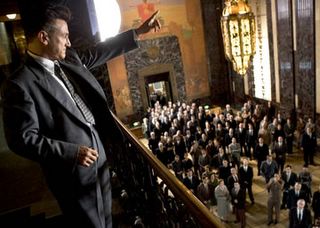
Screenwriter and sometime-director Steve Zaillian is perhaps best-known for penning Steven Spielberg's award-amassing Holocaust travelogue Schindler's List, for which he won and Academy Award and a lifetime of dirty sidelong glances from Jean-Luc Godard. Though he mainly scripts middling mainstream fare along the lines of Clear and Present Danger, Awakenings (for which he was nominated for an Oscar) and Hannibal, Zaillian's resume is not without highlights. Among them are the sturdy if austere chess drama Searching for Bobby Fischer (which Zaillian also directed), Martin Scorsese's charmingly untidy Gangs of New York and his feature-length screenwriting debut, 1985's The Falcon and the Snowman, directed by John Schlesinger. This year, Zaillian reteamed with that film's "Snowman," Sean Penn, to adapt Robert Penn Warren's classic novel All the King's Men, previously filmed by Robert Rossen in 1949.

THE FALCON AND THE SNOWMAN

The first five minutes of Falcon and the Snowman are a study in storytelling efficiency. Without saying a word, disillusioned post-adolescent Christopher Boyce (Timothy Hutton) leaves seminary with pet falcon Fawkes in tow, never to return. Meanwhile, in a fleabag Mexican motel, his childhood friend Daulton (Sean Penn) wakes up, looks out the window at a passing funeral, and leaves a tip on the bed stand for the previous night's prostitute. Both young men have reached a dead-end - one turning his back on his faith and his planned career, the other reeling from multiple convictions for drug dealing back home.

Zaillian's screenplay, based on a true story about two Americans who passed documents to the Soviets, sets up all the dominoes in near-record time. Christopher's father (Pat Hingle, the Commissioner Gordon from Burton and Schumacher's Batman films) gets him a low-level job at a company working largely on behalf of the CIA. (It's based on the real company TRW). His employers like his clean background, his ability to learn quickly and his father's many years of service as an FBI agent. So they give him some high-level clearance and bounce him into a ludicrously easy job transmitting coded documents before shredding them.

John Schlesinger's film looks on from Chris' perspective, which can kindly be called naive, even by the standards of 1974 (when the action is set). He's shocked (shocked!) when some of the documents passing through his office indicate shady CIA dealings in Australia, possibly undermining the democratically-elected government and infiltrating the air traffic controller's union. Chris and Daulton share a particularly timely conversation about the rise of Pinochet in Chile and how the CIA may have been behind that operation as well.

Interestingly, the film depicts Christopher as enthusiastic about selling out his nation from the very beginning. A toxic combination of displaced personal angst and anger about covert CIA wheelings and dealings creates within him a strong desire for vengeance, a wish to do wrong to our nation. Daulton's simply in it for the money, but Christopher clearly poses the greater threat; he's a true believer. (Naming his pet bird after Guy Fawkes, the notorious attempted Parliament bomber, provides early insight into his strongly-held attitudes towards authority.)

Once Christopher sends Daulton to the Soviet embassy in Mexico City, armed with secret documents and licensed to negotiate a price, the movie shifts from an odd, disjointed buddy comedy into a more conventional spy thriller. An intense Soviet agent (David Suchet) doles out thousand dollar payments for unimportant information, but really desires something Christopher can't access - the coordinates of US spy satellites. Daulton wants to string them along, Christopher gets cold feet and the two novices' brief flirtation with international espionage starts to turn exceptionally sour. Fast.

Daulton presumably earns the titular nickname "Snowman" (never spoken during the actual film) because of his constant cocaine and heroin use, which gives Penn an all-too-familiar arc to traverse. (With a few non-crucial changes, Daulton morphs cleanly into his sleazy coked-out lawyer character from Carlito's Way.) Hutton plays Christopher as a bewildered, somewhat lackadaisical proto-slacker, half Benjamin Braddock and half Wayne Campbell. It's a likable enough character for the most part, but the fiery political outbursts he's asked to deliver every 30 minutes or so feel out of place, like the screenwriter subbing in his own voice briefly for that of his character.

A vaguely-sketched, inconclusive romantic subplot between Christopher and a blonde he meets in a pet shop (Lori Singer) feels equally gratuitous. I guess a movie about a conflicted spy needs a girl impatiently waiting for him at home. It's a rule or something.

Still, the sequences set in Mexico City have a certain breezy panache, the '80s music and '70s fashion gives everything a throwback, nostalgic sheen. And it's always fun to watch Penn self-destruct. Falcon and the Snowman remains a solid if largely unremarkable film, enhanced by the provocative knowledge that both of its subjects have since been released from prison and returned to society.

ALL THE KING'S MEN

Zaillian both adapted Warren's novel and also directed this wan, turgid treatise on corruption. The story of Louisiana Governor Willie Stark (based on Louisiana's Governor and Senator Huey Long) could be rendered as a complex, insightful and vital film about the present state of politics in America, a nation still suffering from the kind of systemic rot today that plagued government in Long's time. Instead, Zaillian has turned in a confused and disconnected mess, a movie that's not just inscrutable but downright impossible to follow in any sort of logical fashion.

Much of Falcon and the Snowman benefits from Zaillian's ability to write in a way that's both vague and compelling. In that film, he keeps Christopher's motives obscured for a good, long while and he sets up Daulton for a crime he may or may not have actually committed. In other words, he's deliberately confusing in order to enhance the audience's understanding of the daze in which the protagonists operate. They don't know quite what's going on, so neither do we. (Alan Daviau's angular cinematography adds to the effect; we never see the protagonists from eye level, and always get an obscured, interrupted view of the important on-screen action.)

In All the King's Men, a bit of context and perspective would really help. I have not read the book, but I have seen the previous film, and I'm somewhat familiar with the actual '20s and '30s political career of Huey Long. Yet taken on its own terms, Zaillian's movie fails to tell any kind of complete story. It grasps around amongst 4 or 5 different plots but never settles on one for long enough to fill in any blanks.


It's difficult to even speak about any of the performances because Zaillian gives all the actors so little to go on. We don't know if people are honest or corrupt, if they are noble or devious, if they have good or malicious intentions. There is never an explanation, nor is there any background. Willie Stark exists in a vacuum of his own power and ego. Does he care about the people he represents or doesn't he? Neither Zaillian and Penn seem sure, and if they don't know, how the hell are we supposed to figure it out? Throughout the film, for example, we're told that the voters have elected Stark in response to crippling poverty, but we never get to really see or experience their plight. It exists somewhere out there, because we are told it exists, but it never becomes tactile or palpable. (It doesn't help that Zaillian has senselessly moved the film forward in time from the '30s to the '50s, making some of the details borrowed from Long's actual biography incongruous.)

Willie Stark begins as a small man fighting a corrupt system. As a building inspector, he knew that shoddy work was being done on a schoolhouse, but his decision was overruled by bureaucrats. When the building collapses, he suddenly finds himself a bit of a local celebrity and a respected "voice of the people." So he's flattered but not entirely surprised when an operative for the State, Tiny Duffy (James Gandolfini), shows up and asks him to run for Governor.

It turns out, Duffy intends to set Stark up. He's hoping Stark will peel away some of the populist vote from his own candidate's opposition, and serve as a spoiler for the establishment candidate to retain power. Gandolfini, who along with Louisiana native Patricia Clarkson boasts one of the film's lone realistic accents, does some typically great work in his few scenes here, as a large, imposing man with an unexpectedly meek, servile demeanor. Stark, a brilliant orator who discovers his true voice on the stump at precisely the right moment, turns the tables on Duffy and storms into office on the crest of a whirlwind campaign.

All these events are reported dutifully by the cynical journalist Jack Burden (Jude Law), who's not exactly impressed with Stark's man-of-the-people schtick yet nevertheless agrees to join his administration. Okay, so, in addition to building the relationship between Burden and Stark, Zaillian tries to squeeze in several extraneous, distracting subplots. I realize all this stuff might have been in the novel, but there wouldn't be time for all this story in a 2 hour film even if the director wasn't so fond of long close-up takes and shots of cars driving up to and then away from houses.

Stark's tense relationship with his wife (Talia Balsam), mistress/campaign manager (Clarkson) and assorted girlfriends each get a scene or two. Plus there's Burden's relationship to his wealthy and esteemed godfather, Judge Irwin (Anthony Hopkins). Not to mention his restrained, decades-long infatuation with Irwin's daughter (Kate Winslet) and his longstanding friendship with Irwin's son (Mark Ruffallo). Zaillian attempts to dart between the personal and the political, the historically accurate and the obviously fictional, without giving the audience any kind of central idea, focal point or emotional investment. With so many characters wandering around so many thinly-connected plotlines, it's no wonder nothing gets developed beyond reductive, pitchable sentences.

Zaillian can't even decide who his story's really about. He focuses on Stark and his sudden and surprising rise to prominence within a bonafide populist movement. Then, at about the halfway point, Zaillian's attention shifts to Burden and his relationship with the Irwin family. (It feels like at least a half hour goes by in the middle of the film in which Penn, the ostensible subject of the film, doesn't even appear.) By the conclusion, we're suddenly expected to care deeply about the fate of Ruffallo's character, who has said maybe 10 words and done nothing of import. He's in so little of the film and has such a minor connection to the story of Willie Stark, Zaillian's forced to give other characters expository dialogue merely to explain his presence. We're told that he's an exceedingly moral, upright man, but don't ever get a single example of something he has done to earn this reputation. His story ends with an overblown, kitschy shot of the Louisiana State Logo (you'll know it if you see it) coupled with some poorly-chosen music and an utterly nonsensical bit of dialogue, signaling that Zaillian has lost the emotional thread of his film entirely.

Consider this...A large portion of All the King's Men concerns the impeachment trial of Stark on corruption charges. Bizarrely, Zaillian not only refuses to say whether Stark is guilty or innocent of the charges, but even skips over the specific charges levelled against him. Is he corrupt? This matters! It is the crux of the entire story. If Stark is guilty of corruption, what we are watching is a bleak, angry warning about slimy, monied interests turning otherwise respectable, concerned citizens into hopeless, enabling fraud. If Stark is innocent, we're seeing a melancholy elegy for the "Last Honest Man," a Charlie Kane-like figure who dreamed of doing good only to be destroyed by the very system he hoped to change. Unfortunately, Penn doesn't seem to have a better handle on Stark than in the audience do, making his entire performance muddled and uncertain.

How are we supposed to find any meaning in Willie Stark's story if we don't know the basic facts of his case? Refusing to give any insight into the nature of Stark's leadership, his motives, his perspective or anything else about his administration aside from his rhetoric leaves us totally in the dark, disconnected completely from the story and, essentially, uninterested. There are things happening on screen, but there's no there there.

Monday, December 11, 2006

The Devil Wears Prada

Any attempt to discuss this film in a standard review would be pointless. This is not a movie about characters or comic situations or special effects or even entertainment, according to the standard use of the term. David Frankel's The Devil Wears Prada belongs in that venerable Hollywood sub-genre - the 90-minute commercial.

Anyone circling 30 like me will surely remember The Wizard, that charming Fred Savage vehicle which promised early and exclusive footage of other kids playing "Super Mario Bros. 3"? And of course, who could forget the Garbage Pail Kids feature-length advertisement that actually opened in a few theaters before everyone realized it was a terrible idea and promptly replaced it with the latest Friday the 13th installment? (The GPK movie, you'll recall, made the odd decision to kill off all the most famous characters. Not a lot of franchises would risk that sort of gruesome brand carnage these days. Can you imagine if all the main characters died at the end of the forthcoming Simpsons Movie?)

So, okay, most films of this sort are like those "free" vacations that scam travel companies are always offering. You think you're getting a ski weekend in Vail, but it turns out you have to sit through 10 presentations about time shares in Hickspittle, Montana first. The Devil Wears Prada promises you a dark, edgy comedy about life in the world's most high-pressure office. Sort of a female counterpoint to Swimming With Sharks. But instead, you get about 5 minutes of actual movie along with 85 minutes of ads for Jimmy Choos.

This may not sour everyone on the movie. After all, I am not the target demographic for couture ads. I don't even mean that in a gender-stereotypical "only girls care about clothes" way. Plenty of guys care about clothes and pay close attention to how they dress. Just not me. I'm totally incapable of dressing with any sort of style. I just throw on stuff if it vaguely appears to match, or at least gets close enough. My mother, upon seeing how I leave my apartment, will occasionally give me fashion "tips": Don't wear blue with black, don't wear jeans out to formal dinners, stop wearing those sweatpants with the oversized hole in the crotchal region. This is roughly like trying to teach a deaf Inuit to speak English by reading him passages from Strunk and White. The boldest fashion statement my regular attire makes is: "This guy eats a lot of foods containing barbecue sauce with a relaxed attitude towards drippage."

My point is, a lot of people who aren't me probably enjoyed this movie because it was all about clothes. If Anne Hathaway modeling a variety of designer outfits sounds appealing to you, I can almost guarantee you will enjoy The Devil Wears Prada. As for me, I was bored by the complete lack of momentum and disappointed that an appealing cast and a promising set-up never once connects.


Aline Brosh McKenna's screenplay comes from the best-selling novel by Lauren Weisberger, based on the author's real experiences working for Vogue editor Anna Wintour. Meryl Streep plays Wintour's stand-in, Runway magazine editor-in-chief Miranda Priestly, making this the second recent film in which she has portrayed a harsh, fictionalized caricature of a notable real-life woman. (In Spike Jonze's Adaptation, of course, she portrayed "The Orchid Thief" author Susan Orlean as a reckless, somewhat disturbed, drug-addicted adulterer.)

Priestly is, as the film's title implies, highly unpleasant. She's pretty much the inverse of Kevin Spacey's Boss from Hell in the aforementioned Sharks. He was loud, crude, aggressive and manic, intentionally pushing everyone's buttons, dominating them through intimidation and fear. Preistly prefers to make outrageous and impossible demands, to sew dischord among her various employees and to give everyone the silent treatment. (Her ridiculously long lists of instructions to assistants are always followed with a withering, "That's all.")

The first of many logical inconsistancies occurs right away, when plucky wannabe journalist Andy Sachs (Anne Hathaway) accepts a job working for Priestly despite a total lack of interest in fashion. The film lamely explains this discrepancy away by having Andy note that all the other good New York City journalism internships were taken, but it's still hard to see why anyone would put up with Priestly's crap unless they simply had to be on the inside of her particular industry. Wouldn't Andy's career aspirations be better served by actually doing some writing for a smaller magainze or a newspaper? (She declares her intention to write for The New Yorker, not Marie Claire.)

But the film spends very little time developing a plot, so it's in desperate need of a little conflict. If Miranda and Andy could bond about clothes from the get-go, the whole movie would be over after the first reel, and we wouldn't have any opportunity to check out Dolce & Gabbana's exciting new Fall line.

Andy doesn't only clash with Miranda during the year she must spend at Runway before moving on to an exciting position elsewhere. She locks horns repeatedly with Miranda's catty senior assistant Emily (Emily Blunt) and trades occasionally hostile banter with assistant editor Nigel (Stanley Tucci, working overtime to squeeze something salvagable from a nothing character). Andy's slavish devotion to her assistant duties and newfound friendship with a suave fellow journalist (Simon Baker) likewise cause friction with her chef boyfriend (Vinnie Chase). Not one of these stories has a beginning, a middle or an end. They're just situations to which we're introduced, not plots that actually do any unfolding. Andy hates Miranda, then grudgingly grows to respect her, then decides that she really did just hate her all along. The scenes that would normally make up a comedy of this sort, such as Andy's tussles with Emily or relationships woes, are here just filler, segues between the long sequence about handbags and the even longer sequence about scarves.

Take Baker's "journalist" character, Christian Thompson. I put quotes around it because the guy never does a single journalistic thing for the entire movie. He shows up, randomly, wherever the plot demands that he be at any given time and spouts unrealistic expositional dialogue. When Andy nervously accompanies Miranda to a big fashion show, Christian magically pops up just as our hero is making for the exit. When a massive backdoor deal threatens the future of Runway Magazine, Christian turns out to be the whole scheme...somehow. This is not a character, but a device. This makes sense, though, because all characters in commercials are devices - they're never meant to represent a real person with real thoughts and feelings. They're supposed to represent us, the faceless consumer preparing to enjoy this wonderful new product.

So we see Andy struggle at first, but then slowly get the hang of her environment, while at the same time discovering the amazing powers of expensive clothes to improve her outlook and sense of well-being. A scene in which Nigel takes Andy to the secret Runway dressing room where all the free samples are stored (a mythologized, utopian locale also referenced in a "Sex and the City" episode) really lays out the film's worldview: Clothes are very important because they tell the world what kind of person you are and reflect everything about you, from your personality to your worth as an individual.

At the start of the film, when Andy dresses like a schlub, we know she is clueless and unfulfilled. Then she masters her job and, accordingly, dresses nicely, which is a huge improvement. Unfortunately, it turns her into a bitch. Eventually, she finds the proper balance - dressing really well without being a bitch! See, you too can find happiness by only spending all of your after-tax income on fancy shoes and pretty outfits!

The centerpiece of the film is a musical montage in which Andy wakes up, dresses and walks to work. Over the course of what looks like a single day's commute, Frankel cuts between Hathaway wearing, I'd guess, at least 6 or 7 very different outfits. They really should have just made this scene the entire film - Anne Hathaway modeling new clothes and shoes while stalking the streets of New York. And every 15 minutes or so, Meryl Streep could run up and throw a purse at her. Done. Movie. I think audiences would get it. They're clearly not watching this thing for the jokes, because there aren't any.