Saturday, November 18, 2006

O.J. Pimpson

Despite desperate attempts on the part of certain Republican operatives to focus attention on a standard, unexciting power struggle within the upper eschelons of the soon-to-be Democratic Senate, I think the thing everyone was talking about this week was OJ. Well, him and Borat. People sure do love that wacky, mixed up guy...

But mainly, OJ. The Juice. Nordberg. The Nicole Brown-related news this week has been nostalgic for me. Reminds me of high school to see Fred Goldman ranting on my TV. Like that fucking Cranberries song "Linger" that I've always hated, yet for some reason brings me back to my sophomore year in high school with such uncanny clarity that I almost can't stand to hear it for more than a few seconds.

People are still upset about the OJ Simpson verdict. All he did was butcher his ex-wife and her friend, and then try poorly to cover it up before running from the cops in extremely half-assed fashion! Oh, yeah, and then hire expensive scumbag lawyers to select the dumbest jurors possible so they could lie to them and waste everyone's time and money, so OJ could play golf all day and pretend to look for "real killers" rather than accept his punishment. Lighten up, people!

Seriously, though, OJ Simpson is a murderer and deserves to be in jail. But he's not, because rich people, and especially famous rich people, play by different rules in America. If you want to be upset, there's your cause for upset.

Personally, I'm not thrilled with the idea of OJ Simpson making money off of waving his guilt in front of everyone's face now that he's immune to prosecution for his crimes. But I still can't shake the feeling that people are upset about this case for the wrong reason. And that reason is: racism! Neat!

I think white people are so upset about OJ, in large part, because they don't like the idea of a black man killing a white woman and getting away with it. I know, I know, people are upset by miscarriages of justice. But how many wrongfully imprisoned people do we have in America? We release more and more innocent men and women every month because of newly-discovered DNA evidence. And conversely, how many murderers get away without being punished? Tons! Thousands! You may even know someone who has killed with impunity. How would you know?

But OJ seems to stick in America's craw. They can't get over it. So they focus their hatred on him personally, rather than the real problem, which is that the prosecution fucked up miserably and the wealth and relative celebrity of the defendant was rather directly used to influence the outcome of a murder trial. (Also that the whole thing was a total media fiasco from day one, giving insight into the fundamentally flawed cable news enterprise years before its nadir as the propaganda wing of BushCo.)

I'm not saying this is true of all Americans. But it seems to pop up sometimes in odd ways. Here's Bill O'Reilly:

"Here's a man many believe did kill those two Americans, Nicole Brown Simpson being mother of his two children. Yet Simpson is participating in a project that is exploiting the murders. Shamefully, the Fox Broadcasting Unit is set to carry the program, which is simply indefensible, and a low point in American culture. For the record, Fox Broadcasting has nothing to do with the Fox News Channel."

Many believe did kill those two Americans? OJ's American. What, is Bill O'Reilly now a crusader against American-on-American crime? What if they were from Bolivia? It would have still been wrong, right Billy? (Also, that shit about Fox Broadcasting having nothing to do with Fox News Channel? Yeah, it's not true.)

You think Bill O'Reilly's upset because OJ is a murderer? He's never seemed to care about shocking, deplorable violence before unless he sees an opening for a little attention. Here's Bill making light of Bush's favored abuse techniques, mocking whiny liberals who dare oppose Dear Leader and generally supporting our right to hold potentially innocent men against their will for years at a time and torture them.


So, yeah, torture, no big deal. Get over it, pansies. But OJ Simpson on the Television! That crosses the line!

I mean, this Fox TV special horseshit is 10,000 kinds of wrong. You don't put murderers on TV so they can get thinly-veiled confessions off their chest for fun and profit. You just don't air that sort of thing if you have any class or if you are a corporation concerned with how sane poeple will consider your brand from that point on. I mean, this tarnishes the brand identity of the Fox corporation, which is a company that's exclusively about their brand identity. Cause it sure as shit ain't their quality prime-time programming.

But an OJ half-confession is not the most upsetting thing to happen this month. We're in the midst of an evolving environmental calamity the likes of which few non-scientists can even really comprehend. We're caught in the middle of a dystopian nightmare-conflict we created that's responsible for a body count in the hundreds of thousands. Our President, after promising to work with the Democrats to compromise on key national issues, has decided he'd rather not play nice and plunge the nation into a constitutional crisis over judicial nominees. We're still kidnapping people, imprisoning them and torturing them.

This is frightening shit and it's all real and it matters a hell of a lot more than any fucking stupid crap OJ could possibly ever write. I don't care if OJ's penned a sequel to "Madame Bovary" that's twice as good as the original. He should eat shit and die. The OJ thing lingers because the racism thing lingers. And America, I've got to ask, do you have to let it linger? Do you have to? Do you have to? Do you have to let it linger?

[NOTE: Want proof that Americans, particularly Americans with power over other Americans, still act on their fundamentally racist impulses? Here are some UCLA Campus police officers tormenting an Iranian-American US citizen with a taser gun. Don't watch this video if the idea of a group of cops standing around barking orders at an innocent young man who simply didn't have his student ID, who's screaming out in pain with each new electrical charge sounds like something you can't handle. It's shocking and brutal and stomach-turning and it makes me want to mail them back my diploma with a request for a full tuition refund. I'm not using it anyway.]

Scoop

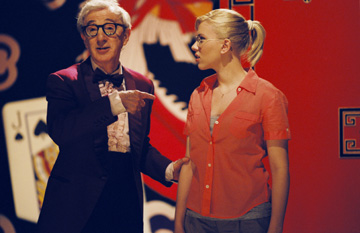
It's sadly appropriate that Woody Allen's latest comedy concerns ghosts. In Scoop, the writer/director has become a ghost of his former self. Many of the signposts of Woody's classic films pop up in this forgettable, joke-free comedy, but they're like dim apparitions, present in a twisted version of themselves for a brief moment before fluttering away into the ether.

I know he's prolific by nature, but it seems strange that Allen would bother to make a film each year unless inspired by some great new idea or passionate artistic urge. Scoop evidences neither. It feels like penance, like Allen giving himself over to the immediate task of throwing a film together even though he, personally, could care less whether or not it's capable of actually providing any laughter or entertainment value. Could filmmaking have, at this point in his long and storied career, become a compulsion for Woody? Is he incapable of taking a break and recharging, giving himself time, perhaps, to discover a new source of inspiration?

(Yeah, I know he's getting kind of old, but if this is the best he can turn out, better to just retire now...I say all this as a huge fan. But I think that even a short break between projects might help the guy come up with something more enjoyable than this blandifesto.)


Even Allen's performance betrays his lack of enthusiasm for the enterprise. In his first scene with co-star Scarlett Johansson, Allen looks down at the floor the entire time and flubs a few of his lines. Could that have possibly been the best take? Or was it the only usable one?

It's particularly disheartening to see such a pinched, awkward effort come right on the heels of Allen's best film in over a decade, Match Point (which also starred Scarlett Johansson, in a role better suited to her abilities). This new film shares much more in common with Allen's career-low, pre-Melinda and Melinda period that included such grim death marches as Small Time Crooks, The Curse of the Jade Scorpion, Hollywood Ending and his unwatchable nadir, Anything Else.

As in most of those films, Allen starts with a big, goofy 1930's-style comic premise. Sandra (Johansson), a plucky young journalism student vacationing in London, meets the ghost of a dead reporter (Ian McShane) during a magic show, who tells her the identity of the infamous Tarot Card Killer. With the help of the jittery, over-the-hill magician who first conjured the spirit (Allen), she must gather evidence against her suspect, wealthy heir Peter Lyman (Hugh Jackman). That is, unless she falls in love with him first.

It's extremely broad and kind of silly, but I see no reason why this premise could not have been turned into a servicable comedy. (Is not one of his career highlights, Sleeper, broad and silly?) But Allen stumbles at literally every step. Most fatally, he hasn't designed one single funny character. Not one.

Johansson and Jackman have zero chemistry (surprising when you consider that they played lovers in another film this year, The Prestige). In this case, it's because their characters are total duds with almost no personality. They're not interesting apart, so why would they make an interesting couple?

Sandra resembles a character Woody might have written for himself years ago; she's urbane, pessimistic and cynical yet somehow still enthusiastic about life. But rather than go over the top like Allen or one of his better stand-ins, Johansson underplays all of the hysterics, the theoretically "funny" moments. So they fall totally flat. Allen has cast her because of her physical attributes, getting her into her underwear or swimsuits whenever possible, but perhaps didn't pause to consider her ability with physical comedy.

Jackman fares even worse. He's saddled with a dilemma from the beginning - he must be likable and charming yet also a potential serial murderer - which he solves by making Peter a complete blank. Sandra seems to like him, but we sense it must be just because he's attractive and rich and has a nice collection of antique musical instruments. He fails to express a single interesting or original thought in 90 minutes. He's got kind of a Prince Charming complex, like a guy who has sat in a room for 30 years doing nothing but practicing his genteel romantic patter in case a young, beautiful woman ever comes by for him to respectfully woo.

For a guy who's used to working with large, talented ensembles, Allen hasn't given himself many funny co-stars with whom to play around. Johansson, though she's been overexposed and on a bad streak lately, can be good in films, but she's not all that funny. Jackman's not funny. The only other major character is undead reporter Joe Strombel, played by the delightful British actor Ian McShane.

McShane has kicked ass in movies and TV for 30 years (he's best known to Americans as the moustache-twirling wildman Al Swearengen on HBO's stellar "Deadwood"), but his character exists purely for the purposes of exposition. Allen needs Sandra to hear about Peter Lyman somehow, and the idea of her hearing it from a ghost is funny. But the ghost himself doesn't get to be funny.

So Joe shows up and explains the in brief little bursts and then disappears on cue. How did he get back to Earth from the afterlife? Where's he going when he vanishes? What does he care about getting a good story if he's dead and won't get any credit? At one point, he interjects randomly into a conversation that he's going to go away forever, and then he does and we never hear from him again. Even Poochie went out with more fanfare.

Joe's story opens the film in excellent, classic Woody Allen fashion, on the boat across the River Styx, escorted by the Grim Reaper. He has died of a heart attack but seems kind of nonplussed about the whole thing. He starts talking to a recently deceased woman, who tells him that she discovered the identity of the Tarot Card Killer and was then poisoned. What a scoop! If only Joe could somehow get this information to a live reporter, he'd be the first one in the world with the story!

At this point, I thought the film was going to be great. What's more Woody Allen-esque than opening a screwball comedy with a serial killer, a funeral and a boat trip through the Land of the Dead? I soon realized that this would be the only inspired sequence in the whole film. Counter-intuitively, despite his familiarity with death-focused comedy, Allen can't even muster any good one-liners for his ghosts.

A feeling of weary laziness just hangs over the proceedings from this point on. Sometimes, Allen sets himself up for a joke and then doesn't even take a swing. In one scene, his blue collar Brooklynite is led into a massive, opulent English garden, a slow underhand pitch to any Marx Brothers fan, let alone Woody Allen, and all he says is, "Wow, this is amazing." Wow, this is amazing? YOU'RE WOODY ALLEN! WHERE'S THE PUNCHLINE?

The Depression-era spirit of Scoop ought to bring out Allen's sharpest comic instincts. Those are the films that inspired him as a young person to write comedy. And it's not just the Preston Sturges reference points (mistaken identities, poor people sneaking into high society, last minute reversals) that suit Allen's sensibilities. He works in some classic vaudeville jokes into the magic routines. It's a wacky romantic comedy with an attractive female lead! It's not like this isn't familiar ground. Woody once was capable of writing really lively, intriguing female characters - women who weren't just refractions of his own nebbishy personality. Sandra's a pair of empty glasses.

[Okay, one more thing I'll mention, but this criticism reveals the ending of the movie, so don't read any more if you plan on renting Scoop next week.


Okay, so, in the end, we find out that Peter isn't really the Tarot Card Killer. However, he did pretend to be the Tarot Card Killer in order to get away with murdering a prostitute who had been threatening blackmail. Unfortunately, the chronology of events doesn't make sense. Joe Strombol becomes convinced, in the afterlife, of Peter's guilt before he murders the prostitute. So it's just a coincidence? Joe was wrong about Peter, but then accidentally turned out to be right because Peter later decided to murder a woman?

This may seem like a minor complaint but it totally derails the movie (as if it didn't already have enough problems). The whole thing is a mystery, albeit an uneventful one. How can it be that the final solution makes no sense and is based around a totally unbelievable, stupid coincidence? It means that Joe Strombol's not a good reporter, that the whole thing happened because of stupid blind luck. Not good, Woody...Not good.]

Wednesday, November 15, 2006

Secrets and Lies

We get a lot of strange, unfillable requests at the video store. Customers will read some random article about a movie or even provide a vague description of something they once saw on television and simply assume that we can obtain a brand-new, professionally mastered DVD copy within a few days. Perhaps the most hilarious example was the woman who thought we made the DVD's ourselves in the back of the store.

"That title's out of print," my co-worker explained. "There aren't any more copies."

"Well why can't you make some more?" the idiot customer replied, imagining, deep within the bowels of Laser Blazer, some fantastical device similar in design to a Bessemer Converter, in which entire movie reels are ground into easy-to-transport, high-quality DVD's.

Sometimes, people will hear an infomercial or radio ad for some self-help product and assume that we will necessarily carry such things. Most of the time, the fake guru behind these fraudulent lectures sells the products him or herself, the better to gouge gullible senior citizens without the hassle of going through a middle man.

Recently, a lot (a lot!) of people have been asking about a movie called The Secret. At first, I assumed it was some TV movie or whatever that came out on DVD that we simply forgot to pre-order. But I couldn't find any evidence of the thing's existence in our computer. It was only when a customer indicated that it might have a secondary title, something like The Art of Happiness that I grew suspicious.

It turns out, The Secret is a movie that proposes to teach viewers, over the course of 2 hours, the success technique employed by history's greatest geniuses and achievers. It's available on DVD, but only from this website, but you can also download it to your computer for the low low cost of $5.

The Secret has existed throughout the history of humankind. It has been discovered, coveted, suppressed, hidden, lost and recovered. It has been hunted down, stolen, and bought for vast sums of money. Now for the first time in history, The Secret is being revealed to the world over two breathtaking hours.

Look, people, here's a tip: If someone's offering to sell you history's greatest secret, an understanding so deep and penetrating that it has inspired centuries of searching and conflict, for $20 on a DVD...that person is a liar. Okay?

It takes all of 2 seconds on this website to figure out the obvious branding these charlatans are going for. All the graphics, the copy, the style of the entire enterprise smacks of The Da Vinci Code. They're clearly hoping the same fools who believed the dross in that book will accept this new quasi-historical fiction with the same blank, slack-jawed, unquestioning outlook.

A number of exceptional men and women discovered The Secret, and went on to become known as the greatest people who ever lived. Among them: Plato, Leonardo, Galileo, Napoleon, Hugo, Beethoven, Lincoln, Edison, Einstein and Carnegie, to name but a few.

Hey, where are the women? But besides that blatant discrepancy, doesn't this list sound totally made up? Like a compilation of Great Men of History that someone just threw together. I mean, what do these people even have in common aside from noteriety? Scientists, philosophers, musicians, physicists, businessmen, politicians, astronomers, novelists and generals? Any secret that could apply to all of them would have to be so vague and widely applied, it would be utterly meaningless.

Fragments of The Secret have been found in the oral traditions, in literature, in religions and philosophies throughout the centuries. For the first time, all the pieces of The Secret come together in an incredible revelation which will be life transforming for all who experience it.

Yowza. An incredible revelation which will be life transforming for all who experience it. Just like Kangaroo Jack!

They're really going for the hard sell here. Why do I feel like this copy was composed by Sheldon "The Machine" Levine? "We're offering life-transforming revelations this week, Dan. I'm trying to do you a favor!...Um, Grace, can you get me Socrates on Line 5 and two first-class tickets for myself and Charles Baudelaire to D.C. for next Tuesday?"

Some of today's greatest teachers will be presented in The Secret and will impart this special wisdom that has been known by so few. They include some of the world's leaders in the fields of business, economics, medicine, psychology, history, theology and science.

And by "business, economics, medicine, psychology, history, theology and sicnece," they mean, "a bunch of touchy-feely New Age bullshit." I mean, let's just take one of those claims...Theology? Who are the world's leaders in the field of theology and are they really on this DVD? Does Pope Joey Ratz make an appearance?

Included are; 'Miracle Man' Morris Goodman, who tells his awe inspiring story of how he recovered from paralysis by using The Secret.

This must be how Christopher Reeve walked around in those commercials! And you all thought it was just cheesy special effects...

Dr. Denis Waitley, who used various aspects of The Secret in training Olympic athletes and Apollo astronauts to reach new heights of human endeavour.

I'm surprised that Olympic athletes and Apollo astronauts share the same trainer. Doesn't seem like these two activities would have overlapping skill sets like that. For starters, it's probably unsafe to actually throw a javelin inside a lunar module. Those walls are made of, like, tin foil.

Doctors in the fields of medicine and quantum physics explain the science behind The Secret.


As you can see, the use of The Secret opens up a transdimensional portal, m-hai, in which high speed positrons collide with feel-good vibrations, creating a vortex of wealthonomy and happitude. Glavin!

Best selling authors and philosophers including Bob Proctor, John Assaraf, James Ray and Joe Vitale, explain how they have created lives of phenomenal success utilising The Secret.

To the Google!

Bob Proctor is another bogus self-help guru who runs an outfit called LifeSuccess Productions LLC. Hey, if these guys have the secret to eternal happiness, how come they have to spend so much time hawking merchandise on poorly-designed websites?

Anyway, this creepy Proctor asshole has written a book called "You Were Born Rich." His website declares on a garish blue masthead - "If you can tell me what you want, I can show you how to get it." Bob, I want you to go the fuck away and stop cheating sad, desperate people out of their hard-earned money with your lame, unoriginal collection of useless platitudes and easy answers. Can you show me how to get what I want?

An author, perhaps, if you want to define the term loosely. But he's not exactly Schopenhauer.

John Assaraf runs a ridiculous company called OneCoach that...say it with me now...teaches the secret for getting what you want in the business world! The only guy who would call this idiot a philosopher is maybe David Brent. (Or, for you American fans, Michael Scott.)

James Ray wants to offer you "wealth in all areas of your life." That is, unless they're referring to the assasin who killed Martin Luther King. Becuase, say what you will about that guy, but he was ambitious and knew how to get things done. Here's a taste of this Ray character's heady philosophical writings...

Just like the harmony created by each unique and important instrument in an orchestra causes your emotions to soar (like an eagle rising on an invisible thermal), complete harmony in your life causes your level of happiness, wealth and success to soar.

That kind of sounds like it was written by Stephen Colbert. "Like a majestic eagle rising on an invisible thermal, this War on Terror's about the really take off!" Otherwise, though, this guy's definitely on the level of a Heidegger or, at the very least, John Stuart Mill.

Finally, poor poor Joe Vitale. I'm going to insist you all visit his personal website, which has thus far been the highlight of my day. (And it's getting pretty late.)

Besides being one of the five top marketing specialists in the world today, and the world’s first hypnotic writer, Joe is also a certified hypnotherapist, a certified metaphysical practitioner, a certified Chi Kung healer, and an ordained minister. He also holds a doctorate degree in Metaphysical Science and another doctorate degree in Marketing.

Oh, well, a certified metaphysical practicioner. I had imagined he was the rogue loner of the metaphysical practicioner game, practicioning on his own out there with no licence.

And what the fuck is a hypnotic writer? Does he write while hypnotized? Is he writing prose that will actually hypnotize the viewer? Is it just an entire book saying "You are getting sleepy...your eyelids are getting heavy...look at this picture of a stopwatch and imagine I'm waving it in front of your face...everything's getting dark..."

Seriously, I love that paragraph. I'm going to make it my description in my Blogger profile. It fucking rules. I'd say it's probably the most hilarious resume I've ever seen. I wanna be a certified Chi Kung healer!

Anyway, four testimonials, four egregious lying phonies. I thought this was some great secret! How come they can only get hucksters to appear in their video discussing its intricacies and details? Were Stephen Hawking and Thomas Pynchon unavailable during the week they "borrowed" that camera from Best Buy? You know, before they had to return it to get their money back?

Tonight, a guy came into the store looking for The Secret, and after I told him we didn't carry that title, he actually told me the secret. (He claimed to want the film only to see how the filmmakers are reapplying a very old technique called "visualization.") All of these guys in the film are pitching the same line, which is pretty much a variation on "the power of positive thinking."

As in any kind of visualization exercize, they tell you to imagine the thing you most want in the world all the time as a way of actually achieving that goal. It's the same idea behind the sports psychologist telling his patient to imagine the ball going through the hoop or into the cup. First you see it in your mind, then you reproduce that action in reality.

I don't doubt that this could work on some level, becuase it's built on one of the most simple and logical principles in all of Communication. Humans can detect confidence, even on a subconscious level. Someone's facial expressions, body language, tone of voice and mannerisms communicate as much, if not more, than what they actually say. So if we make an effort to project confidence, people pick up on that and assume we know what we're talking about. Thus, imagining that you are successful will cause people to treat you with respect, which will in turn cause you to become successful.

A-duh. Most clever, alpha-dog individuals figure this out on their own by junior high school. If you talk to girls like a frightened little supplicating puppy dog who desperately wants their companionship, they will not take you seriously. But if you act aloof like you don't care what they think, they won't be able to resist blowing you underneath the stairs in the back of the gymnasium during the Holiday Dance.

(I only figured this out a few weeks ago, but it occurs to most guys much earlier.)

The Secret adds one additional level. You don't just visualize the thing that you want, you actively force yourself to believe that this thing has already happened, much in the way a devout Christian forces him or herself to believe that a man turned water into wine and came back from the dead.

Yeah, it's insane. (At least Christianity has several thousand years of tradition and history.) They encourage you to become delusional, pretending to achieve things that you have not achieved. I think Jon Lovitz used to teach this same technique on "Saturday Night Live."

And the proof they offer for their program's success, before you shell out $20? A few douchetards who have become rich teaching other people about the program. This is like when fundies try to prove stuff in The Bible by quoting from The Bible.

What about all the people who try The Secret and then don't become rich and famous hawking The Secret? They're just walking around with a strong belief that they're millionaire playboys. They're still just braindead slobs! You've now done these people a significant disservice. Before, they were just miserable losers. But now they're miserable losers in an advanced stage of denial.
Well done, Joe "Mr. Fire" Vitale! By the way, that's a stupid nickname! And you look like a doofus! And your poorly-written and unconvincing personal website makes me doubt your abilities as a self-proclaimed marketing genius!

Tuesday, November 14, 2006

Accepted

Every comedy set in the world of college must, by law, rip off certain scenes from Animal House. So I don't fault Accepted for having a generally not funny and tedious final 20 minutes in which the main characters must defend their wacky, sophomoric hijinks in front of a deeply serious panel of crusty old Ivory Tower elitists. It's the law, after all.

I still say someone needs to come blow the lid off the campus comedy genre. There are some hilarious comedies of this style - Old School, Back to School, even PCU - but they're all so stale and predictable at this point, so obviously trying for that old Bluto Blutarsky magic. Accepted is a worthwhile addition to the format, notable because there are so few mainstream comedies coming out of studios that actually work in any way, shape or form. If I could afford higher standards, I'd probably dismiss the film as fluff, but I'll take what I can get.


Here's something that kind of pisses me off. I'm trying to write big, broad, mainstream comedy scripts not unlike Accepted. But when I turn in a script, every little detail has to be figured out. No logical inconsistancies are ever permitted. In my last script before the one I'm currently engaged in revising, I had a car trip from West Hollywood to Manhattan Beach take about 20 minutes. I was told it would be more like 45 and that this would never fly. I also had a character agree to a rather bizarre living situation in order to kickstart my plot and was similarly told that this was way too outlandish and needed to be better explained.

Yet here we have a movie that's not only totally ludicrous from minute one, but blatantly inconsistant. Bartleby Gaines (Justin Long) is presented as kind of a Ferris Bueller figure. An expert liar and a quick thinker, he seems to have high school pretty much all figured out. That doesn't include, unfortunately, the college admissions process. So while his best friend Schrader (Jonah Hill) eagerly awaits his arrival at Harmon College, Bartleby must figure out a way to avoid his father's disappointed wrath.

The whole first act is sloppy. Bartleby's not only smart but clever. If he really didn't get in to any schools, we sense he'd still figure out a way to make it on his own for a semester before applying again. And what kind of parents totally ignore the issue of college until their child graduates high school, then randomly remember to ask what school he or she will be attending one night over dinner?

Anyway, that's just my personal beef about having to write scripts on spec, which is much more exacting in this way than just being well-known and connected already and churning something out. The point is, despite these logistical flaws, Accepted actually works pretty well. It's funny in kind of a sly way. Focusing on character-based comedy and witty dialogue rather than outrageous schtick, impressions, pop culture references or farce means that Steve Pink's directorial debut doesn't come off as desperate for laughs like a lot of other recent comedies.

There are some dopey jokes, sure, but not a lot of really obvious, easy ones. (This may be the first college comedy ever without a single beer joke.)

Bartleby's plan, which involves renting out a mental hospital and revamping it as a de facto college, probably wouldn't work, but Adam Cooper, Bill College and Mark Perez's script makes it just plausible enough to get through 85 minutes. The South Harmon Institute of Technology (S.H.I.T.) starts out as an excuse to get out of the house and play PlayStation, but turns into a community of charming rejects who unite to...well, get out of the house, play PlayStation and skateboard. Oh, and check out hot girls in bikinis.

What I really liked about the set-up was that it gave the characters money to fool around with. (Because students show up at their fictional school with tuition checks, they can actually afford to renovate the building and buy lots of video games and pool toys.) It makes the payoff in the second half much more satisfyting. These kids had a million dollars to play around with. They could have just blown it like everyone expects, but instead they use it try and learn something and better themselves. That's actually kind of an uplifting message for a teen comedy.

Another master stroke was casting Lewis Black as the school's nominal "dean," an ex-academic with a fiery temper and an expertly-tuned bullshit detector. Black's monologues and rants, most of which would have fit in perfectly on "The Daily Show," are some of the highlights of the film.

Finally, the script cleverly cuts back and forth between Bartleby's impromptu experiment in education and his friend Schrader's humiliation at the hands of Harmon's most villainous fratboys. Evil preppy frat boys are the villains in pretty much every college comedy and the ones here in Accepted are totally anonymous and generic. But Hill's a pretty talented comic presence (he'll be seen next in the 40 Year Old Virgin follow-up Knocked Up) and he milks these scenes for all they are worth. (He's the guy in the hot dog suit in the commercial instructing you to question him about his weiner.)

I liked Accepted way more than I expected. It's an above average comedy than never quite rises to the level of hilarity. I doubt I'd ever watch it again, but hey, it kicks the ass of Nacho Libre up and down the block.

The Double Life of Veronique

Each shot, each image, of Krzysztof Kieslowski's 1991 masterpiece The Double Life of Veronique has some deeper significance. His films are so dense with symbols, motifs and subtle threads, you sense this must reflect the way the man actually saw the world - not a random, senseless collision of moving parts, but an elegant and synchronous universe of interconnectivity. In everyday life, we're unable to detect the hand of fate shuttling us all around, so Kieslowski attempts to slow time down in his films, to demonstrate how "coincidence" is really just a convenient euphamism for fate.

The Double Life of Veronique opens with an inverted image. As a young girl, the main character(s) look(s) on a city from upside-down. We see a reverse cityscape, dimly-lit buildings floating above a blue night sky. The film to follow presents an equally capsized perspective, only metaphysical instead of geographical. Everything is recognizable - the people with their jobs and their commutes and their private hopes and dreams, the bustling streets of post-Cold War Paris and Warsaw playing themselves - just as a night sky is still recognizable upside-down. The ingredients are all present but their sense, their order, has been violated.

Kieslowski uses this set-up to provoke. Is the identity crisis at the center of The Double Life of Veronique truly impossible? How could you prove or disprove an unspoken emotional and spiritual bond between strangers? (You couldn't, because the moment the two became aware of one another's existence, they would cease to be strangers.)

Kieslowski presents us with a barrage of surreal-yet-theoretically-possible circumstances, strange events that we all know can and do actually occur, from unlikely coincidences to low-grade extra-sensory perception to the uncanny realism of a well-executed puppet show. He then challenges us with the far-reaching implications. If one logic-defying event is possible, couldn't all of our ideas about what is "reasonable" and what is "irrational" be wrong?

The purposefully vague final sequence in the European cut of the film shows Veronique driving up to a tree while her father works in a woodshop nearby. She moves down her window and touches the tree and her father looks up from his project at the same moment. His tools and equipment are loud so he couldn't have heard his daughter outside, yet he sensed her presence. These sorts of peculiarities do exist, even if we don't fully understand the how's and the why's. So if it's possible for a father to sense his daughter nearby, couldn't two people in different nations who have never met still be somehow connected in a way that defies human understanding?


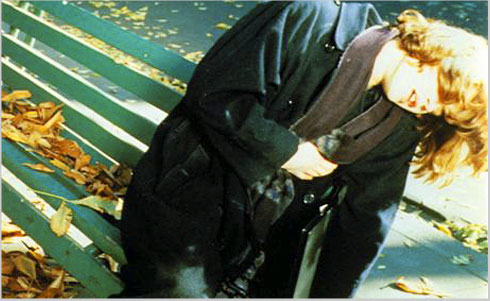
Gorgeous French actress Irene Jacob opens the film as Weronika, an adventurous and child-like Polish girl auditioning for a position singing in a prestigious Warsaw company. Much of Weronika's brief story focuses on her sensory experience of the world. She delights in holding and bouncing a small rubber ball and in pressing her forehead against a glass window on a chilly day. When her chronic heart troubles act up, she lashes about in a public park, knocking leaves off of benches and short walls. When her life comes to an abrupt halt during a virtuoso choral performance, we feel the thud of her head knocking against the wooden floorboards. Whenever possible, Kieslowski gives the audience insight into Weronika's tactile experience, whether it's dust blowing in her face or the warmth of a glint of sunlight creeping around half-closed blinds.

When Weronika dies, Veronique, a music teacher and singer living hundreds of miles away, gets a strange feeling of loneliness and isolation. It's as if someone close to her had died. Does Kieslowski want to emphasize Weronika's perceptions so that he can then show them transferred into Veronique? Or perhaps he's demonstrating that Weronika is a real person, not a dream or creation of Veronique, but a genuine doppelganger whose fleshy existence offers a challenge to our logic. These two girls never met (though they once came close) and know nothing of one another, yet they are somehow sharing a union of not only soul but body.

Over the next few scenes, Kieslowski will reveal literally dozens of connections between these two women (boht, naturally, played by Jacob). They both lost their mothers at an early age. They both suffer from heart disease. They were born of the same day. They have great musical ability. (One of the most significant connections between the two women is the piece of music Weronika sings on the night of her death. Veronqiue begins teaching it to her pupils soon after.)

But beyond these superficial coincidences, and the fact that specific objects owned by one girl occasionally pass to the other, Weronika and Veronique are tied together by something more. Obviously, they are discussed in tandem because Kieslowski has chosen to make a film about them. But more importantly, the women seem to share inner lives. They both have boyfriends but seek out something more fulfilling than the men in their lives can provide. Specific actions occur to both of them, like watching an old woman cross the street or fidgeting with a ring.

Again, Kieslowski seems to offer something of a rhetorical challenge. It's arguable that there's nothing terrifically unique about Weronika and Veronique. You could probably scrutinize dozens of women throughout Poland and France and find some of the same age who look alike and have similar aspirations, backgrounds and personalities, even names with the same root or origin. Factor in the science of psychology and our understanding of things like archetypes and we begin to understand how much "strangers" can have in common. (Of course, cinema itself is predicated upon common, shared reactions. Filmmakers can reliably make us excited or scared or sad because we all occupy similar emotional planes.) So if we can agree that strangers would have so much in common, why is it so outrageous to make the leap that these connections are more than simplistic and coincidental?

The two girls are not identical. Weronika is more outgoing and bubbly than Veronique, while Veronique seems to have more money and is generally more urban and sophisticated. Impressively, Jacob turns in two unique and individual performances even though she's playing two identical women. Without altering her physical appearance at all, she accurately conveys the shift between Weronika and Veronique. Each woman has a love scene and the differences in body language are immediately noticeable, with Weronika's playfulness directly opposing the colder and more reserved Veronique's.

Kieslowski highlights this notion throughout the film, using backwards and upside-down imagery as well as lots of shots with mirrors and reflective glass. Weronika and Veronique are not the same person, but two people having similar experiences. (An intriguing quesiton is whether Veronique would have suffered the same fate as her twin had she not given up singing.) It's a testament to Kieslowski's originality and inclusive nature. He didn't make a typical psychological thriller about divisions within the mind of the main character and he didn't make a romantic thriller about conflicts within an interpersonal relationship. This is not the story that happens to one or two people. In filming a thriller about individuals who never meet, Kieslowski encompasses not a few individual and idiosyncratic characters but the sum total of humanity.

There's far too much going on in this film to discuss in a blog entry. Long-form papers could (and, I'm sure, have) been written on the subject. At this point, I've seen most of Kieslowski's films and this remains one of my absolute favorites, something of a distillation of some of the guy's more prominant themes and ideas. Though not as overwhelming as experience as the Decalogue or the Three Colors trilogy (though it's close), this may be the best entryway into the guy's sensual and mysterious artistry.

Saturday, November 11, 2006

Village of the Slammed

I'm not saying that I doubt the veracity of the Daily Mail's reporting in this article, but it's still hard to believe some of the accusations being made here against Sacha Baron Cohen and the crew of Borat.

When Sacha Baron Cohen wanted a village to represent the impoverished Kazakh home of his character Borat, he found the perfect place in Glod: a remote mountain outpost with no sewerage or running water and where locals eke out meagre livings peddling scrap iron or working patches of land.

But now the villagers of this tiny, close-knit community have angrily accused the comedian of exploiting them, after discovering his new blockbuster film portrays them as a backward group of rapists, abortionists and prostitutes, who happily engage in casual incest.

Unbelievably, it turns out that the Kazakhstan-set sequences that open Borat were actually filmed in the impoverished Romanian village of Glod. (Actual translation of the word "glod": Mud). If you read the entire article, it also claims that the town is mainly inhabited by Borat's hated gypsies, who thought a documentary was being made about their grinding poverty.

They claim film-makers lied to them about the true nature of the project, which they believed would be a documentary about their hardship, rather than a comedy mocking their poverty and isolation.

Villagers say they were paid just £3 each for this humiliation, for a film that took around £27million at the worldwide box office in its first week of release.

Now they are planning to scrape together whatever modest sums they can muster to sue Baron Cohen and fellow film-makers, claiming they never gave their consent to be so cruelly misrepresented.

Disabled Nicu Tudorache said: This is disgusting. They conned us into doing all these things and never told us anything about what was going on. They made us look like primitives, like uncivilised savages. Now they,re making millions but have only paid us 15 lei [around £3].

I just assumed that these scripted sequences were created on a Hollywood set. Seriously, I had no idea any of that stuff was real. I'm a big fan of Borat, and I understand that the whole concept is an elaborate prank, but playing a prank on isolated and desperate Romanian villagers and failing to even pay them fairly for their inconvenience and effort doesn't strike me as particularly funny.

I don't feel bad for those drunken frat boy assholes who are suing Borat because now we all know what racist, chauvanist, arrogant assholes they are. I think those USC students learned a valuable life lesson from Borat - being a sloppy drunk who says ignorant, racist shit all the time will eventually get you into trouble.

Those guys really have no excuse for their behavior and deserve our collective scorn. But systematically oppressed peasants hoping for a few scraps in exchange for some extra work on a film project? Are those really Cohen's intended targets?

The crew was led by a man villagers describe as 'nice and friendly, if a bit weird and ugly', who they later learned was Baron Cohen. It is thought the producers chose the region because locals more closely resembled his comic creation than genuine Kazakhs.

The comedian insisted on travelling everywhere with bulky bodyguards, because, as one local said: 'He seemed to think there were crooks among us.'

While the rest of the crew based themselves in the motel, Baron Cohen stayed in a hotel in Sinaia, a nearby ski resort a world away from Glod's grinding poverty. He would come to the village every morning to do 'weird things', such as bringing animals inside the run-down homes, or have the village children filmed holding weapons.

Mr Tudorache, a deeply religious grandfather who lost his arm in an accident, was one of those who feels most humiliated. For one scene, a rubber sex toy in the shape of a fist was attached to the stump of his missing arm - but he had no idea what it was.

Only when The Mail on Sunday visited him did he find out. He said he was ashamed, confessing that he only agreed to be filmed because he hoped to top up his £70-a-month salary - although in the end he was paid just £3.

That's pretty indefensible behavior, regardless of the hilarity of the finished product. I don't think the Borat skits from HBO's "Da Ali G Show" are offensive in any way. He's not mocking people from Kazakhstan, he's mocking ignorant Americans who have never even heard of that place and who so readily accept such a backwards, stereotypically "foreign" man.

The movie pushes that line a bit further - in many cases, we are simply laughing at Kazakhs. Borat washes his face in the toilet, for example, with no witnesses around save the camera. Cohen is no longer playing around with American attitudes towards people from far-flung parts of the world, he is simply playing a character for our amusement. I still found the movie acceptable. Borat is lovable and charming and part of his personality is being disgusting or violating taboos.

But to later find out that we may be laughing at the real villagers who in some ways inspired Borat so directly, as in bringing animals inside their house to defecate and then filming it to give others a chuckle, that crosses the line. Again, if these reports are accurate, and I have no way of knowing if they are.

I'd like to stress that this next excerpt is from a news article, not a Borat sketch.

Bogdan Moncea of Castel Film, the Bucharest-based production company that helped the filming in Romania, said the crew donated computers and TV sets to the local school and the villagers. But the locals have denied this.

Mr Staicu said: 'The school got some notebooks, but that was it. People are angry now, they feel cheated.'

It's a feeling Glod is used to. The village, like others in the Dambovita region of Romania, is populated mainly by gipsies who say they are discriminated against by the rest of the country.

Indeed, when local vice-mayor Petre Buzea was asked whether the people felt offended by Baron Cohen's film, he replied: 'They got paid so I am sure they are happy. These gipsies will even kill their own father for money.'


No one from the 20th Century Fox studio was available for comment on the villagers' claims.

You've got to love Dambovita vice-mayor Petre Buzea. Way to keep that Old World prejudice alive.

Anyway, it's unclear to me simply from this article what really happened. Perhaps Cohen's team came to the town and offered to give them lots of fabulous gifts and prizes and money in exhcange for help with the scenes, and now they just want more stuff or didn't get as much as they had wanted, so they're making a stink about it. I could definitely see that happening.

On the other hand, if these stories are true, and Cohen's team basically exploited this town and these people for the purposes of hilarity...well, nothing would happen. Americans don't care about that sort of crap, and they apparently love them some Borat, so who cares, right? Still, it would be a real shame.

Friday, November 10, 2006

Pan's Labyrinth

Before tonight's AFI sneak preview of Pan's Labyrinth, writer/director Guillermo del Toro gave a brief introductory speech. He described the film as a fairy tale for adults, a parable designed to teach a moral lesson about following one's own heart and refusing to conform. It's a fairly accurate description, and one that captures the film's successes and flaws succinctly. Like a good fairy tale, Pan's Labyrinth is fanciful and imaginitive, told using unpredictable dream logic. But as you'd expect from a movie derived from these kinds of simple, old-fashioned and familiar stories, it's also broad and overly simplistic, relying on stock characters and convenient gimmicry to move ahead a plot that's largely perfunctory.

The tremendous worldwide success of Del Toro's previous two Spanish-language genre films, Cronos and The Devil's Backbone, has made Pan's Labyrinth one of the year's most hotly anticipated movies by film fans. It has already been chosen as Mexico's submission for Best Foreign Language Film and won raves at Cannes and the New York Film Festival. As a longtime fan of Del Toro's (particularly the aforementioned Spanish-language horror films), it gives me no pleasure to say that I found the film a significant disappointment. It feels more like the work of the ambitious and well-intentioned, but occasionally clumsy, Hollywood director behind Hellboy and Mimic than a genuine follow-up to The Devil's Backbone, one of the best horror films of the present decade.


As in Cronos and The Devil's Backbone, two parallel stories - one realistic and one supernatural - unfold in Pan's Labyrinth simultneously. Ofelia (Ivana Baquero) moves to a country house in Northern Spain in the immediate aftermath of the Spanish Civil War. Her father died in the conflict, forcing her widowed and pregnant mother (Ariadna Gil) to remarry. Her vile new husband (Sergi Lopez, the terrific heavy from Dirty Pretty Things) leads a company of Spanish Fascist soldiers, stationed in the area to decimate a local underground resistance movement hiding in the local forest. Ofelia, terrified and alone in her new home, befriends a maid (Maribel Verdu, of Y Tu Mama Tambien) and a friendly doctor (Alex Angulo) who harbor a dangerous secret.

While this tragic story of bloody combat, torture and intrigue takes up the bulk of the film's midsection, most of the attention the film has received thus far focuses on Ofelia's possibly imaginary adventures with a magical faun (Doug Jones) who also lives in the apparently enchanted woods. The faun tells the storybook-obsessed and troubled little girl that she is actually descended from the King of the Underworld, who will happily allow her to return to her throne if she can complete three increasingly dangerous tasks.

All of this sounds complicated, and for a while Del Toro seems to be building a complex and extended historical metaphor as he did in Devil's Backbone, which was also set during the Spanish Civil War.

But there just isn't nearly as much going on under the surface here. Del Toro has a fairly straight-forward message to convey. An ode to nonconformity, Pan's Labyrinth uses the Spanish Fascist movement to represent the forces in everyone's lives that try to make them fit a pre-selected mold. It's not a very difficult fit, and it becomes obvious fairly soon what Del Toro clearly has it mind. (After an early scene in which Ofelia's mother urges her to put down her storybooks and adopt a more realistic worldview gives away pretty much the entire film's perspective in one two-minute exchange).

Beyond this rather vacuous central motif, the movie just kind of plods along on its two occasionally interesting narratives. The fantasy segments, in which Ofelia battles a ferocious toad, challenges a mutant at a fancy underground buffet and eventually faces a near-impossible choice, at least have an interesting look and rely on well-realized special effects. (That scene with the mutant, a grotesque humanoid being with no face and hands in its palms, is by far the film's most memorably surreal and visionary.)

There isn't a lot of internal logic to the fantasy universe of Pan's Labyrinth. Generic fairy tale tropes like intricate lockboxes, golden keys and, well, fairies add up into a story that approximates the familiar formula but fails to capture what makes these stories worthwhile or interesting. It's strange, as well, how the individual quests don't really link up all that well or have any individual reason for being. (Ofelia battles the toad to obtain a key to obtain a knife that winds up being used to teach her an elaborate lesson about self-sacrifice.) There's not a lot of sense to the proceedings. They're imaginative, sure, but kind of meaningless.


The realistic story about the fascists fighting the resistance doesn't fare much better. Lopez is always a great choice for a scene-stealing movie villain, but as with most of the other characters, his Captain Vidal is more a type than a character. Those black leather gloves say more about Vidal than anything Lopez says or does in the role. He's probably still the most dynamic character in the film, but aside from a nice little subplot about his father's old war watch, Vidal is the definition of one note - he's pure malice, embodied.

He's so cruel, in fact, that his story becomes repetitive quickly. One of his soldiers disobeys him and gets shot. Some innocent farmers are suspected of aiding the resistance so they are shot. He suspects someone working for him of being a spy for the other side and threatens to have them shot. He tells the doctor that, if presented with the choice between his baby's life and that of his wife, he should save the baby. He can always have it shot later, I suppose.

These sequences are extremely bloody, more gruesome and focused on violence than was really necessary. I'm not a person who's offended by violent movies, but Pan's Labyrinth gets to feel gratuitous after a while. (A late scene features a character sewing up his own wound for no reason other than the fetishization of pain.) Before the film, Del Toro referred to the movie as an adult fairy tale, but I assumed he meant that it dealt with complex issues in a mature and frank fashion, not that it was super-gory. The final 30 minutes of this film has more torture scenes than the dailies for Hostel 2.

It does give the movie an unsettling, dark feeling of atmosphere, aided by Guillermo Navarro's able cinematography. But for all their wrenching melodrama, these scenes don't add up to all that much because the characters are too thin and broadly sketched. The subtlety of The Devil's Backbone, in which the backstory gradually becomes illuminated over the course of an intriguing investigation carried out by plucky orphans, has been replaced by cartoonish exaggerations lifted from old WWII movies. Del Toro was aiming for Army of Shadows meets Wizard of Oz but ended up with The Keep meets Return to Oz.

(Actually, there are numerous parallels with Michael Mann's non-classic The Keep, in which Gabriel Byrne plays a sadistic fascist overseeing a camp being haunted by a Golem. The fact that I could draw comparisons between Del Toro's film and Michael Mann's cheesy cautionary tale pretty much demonstrates my point about this new movie without even saying anything further.)

I'm disappointed.

As with numerous other recent movies I've seen by talented, established directors (Babel, Tideland, The Prestige), Pan's Labyrinth did not live up to my lofty expectations. The fact that it took Guillermo del Toro 2.5 years to make is even more disheartening. But I suppose there's always Hellboy 2.

I'd Like To See You Make a Better Movie

I get that comment a lot on my movie review posts.

"Yeah, you make some valid points about Gunga Din, but I'd like to see you make a better movie!"

This argument is inherently juvenile. To me, it suggests a complete absence of genuine insight, a desire to argue without anything to actually argue about. You find that a lot on the Internet...angry people who want to pick fights, often about subjects they don't fully comprehend or even care about.

My gut instinct is that people walk around with a lot of suppressed anger and frustration at the world, and don't feel comfortable taking it out on other people in real-world, one-on-one settings. So you get phenomenon like road rage, in which people can act out their wrath on invisible, faceless strangers, and Internet flame wars, in which people can voice their distaste for everyone who isn't them by peppering blogs with bilious, anonymous commentaries.

These are generally just insecure assholes. You can tell by their writing style and taste for crude put-downs. (Any time someone I don't even know who isn't British calls me a "cunt" or some variation thereof, I know I can pretty much discount all of their other opinions.) Still, it's odd that film reviews seem to set off the angry folks much more than, say, political commentaries or personal anecdotes.

I don't want to sound like a whiner. I can take the abuse, really...I'm not so insecure that a few nasty comments on my blog are going to send me into fits of self-doubt and depression. In fact, I kind of wish there was a bit more spirited debate around here, film-related or otherwise. Anyone reading the blog is more than welcome to take issue with one of my points. But is it too much to ask that they actually, well, have a comment to make rather than just a strong desire to ridicule someone else for daring to express an opinion?

Take my review of Lucky Number Slevin. I did not like the film and the ensuing review was harsh. I figure, what's the point of reviewing movies for free on my blog if I'm not being totally honest? The filmmakers themselves don't read this blog, so I'm not in danger of hurting anyone's feelings (and a thick skin should be a requirement for people working in creative fields anyway). Wouldn't you, the readers, prefer to hear what I really think about movies, rather than softened reviews in which I hedge my bets? I'm seriously asking readers of this blog...which would you prefer:

(1) Lucky Number Slevin clearly took a lot of time and effort to produce and much of the production is carried off with an average to above average level of professionalism and ability. I have never personally made a film, and if I did, there is a strong chance that certain aspects of it would be more amateurish and less accomplished than Lucky Number Slevin. Having said that, the movie was not perfectly suited to my tastes, and I found some of its later developments disappointing and wrong-headed.

Or this, from my actual review:

(2) Anyway, this one's pretty much a disaster from beginning to end. One of those movies that obviously just didn't click, but because everyone had already cashed those advance checks, the project just developed its own momentum. Better luck next time, McGuigan. Only, maybe forget about the Hartnett collaborations next time. He's just not up to it.

Now, it's not very nice. I'm kind of being a wiseass, and I certainly wouldn't speak like that to Paul McGuigan in person. (I'd like to ad here that I rather like his breakthrough film, Gangster #1.) But it's how I felt about the movie. Nowhere in the review do I imply that, if you feel differently, you are stupid. I guess I could run a disclaimer above every review, letting you know that it's just my opinion and that I'm not setting these posts forth as an objective arbiter of all cinematic taste. But of course it's my opinion...It's my fucking blog! Who's opinion on film would you expect to read here, Andre Breton's?

Here's an actual two-part comment left at the bottom of that review:

Bro, seriously, what movie's do you like if you didn't like this movie? I know everyone's entitled to their own opinions and all, but you have problems if you didn't like this one. I seriously had to stop reading your blog because of my emotions of hate for you drilling through me. You've done a huge injustice to the people of the world who haven't seen the movie yet and are not going to because of your shitty blog. It's an entertaining movie man! Sit back, grab a drink and enjoy it, dont analyze and critique every word spoken and every step taken. "Strange, yes. Hard to believe, sure." Do you listen to yourself? It's a movie... movies take you away from reality for a while. I suppose you didn't like "Minority Report" because since when do people get around retinal scans by having eye transplants?! Who ever heard of that garbage?! Get your face out of the books man, your broadcasting to the world with this blog that you were the kid in highschool that got his underwear pulled over his head, stuffed in a locker and dunked in a toilet on a regular basis. I hate you.

And another thing cuntbag, nobody cares about your movie opinions, who your favorite directors are and other uninteresting stuff that apparently gets you off. Your blog is boring and I hate the fact that one of your lame posts caused me to look around it just to see how much of a dick you really are. It's no wonder that Roman Polanski rates high on your list of favorite directors, because you both probably have child molestation in common. I know your type, you're either a lame film student that graduated, with no direction whatsoever that gets mad when other people put out good movies, or a college film professor, also, who went nowhere in life and had to turn to a life of blogging his uninteresting movie opinions to people hoping that he can find some followers of his own. If you could do better, do it then, dick.

First off, I hate being called "bro," both in real life and on the Internets. I have only one bro, and he never ever refers to me as such, and I prefer it that way.

I'd like to stress that this comment is atypical only in its length. Most of the comments left here consist one or two sentences. But because this guy (and I'm assuming thsis the work of a male, probably an adolescent one) goes on for a while, we can extrapolate a lot of Universal Mean-Spirited Blog Comment tropes from this one example.

BLATANT CONTRADICTION

Anonymous can't really get through two sentences without contradicting himself. My opinions are not interesting, yet he has clearly read several entries on my blog. (He knows, for example, that Roman Polanski was on my Top 10 Directors list.) It's lame to spout off about movies on the Internet, yet here he is, spouting off about movies on someone else's website without providing even a pseudonym. No one cares what I think, and yet I should be encouraged to make my own films as a response to Lucky Number Slevin!

Blatant contradiction is perhaps the most comment anonymous comment attribute. It happens so often in comments, I tend to think a lot of them are left as pranks by friends of mine. Check out this comment, left a few days ago on my review of Joss Whedon's Firefly.

mommy not give you enough hugs when you were growing up? So much anger and bitterness. It's a movie, get over yourself. I loved firefly, serenity was a let down but at the end of the day I am not bothered about it. I have a life and I love cinema, some of its fantastic Old Boy and million dollar baby, some of its just there serenity, sixth sense (oh the guy's DEAD, didn't see that coming) and some of it is used toilet paper. (fast and furious, starship troopers) BUT somebody somewhere loves it and it speaks to them or they wouldn't be able to sell all those tickets and DVDs now, would they? One mans meat..yada yada

Okay, so put aside the ludicrous idea that my disliking a movie this idiot liked translates to me "not having a life." Can you spot the blatant contradiction?

Giving my opinion about Serenity reflects my anger and bitterness. I don't understand that it's just a movie, and that writing down what I think about said movie makes me a loser who can't get over myself.

Yet two sentences later, this fool starts rattling off his own opinions about movies! (Including the woefully inaccurate assertion that Starship Troopers is akin to "used toilet paper.") That's got to be a parody of a troll, right? That can't be a real comment. No one's that stupid.

BULLYING RHETORIC

This sounds like someone who wishes to silence me. In fact, more than once, he instructs me to be quiet. "Sit back, grab a drink and enjoy it, dont analyze and critique every word spoken and every step taken." "You've done a huge injustice to the people of the world who haven't seen the movie yet and are not going to because of your shitty blog."

ATTEMPT TO CLASIFY ME BASED ON MY OPINIONS

The commentator insists that I must be a frustrated film professor based on my review. I think he means that as a put-down, but I wouldn't really mind a tenured position teaching film at a quality university. You get paid to watch lots of movies and write about them. It's what I do now, pretty much, but with benefits and a nicer apartment. Isn't it complementary to read someone's writing about film and conclude that they must be a Ph.D. in the subject?

So that's actually kind of a nice one, but usually peopel conclude that I must be some kind of basement-dwelling mouthbreather because I have a film-centered blog. I won't lie to you...In many, many ways, I fit the film nerd stereotype to a T.

I work in a video store. I am overweight. I am kind of a slob. I don't go on a ton of dates. Sometimes, late at night, when no one's around, I will watch cartoons in my underwear while drinking Mountain Dew. I can quote entire Monty Python routines and whole scenes from This is Spinal Tap and I know the theme song from "Duck Tales" by heart, still, to this day. I have paid to see Tenacious D and The Kids in the Hall in concert.

But even if a well-placed anonymous zinger confirmed to the entire universe my dork credentials, how does this discount my opinions about a movie, exactly? Being somewhat easily categorized someone makes my observations about the world less salient? It's not that it's mean, necessarily. It's dehumanizing. I have no life, meaning I am worthless, meaning my opinion matters less than those of other people.

I swear, I'm building to a point here. It's not supposed to be a pity thing. What I'm saying is that I think all these angry anonymous comments seem so similar because they all come from the same place. It's oversimplifying to say that individual, unrelated frustrations cause so many people to come here and rant at me without even trying to make an actual point or raise a counterargument.

These people want me to be quiet because any contrary opinion causes them to question their own position, and thus cannot be tolerated. On one level, people just don't like to have their conclusions dismissed, both out of pride and fear of humiliation. If I've told 10 people that Lucky Number Slevin is great, and then I read online some guy ripping it apart, it raises the possibility that others will think it's terrible as well, thus causing them to question my judgement and taste.

But on another level, reading an thorough takedown of a movie he or she enjoyed makes some individuals (generally the weak-minded) feel inherently threatened. I am not questioning Paul McGuigan's filmmaking but the judgement of my readers. And how have Americans been trained to deal with threats? Violence, or if this option is not available, intimidation.

Hence, the contradictory and nonsensical arguments, always delivered with maximum dehumanizing language intended to humiliate and ostracize. These Anonymous Commenters wish to bully me, wish to prove their superiorty over me because I raised doubts about their cognitive abilities.

I'd like to stress that I think all of this works independantly of my reviews. I word my opinions strongly, which obviously triggers a defensive response in some people, but I'm not trying to say that I'm always right and my angry readers always wrong. I mean, lots of people seem to like Lucky Number Slevin. Perhaps you would as well. I think of my reviews as conversations about film, bringing up points of interest, more than I do as some kind of "guide" to what people should watch. Watch what you want.

I think any strongly-phrased reviews that differed from these folks' opinions would be challenged in this way. And of course, I think the phenomenon extends well beyond film reviews or blogging in general.

Conservatives treat politics and social issues this way. A difference in opinion represents a challenge to their very existence and way of life. GAY MARRIAGE RENDERS STRAIGHT MARRIAGE OBSOLETE! In fact, try reading any of those comments in a Bill O'Reilly voice. It works perfectly. "Shut up, sir. Shut up. The fact is, Lucky Number Slevin is one of the best movies of the year. I'll give you the last word."

The super-religious treat faith in this manner. "If you are a nonbeliever, you are AN ABOMINATION!"

In fact, I'd say this kind of eliminiationist gainsaying provides the backbone for much of our public discourse. It's really unfortunate that we can't start out with the notion that it's okay, nay encouraged, to disagree. Everything's more interesting once people stop trying to convince one another and simply attempt to converse.

Notice I didn't say it's okay to lie and distort known information, which is why George W. Bush and other Republican politicians don't get around this loophole. It's not okay to disagree that they are traitorous scumbags. That is no longer a manner of opinion but proven fact. We're talking about subjective issues here. And for the record, my mother has always been affectionate towards me.

Thursday, November 09, 2006

He's Got a Plan to Stick it to The Man

This New York Daily News article is a blessing. It eases my pain:

Harlem's newly powerful Rep. Charles Rangel wants to stick it to his White House nemesis Vice President Cheney - by taking over his spacious House office.

At the same time, the veteran congressman offered a limp olive branch to the vice president yesterday, saying he regretted publicly calling him an SOB last week.

"I take back saying that publicly. I should have reserved that for him when we were together privately," said Rangel. "Believe me, he would have understood."

Ba-zing!

Rangel (D-Harlem), poised to become the next chairman of the important House Ways and Means Committee, spoke of the need for bipartisanship with the Republicans, even as he continued his feud with Cheney.

"Mr. Cheney enjoys an office on the second floor on the House of Representatives that historically has been designated as the Ways and Means chairman," Rangel mused. "And, I've talked with [future Speaker of the House] Nancy Pelosi ... and I'm trying to find some way to be gentle as I restore the dignity of that office to the chair."

The White House declined to comment.


Brilliant.

Rep. Rangel demonstrates here a principle I've been discussing for literally years on this blog - the use of ridicule and humiliation in illuminating the den of villainy that is the modern Republican party. John Stewart and Stephen Colbert demonstrate this principle every night: a well-observed and cutting remark can shut down right-wing propaganda with greater clarity and vitality than angry rhetoric or cataloging facts. Compare the number of people e-mailing one another shrill (if well-written) rants from partisan blogs vs. the number of people e-mailing one another You Tubed deleted scenes from Borat.

Rangel here mocks the entire ridiculous Cheney mystique - the carefully-guarded, mysterious "shadow President" - by depicting him as just a sad old man who has to give up his office. (Notice that he and Nancy Pelosi have to go about the task of kicking Cheney's ass out gently, so as not to hurt the poor guy's feelings. You can't make sudden moves around DC. He's sickly! The guy could drop at any minute!) It's great stuff.

[Jane at Firedoglake draws the obvious cinematic parallel.]

Wednesday, November 08, 2006

Congratulations, Americans!

You're not as stupid as you look! Though it would admittedly be pretty difficult for you to be as stupid as you look!


See what I mean?

(By the way, what's Rumsfeld doing in that photo above? It looks like he's recreating the process by which he broke through his egg's hard protective shell and first entered the world as a brash, young baby lizard.)

It was a night of big surprises. Well, okay, one big surprise: the Republicans didn't cheat effectively. Everything else was pretty much expected.

Joe Liarman beat Ned Lamont despite the handicap of being born the world's most useless, boring and sanctimonious prick. (Those traits play well to the hardcore Republicans base.)

A variety of Republican incumbents in the House, sycophants and toadies all, lost to a promising collection of Democrats pledging to return some measure of sanity to government and public discourse, and to get us the hell out of Iraq.

The support of Michael J. Fox and buffoonery of Rush Limbaugh helped pave the way for a possible Democratic takeover of the Senate.

And Little Ricky "Iraq's Just Like Mordor" Santorum, the man so nice they named co-opted his last name to describe used feces-stained lube, was evicted from his cushy job and forced to look for alternate employment.

Which brings us to tonight's celebratory caption contest...


Hello, room service? Can you recommend a quality, discreet drug-dealing gay masseur and/or prostitute? I've had a really long day.

Okay, that's my humble entry. Feel free to provide your own in the comments below.

All around the Web, I've been reading exultant, celebratory posts about the Democratic victories tonight. And any sort of change in our country's woeful direction over the past six years is cause for celebration. I haven't really felt joy so much as relief. Until the W. years, I hadn't been a hardcore political partisan. I've never voted for a major Republican candidate in my entire life, but because they're always sick evil fucks, not because of fealty to the Democratic Party. In theory, I'm willing to vote for anybody who actually makes sense when they speak and with whom I agree on Big Picture/personal philosophy type issues.

So this isn't really a "we won!" kind of night for me in those kinds of terms. I only feel loyalty to the Dems these days because of my intense loathing for the other guys. But this election has given me something I haven't felt about our country in a long time...Hope. Real hope that things might turn around. Maybe things will improve and maybe they won't. Recent history gives us little cause for sunny optimism. But at least now there's a CHANCE, whereas before the Congress was just going to rubber stamp any fool idea that entered George Bush's head. And that guy's a ludicrous assclown.

I also feel (and I almost can't believe I'm writing this...) kind of proud of Americans tonight. We have our first-ever female Speaker of the House. The first Muslim has been elected to our Congress. (Granted, he's a homegrown black Muslim and not the dangerously swarthy Arab variety.) 1/3 of evangelical Christian voters went blue. Voters in South Dakota rejected a near-total ban on abortions. Arizona became the first state in the union to purposefully reject enshrining anti-gay bigotry in its constitution. I can't remember the last time there was that much good news in an entire month, let alone one day.

So tonight's a real victory for America. We've been through a lot. We deserve it. So, to celebrate, I will now make fun of this clip from "Oprah," with Kirstie Alley showing off her new thin slightly less fat body for the first time.


She has clearly lost a lot of weight. I don't think anyone's really denying that. (I mean, she was impossibly enormous not too long ago. Just the exercize of walking on to Oprah's stage would have triggered her body to drop at least 5 pounds.) But I'm not sure she's really in bikini-on-national-television kind of shape just yet.

You don't want to rush out on the "I Lost a Lot of Weight" publicity tour. Wait until you've dropped the maximum amount of weight you're ever going to drop. Kirstie looks better than she did, but she's still got four or five additional Nicole Ritchie's to lose if she's going to get back to actual attractivity. (She's already kind of old for that also, but let's overlook that unfortunate reality for the purposes of argument.)

And what's with Oprah's condescending bullshit? "Beautiful! You look beautiful!" If she said it once, I'd think, "okay, maybe Oprah genuinely thinks Kirstie Alley in her present form looks attractive. We must just differ on this point." But she says it about 10 times in the course of 2 minutes, which of course means that it's bullshit.

Think about when you give someone a present. If they open it and say, "Hey, a collection of religious-themed snow globes! I love it!" once, you might think you've done a good job of picking out a gift. But if they say it over and over again, it means they're covering just how much they hated your present, and by extension, you.

"Oh, wow, great. Snow globes. This is great. I love them! I'll use them all the time! Any time I want to see Jesus and some children frolicking in the artificial plastic snow! That's great! I know a million places I can use these! Hey, great gift, man! I really like them."

That's Oprah when Kirstie Alley drops her robe and shows off her new line of chunky girls' summerwear. "Oh, wow, you're not morbidly obese any more! Terrific! That's really beautiful, I guess, in a totally non-sexual way. Good for you!"

(And before anyone who knows me personally feels the need to show up and point it out...I'm aware of the conflict of making fun of the overweight when I, myself, am overweight. No one wants to see me parade around television in skintight, revealing swimwear either. The difference is, I have the good sense not to do so.)

Tuesday, November 07, 2006

Vote for Change

Polls open on the East Coast about 5 hours from now. I feel hope and excitement for the first time in a while. It actually seems theoretically possible that Americans are going to fire some of these Republican assclowns. Of course, I'm restraining my optimism, keeping my expectations in check. Not that I don't think Democrats will win tomorrow. Everything I've seen seems to paint a Democratic takeover of at least the House as practically inevitable. And history seems to indicate that Americans prefer a divided government. It sometimes takes a while to get there, but eventually our citizenry realizes that checks and balances work a lot better than collecting all the influence in just one cabal or another.

6 years of near-constant, grinding Republican rule has perfectly illustrated the dangers of allowing just one group of rich white men to amass all the power, rather than spreading the power around among several groups of different rich white men. Maybe one day, they'll even let a few non-white women share in the pie! I wouldn't hold my breath, though!

So I'm almost positive Democrats will get a lot of votes tomorrow, probably enough to take control of one or more bodies of Congress. Will they actually be elected, though? This one, I'm not so sure about. It's horribly distressing, but I'm at the point of having no confidence whatsoever in the legitimacy of American elections.

I'm thinking, if it's close tomorrow, Republicans will just steal the victory. Democrats no longer simply have to get the most votes. They have to blow Republicans out of the water to such a degree that fudging the numbers is untenable. They have to win in a rout.

Republicans have either stolen or flagrantly attempted to steal the previous two presidential elections. I'm pretty sure 2000 was rigged, that Al Gore won Florida but was mau-maued into conceding defeat, then the Supreme Court came in to make it all nice and legal. (This election was the first time since the election of Rutherford B. Hayes, ending Reconstruction, that a government body actually declared a president rather than relying strictly on the electoral results.)

And 2004 was rife with stories about questionable tactics and outright fraud. (I don't feel like swarming you with a bunch of links no one's going to click anyway. Everything from robocalling and push polling to good old fashioned minority voter suppression.)

So if they're willing to steal elections, and capable of at least making a strong attempt, what's to stop them from just doing it again?

I don't mean for this post to be a downer or an "it's futile so don't vote" message. I strongly urge all of you to vote. And if voting a straight Democratic ticket feels too partisan for you, why not just vote out every single incumbent? That would work for me. Most of the elected officials towards whom I feel any loyalty at all aren't up for re-election this year, and I'd be happy seeing Washington stocked exclusively by new blood this time around.

Even if you live in California. Because, frankly, as much as I want a Democratic majority in the House and Senate, I don't think Dianne Feinstein deserves a win. She's been absolutely atrocious for the past few years.

Monday, November 06, 2006

Cars

Cars isn't just a step down from previous Pixar animated films. It's a full-on stumble. A failure on a basic, conceptual level. If the animation itself weren't so impressive (the backgrounds in get more realistic and detailed with each passing Pixar film), it would be unidentifiable as the work of CG animation's premiere studio.

An animated feature about self-aware, talking cars that race one another for sport is just a bad idea for a movie. I felt this way when I first heard that it would be the subject of John Lassiter's next Pixar film (the studio's final collaboration with Disney). Talking cars violate the Pixar formula, which tends to focus on invisible worlds that parallel our own human reality. In Toy Story, inanimate playthings share their own adventures when the children are away. In A Bug's Life, tiny insects struggle and fall in love silently under our feet. In Monster's Inc, the imaginary creatures of children's dreams work out of a factory filled with closet doors.

Brad Bird's debut with the studio, the phenomenal Incredibles, departed from the standard formula admirably, mainly due to its director's wit, creativity and unerring sense for story. Cars, on the other hand, just doesn't make a lot of sense.

We're asked to accept talking cars with humanoid faces driving around a world that exactly replicates our own, save for the total absence of any actual carbon-based lifeforms. I don't want to overthink this, but wouldn't a world built for and by cars look significantly different from a world built for and by humans? Why are roads so narrow if everyone's a car? Who is building all these cars? How come the cars have shelves and gas pumps and other tools requiring opposable thumbs?

I know this movie is for kids and not discerning, cynical adults, but I'm thinking that even children would question some aspects of this premise. It's one thing to have a plot device that doesn't stand up for post-movie scrutiny, but there's just cognitive dissonance going on in a film where cars own multi-story hotels. How are they getting up to the second floor?


Beyond the fact that it's nonsensical to have a world solely populated by manmade machines, the concept of Cars limits Lassiter and co-director Joe Ranft's ability to craft memorable characters. They throw in just about every recognizable 20th century automotive design, from Model T's to tow trucks to fire engines, but there's not as much variation in car models as, say, underwater life or monsters. It's as if Pixar generally chooses subjects with a lot of diversity, to allow for maximum colorful and interesting designs, but this time went with cars because Americans like 'em.

The plot is lifted directly from Michael J. Fox's '80s comedy Doc Hollywood. Race car Lightning McQueen (voiced by Owen Wilson), en route to the finals of the Piston Cup in California, accidentally rips up the main road through the near-deserted town of Radiator Springs. A stern local judge (voiced by Paul Newman) sentences him to painstakingly repave the road before leaving town, putting him in danger of missing the race entirely and losing his shot at eternal racing glory.

Of course, while in Radiator Springs, Lightning will learn that winning isn't everything and there's more to life than big contracts and endorsement deals and a whole lot of other messages that are entirely hypocritical coming from Walt Disney Studios. That kind of "message" stuff is par for the course in contemporary kiddie flicks, which don't so much suggest high-minded ideals to children as repeatedly hammer away at familiar bromides. That's not the problem.

Cars is just such a slack affair. None of the main characters really click this time out, despite the efforts of a large ensemble of mainly-talented voice actors. Only Jeremy Piven, riffing on his "entourage" role in a bit part as Lightning's agent, got any real laughs from me. George Carlin appears as a VW bug (which, of course, sounds like a hippie), Cheech Marin plays a lowrider (cause he's a Mexican!) and Tony Shalhoub plays a cheap Italian stereotype tire salesman, but none of them really has anything funny to work with. How can this be the same group that made the effortlessly hilarious and even insightful Toy Story 2?

Worst of all, some numbskull agreed to give a sizable role to the noxious Larry the Cable Guy, as the half-retarded tow truck Mater. The animators did a remarkable job in this case, because the character totally captures the shrill, obnoxious, semi-offensive and desperate schtick of the real Larry the Cable Guy. It takes ability to perfectly translate redneck-style ignorance into the realm of digital animation and I want to give credit where it's due.


I don't want to sound repetitive, but the writers were clearly hampered by the weak concept. How many fuel and exhaust jokes can you make within the confines of one film? Even so, Cars smacks of a lack of effort in terms of the material. (For example, Radiator Springs contains several businesses, but almost all of them sell fuel. There's a restaurant that serves oil and fuel, a hippie VW bus that sells "organic fuel," which I guess is supposed to be a play on organic food but which isn't even remotely funny, and so on. Couldn't they think of some more "car stores"? These kinds of punny alternate-reality jokes are Pixar's bread and butter.

It's a real shame the material doesn't work better because the animation, in typical Pixar style, is absolutely stellar. Despite the unfortunate focus on linear, car race-style action as opposed to the more broad and inventive set pieces in Monsters Inc or Finding Nemo or The Incredibles, many of the shots are still breathtaking in their attention to the small details of scenery, color and shading. Some of the desert shots look photorealistic, like actual footage taken from a car window of the arid world passing by.

But though it's uniformly terrific, my instinct tells me that Pixar's the biggest brand name in American film today because of its personality, not its technical acumen. Maybe I'm wrong, but I don't think it's the programs allowing for the random movement of individual hairs on Sully the Monster that made Monsters Inc such a hit. It was the charm and likability of the scenario, the genial attitude and the impressive scope. And the jokes were funny! I really can't stress the importance of funny jokes enough in a comedy...

Saturday, November 04, 2006

Babel

Alejandro González Iñárritu's informal trilogy of alinear ensemble dramas - Amores Perros, 21 Grams and the new release Babel - center on accidents and traumas that unite disparate strangers. Taken together, they insist that we discover ourselves in times of crisis as opposed to peace, that the only true and honest moments occur when our perceptions about the world collide with harsh reality. Call it the Accidental Trilogy.

Though all three of these films have their merits, I remain unmoved by Iñárritu's passion for non-chronological storytelling. It makes some measure of sense as structural metaphor - we see the stories unfold in a jumble to simulate the fog of interconnectedness in which we all live. Our actions all directly impact others and yet we remain blissfully unaware of the far-reaching consequences of everyday decicions, operating under the illusion of randomness. Iñárritu jumps around, always showing us the how's of any given situation but leaving all the other important answers - who? why? - for the end, because that's how we live. We don't get to know everyone we meet up with during our daily adventures. We just encounter them and proceed from there.

Theoretically, the notion is sound, if a bit cerebral and High Modernist for a 21st Century filmmaker. In practice, Iñárritu doesn't really get the most out of the technique. His films tend to feel as if they are about to reveal some grand, transcendent truth about human life, but they never quite get there. Amores Perros makes the best, if most gimmicky, use of the chaotic structure. 21 Grams always felt to me like a great movie buried beneath a bunch of pointless, busy and intrusive over-direction. Babel employs Iñárritu's favored method with the most grace and subtlety of the three but nevertheless fails to turn its handful of interesting short stories into something more than the sum of its parts. All the tangential elements feel as if they're going to come together, they seem on the verge of coming together, but they never truly come together. Unfortunately, it's a well-made, interesting miss.


What's most impressive about Iñárritu's direction this time out is his ability to maintain intensity over the course of a 2.5 hour film. Babel darts between four different sets of characters, all of them in the midst of a crisis situation. It's the anti-Crash. Paul Haggis' miserable disgusting failure focuses on a variety of interconnected stories in which the mundane details of a typical day in Los Angeles (or what was meant to signify a typical day) paint a broad picture of race relations in modern America.

(He goes so far as to suggest that secret, unspoken, burning desires guide our everyday actions. For example, that we Angelinos get into car crashes not out of carelessness but a need to meet n' greet our faceless neighbors.)

In Babel, Iñárritu examines abstracts like Hope and Dread by putting his characters into severe distress and then watching them claw their way out. These are not everyday frustrations and annoyances, the kind of encounters to which any of us in the audience can theoretically relate, but wrenching and life-altering tragedies. The latter approach yields a more compelling and watchable, if emotionally draining, finished product.

In Morocco, two brothers (Boubker Ait El Caid and Said Tarchani) fire their father's new rifle off a mountaintop. When they connect with a bus full of tourists and realize that the game has suddenly turned deeply serious, they ditch the gun and run home to feign ignorance. The bullet has entered with the chest of the unsuspecting Susan (Cate Blanchett), an American on vacation with her husband Richard (Brad Pitt) as an escape from troubles at home.

In trying to save his wife's life, Richard will confront a number of perplexing obstacles. The nearest hospital is 4 hours away and Susan is in no shape to travel. The local ambulance cannot be found. The other tourists on the bus don't feel safe in a Moroccan village after dark. Even the American embassy won't help - there are concerns that this might have been a terrorist attack, which could cause diplomatic complications.

Pitt's pretty solid in these sequences. It's a demanding role, developing a character who spends the entire film in a cold sweat. With his wife unconcious most of the time and the locals speaking in halted, broken English, he's at the center of almost all the Moroccan material, which makes up a little under 1/2 of the movie. Along with Fight Club and 12 Monkeys, it's one of his rare worthwhile performances. (He's fun in stuff like Ocean's Eleven, but generally the guy's coasting on his looks and charm and you can tell.)

The film's other two stories take place in Mexico and Japan. Iñárritu does eventually explain the connections between these stories to the "main" action in Morocco but they're both pretty thin and not particularly meaningful.

Richard and Susan's blonde moppets (Nathan Gamble and Dakota Fanning's clone sister Elle) have been left behind in San Diego, in the care of the family's faithful Mexican nanny Amelia (Adrianna Barraza). When Mom and Dad are delayed in-country by that regrettable stray bullet, Amelia is forced to take her charges across the border into Mexico for her son's wedding. The intial portion of their trip provides the film's lone upbeat, happy scenes, with Amelia's nephew Santiago (Gael Garcia Bernal) driving the kids on a whirlwind tour of Baja California followed by the actual wedding, but the journey back into the United States proves more problematic.

Meanwhile, in Japan, a deaf-mute teenaged girl (Rinko Kikuchi) and her befuddled father (Kôji Yakusho) come to terms with one another in the wake of her mother's suicide. Thematically, Chieko and her search for a human connection mirrors the film's other sections, which all focus on communication breakdowns, but Iñárritu properly connects this story to the others at the very end. When the explanation finally comes, it's fairly far-fetched and not exactly the momentous turnaround the movie seems to anticipate.

Over the course of the four narratives, Iñárritu and co-screenwriter Guillermo Arriaga (who collaborated on the entire trilogy) develop a number of provocative ideas. As a part of their larger examination of the collision between perceptions and reality, they spend time probing the stereotypical, simplistic and frequently damaging perceptions people hold about one another, particularly Americans as they regard foreigners.

Susan and Ricahrd's kids are afraid at first to go to Mexico, because their parents have told them it is a dangerous place. (Santiago agrees, pointing out that it's full of Mexicans.) Despite Susan's worsening condition, Richard has a hard time convincing his fellow busmates to stick around in a remote Moroccan village. They are afraid the Muslim locals will rob or murder them whilst they sleep.

Unfortunately, Iñárritu takes on so much in the film, working on a canvas that's so broad and filling it with so many scattered insights, a lot gets lost in the shuffle.

The Japanese sequences would probably work better as a stand-alone film. The connection to the main story about the bus shooting doesn't really do anything to advance our understanding of Chieko and her encroaching isolation. Her story closes out Babel and brings Iñárritu's Big Themes into the clearest relief.

What character could better express feelings of separation from humanity, an inability to make oneself understood, than a girl who cannot hear or speak? And what more clear invocation of raw human pain could be imagined than a girl desperately trying to find love after being abandoned by a beloved parent? Kikuchi's fantastic in the role - clearly one of the best female performances of the year - and her chemistry with Yakusho felt lived-in and palpable. Their final scene together ranks among the film's best, and ends the film on a moment of significant power.

Like The Prestige, The Black Dahlia and several other moderate 2006 disappointments thus far, Babel gets a whole lot right. Cinematographer Rodrigo Prieto (who shot the entire trilogy, along with 8 Mile and The 25th Hour) ably gives the various segments unique visual styles and color patterns. Again, I found the Japanese segments to be the most accomplished. That final shot works as well as it does in part because of the contrast between the blackness of the night sky and the vibrant neon lights of Downtown Tokyo.

Most of the performances, in addition to the standouts I already mentioned, are warm and vivid. Gael Garcia Bernal, who has already demonstrated his considerable ability in Y Tu Mama Tambien and Bad Education, had a huge year in 2006 with Science of Sleep, the exceptional direct-to-DVD The King and now Babel. His reckless chatterbox Santiago is the film's most funny and immediately likable character.

But taken as a whole, Babel is essentially a roiling mass of ideas in search of a movie, a humane vision of the meaning behind the randomness of our lives that's too big for one film to contain. I don't want to knock the film, really, because I admire its outsized ambition. But it's a bit too disjointed and messy to strongly recommend either. I left the movie feeling confused and a bit let-down, like I had seen something worthwhile but also incomplete.