Wednesday, November 22, 2006

Not That There's Anything Wrong With That...

The Michael Richards racism scandal has pretty much its course during the past 24 hour news cycle. Everyone's heard about it, seen that video and moved on with their lives. I'll admit, it gets less and less shocking each time you watch it. The first time, you're like, "Whoa, Kramer's a psycho." But you rewatch it and it starts to look like a very angry, desperate man trying to say the single most insulting think he can think of, hoping for a reaction, which then spirals out of control.

I'm bringing it up again only because John Derbyshire at the National Review has an initially interesting yet ass-backwards theory about the whole debacle.

The n-word rant by Michael Richards ("Kramer" in the Seinfeld show) was freaky enough in its own way, but it is the reporting and commenting on it that is more revealing of our current collective state of mind. I just note in passing the following two points:

(1) The language in which we discuss these things is as ritual and formulaic as a Papal anathema**. Richards didn't say, speak, or utter the offending words, he spewed them. Those words weren't insults or crudities, they were epithets. (I discovered by chance a year or so ago that my son believed "epithet" to be a synonym for the n-word.) People didn't find them obnoxious, annoying, outrageous, or insulting, but repugnant ... Etc., etc. You could program a computer to come up with commentary on events like this.

Okay, nothing too shocking here, although his first "point" is pretty thin. I'd say all the words he goofs on here are pretty appropriate to the situation. (I myself used one or two...) Screeching "nigger" to a crowd of people who have come to see a comedy show is, in fact, repugnant. Rejecting the word "repugnant" to describe a loud, hostile racist screed is like rejecting "Pasta Primavera" as a title for a zesty Italian noodle dish. Sure, I could have used other words, but why?

And "nigger" is a racial epithet. That's just a well-chosen noun. To call it a "crudity" is less accurate. Nigger has fallen out of use because it is a racial slur, not a dirty word. If he had called everyone "felching assgobblers" or "cockfucklers," that would have been crudity.

As for his final insult, mean to degrade all commentators who are not so wise and careful as The Derb in their assessments of pop culture moments, I suppose you probably could program a computer to concoct generic statements in response to racist outbursts. So what? You could also program a computer to concoct generic NRO columns.

STOP STARING AT MY MAN-BOOBS! [Jonah Goldberg]
Everything Bush does makes sense; you're just not high-level enough to understand it. He reminds me of a miracle baby created in a lab by combining the DNA of Abraham Lincoln, Ronald Reagan, Jesus and a massive, bloodthirsty grizzly bear. Only more manly.

See? How hard was that?

Here's the part where John's argument actually started to make sense, causing me to panic and dial 9-1-1, certain I was having a stroke:

(2) There is much discussion about Richards' essential nature—is he or isn't he a racist? This is supposed to be a binary attribute, like being Armenian, homosexual, or club-footed: you either are, or you aren't, a racist. That seems to me all wrong. Every normal person harbors some identification with his race, as he does with his family, his nation, his mother-language group, his bowling league, etc. Group identification is a perfectly ordinary facet of human nature—though, like others, more intensely felt in some, less so in others, and possibly absent in a very few.

You know what? He's absolutely 100% right. (Well, okay, 95% right. I don't think being a homosexual is necessarily a binary attribute. Lots of people are somewhere in the undecided center on that issue. Actually, being Armenian isn't a black-or-white clear-cut proposition either. What if you're 1/2 Armenian? Or 1/4? So, fuck his analogies, but the rest is right.)

I'm just as guilty as anyone on this count. I commonly label people "racists" based on their behavior and/or language towards minorities, but this isn't entirely accurate. Most people are not strict "racists" or "non-racists." It's just a bunch of people who are at different points on a Tolerance Spectrum. When I call them "racists," I do not mean it as a 100% fool-proof, always accurate barometer of their attitudes towards every group of people. I just mean people like Michael Richards, Mel Gibson and John Derbyshire fall far more towards the Intolerant Asshat end of the spectrum than I feel is acceptable for a modern human being.

(Check out the handy euphamism "group identification." Like all insidiously perfect euphamisms, it takes something negative and turns it into a positive. You're not a terrified racist or xenophobe - you just really really love your own group! White Power Pride!)

Of course, as with other innate qualities—the urge to help oneself to other people's property, or to be intimate with attractive members of the opposite sex—this one is, among civilized people, circumscribed with rules and restraints. Under the system of manners prevailing in current American society, white people may express feelings about their whiteness, or about other folks' non-whiteness, only under a few extremely restricted circumstances, and are in fact taught from an early age to feel that white group identity is an unsavory and antisocial matter. (Non-white people have considerably more latitude in expressing their group identities. Try googling "association of black..." and see how many hits you get. Now change "black" to "white.")

And, just like that, we go completely off the fucking cliff.

Referring to racial sensitivity as manners strikes me as inappropriate. Not acting out on your deeply-felt bigotry isn't just proper etiquette, like eating your salad with the tiny fork or pulling out a chair for a lady. It's your duty as an American citizen to treat everyone else with dignity and respect. You have to, whether you like it or not.

Also, I hate this goddamn idiotic "white people aren't allowed to express their whiteness" nonsense. People have even left this stuff in comments on my blog posts before. "How come every culture gets to celebrate its traditions and heritage and white people don't...Minorities have it so good in this country...I want to start a Christian Club at my school..."

See, the thing is, white people don't need special secret groups to celebrate their Caucasiocity. This entire nation is a celebration of whiteness. Every day is National White Motherfucker Awareness Day!

There is definitely an Association of White Businessmen, Derb! It's called Every Fucking Industry in America! Jesus Christ, you want a group photo? Take a look at a list of the richest CEO's sometime. There's no way John Derbyshire is this dumb. He's just making up this bullshit to boost the spirits of his readers, whom he obviously knows via state-of-the-art demographic-focused market research are bitter, elderly white people upset that the Negro is taking over this country with his jive talking and his inflatable sneakers.

This nonsense about a lack of whtie group identity. Aren't we all sick of this idiocy by now?

I think white people have fully expressed an open desire to stick together and protect their own, thank you very much. Been to Central Orange County lately? Go to any major street in Irvine during the Power Walking Hour on any Saturday and you'll think you've stumbled into the Pale Whitey Pride Parade. Why do you think black people had to make up their own professional associations? Because they had nothing better to do with their evenings? It was so they could band together to try and get a toehold in a white-dominated society. THIS IS SO FUCKING OBVIOUS!

Michael Richards committed a gross breach of those customary rules and restraints—a severe etiquette malfunction, just as much as it he'd started fondling a female audience member. The inner Kramer—the one kept in rein by all those internalized restraints that make civilized life tolerable—just broke out for a moment. To assert that this proves him to be different from you and me in some fundamental, essential way—he is a "racist" and I am not—is just an absurd kind of moral preening. Richards may be a bit shorter on self-control than you or me (and that's deplorable enough, in a highly-paid stage performer)... but that's a continuous variable, too, not a binary quality.

Wow, there's so much pigshit ignorant stuff up there, I could write 20 blog posts and not pick through it. The guy's a marvel of modern bigotry. If only there were a Nobel Prize in the subject, he'd be on the shortlist...

Let's start with severe etiquette malfunction. Um, no. In fact, I never want to hear Democrats or liberals tarred with the "politically correct" label again after this. Calling an act like Michael Richard's a "severe etiquette malfunction" is way more silly than calling a mailman a mail carrier or changing the spelling of women to "womyn." Way more silly. I'd think he's trying to make fun of the Janet Jackson "wardrobe malfunction" line, but John Derbyshire's doesn't typically reference pop culture more recent than Safety Last.

As I said above, this has nothing to do with being polite. The Derb intimates that if you got up on a stage and heard a few black guys heckling you, any reasonable person would think, "Hey, I should totally yell out to everyone here that these guys are niggers" and then catch themselves. That, of course, is ridiculous. These men attempted to irritate Richards, possibly even tried to ruin his stand-up performance. That's rude. Insulting them repeatedly in front of a room full of people on the basis of their race is not rude, it is disgusting. (Why? To call someone a tardpuss is to have a laugh at their expense. To call someone an asshole is to insult them. To call a black person a nigger is to demean that person. All are inappropriate, but isn't calling them all equally upsetting just moral relativism?)

I also disagree with Derbyshire that it's similar to molesting a woman. Each situation robs the victim of their dignity, but in the case of the woman, the violation is more flagrant because of the physical and invasive nature of the attack. Richards' insulted these guys, but did not assault them. But the fact that his prevailing argument centers on personal restraint - that in a consequence-free world, most people would respond like Richards, but hold back to maintain a certain level of decorum - makes this a puzzling metaphor. Is he likewise implying that most men would molest women in front of a room full of people, were they not so well-mannered?

Then, as if he hadn't done enough already, he compares the vile, invective-spewing Richards performance to the Kramer character from "Seinfeld," saying Richards' "inner Kramer" came flying out. Ridiculous. Kramer said whatever was on his mind, true, but he was an open-minded and easy-going guy. There were rarely black people on "Seinfeld," so it's hard to say if he would have thought to call anyone a nigger, but I kind of doubt it. Should one's inner Kramer come out, they'd unlikely engage in loud shouting matches over lynching jokes. More likely, they'd be sharing some fine Dominican cigars with Japanese tourists, possibly while enjoying fresh plantains and collaborating on a coffee table book about coffee tables.

Derbyshire apparentlky thinks posts like mine of the other day, in which I chided Richards for his "racism," was just so much self-aggrandizement, elevating myself because I would never speak aloud that which Richards dared to mention.

I think he's about 1/3 right. I agree that there's no such thing as a pure "racist" vs. a pure "non-racist." It's unfair to say Richards is solidly in one category and I am in another. There have been times in my life when I have harbored unkind thoughts about other races.

I will be perfectly honest: A roommate (who will remain nameless) and I, while living in a very noisy Los Angeles apartment complex, came to refer to all loud Latinos in our immediate area using the moniker "Fernando Beans." For example, if a small child whom we believed to be Mexican happened to be sitting on the stairs loudly bawling, we might say, "Sounds like Fernando Beans is having a bad morning." Sometimes, we might even take it to the next logical step - "Sounds like we should get Fernando some more beans."

This is racist. I apologize to anyone who is offended. Obviously, it's a variation on the racial epithet "beaner" referring to a Mexican, with the added insult of directly implying that Mexicans eat an inordinate amount of beans or rely on beans for proper nutrition, or even prefer beans to any and all other foods. You see what I'm saying.

I mention it not to insult anyone but to point out that I recognize Derbyshire's overall point. We all have the capacity for racism, whether or not we openly act upon it in daily life.

However, he glosses the most important facet of this entire case. He argues that we are wrong to castigate Richards for his racism because we all sometimes harbor racist thoughts or feelings. But Richards is not in trouble for having racist feelings, and that is not why I or anyone else derided him in print. He's in trouble because he maniacally insulted a crowd of people who had paid to see him perform stand-up comedy. And he did so in such a passionate and emotional way as to imply that these outrageous statements reflected his actual feelings and perspectives about race relations.

(Also, I mocked him largely for his response to the matter, which was cryptic and convoluted.)

The comparison would be if I found myself bombing at stand-up comedy in front of a largely Latin crowd. I've bombed in front of a few audiences, so this could theoretically have happened. It's extremely unlikely I would have done my best 2 minutes on Fernando Beans. In fact, I wouldn't. No matter how badly I was doing. I'd probably fall back on more jokes about going bald or being a Jew or being a fat bald Jew. Those seemed to go over well.

The only difference between my jokes about Fernando Beans and Richards' jokes about sticking forks in the asses of black hecklers is the degree of hostility, granted. I don't feel hatred towards Mexicans. I just kind of felt frustrated with my neighbors sometimes and making up a silly, albeit racist, name for them made me feel better. The difference in our behavior and attitude could not be more clear, I think. (I hope!) And that's why I feel justified in condemning his actions. I do not think anyone should be censored or prohibited from speaking their mind, but I reserve my right to be repulsed by what I hear.

Tuesday, November 21, 2006

R.I.P. Robert Altman

[UPDATE: I wrote this in a real hurry this morning, before work, so it has now been cleaned up considerably. Jeffrey Wells of Hollywood Elsewhere noted our efforts at the video store to keep up with current events.

I feel kind of morbid setting up DVD displays for the recently deceased, but it's pretty much a necessity. Otherwise, we'd all just be running around the store grabbing Bob Altman films for people for 8 hours straight. Seeing a director's name in the newspaper alone on any occasion inspires people to seek out that person's films. Believe me, I see it every day. But when they die it's an entirely different phenomenon. Even relatively obscure directors get this treatment once the obit appears. We had a run on The Eel and The Pornographer the week Shohei Imamura passed...It was weird.

Today, a guy came in and derided us for setting up an Altman display so soon after the guy's death. Apparently, he felt it was insensitive to not allow a few days to pass before making money on the guy's memory. Even though we're a video store and renting Altman movies is how we make money 365 days a year. This guy, not 10 minutes later, came up to the front counter to rent McCabe & Mrs. Miller, totally unaware of the hypocracy of his situation. What an idiot.]

Legendary American director Robert Altman has died today, here in Los Angeles, at the age of 81. His IMDB biography includes this sentence, pretty much the best sentence I've ever read in anyone's biography ever.

"After a brief fling as publicity director with a company in the business of tattooing dogs, Altman finally gave up and returned to his hometown of Kansas City, where he decided he wanted to do some serious work in filmmaking."

Tattooing dogs? That seems kind of cruel. Either way, you just know it's difficult to publicize. "Hey, is this the Kansas City Star? I represent a company that draws decorative, yet searingly painful, designs on people's pets and we were hoping...Hello? Hello?"

Anyway, he eventually did get to start making movies (amazingly, at first he worked out of Kansas City, which apparently served as kind of a small Midwestern Hollywood at the time). Once he got to Hollywood, he worked a lot in television, on shows like "Bonanza," "Surfside 6," "The Millionaire" (one of the weirdest shows ever) and "Combat!" His first big hit was MASH in 1970, but many many many more successes followed. I mean, look at the other highlights on this resume:

The Long Goodbye
McCabe & Mrs. Miller (among the greatest Westerns ever filmed!)
California Split
Nashville
3 Women
Thieves Like Us
The Player
Short Cuts
Gosford Park

That's a really tremendous, important collection of films. Altman and Martin Scorsese are probably the two most influential American directors of the 1970's. California Split and Long Goodbye in particular strike me as overlooked gems. Split is that rare, perfect combination of comedy and drama, an ultimately depressing story about two degenerate gamblers that's somehow funny all the way through. Elliott Gould and Peter Segal are ridiculously charismatic here, making their downfall almost unbearable to watch. In fact, this is probably my favorite Segal performance. My favorite Gould performance might well be his take on Phillip Marlowe in Long Goodbye, a reimagining of film noir that's ceaselessly, and effortlessly, brilliant. This film features one of the great final scenes/shots of all time.

No career overview, of course, would be complete without mentioning the duds. Altman directed perhaps more bad movies than any other filmmaker of his esteemed generation. It's rare that such a key artistic talent would have bombs like OC and Stiggs, The Gingerbread Man or Dr. T and the Women littering his CV.

Some of the "lesser" Altman films aren't as bad as everyone says. Quintet moves slowly but is actually quite watchable, and some of the sets are really impressive in their detail. Brewster McCloud has enjoyable moments (though it's getting more and more difficult to even find a copy to watch, what with no DVD available). Some are just as bad as people say, if not worse. Popeye, I'm looking in your direction.

Altman faltered so often not only because he was a cagey risktaker, but because he refused to be restricted to certain genres or types of stories. His style is immediately recognizable (an Altman film announces itself as an Altman film typically by the first scene), yet Altman worked in such a wide variety of genres and forms. Period pieces, comedies, science-fiction, domestic dramas, thrillers, they're all up there. He would tell many of these stories in the same fashion, and with his trademark sarcasm, but that's about all they would really share. (Though I suppose his old school Lefty politics tended to play a role in some of his films, particularly the satires...)

Altman pioneered a type of filmmaking that's become increasingly prevalent in today's Hollywood. These ensemble character studies - films like Crash, Babel and Magnolia - share a lot in common with Altman classics, particularly Nashville and Short Cuts. Except none of them come even close to Altman's mastery of the form. The man had an extrasensory ability to juggle narratives. Gosford Park manages to keep dozens of characters engaged in involving, complex stories all going on simultaneously in a few shared rooms. And it's funny!

Altman's technique for placing microphones around the set and filming multiple conversations and interactions simultaneously, creating a lived-in natural environment, works perfectly in these sorts of ensemble films. We get a sense not only common themes and ideas running through these stories, but the context of the larger community in which they're set. Movies about nebulous connections between people are obviously buoyed by a roving camera that takes in as many conversations and meetings and, yes, connections as possible.

Anyway, the guy will be missed. His was a restless creativity; he continued working right up until the time of his death, always bucking the Hollywood system and carving out his own path. At 81!

His last film was released earlier this year - Prairie Home Companion - and regrettably, it's not among his best work. It's an example of Altman turning over his considerable gifts to a different artist's work, in this case, using his film to showcase the writing (and, oddly, singing) of Garrison Keillor. He'd done this sort of thing before - his ballet film The Company focused mainly on the dancing, his Secret Honor is an acting showcase for Phillip Baker Hall - and the success or failure of the enterprise is really up to the other artists whose performances are the centerpieces.

But the guy will be remembered not for his handful of misfires, but for the amazing wealth of quality cinema he gave the world.

Casino Royale

Movies about James Bond sell well on DVD, they do well at the box office and the character has become one of the most iconic and recognizable in the history of cinema. So it's surprising that the vast majority of them are horrible, bordering on unwatchable. These films are not bad in a mild, mediocre kind of way. Moonraker is many things, but it's not mediocre. More like dreadful.

Even Sean Connery, the most famous and beloved of all Bonds, has a few duds on his 007 filmography. (Diamonds are Forever? Never Say Never Again?) Certainly, some of this has to do with the difficulty of adapting Ian Fleming's gritty, unkind novels, with their cumbersome plotlines, overlapping webs of intrigue and hard-nosed cruelty. But it's not just the source material that's held these films back for so long. There's something of an addict's desperation to the post-Connery Bonds (really, post-Thunderball Bonds), always chasing that carefree, unstudied Goldfinger high.

It's impossible to top Dr. No and Goldfinger at their own game. They are pop culture moments unto themselves, unrepeatable. Back then, the series wasn't about fulfilling everyone's expectations about how James Bond should behave and what kind of things he should do. He was a largely unknown property (at least, to cinema fans and the less well-read). For the last time ever, the audience was discovering Bond's impeccable tastes, his odd little quirks and his swift bursts of casual violence, not waiting for them to once more make a gratuitous appearance.

From that moment on, every actor portraying the character has nipped at Connery's heels. You sense they're hoping, through strength of will, to out-Connery Connery. But of course, that's a fools errand, particularly if you happen to be a lumbering oaf by the name of Roger Moore.

Moore's not even the worst bond. George Lazenby, who portrayed the secret agent in only one nearly-unwatchable film - On Her Majesty's Secret Service - would be my pick, although Timothy Dalton likewise failed to fill out the tuxedo. Talk about studied. His quips went over about as well as Michael Richards hosting the NAACP Image Awards. (Too soon?)

I'd say Brosnan comes the closest to the old school Connery vibe (though he wound up featuring in some of the series' lamest entries), but that's the whole point I'm trying to make right there. The later films always try to come close to the old school Connery vibe. Why?

Honestly, this hadn't even occured to me before. I think I, like most people, always think of James Bond in terms of Goldfinger. So when I hear they are casting a new James Bond, I think they should go for the guy who could be the most like Sean Connery. And when they are making a new Bond film, I always think they should go back in time and set it during the Cold War, back when a British Secret Agent doing cool spy shit had a worthwhile, equally iconic enemy to fight against. (Evil though terrorists may be, they're not Reds.)

Martin Campbell (who directed Brosnan's debut, the better-than-average Goldeneye) dared to pose this question. He has refashioned James Bond into a totally different character, one who mirrors the Connery version without ever really resembling him. The signposts of Bondness are all here, and in fact the film takes great delight in showing us the origin of many of the spy's favorite catch phrases and ephemera. But Daniel Craig, Campbell and a trio of screenwriters (Neal Purvis, Robert Wade and Paul Haggis) never once fall back on tradition when they can try something new.

For the first time in decades, a James Bond film is the year's most fresh, daring, original and entertaining action movie. In a year full of big disappointments and let-downs, finally here's a pleasant surprise.


I usually hate being wrong, but this is one occasion where I don't mind it so much. I saw the mookish Daniel Craig, the same guy who directed the last middling "reinvention" of James Bond and Paul Haggis, creator of my Least Favorite Film of 2005, working together on the project and merely assumed all was lost. (Plus, years of grinding Brosnan refuse and Clive Owen absolutely refusing to take part in the franchise in any way had caused the prospect of new Bonds to lose some of their luster.) So I had essentially written this movie off. Then I started reading overwhelmingly positive reviews from English critics. Then English bloggers and audiences. Then American critics. Then people I knew. And they were all right.

Restarting the franchise in the present day (and with Judi Dench continuing on as M from the previous films) seems like it won't make any sense, but it's never really an issue in the film. The opening scene, generally showing Bond on some sort of outrageous, death-defying assignment, instead shows him making his first two kills, the mandatory pre-requisite for obtaining MI:6's elite double-0 status.

These are not typical James Bond murders, which tend to be sleek and neat and followed by some sort of devilishly clever quip. Craig bashes a guy's face in with a urinal in grimy black and white, then shoots a different unarmed man at point blank range. This is just the first upheaval of the Bond formula, which has long since been due for some refurbishing.

In lieu of an extensive "assignment" sequence which would normally find James being briefed by M and armed by Q (who doesn't appear at all), Campbell rejoins Bond already on his first assignment as a double-0, tailing a bombmaker in Madagascar. The film's first and best action sequence comes immediately, when Bond's cover is mysteriously blown and his target takes off on foot through a construction site.

This scene is, quite simply, brilliant. Bond and his quarry bounce around girders and through half-completed walls, improvising weapons and barely evading death at least a dozen times each. It's easy to forget, watching bloated, flat, hyperactive Brett Ratner set pieces designed wholly inside a computer, how much fun simple things like creative stuntwork and shootouts can be. The only problem with this sequence is that it's so great, and ends on such a perfect moment of half-mad defiance, there's pretty much no way for the rest of the movie to top it.

Campbell tries anyway. The trail left by the bombmaker leads to the scarred Le Chiffre (Mads Mikkelsen), a banker for terrorists who invests blood money in the stock market. Having lost the bulk of his client's money in unwise investments, Le Chiffre has no choice but to win it back by holding an elite $150 million Texas Hold 'Em Style poker game at the Casino Royale in Monte Carlo. And to make sure he doesn't win the money, and has to turn himself in to MI:6, M sends Bond to beat him in the game.

It's simple and straight-forward, a welcome relief from the cartoonish supervillainy of most Bond films. The film contains a lot of incident, but doesn't require too much exposition. The pieces are set in motion and then the drama becomes largely about shifts in loyalty or buried agendas. The filmmakers actually bothered to include interpersonal conflict between characters this time around, rather than the cardboard artifice of, say, Tomorrow Never Dies.

Obviously, this allows Campbell to make use of his terrific ensemble cast. For the first time, Judi Dench actually has a reason to appear in the film aside from the sizable paycheck. M has things to do and a personality in Casino Royale, growing irritated with this overzealous, self-centered new agent even as she admires his chutzpah. Jeffrey Wright turns in yet another in an ongoing string of memorable supporting performances as another player in Le Chiffre's tournament. And Eva Green, playing an MI:6 accountant watching over Bond's initial $10 million stake, ranks among the all-time great Bond girls, right up there with Pussy Galore.

Usually, Bond movies will pretend that their featured women are intelligent. (Denise Richards was, after all, playing a nuclear scientist.) But they're really just arm candy. They often have nothing to do with the actual storyline, so sometimes the movies have them stand around or get kidnapped often. And Green's Vesper Lynd does, indeed, get kidnapped during the movie. But, hey, so does James Bond. He even bleeds and gets tortured. It's just that kind of realistic environment with actual stakes.


But Lynd is actually intelligent. You can tell because she says things that aren't totally vapid and dumb. She and Craig exhibit actual chemistry during some of their scenes together, particularly in their first flirtatious meeting on a train. This may be one of the best-written scenes in Bond history, reminding me at times of the mysterious train banter in The Manchurian Candidate. Vesper and James are showing off their remarkable intuitive abilities, Sherlock Holmesing personal information about one another based solely on mannerisms and appearance.
It's a trick James will likewise put to use during the actual poker game. I wasn't a big fan of the idea of replacing baccarat with poker in this entry, but once again, I was proved wrong by Casino Royale. The poker perfectly reflects the central concept of the movie. In cards, a player must hide his or her tells at all cost, must never reveal the truth about his or her hand to anyone. To reveal any hint of information at all gives your opponent an unbeatable advantage.

Similarly, a double-0 agent can't trust anyone, ever, for any reason. Bond, in other words, does not become a cold, uncaring womanizer who uses people because that's his essential nature. He had no choice but to develop this way. It's the nature of who he is and who he must be. Yeah, it's not exactly the most thrilling, original concept in the world, but this is a James Bond movie. The fact that there's subtext at all besides "watches are cool!" is fucking amazing.

Campbell and his screenwriters have put some geniune thought into who James Bond is and why he does what he does, and it shows in the script. Rather than just assuring us he's a badass by giving him a martini and putting him into GQ poses, Campbell attempts to show us the traits that make James Bond such an unstoppable force for good. I mentioned his intuitive abilites. There's, of course, his complete physical dominance of all adversaries. Then there's his remarkably adaptive nature. (During action scenes, Campbell will frequently shift to Bond's perspective, scanning his environment, MacGyver style, for something he can grab and use against his foe). But most importantly, there's Bond's resilience.

Time and again, Casino Royale pivots on Bond's ability to pick himself up and keep fighting. He can take a harsh beating standing up and then go back to running at full speed. When he's being sadistically tortured, he'll wince for a moment before laughing off the pain. Connery's James Bond always won because he was invincible. Even staring down a death laser, he never had to worry about actually getting hurt. Bullets bounced off the guy like whiffle balls.

Conversely, Craig's Bond will always win because he can take any amount of punishment, physical or otherwise. Love of your life dies before your eyes? Walk it off. Best friend savagely massacred to get your attention? Tell them to leave a message. Broken neck? Well, that's just a minor setback.

The film's not perfect. It's long and a late sequence featuring Vesper and James in love could have been trimmed and had the same exact effect. (In fact, the film begins to drift right when it should really be gathering up steam for a big finish.) Some of the allusions to James Bond-isms come off kind of forced and awkward. I get that they were doing a prequel and wanted to tie in as much of the later stuff as possible, but you don't need to work in every single cliche into the first movie. Maybe he starts drinking shaken not stirred martinis and driving an Aston Martin, but he can devise the "moneypenny" nickname next time? A little bit can sometimes be too much of that sort of cutesy self-referential humor.

But, still, these are minor issues. Overall, this is a hugely satisfying success merely in terms of tight action filmmaking. It starts the Bond series off anew in an intriguing direction and makes me actually excited to see where things will go next. This crow tastes delicious!

Monday, November 20, 2006

Good Luck With All That!

Cosmo Kramer, Jerry's unemployable neighbor on "Seinfeld," ranks among the most beloved, iconic television characters in the history of the form. That character, and everything else about "Seinfeld," will remain popular so long as there are monitors on which TV can be viewed. I don't think we have to worry about cementing Larry David and Jerry Seinfeld's creative legacy.

But I think Michael Richards, the potentially insane but definitely demented actor responsible for playing Cosmo Kramer, is over. Finished. Done. He has committed career suicide, harakiri-style. This guy is the Sylvia Plath of sitcom burnouts.

It's not like he was working anyway. A go-nowhere movie career (Trial and Error, anyone?) and a couple of failed post-"Seinfeld" aberrations had already caused Richard's stock to plummet, long before this week. But...oh my Lord...

A video posted on TMZ.com shows that the tirade apparently began after two black audience members started shouting at him that he wasn’t funny.

Richards retorted: “Shut up! Fifty years ago we’d have you upside down with a f—— fork up your a–.”

He then paced across the stage taunting the men for interrupting his show, peppering his speech with racial slurs and profanities.

“You can talk, you can talk, you’re brave now mother——. Throw his a– out. He’s a n—–!” Richards shouts before repeating the racial epithet over and over again.

I've discussed some pernicious racism before on the blog, but I have to say that Richards takes the cake. This is some skinhead rhetoric right here, making light of lynching among other things. I'm shocked and appalled.

Watch the video at TMZ. It's not like he used the n-bomb in the pursuit of comedy, even lame unfunny comedy. This is not a joke gone horribly awry. This is not some Andy Kaufman, messin' with the audience shit. That's how the crowd responds at first...Nervous laughter obviously awaiting an actual punchline. Then, when none arrives, people start to get actively upset. (In a rather mature, measured way. Guys are yelling out "that's uncalled for" at Richards, which is not exactly an incitement to mob violence or anything. I think the worst insult hurled his way is "cracker.")

There's a big difference between being a bad comedian trying for "edge" and letting your deeply-held racist ideology to break through to the surface in a moment of stress.

Artie Lange does a rather humiliating routine about accidentally saying "nigger" during a pick-up basketball game with some black guys, and it's not funny, but I also don't think he's a virulent racist. (Probably). He's just a messy drunk and a merely adequate stand-up comedian with some great heroin stories to liven things up along the way.

I'd like to stress this point because I love offensive comedy and think that pushing the boundaries of what is acceptable through humor is one of the most important things we, as active and vocal citizens, can do for our country. (Just look at the impact Stephen Colbert and John Stewart have had on our national discussion this year.)

But this is not that. This is not brave or subversive or satirical. This video is just a frightening lunatic getting angry at some black dude for interrupting him and then calling the guy a nigger. The rage on display here, from a successful, respected multi-millionaire no less, is really unsettling. Where did that come from? I mean, yeah, he's a guy with a lot of talent who was massively typecast by a single, really goofy role that, though granting him fame and wealth, will essentially trap him for the rest of his days in the persona of a goony idiot. (Or "hipster doofus," to use the Seinfeld term.)

But come on. That's still not such a horrible fate. I think Michael Richards must have mental problems or something, because hostility like this isn't natural. (Full disclosure: I've met him before and see seemed aloof and reserved but hardly maniacal.)

Amazingly, when a black guy in the crowd yells out the "cracker" retort, Richards gets all offended. As if that's worse! And the manic behavior didn't even end at the performance. Here's Richards today in an apology that will air tonight on "The Late Show With David Letterman":

"…You know, I’m really busted up over this and I’m very, very sorry to those people in the audience, the blacks, the Hispanics, whites – everyone that was there that took the brunt of that anger and hate and rage and how it came through, and I’m concerned about more hate and more rage and more anger coming through, not just towards me but towards a black/white conflict.

There’s a great deal of disturbance in this country and how blacks feel about what happened in Katrina, and, you know, many of the comics, many of performers are in Las Vegas and New Orleans trying to raise money for what happened there, and for this to happen, for me to be in a comedy club and flip out and say this crap, you know, I’m deeply, deeply sorry. And I’ll get to the force field of this hostility, why it’s there, why the rage is in any of us, why the trash takes place, whether or not it’s between me and a couple of hecklers in the audience or between this country and another nation, the rage –"

Guh? What the fuck is he talking about? Is he saying that, in the aftermath of Katrina, his comments were even more offensive than they would have been otherwise? Of is he trying to say that the anger about Katrina fueled his tirade? Or is he trying to say that black people are particularly angry with him because they are angry at White America? I don't follow...but I don't think that this is a reflection of black and white people being angry with one another. This is about everyone being angry at Michael Richards for being fucking retarded. And I don't see how any national event, no matter how tragic, could possibly inspire someone to chant "nigger nigger nigger" loudly in public for comic effect.

You know you've done something bad when Jerry Seinfeld has to come out of seclusion to condemn your behavior.

"I'm sure Michael is also sick over this horrible, horrible mistake. It is so extremely offensive. I feel terrible for all the people who have been hurt," Seinfeld said of Richards, 57, who played eccentric Kramer on the hit 1989-98 sitcom and whose major credit since was the failed 2000 comedy series, "The Michael Richards Show."

The sentiment is appreciated by all sane people, but Seinfeld grossly mischaracterizes this incident as a "mistake" which indvertedly "hurt" people. It doesn't seem like anyone is all that hurt. Upset, sure, but I don't think anyone in the crowd's self-esteem was such that the rantings of this unstable loon could really do their egos serious damage. What's upsetting isn't that we found out some people think "niggers" deserve to be strung up. What's upsetting is that a man who has brought laughter to millions has secretly been a vile racist all this time.

It doesn't necessarily invalidate the genius of "Seinfeld" or even the character of Kramer, whose delightful antics remain hilarious, but it's just unpleasant to think about. This will occur to me forever now when I watch the show. But I guess Jerry Seinfeld can't make a statement to that effect - "sorry for employing this guy for years and making him famous...who knew, all this time, he really was the Ass Man?"

Here's a sentence I never thought I'd type: Comedian George Lopez has, to my mind, the most sensible reaction.

Comedian George Lopez told Los Angeles television station KTLA that he thought Richards' lack of stand-up experience may have been a factor.

"The question is you have an actor who is trying to be a comedian who doesn't know what to do when an audience is disruptive," Lopez said. "He's an actor whose show has been off the air, he shouldn't ever be on a stand-up gig."

I'm not actually certain that Lopez is correct. I seem to recall Richards having a background in stand-up from the years prior to "Seinfeld," and his gift for improvisation is legendary. (He famously participated in an Andy Kaufman prank as part of the old sketch comedy show "Fridays" and made up all of his monologues in the film UHF on the spot.) So it's not like he would necessarily freeze in front of an audience.

But there does seem to be something wild and desperate about Richards' behavior on stage, as if he's been caught off guard somehow by the hecklers. I'm not saying he doesn't most likely believe the shit he said, which is why he deserves the coming infamy, but I've never heard the guy say anything like this before, so he must know that it's unacceptable. What about the mild disruption of a heckler or two could possibly set him off like this?

Oh, also, Paul Rodriguez (who hosted the event at the Laugh Factory) said some stupid shit that, while not racist, makes absolutely no sense.

"Once the word comes out of your mouth and you don't happen to be African-American, then you have a whole lot of explaining," Rodriguez told CNN. "Freedom of speech has its limitations and I think Michael Richards found those limitations."

Yes, Paul, free speech does have limitations. You're not allowed to endanger the lives of others, say by yelling "fire" in a crowded theater. And you're not allowed to ask someone to murder your spouse or call a friend to arrange a kidnapping/drug deal. But you are perfectly within your rights as an American citizen to get up in front of a large crowd at a popular comedy club and start yelling "nigger" at the black people. You would (and should) get your ass kicked, but you would not be in violation of the law. And that's a good thing.

(Also, there's nothing wrong with just saying the word if you are a white person, depending on your context. If I am quoting a rap lyric or, say, discussing its use by another individual in a news story, that's not at all racist and would require no further explanation. I have typed it at least 4 or 5 times in this article, but that's just because I don't like saying "the n-word," because that gives the word more power and mystery than it deserves.)

This is not a free speech issue. It is a career-ending racist fuckwit issue, Paul. You're simply confused.

Sunday, November 19, 2006

An Inconvenient Truth

Hopefully, Al Gore's compelling lecture/documentary An Inconvenient Truth can finally end the debate about the existence of global warming and move our national discussion to a more productive phase. That's the one where we figure out what, if anything, can actually be done about climate change before it's too late. (More sober and realistic countries than mine have been in this phase for years now.)

Practically guaranteed an Oscar nomination by virtue of its box office gross alone, Truth mainly consists of Gore's traveling slideshow, in segments filmed all over the world. In between sequences of Gore lecturing various crowds about the nature of the coming climate crisis (alliteration!), we get little interstitial bits about his political and family background and the teacher who first inspired him to study global warming back in his collegiate days.

It's all well-directed by David Guggenheim and surprisingly entertaining. Despite the media's incessant, juvenile focus on Gore's stiffness and monotone style of speech, he's actually kind of a funny, self-effacing guy. It's interesting how professional politicians like Bob Dole and Al Gore hide their real personalities on the campaign trail, because most Americans who aren't blind partisans choose their candidate based on likability, confidence and charisma. If Gore had spoken with the dynamism, passion and confidence he exhibits here back in 2000, he'd have been elected. By an even wider margin, I mean.

But despite Gore's best efforts to keep things positive and optimistic, this is a bleak horrorshow for those of us who already believe in the reality of global warming. Back in the '90s, before there was a lot of real-world evidence to clearly demonstrate the effects of greenhouse gases, I already believed in global warming. You see, I read news articles in which scientists predicted it based on studies and calculations. And, though they're not omniscient, those guys tend to know what they're talking about.

In 1996, almost exactly midway through Gore's tenure as Vice President, I was a freshman at UCLA. First-year undergrads at UCLA always have to take two "paired" science classes in the same discipline. I chose "atmospheric science." Ugh. The lectures and reading were, to me, hugely boring, save for the one particular session when the guy sitting in the row in front of me asked the professor if your face would really explode on the surface of Mars "like in Total Recall." That was awesome.

Anyway, this Atmo. Sci. 2 lecturer convinced this layman that the greenhouse effect and global warming were real. I believed him then and still do. The difference is, now it's 2006 and we can already see the empirical changes on a worldwide scale.

And I don't just mean Hurricane Katrina. I mean inexplicable heat waves in Europe, Asia and North America. I mean a record number of tornados recorded in the U.S. last year. I mean increased levels of species extinction, floods, tsunamis and glacial destruction. We are emitting gases that are destroying our habitat, and rather than getting down to the business of solving the problem (as we did years ago with that hole in the Ozone layer), we have to spend our time debunking right-wing assholes who insist that there's no problem. Becausethey'd prefer to be rich today, even if it means their progeny die off in 50 years.

But, hey, SUV's are the bomb! Tony Soprano drives one! You get to be all high up on the road, so you can feel momentarily bigger and more important than everyone else! And buying a hybrid car just makes you a smug goody-goody...Boo!


Appropriately, Gore doesn't spend too much time either explaining or proving global warming. It's real, okay? It's real...He points out the overwhelming scientific consensus about its reality, despite the overhyped, fictional "argument" presented by the media, and then focuses his presentation on the likely effects of increased global temperatures. ( never believed the hype because of my Atmo. Sci. 2 professor, who was very smart and an expert on this particular subject and who presented global warming as confirmed factual information.)

The remaining hour of film makes you want to lock yourself in a leak-proof basement with 100 years supply of rations. Obviously, as we saw in New Orleans, warmer oceans can contribute to larger and more turbulent storm systems, but this is only the beginning of our troubles.

I had, previous to watching the film, considered the coming famines and refugee crises to be the most dire environmental threats to our success as a species. A change in temperature can put crops and fresh water supplies at risk. Coastal flooding in areas like Florida, the Netherlands, China and India could create hundreds of millions of homeless people. Hundreds of millions!

Unbelievably, Gore sees the stakes as even more extreme. He's direct in his conclusions - this is a threat to human life on Earth. If we cannot solve this problem very soon, we may not live out the century. I mean...wow, that's heavy.

Delicate ecosystems cannot maintain stability if the climate is thrown off, even a minute amount. Already, we're seeing some species being threatened by the disappearance of glaciers and the change in seasons, both of which are directly attributable to human pollution and industry. I had not even considered the idea that global warming may lead to more exotic viral diseases, but the connection is clear enough. Warmer temperatures allow carriers like mosquitos to thrive, so naturally more viruses are spread. And more viruses means more mutations.

Rich or poor, First World or Third, tis kind of tumult in our living space may not be survivable at all. If Greenland melts, a process that has already begun and can be measured, global ocean levels will rise 20 feet. I'm pretty sure Palms, CA would be completely submerged, but I'd at least be getting my feet wet. Gore, in a clever bit of oratorical showmanship, points out that Ground Zero in Manhattan would be underwater. The implication is clear - this is a much more significant threat than that of terrorism, but it has been criminally ignored.

Despite this overwhelming pile of dramatic footage and harsh, gloomy charts and graphs, Gore tries his best to end An Inconvenient Truth with some hope for the future. His purpose is not to fill the viewer with suicidal despair so much as shock him or her into action. He confronts this problem directly at the close of the slideshow, urging his audience not to move directly from "denial to despair," but to pause for a moment and consider the possibility that our generation can save the entire human race.

Gore notes that we already possess the tools and technology needed to hold off and potentially even reverse global warming's effects. New energy-conservating technologies, more old-fashioned conservation efforts like recycling and heightened fuel emissions standards all play into Gore's "solution," but I can't say I was sold on our chances of evading tragedy here. Yes, of course, we know potentially how to save ourselves.

But will we actually do anything about it?

Gore says that the only thing America lacks is political will, as if that's something easy to come by. It's not. The American people have wanted out of Iraq for years now and still no one seems to have the political will to bring our troops home. (Nancy Pelosi, we're all fucking counting on you. Don't let us down.) We were arguing the pros and cons of universal health care in high school debate tournaments in the early 1990's and we can't even get a workable heath and prescription drug program going for senior citizens! Do I think that, in less than a decade, we can start really working towards staving off carbon dioxide emissions into the atmosphere? Um...can I get back to you on that? I've got to go load up on canned food and ammunition.

Saturday, November 18, 2006

O.J. Pimpson

Despite desperate attempts on the part of certain Republican operatives to focus attention on a standard, unexciting power struggle within the upper eschelons of the soon-to-be Democratic Senate, I think the thing everyone was talking about this week was OJ. Well, him and Borat. People sure do love that wacky, mixed up guy...

But mainly, OJ. The Juice. Nordberg. The Nicole Brown-related news this week has been nostalgic for me. Reminds me of high school to see Fred Goldman ranting on my TV. Like that fucking Cranberries song "Linger" that I've always hated, yet for some reason brings me back to my sophomore year in high school with such uncanny clarity that I almost can't stand to hear it for more than a few seconds.

People are still upset about the OJ Simpson verdict. All he did was butcher his ex-wife and her friend, and then try poorly to cover it up before running from the cops in extremely half-assed fashion! Oh, yeah, and then hire expensive scumbag lawyers to select the dumbest jurors possible so they could lie to them and waste everyone's time and money, so OJ could play golf all day and pretend to look for "real killers" rather than accept his punishment. Lighten up, people!

Seriously, though, OJ Simpson is a murderer and deserves to be in jail. But he's not, because rich people, and especially famous rich people, play by different rules in America. If you want to be upset, there's your cause for upset.

Personally, I'm not thrilled with the idea of OJ Simpson making money off of waving his guilt in front of everyone's face now that he's immune to prosecution for his crimes. But I still can't shake the feeling that people are upset about this case for the wrong reason. And that reason is: racism! Neat!

I think white people are so upset about OJ, in large part, because they don't like the idea of a black man killing a white woman and getting away with it. I know, I know, people are upset by miscarriages of justice. But how many wrongfully imprisoned people do we have in America? We release more and more innocent men and women every month because of newly-discovered DNA evidence. And conversely, how many murderers get away without being punished? Tons! Thousands! You may even know someone who has killed with impunity. How would you know?

But OJ seems to stick in America's craw. They can't get over it. So they focus their hatred on him personally, rather than the real problem, which is that the prosecution fucked up miserably and the wealth and relative celebrity of the defendant was rather directly used to influence the outcome of a murder trial. (Also that the whole thing was a total media fiasco from day one, giving insight into the fundamentally flawed cable news enterprise years before its nadir as the propaganda wing of BushCo.)

I'm not saying this is true of all Americans. But it seems to pop up sometimes in odd ways. Here's Bill O'Reilly:

"Here's a man many believe did kill those two Americans, Nicole Brown Simpson being mother of his two children. Yet Simpson is participating in a project that is exploiting the murders. Shamefully, the Fox Broadcasting Unit is set to carry the program, which is simply indefensible, and a low point in American culture. For the record, Fox Broadcasting has nothing to do with the Fox News Channel."

Many believe did kill those two Americans? OJ's American. What, is Bill O'Reilly now a crusader against American-on-American crime? What if they were from Bolivia? It would have still been wrong, right Billy? (Also, that shit about Fox Broadcasting having nothing to do with Fox News Channel? Yeah, it's not true.)

You think Bill O'Reilly's upset because OJ is a murderer? He's never seemed to care about shocking, deplorable violence before unless he sees an opening for a little attention. Here's Bill making light of Bush's favored abuse techniques, mocking whiny liberals who dare oppose Dear Leader and generally supporting our right to hold potentially innocent men against their will for years at a time and torture them.


So, yeah, torture, no big deal. Get over it, pansies. But OJ Simpson on the Television! That crosses the line!

I mean, this Fox TV special horseshit is 10,000 kinds of wrong. You don't put murderers on TV so they can get thinly-veiled confessions off their chest for fun and profit. You just don't air that sort of thing if you have any class or if you are a corporation concerned with how sane poeple will consider your brand from that point on. I mean, this tarnishes the brand identity of the Fox corporation, which is a company that's exclusively about their brand identity. Cause it sure as shit ain't their quality prime-time programming.

But an OJ half-confession is not the most upsetting thing to happen this month. We're in the midst of an evolving environmental calamity the likes of which few non-scientists can even really comprehend. We're caught in the middle of a dystopian nightmare-conflict we created that's responsible for a body count in the hundreds of thousands. Our President, after promising to work with the Democrats to compromise on key national issues, has decided he'd rather not play nice and plunge the nation into a constitutional crisis over judicial nominees. We're still kidnapping people, imprisoning them and torturing them.

This is frightening shit and it's all real and it matters a hell of a lot more than any fucking stupid crap OJ could possibly ever write. I don't care if OJ's penned a sequel to "Madame Bovary" that's twice as good as the original. He should eat shit and die. The OJ thing lingers because the racism thing lingers. And America, I've got to ask, do you have to let it linger? Do you have to? Do you have to? Do you have to let it linger?

[NOTE: Want proof that Americans, particularly Americans with power over other Americans, still act on their fundamentally racist impulses? Here are some UCLA Campus police officers tormenting an Iranian-American US citizen with a taser gun. Don't watch this video if the idea of a group of cops standing around barking orders at an innocent young man who simply didn't have his student ID, who's screaming out in pain with each new electrical charge sounds like something you can't handle. It's shocking and brutal and stomach-turning and it makes me want to mail them back my diploma with a request for a full tuition refund. I'm not using it anyway.]

Scoop

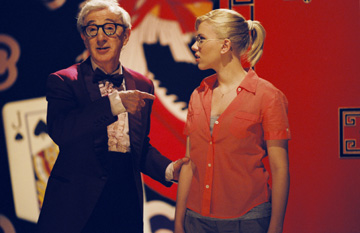
It's sadly appropriate that Woody Allen's latest comedy concerns ghosts. In Scoop, the writer/director has become a ghost of his former self. Many of the signposts of Woody's classic films pop up in this forgettable, joke-free comedy, but they're like dim apparitions, present in a twisted version of themselves for a brief moment before fluttering away into the ether.

I know he's prolific by nature, but it seems strange that Allen would bother to make a film each year unless inspired by some great new idea or passionate artistic urge. Scoop evidences neither. It feels like penance, like Allen giving himself over to the immediate task of throwing a film together even though he, personally, could care less whether or not it's capable of actually providing any laughter or entertainment value. Could filmmaking have, at this point in his long and storied career, become a compulsion for Woody? Is he incapable of taking a break and recharging, giving himself time, perhaps, to discover a new source of inspiration?

(Yeah, I know he's getting kind of old, but if this is the best he can turn out, better to just retire now...I say all this as a huge fan. But I think that even a short break between projects might help the guy come up with something more enjoyable than this blandifesto.)


Even Allen's performance betrays his lack of enthusiasm for the enterprise. In his first scene with co-star Scarlett Johansson, Allen looks down at the floor the entire time and flubs a few of his lines. Could that have possibly been the best take? Or was it the only usable one?

It's particularly disheartening to see such a pinched, awkward effort come right on the heels of Allen's best film in over a decade, Match Point (which also starred Scarlett Johansson, in a role better suited to her abilities). This new film shares much more in common with Allen's career-low, pre-Melinda and Melinda period that included such grim death marches as Small Time Crooks, The Curse of the Jade Scorpion, Hollywood Ending and his unwatchable nadir, Anything Else.

As in most of those films, Allen starts with a big, goofy 1930's-style comic premise. Sandra (Johansson), a plucky young journalism student vacationing in London, meets the ghost of a dead reporter (Ian McShane) during a magic show, who tells her the identity of the infamous Tarot Card Killer. With the help of the jittery, over-the-hill magician who first conjured the spirit (Allen), she must gather evidence against her suspect, wealthy heir Peter Lyman (Hugh Jackman). That is, unless she falls in love with him first.

It's extremely broad and kind of silly, but I see no reason why this premise could not have been turned into a servicable comedy. (Is not one of his career highlights, Sleeper, broad and silly?) But Allen stumbles at literally every step. Most fatally, he hasn't designed one single funny character. Not one.

Johansson and Jackman have zero chemistry (surprising when you consider that they played lovers in another film this year, The Prestige). In this case, it's because their characters are total duds with almost no personality. They're not interesting apart, so why would they make an interesting couple?

Sandra resembles a character Woody might have written for himself years ago; she's urbane, pessimistic and cynical yet somehow still enthusiastic about life. But rather than go over the top like Allen or one of his better stand-ins, Johansson underplays all of the hysterics, the theoretically "funny" moments. So they fall totally flat. Allen has cast her because of her physical attributes, getting her into her underwear or swimsuits whenever possible, but perhaps didn't pause to consider her ability with physical comedy.

Jackman fares even worse. He's saddled with a dilemma from the beginning - he must be likable and charming yet also a potential serial murderer - which he solves by making Peter a complete blank. Sandra seems to like him, but we sense it must be just because he's attractive and rich and has a nice collection of antique musical instruments. He fails to express a single interesting or original thought in 90 minutes. He's got kind of a Prince Charming complex, like a guy who has sat in a room for 30 years doing nothing but practicing his genteel romantic patter in case a young, beautiful woman ever comes by for him to respectfully woo.

For a guy who's used to working with large, talented ensembles, Allen hasn't given himself many funny co-stars with whom to play around. Johansson, though she's been overexposed and on a bad streak lately, can be good in films, but she's not all that funny. Jackman's not funny. The only other major character is undead reporter Joe Strombel, played by the delightful British actor Ian McShane.

McShane has kicked ass in movies and TV for 30 years (he's best known to Americans as the moustache-twirling wildman Al Swearengen on HBO's stellar "Deadwood"), but his character exists purely for the purposes of exposition. Allen needs Sandra to hear about Peter Lyman somehow, and the idea of her hearing it from a ghost is funny. But the ghost himself doesn't get to be funny.

So Joe shows up and explains the in brief little bursts and then disappears on cue. How did he get back to Earth from the afterlife? Where's he going when he vanishes? What does he care about getting a good story if he's dead and won't get any credit? At one point, he interjects randomly into a conversation that he's going to go away forever, and then he does and we never hear from him again. Even Poochie went out with more fanfare.

Joe's story opens the film in excellent, classic Woody Allen fashion, on the boat across the River Styx, escorted by the Grim Reaper. He has died of a heart attack but seems kind of nonplussed about the whole thing. He starts talking to a recently deceased woman, who tells him that she discovered the identity of the Tarot Card Killer and was then poisoned. What a scoop! If only Joe could somehow get this information to a live reporter, he'd be the first one in the world with the story!

At this point, I thought the film was going to be great. What's more Woody Allen-esque than opening a screwball comedy with a serial killer, a funeral and a boat trip through the Land of the Dead? I soon realized that this would be the only inspired sequence in the whole film. Counter-intuitively, despite his familiarity with death-focused comedy, Allen can't even muster any good one-liners for his ghosts.

A feeling of weary laziness just hangs over the proceedings from this point on. Sometimes, Allen sets himself up for a joke and then doesn't even take a swing. In one scene, his blue collar Brooklynite is led into a massive, opulent English garden, a slow underhand pitch to any Marx Brothers fan, let alone Woody Allen, and all he says is, "Wow, this is amazing." Wow, this is amazing? YOU'RE WOODY ALLEN! WHERE'S THE PUNCHLINE?

The Depression-era spirit of Scoop ought to bring out Allen's sharpest comic instincts. Those are the films that inspired him as a young person to write comedy. And it's not just the Preston Sturges reference points (mistaken identities, poor people sneaking into high society, last minute reversals) that suit Allen's sensibilities. He works in some classic vaudeville jokes into the magic routines. It's a wacky romantic comedy with an attractive female lead! It's not like this isn't familiar ground. Woody once was capable of writing really lively, intriguing female characters - women who weren't just refractions of his own nebbishy personality. Sandra's a pair of empty glasses.

[Okay, one more thing I'll mention, but this criticism reveals the ending of the movie, so don't read any more if you plan on renting Scoop next week.


Okay, so, in the end, we find out that Peter isn't really the Tarot Card Killer. However, he did pretend to be the Tarot Card Killer in order to get away with murdering a prostitute who had been threatening blackmail. Unfortunately, the chronology of events doesn't make sense. Joe Strombol becomes convinced, in the afterlife, of Peter's guilt before he murders the prostitute. So it's just a coincidence? Joe was wrong about Peter, but then accidentally turned out to be right because Peter later decided to murder a woman?

This may seem like a minor complaint but it totally derails the movie (as if it didn't already have enough problems). The whole thing is a mystery, albeit an uneventful one. How can it be that the final solution makes no sense and is based around a totally unbelievable, stupid coincidence? It means that Joe Strombol's not a good reporter, that the whole thing happened because of stupid blind luck. Not good, Woody...Not good.]

Wednesday, November 15, 2006

Secrets and Lies

We get a lot of strange, unfillable requests at the video store. Customers will read some random article about a movie or even provide a vague description of something they once saw on television and simply assume that we can obtain a brand-new, professionally mastered DVD copy within a few days. Perhaps the most hilarious example was the woman who thought we made the DVD's ourselves in the back of the store.

"That title's out of print," my co-worker explained. "There aren't any more copies."

"Well why can't you make some more?" the idiot customer replied, imagining, deep within the bowels of Laser Blazer, some fantastical device similar in design to a Bessemer Converter, in which entire movie reels are ground into easy-to-transport, high-quality DVD's.

Sometimes, people will hear an infomercial or radio ad for some self-help product and assume that we will necessarily carry such things. Most of the time, the fake guru behind these fraudulent lectures sells the products him or herself, the better to gouge gullible senior citizens without the hassle of going through a middle man.

Recently, a lot (a lot!) of people have been asking about a movie called The Secret. At first, I assumed it was some TV movie or whatever that came out on DVD that we simply forgot to pre-order. But I couldn't find any evidence of the thing's existence in our computer. It was only when a customer indicated that it might have a secondary title, something like The Art of Happiness that I grew suspicious.

It turns out, The Secret is a movie that proposes to teach viewers, over the course of 2 hours, the success technique employed by history's greatest geniuses and achievers. It's available on DVD, but only from this website, but you can also download it to your computer for the low low cost of $5.

The Secret has existed throughout the history of humankind. It has been discovered, coveted, suppressed, hidden, lost and recovered. It has been hunted down, stolen, and bought for vast sums of money. Now for the first time in history, The Secret is being revealed to the world over two breathtaking hours.

Look, people, here's a tip: If someone's offering to sell you history's greatest secret, an understanding so deep and penetrating that it has inspired centuries of searching and conflict, for $20 on a DVD...that person is a liar. Okay?

It takes all of 2 seconds on this website to figure out the obvious branding these charlatans are going for. All the graphics, the copy, the style of the entire enterprise smacks of The Da Vinci Code. They're clearly hoping the same fools who believed the dross in that book will accept this new quasi-historical fiction with the same blank, slack-jawed, unquestioning outlook.

A number of exceptional men and women discovered The Secret, and went on to become known as the greatest people who ever lived. Among them: Plato, Leonardo, Galileo, Napoleon, Hugo, Beethoven, Lincoln, Edison, Einstein and Carnegie, to name but a few.

Hey, where are the women? But besides that blatant discrepancy, doesn't this list sound totally made up? Like a compilation of Great Men of History that someone just threw together. I mean, what do these people even have in common aside from noteriety? Scientists, philosophers, musicians, physicists, businessmen, politicians, astronomers, novelists and generals? Any secret that could apply to all of them would have to be so vague and widely applied, it would be utterly meaningless.

Fragments of The Secret have been found in the oral traditions, in literature, in religions and philosophies throughout the centuries. For the first time, all the pieces of The Secret come together in an incredible revelation which will be life transforming for all who experience it.

Yowza. An incredible revelation which will be life transforming for all who experience it. Just like Kangaroo Jack!

They're really going for the hard sell here. Why do I feel like this copy was composed by Sheldon "The Machine" Levine? "We're offering life-transforming revelations this week, Dan. I'm trying to do you a favor!...Um, Grace, can you get me Socrates on Line 5 and two first-class tickets for myself and Charles Baudelaire to D.C. for next Tuesday?"

Some of today's greatest teachers will be presented in The Secret and will impart this special wisdom that has been known by so few. They include some of the world's leaders in the fields of business, economics, medicine, psychology, history, theology and science.

And by "business, economics, medicine, psychology, history, theology and sicnece," they mean, "a bunch of touchy-feely New Age bullshit." I mean, let's just take one of those claims...Theology? Who are the world's leaders in the field of theology and are they really on this DVD? Does Pope Joey Ratz make an appearance?

Included are; 'Miracle Man' Morris Goodman, who tells his awe inspiring story of how he recovered from paralysis by using The Secret.

This must be how Christopher Reeve walked around in those commercials! And you all thought it was just cheesy special effects...

Dr. Denis Waitley, who used various aspects of The Secret in training Olympic athletes and Apollo astronauts to reach new heights of human endeavour.

I'm surprised that Olympic athletes and Apollo astronauts share the same trainer. Doesn't seem like these two activities would have overlapping skill sets like that. For starters, it's probably unsafe to actually throw a javelin inside a lunar module. Those walls are made of, like, tin foil.

Doctors in the fields of medicine and quantum physics explain the science behind The Secret.


As you can see, the use of The Secret opens up a transdimensional portal, m-hai, in which high speed positrons collide with feel-good vibrations, creating a vortex of wealthonomy and happitude. Glavin!

Best selling authors and philosophers including Bob Proctor, John Assaraf, James Ray and Joe Vitale, explain how they have created lives of phenomenal success utilising The Secret.

To the Google!

Bob Proctor is another bogus self-help guru who runs an outfit called LifeSuccess Productions LLC. Hey, if these guys have the secret to eternal happiness, how come they have to spend so much time hawking merchandise on poorly-designed websites?

Anyway, this creepy Proctor asshole has written a book called "You Were Born Rich." His website declares on a garish blue masthead - "If you can tell me what you want, I can show you how to get it." Bob, I want you to go the fuck away and stop cheating sad, desperate people out of their hard-earned money with your lame, unoriginal collection of useless platitudes and easy answers. Can you show me how to get what I want?

An author, perhaps, if you want to define the term loosely. But he's not exactly Schopenhauer.

John Assaraf runs a ridiculous company called OneCoach that...say it with me now...teaches the secret for getting what you want in the business world! The only guy who would call this idiot a philosopher is maybe David Brent. (Or, for you American fans, Michael Scott.)

James Ray wants to offer you "wealth in all areas of your life." That is, unless they're referring to the assasin who killed Martin Luther King. Becuase, say what you will about that guy, but he was ambitious and knew how to get things done. Here's a taste of this Ray character's heady philosophical writings...

Just like the harmony created by each unique and important instrument in an orchestra causes your emotions to soar (like an eagle rising on an invisible thermal), complete harmony in your life causes your level of happiness, wealth and success to soar.

That kind of sounds like it was written by Stephen Colbert. "Like a majestic eagle rising on an invisible thermal, this War on Terror's about the really take off!" Otherwise, though, this guy's definitely on the level of a Heidegger or, at the very least, John Stuart Mill.

Finally, poor poor Joe Vitale. I'm going to insist you all visit his personal website, which has thus far been the highlight of my day. (And it's getting pretty late.)

Besides being one of the five top marketing specialists in the world today, and the world’s first hypnotic writer, Joe is also a certified hypnotherapist, a certified metaphysical practitioner, a certified Chi Kung healer, and an ordained minister. He also holds a doctorate degree in Metaphysical Science and another doctorate degree in Marketing.

Oh, well, a certified metaphysical practicioner. I had imagined he was the rogue loner of the metaphysical practicioner game, practicioning on his own out there with no licence.

And what the fuck is a hypnotic writer? Does he write while hypnotized? Is he writing prose that will actually hypnotize the viewer? Is it just an entire book saying "You are getting sleepy...your eyelids are getting heavy...look at this picture of a stopwatch and imagine I'm waving it in front of your face...everything's getting dark..."

Seriously, I love that paragraph. I'm going to make it my description in my Blogger profile. It fucking rules. I'd say it's probably the most hilarious resume I've ever seen. I wanna be a certified Chi Kung healer!

Anyway, four testimonials, four egregious lying phonies. I thought this was some great secret! How come they can only get hucksters to appear in their video discussing its intricacies and details? Were Stephen Hawking and Thomas Pynchon unavailable during the week they "borrowed" that camera from Best Buy? You know, before they had to return it to get their money back?

Tonight, a guy came into the store looking for The Secret, and after I told him we didn't carry that title, he actually told me the secret. (He claimed to want the film only to see how the filmmakers are reapplying a very old technique called "visualization.") All of these guys in the film are pitching the same line, which is pretty much a variation on "the power of positive thinking."

As in any kind of visualization exercize, they tell you to imagine the thing you most want in the world all the time as a way of actually achieving that goal. It's the same idea behind the sports psychologist telling his patient to imagine the ball going through the hoop or into the cup. First you see it in your mind, then you reproduce that action in reality.

I don't doubt that this could work on some level, becuase it's built on one of the most simple and logical principles in all of Communication. Humans can detect confidence, even on a subconscious level. Someone's facial expressions, body language, tone of voice and mannerisms communicate as much, if not more, than what they actually say. So if we make an effort to project confidence, people pick up on that and assume we know what we're talking about. Thus, imagining that you are successful will cause people to treat you with respect, which will in turn cause you to become successful.

A-duh. Most clever, alpha-dog individuals figure this out on their own by junior high school. If you talk to girls like a frightened little supplicating puppy dog who desperately wants their companionship, they will not take you seriously. But if you act aloof like you don't care what they think, they won't be able to resist blowing you underneath the stairs in the back of the gymnasium during the Holiday Dance.

(I only figured this out a few weeks ago, but it occurs to most guys much earlier.)

The Secret adds one additional level. You don't just visualize the thing that you want, you actively force yourself to believe that this thing has already happened, much in the way a devout Christian forces him or herself to believe that a man turned water into wine and came back from the dead.

Yeah, it's insane. (At least Christianity has several thousand years of tradition and history.) They encourage you to become delusional, pretending to achieve things that you have not achieved. I think Jon Lovitz used to teach this same technique on "Saturday Night Live."

And the proof they offer for their program's success, before you shell out $20? A few douchetards who have become rich teaching other people about the program. This is like when fundies try to prove stuff in The Bible by quoting from The Bible.

What about all the people who try The Secret and then don't become rich and famous hawking The Secret? They're just walking around with a strong belief that they're millionaire playboys. They're still just braindead slobs! You've now done these people a significant disservice. Before, they were just miserable losers. But now they're miserable losers in an advanced stage of denial.
Well done, Joe "Mr. Fire" Vitale! By the way, that's a stupid nickname! And you look like a doofus! And your poorly-written and unconvincing personal website makes me doubt your abilities as a self-proclaimed marketing genius!

Tuesday, November 14, 2006

Accepted

Every comedy set in the world of college must, by law, rip off certain scenes from Animal House. So I don't fault Accepted for having a generally not funny and tedious final 20 minutes in which the main characters must defend their wacky, sophomoric hijinks in front of a deeply serious panel of crusty old Ivory Tower elitists. It's the law, after all.

I still say someone needs to come blow the lid off the campus comedy genre. There are some hilarious comedies of this style - Old School, Back to School, even PCU - but they're all so stale and predictable at this point, so obviously trying for that old Bluto Blutarsky magic. Accepted is a worthwhile addition to the format, notable because there are so few mainstream comedies coming out of studios that actually work in any way, shape or form. If I could afford higher standards, I'd probably dismiss the film as fluff, but I'll take what I can get.


Here's something that kind of pisses me off. I'm trying to write big, broad, mainstream comedy scripts not unlike Accepted. But when I turn in a script, every little detail has to be figured out. No logical inconsistancies are ever permitted. In my last script before the one I'm currently engaged in revising, I had a car trip from West Hollywood to Manhattan Beach take about 20 minutes. I was told it would be more like 45 and that this would never fly. I also had a character agree to a rather bizarre living situation in order to kickstart my plot and was similarly told that this was way too outlandish and needed to be better explained.

Yet here we have a movie that's not only totally ludicrous from minute one, but blatantly inconsistant. Bartleby Gaines (Justin Long) is presented as kind of a Ferris Bueller figure. An expert liar and a quick thinker, he seems to have high school pretty much all figured out. That doesn't include, unfortunately, the college admissions process. So while his best friend Schrader (Jonah Hill) eagerly awaits his arrival at Harmon College, Bartleby must figure out a way to avoid his father's disappointed wrath.

The whole first act is sloppy. Bartleby's not only smart but clever. If he really didn't get in to any schools, we sense he'd still figure out a way to make it on his own for a semester before applying again. And what kind of parents totally ignore the issue of college until their child graduates high school, then randomly remember to ask what school he or she will be attending one night over dinner?

Anyway, that's just my personal beef about having to write scripts on spec, which is much more exacting in this way than just being well-known and connected already and churning something out. The point is, despite these logistical flaws, Accepted actually works pretty well. It's funny in kind of a sly way. Focusing on character-based comedy and witty dialogue rather than outrageous schtick, impressions, pop culture references or farce means that Steve Pink's directorial debut doesn't come off as desperate for laughs like a lot of other recent comedies.

There are some dopey jokes, sure, but not a lot of really obvious, easy ones. (This may be the first college comedy ever without a single beer joke.)

Bartleby's plan, which involves renting out a mental hospital and revamping it as a de facto college, probably wouldn't work, but Adam Cooper, Bill College and Mark Perez's script makes it just plausible enough to get through 85 minutes. The South Harmon Institute of Technology (S.H.I.T.) starts out as an excuse to get out of the house and play PlayStation, but turns into a community of charming rejects who unite to...well, get out of the house, play PlayStation and skateboard. Oh, and check out hot girls in bikinis.

What I really liked about the set-up was that it gave the characters money to fool around with. (Because students show up at their fictional school with tuition checks, they can actually afford to renovate the building and buy lots of video games and pool toys.) It makes the payoff in the second half much more satisfyting. These kids had a million dollars to play around with. They could have just blown it like everyone expects, but instead they use it try and learn something and better themselves. That's actually kind of an uplifting message for a teen comedy.

Another master stroke was casting Lewis Black as the school's nominal "dean," an ex-academic with a fiery temper and an expertly-tuned bullshit detector. Black's monologues and rants, most of which would have fit in perfectly on "The Daily Show," are some of the highlights of the film.

Finally, the script cleverly cuts back and forth between Bartleby's impromptu experiment in education and his friend Schrader's humiliation at the hands of Harmon's most villainous fratboys. Evil preppy frat boys are the villains in pretty much every college comedy and the ones here in Accepted are totally anonymous and generic. But Hill's a pretty talented comic presence (he'll be seen next in the 40 Year Old Virgin follow-up Knocked Up) and he milks these scenes for all they are worth. (He's the guy in the hot dog suit in the commercial instructing you to question him about his weiner.)

I liked Accepted way more than I expected. It's an above average comedy than never quite rises to the level of hilarity. I doubt I'd ever watch it again, but hey, it kicks the ass of Nacho Libre up and down the block.

The Double Life of Veronique

Each shot, each image, of Krzysztof Kieslowski's 1991 masterpiece The Double Life of Veronique has some deeper significance. His films are so dense with symbols, motifs and subtle threads, you sense this must reflect the way the man actually saw the world - not a random, senseless collision of moving parts, but an elegant and synchronous universe of interconnectivity. In everyday life, we're unable to detect the hand of fate shuttling us all around, so Kieslowski attempts to slow time down in his films, to demonstrate how "coincidence" is really just a convenient euphamism for fate.

The Double Life of Veronique opens with an inverted image. As a young girl, the main character(s) look(s) on a city from upside-down. We see a reverse cityscape, dimly-lit buildings floating above a blue night sky. The film to follow presents an equally capsized perspective, only metaphysical instead of geographical. Everything is recognizable - the people with their jobs and their commutes and their private hopes and dreams, the bustling streets of post-Cold War Paris and Warsaw playing themselves - just as a night sky is still recognizable upside-down. The ingredients are all present but their sense, their order, has been violated.

Kieslowski uses this set-up to provoke. Is the identity crisis at the center of The Double Life of Veronique truly impossible? How could you prove or disprove an unspoken emotional and spiritual bond between strangers? (You couldn't, because the moment the two became aware of one another's existence, they would cease to be strangers.)

Kieslowski presents us with a barrage of surreal-yet-theoretically-possible circumstances, strange events that we all know can and do actually occur, from unlikely coincidences to low-grade extra-sensory perception to the uncanny realism of a well-executed puppet show. He then challenges us with the far-reaching implications. If one logic-defying event is possible, couldn't all of our ideas about what is "reasonable" and what is "irrational" be wrong?

The purposefully vague final sequence in the European cut of the film shows Veronique driving up to a tree while her father works in a woodshop nearby. She moves down her window and touches the tree and her father looks up from his project at the same moment. His tools and equipment are loud so he couldn't have heard his daughter outside, yet he sensed her presence. These sorts of peculiarities do exist, even if we don't fully understand the how's and the why's. So if it's possible for a father to sense his daughter nearby, couldn't two people in different nations who have never met still be somehow connected in a way that defies human understanding?


Gorgeous French actress Irene Jacob opens the film as Weronika, an adventurous and child-like Polish girl auditioning for a position singing in a prestigious Warsaw company. Much of Weronika's brief story focuses on her sensory experience of the world. She delights in holding and bouncing a small rubber ball and in pressing her forehead against a glass window on a chilly day. When her chronic heart troubles act up, she lashes about in a public park, knocking leaves off of benches and short walls. When her life comes to an abrupt halt during a virtuoso choral performance, we feel the thud of her head knocking against the wooden floorboards. Whenever possible, Kieslowski gives the audience insight into Weronika's tactile experience, whether it's dust blowing in her face or the warmth of a glint of sunlight creeping around half-closed blinds.

When Weronika dies, Veronique, a music teacher and singer living hundreds of miles away, gets a strange feeling of loneliness and isolation. It's as if someone close to her had died. Does Kieslowski want to emphasize Weronika's perceptions so that he can then show them transferred into Veronique? Or perhaps he's demonstrating that Weronika is a real person, not a dream or creation of Veronique, but a genuine doppelganger whose fleshy existence offers a challenge to our logic. These two girls never met (though they once came close) and know nothing of one another, yet they are somehow sharing a union of not only soul but body.

Over the next few scenes, Kieslowski will reveal literally dozens of connections between these two women (boht, naturally, played by Jacob). They both lost their mothers at an early age. They both suffer from heart disease. They were born of the same day. They have great musical ability. (One of the most significant connections between the two women is the piece of music Weronika sings on the night of her death. Veronqiue begins teaching it to her pupils soon after.)

But beyond these superficial coincidences, and the fact that specific objects owned by one girl occasionally pass to the other, Weronika and Veronique are tied together by something more. Obviously, they are discussed in tandem because Kieslowski has chosen to make a film about them. But more importantly, the women seem to share inner lives. They both have boyfriends but seek out something more fulfilling than the men in their lives can provide. Specific actions occur to both of them, like watching an old woman cross the street or fidgeting with a ring.

Again, Kieslowski seems to offer something of a rhetorical challenge. It's arguable that there's nothing terrifically unique about Weronika and Veronique. You could probably scrutinize dozens of women throughout Poland and France and find some of the same age who look alike and have similar aspirations, backgrounds and personalities, even names with the same root or origin. Factor in the science of psychology and our understanding of things like archetypes and we begin to understand how much "strangers" can have in common. (Of course, cinema itself is predicated upon common, shared reactions. Filmmakers can reliably make us excited or scared or sad because we all occupy similar emotional planes.) So if we can agree that strangers would have so much in common, why is it so outrageous to make the leap that these connections are more than simplistic and coincidental?

The two girls are not identical. Weronika is more outgoing and bubbly than Veronique, while Veronique seems to have more money and is generally more urban and sophisticated. Impressively, Jacob turns in two unique and individual performances even though she's playing two identical women. Without altering her physical appearance at all, she accurately conveys the shift between Weronika and Veronique. Each woman has a love scene and the differences in body language are immediately noticeable, with Weronika's playfulness directly opposing the colder and more reserved Veronique's.

Kieslowski highlights this notion throughout the film, using backwards and upside-down imagery as well as lots of shots with mirrors and reflective glass. Weronika and Veronique are not the same person, but two people having similar experiences. (An intriguing quesiton is whether Veronique would have suffered the same fate as her twin had she not given up singing.) It's a testament to Kieslowski's originality and inclusive nature. He didn't make a typical psychological thriller about divisions within the mind of the main character and he didn't make a romantic thriller about conflicts within an interpersonal relationship. This is not the story that happens to one or two people. In filming a thriller about individuals who never meet, Kieslowski encompasses not a few individual and idiosyncratic characters but the sum total of humanity.

There's far too much going on in this film to discuss in a blog entry. Long-form papers could (and, I'm sure, have) been written on the subject. At this point, I've seen most of Kieslowski's films and this remains one of my absolute favorites, something of a distillation of some of the guy's more prominant themes and ideas. Though not as overwhelming as experience as the Decalogue or the Three Colors trilogy (though it's close), this may be the best entryway into the guy's sensual and mysterious artistry.