Tuesday, April 26, 2005

Seacrest OUT!

According to the Drudge Report, ABC News has learned that Fox TV's massively popular show "American Idol" is a total sham. They've also learned that the new pope, Cardinal Joseph Ratzinger, is Catholic and are reporting on an exciting study which concludes that bears will occasionally shit in the woods.

No, seriously, Drudge breaks the story that "American Idol" may not be entirely on the up-and-up as if it were Watergate and a Clintonian blowjob all wrapped up into one. It gets a whole page with the word "EXCLUSIVE" written on it repeatedly and a huge picture of Simon Cowell. And here's the "big scoop" the fedora-ed one came up with:

At the center of the questions, the IDOL source claims, are the actions of show judge Paula Abdul.

"[ABC] is trying to say Paula somehow cheats and picks favorite singers to nurture, in violation of some sort of network standards," the IDOL source, who demanded anonymity, explains.

That's it? Paula nurtures certain contestants? What the hell is wrong with that? That's part of the show! They have obvious favorites which they admit to on-air. How does that make the show rigged?

I'm sorry, but there's not a story here at all. And I'm really ready to believe that "American Idol" is faked. I mean, I doubt very much that the music industry wants to trust the American people's whim with this many millions of dollars at stake. Look how much cash Ruben Studdard, Kelly Clarkson and Clay Aiken have brought in. Clarkson was just on "Saturday Night Live" this weekend. These kids come out after being on this wretched "Star Search" rip and sell millions of albums.

So, yeah, I don't doubt the producers pick a few candidates who have the requisite looks as abilities to work as a marketable pop star right from the start of the season. (This isn't really that hard when you think about it...we're talking about a career field in which both Nick Lachey and JC Chasez don't simply find work but thrive). I just kind of assume that all reality shows are set up in this way.

That's why you can't really fault reality TV for being uncreative. You can fault it for many things, primarily for seeking out the worst of humanity to scrutinize for up to an hour a week. But you can't fault it for not being made with a great deal of creativity, intelligence and savvy. These shows don't just produce themselves...Behind every "America's Next Top Model" is some very adroit scumbag.

But front page news, such behavior is not. I would imagine Drudge could do a little better than this for an exclusive at this stage of his career. Surely Arnold Schwartzengger's been groping somebody. Find them! There's your exclusive!

The Imbiber of Seville

An entire post just for one amusing sentence. It's from a local news report out of Seminole County, Florida, and here it is:

Mitchell Raulerson, 55, of Seville, was stopped in Sanford by an officer who was suspicious about his hand-drawn license plate.

This was Raulerson's 16th DUI, which has to place him in some sort of national sweepstakes for "Most DUI's Leading To Stupidest Arrest." I mean, your 16th DUI and you get arrested with a hand-drawn license plate...Did he think that would work?

Did he honestly sit down and doodle and license plate, and then stick it on his car, and step back and observe it and finally decide, "Yeah, some cop is totally gonna go for this. Time to get loaded!"

A Seminole sheriff's sergeant said Raulerson's speech was slurred, his eyes were bloodshot and he had empty beer cans in his van.

But how did they know he was drunk?

Monday, April 25, 2005

The Most Annoying Sentence in the English Language

It's a close competition. Definitely some slogans or catch-phrses would apply. "Don't go there." "Talk to the hand." "Git 'er done." And, of course, there's certain ignorant or poorly-worded socio-political sentiments, like "support our troops," "no blood for oil" or, sigh, "Go Bush!"

But those aren't the annoying sentences I'm talking about today. No. Today's topic is a sentence I hear pretty frequently, even here in media-saturated Los Angeles. Give up? Here ya go:

"I don't have a TV."

Now, please, before you click that comment box to let me know how much you loathe television and how much of a loser I am for defending it, allow me to explain.

I'm not of the opinion that watching a lot of television is a life-essential activity. I feel that the amount of television a person chooses to watch probably has to do with a number of personal factors that have very little to do with overall intelligence, or whether or not a person "has a life" for that matter, but we'll deal with that later.

No, my problem with the statement "I don't have a TV" generally arises from context. Because there are certain situations in which this would be a perfectly logical and reasonable thing to say. Here's just on example.

Two people are standing in a living room.

One of them, Trevor, says, "Hey, Jill, here I am, in your living room, and I would like to know the score of the football match. Could you please turn on the television."

"I don't have a television," Jill responds.

"Oh," responds Trevor. "Wanna make out?"

So, you see, this situation would be one in which the use of the sentence "I don't have a television" fails to offend. But that's not how most people say it. At least not to me. I'm never in a girl's living room.

Most people say it with a haughty, condescending attitude, implying that their refusal to purchase television is an obvious and thoroughly sensible decision that deserves accolades. Here's how our fictional conversation with Trevor and Jill might go.

Trevor and Jill are at a bar, talking.

"Hey, did you see last night's 'Lost'?" queries Trevor.

"I don't have a television," sneers Jill. "Cause I have something called a life."

"You're a bitch," says Trevor. "Wanna make out?"

You get what I'm saying. These people who don't own TV's are so proud of themselves, like they've done something really brave and progressive by ignoring technology.

Because really, that's all you're doing. You're making a blanket judgement about an entire medium based on popular stereotypes and pop psychology hokum about mind control and mental passivity. I'm not saying you're stupid or wrong to do it. There aren't a massive amount of television shows I enjoy, and my TV viewing probably comes in at below the national average.

I'm just saying that it doesn't make you cool or special or somehow more in touch with the world. Just like avoiding movies or the Internet or newspapers or magazines or talk radio doesn't make you smarter or more attractive as a person.

I bring this entire subject up because it's something dumb called TV Turnoff Week in the UK and America, and these anti-TV groups are organizing protests and activities. I reported previously on this blog about a device called TV-B-Gone that will turn off a television up to 50 feet away without anyone knowing who's controlling it. Well, activists are planning to go into bars and restaurants where TV's are playing to turn them off.

No word on how they plan to retaliate should the bar owner just walk over and turn the TV back on. Probably whale on them with a baseball bat until the cops arrive, I'd imagine. But maybe I've just seen too many violent shows on TV. Here's British paper The Guardian:

"For most people, TV has become a default activity. If you're not doing anything else you tend to watch TV. People become very defensive when you challenge them about it. If you sleep for eight hours and work for eight hours, people give half the rest to TV," said David Burke, the founder of the UK arm of White Dot which is organising the protest on this side of the Atlantic.

Ummm....I still don't get exactly why Burke thinks TV is so bad. I mean, granted, people watch too much of it. But any activity can be harmful when overindulged. You don't have "Stop Eating Chocolate" Week or "Stop Masturbating in the Men's Room of the 6th Floor of Your Office Building in the Afternoon" Week, yet these are also activities in which moderation is preferable.

"They're all minutes of our lives. You're devoting 10 to 12 years of your life to watching TV. What would you be doing with those 10 years otherwise? You would be talking to your kids or your partner. It's not a small thing," he says.

Really, Dave? Really? You believe that? That if TV didn't exist, we'd all be closer people, with better communication skills? I think, sure, you can make the case that television is a highly effective communication tool that we mainly use in America to hawk brand merchandise. It's simultaneously a horrible waste and a menace, creating an ignorant society of rabid consumers who can neither control their outrageous spending habits nor obtain a job to satisfy their material wants and needs. That's an argument I can understand.

But this whiny ridiculous "TV ruins family dinners!" line just doesn't work on me for a second. If Dad wants to unwind after a long day at the office, and there's no such thing as TV, he'll listen to the radio or read the paper or sit in the corner and drink scotch until his eyes gloss over. If he's the kind of Dad that wants to hang out with the kids, like my Dad was, it doesn't matter if there's TV or not, he's hanging out with those kids.

I mean, there was TV when I was growing up, and I watched a lot of it. A lot. Don't believe me? Here's the entire theme song from TV's "Perfect Strangers," from memory.

Sometimes the world looks perfect
Nothing to rearrange
Sometimes you just get a feeling
Like you need some kind of change

Standing tall
On the wings of my dream
Rise and fall
On the wings of my dream

The rain and thunder
The wind and haze
I'm bound for better days

It's my life, my dream
Nothing's gonna stop me now

[Here, there's a little harmonica solo while we see Cousin Larry and Balki do the Dance of Joy]

Okay, so, as you can see, I watched TV growing up, and remember some of it, even. And I'm a fairly intelligent, able-minded kind of guy. I've read some Dostoyevsky and some Immanuel Kant, and I think I've understood some parts of it.

And I spent plenty of time with my family, believe me. More than enough, really. They're probably sick to death of me. You should see these pictures my parents sent back from Hawaii. Their smiles grow 50% for every 100 miles of distance from me and my brother.

But according to D. Burke, I'm horribly depriving the rest of the world my company during those nights spent watching Donald Trump or Paris Hilton or Ashton Kutcher humiliate strangers. He and the other anti-TV-ites want me to go outside, join the world, do...well, do something. I'm not quite sure what they want me to do. They never say.

This is why it's not an intelligent protest, and why the people who say "I don't even have a TV" are off-base. Because it's not about "not watching TV." How bland, how boring. Anyone can not do something, it's all about doing something else that's more interesting. I mean, if the decision is between watching television or data entry, anyone in their right minds would choose TV. A lot of TV rules, particularly when Puff Daddy makes wannabe musicians walk to Brooklyn to retrieve snack foods. If the anti-TV crowd were sincere, and not just trying to act superior, they'd have a suggestion at the ready.

"Don't Watch TV. Take Up Backgammon." I think that sort of thing would go over better.

The Amityville Horror

No guy who starred in a sitcom called "Two Girls, A Girl and a Pizza Place" has any business starring in a riff on The Shining. I'm just going to come out and say that right up front. It's not that Ryan Reynolds is a horrible actor or anything, though he's yet to prove his chops in anything except lightweight material along the lines of Blade: Trinity (review forthcoming), the miserable romantic comedy Buying the Cow or this 70's remake. It's just that his presence in all wrong for this kind of a part. The stepdad in Amityville undergoes a transformation from kindly authority figure to demented kill-crazy psycho in under 90 minutes - you need an actor capable of real menace. I'd have loved to see a guy like Ed Norton take on this role.

But, for budgetary reasons, that wasn't in the cards. So you get Reynolds, who's fine in the film's opening, dreamy, idyllic suburban opening and pretty much completely dull and unconvincing once the fit hits the shan.
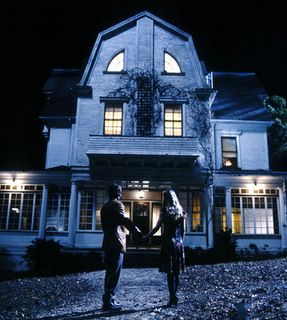


If only that were the Amity remake's only problem. I think the biggest failing of the film overall was the very basic decision of which classic horror film to rip off. The original Amityville Horror, the popular 1970's version, wasn't terrifically good, but it had the good sense to take a formula that works (the formula being the original Exorcist) and simply reapply it to the haunted house genre.

This new movie seems to take its cue more from The Shining. It's also a good film, but it's harder to simply plug that narrative into another movie. And not just because you'd be trying to rejigger an almost perfect film, a film boasting the combined talents of Stanley Kubrick and Jack Nicholson. But because The Shining is such a nuanced, layered piece of art, and removing any one of its interlocking parts (like, say, a house instructing its owner to kill) makes the entire enterprise seem, well, silly. Kubrick was enough of a master stylist to gloss over a possibly humorous plot twist (like the ghost of a man dressed as a rodent hiding in a hotel room) without making it seem humorous. Amity's director, Andrew Douglas, frequently misses the target, hitting camp instead of horror.

What The Exorcist had that the original 70's Amityville captured with minimal success was a lived-in comfort with suburban settings. Exorcist wasn't some horrorshow set in a traditionally frightening setting, like an old castle or an insane asylum or remote woods. It was set in a middle-class all-American home, with some familiar, relatable, recognizable kind of characters. The devil doesn't possess some lustful concubine or hellspawn, but a young, fresh-faced girl. The Shining on the other hand introduces a psychological level to the horror that Exorcist avoids. No demon invades the Nicholson character forcing his hand to grab an axe - the evil comes from within him, from his own mind.

And this new Amityville horror tries to go there, to get us inside George's meltdown, to come to terms with his madness. But it's an empty exercize. The film's not really interested in any kind of psycho-sexual exploration. It just wants cheap scares, "safe" and conventional gory bits and a few whiz-bang effects that will make for a nice trailer.

We're introduced to the haunted house of Amityville via a violent and disturbing opening scene. A man, Ronald Defeo, murders his own family in their beds with a hunting rifle, and we're shown each grisly death in close up. We cut to a year later (the entire film takes place in the mid-70's, in an attempt to maintain some artificial sheen of "authenticity" even though the legend of the real Amityville horror house has since been completely discredited). Widow Kathy Lutz (a bland Melissa George), her three adorable children and her new hubby George (Reynolds) have just moved into a seemingly perfect house with a horrible (yawn) secret.

It seems Defeo wasn't just a lunatic with a grudge - the house "made him" kill his family. The house has powers, you see. It can make people see things that aren't there, it can move objects around on its own, it can turn the lights on and off, it can even talk if you listen very carefully. Although usually it just says the usual haunted house stuff like "get out" and "kill them all."

You'd think a house that has been around since the 1600's would have more things to say than "kill your family." Most old people won't shut the hell up, and they've only been around for 70 or 80 years. This house has been there for centuries, yet it hasn't learned any repartee at all.

So eventually the house starts to win George over, and he starts getting very short with his family, and they get increasingly freaked out by the fact that the walls sometimes bleed. And at around 45 minutes, you start wondering why Kathy doesn't just round up the kids and get the hell out of the house.

As I see it, there's only one thing you need to write a good haunted house movie. You don't need a great backstory about why the house is evil - just make up some shit with Indian burial grounds or mass murders in the conservatory or occult symbols built into the architecture or something and that will do. (In Amityville, it's a particularly bizarre mixture of religious paranoia and guilt over Native American relations which I'll get into later).

And I'm not going to give you the old "you need good characters" crap, cause you don't, really. I mean, Wendy in The Shining isn't a great, nuanced character. She's just eerie and reedy and knows how to scream a lot.

No, what you need for a great haunted house movie is a plausible reason why the people can't just leave the house. And, let's face it, The Shining has the best possible excuse to keep the family trapped inside. The whole reason they're there is that the hotel is inaccessible for the winter months. Brilliant! Kudos to Stephen King for that one...

But Amityville Horror doesn't even try to explain why a woman would force her three children to inhabit a place that's so obviously evil. I mean, from the first day they live there (conveniently labeled as "Day 1" by some extremely unnecessary and inconsistant title cards), weird badness starts going down. Her husband gets violently angry for no good reason, they all start seeing and hearing things, the babysitter freaks the kids out by revealing the house's (double yawn) horrible secret, the dog constantly barks at invisible enemies, the lights keep flickering on and off. I mean, yeah, they've got a mortgage, but it gets fairly inconceivable.

Late in the game, a priest played by veteran character actor Phillip Baker Hall appears (filling in for Rod Steiger from the original), and it takes him four scenes before he recommends to Kathy that she get her family out of the house.

Excuse me? Four scenes? Wouldn't that be the first thing any logical person would say? "Um, hi, Father...I think my house is implanting the deep-seated desire to kill in my new husband. Oh yeah, and the girl murdered in the house has befriended my youngest daughter...What should I do?"

I could go on all day with the gaping plot holes and logical inconsistancies, but who cares? If the movie was scary or entertaining, I wouldn't have even bothered with them at all. But I was kind of bored, because everything in Amityville is so familiar and tired, that I started making mental notes about all the stuff that didn't make logical sense.

And I started thinking about the really subversive ideology behind the movie. No, really.

We've seen this plot enacted hundreds of times, but never quite with this kind of spin. A family man, being influenced by evil spirits, turns against the family he loves and cares about. He starts to view them as a burden, as a "bad family" whose behavior he must "correct," thus perverting the Father's traditional role as disciplinarian and stern teacher.

Obviously, this plays on some deep-seated fears of wives, children, anyone who lives in a family unit with a powerful man at its center. Because young children are so dependant on their fathers, because wives are physically not capable of fighting off their spouses, this notion of a father going mad and overpowering his family into submission has some sort of archetypal significance.

Okay, fair enough. But in Amityville Horror, George's condition seemingly springs from nowhere. Generally, in films of this kind, the man at the center of the puzzle has some sort of problem before he even enters the arena of evil. Take The Shining. Before he goes to the Overlook Hotel, Jack Torrence has hurt his child before. He claims it was an accident, but his alcoholism and frustration over a failed career may have also played into the equation. His wife refuses to talk about it, even when pressed.

So when he gets to the Overlook, there's a sense that the hotel is bringing his evil side out rather than creating it. It plays on his weaknesses (alcohol, pride, rage) and wears down his resistance, until his worst impulses simply get the better of him. This, along with a healthy dose of fatalistic inevitability, makes The Shining feel like a great tragedy as well as a horror film. It's not just the story of a how a man tried to axe his wife and kid, but of a man fighting a losing battle against his own demons.

And now consider Amityville Horror. He has no real gripe here. At the opening of the film, before he's a homeowner, he's the perfect husband and stepfather. Caring, compassionate, funny, warm, open, responsible, stable. He refers to working as a contractor, and implies that there are financial concerns with buying a new home, but he doesn't seem overworked or strapped for cash. And then he moves into this house, and suddenly, without warning, he begins to morph into a kill-crazy maniac.

So, clearly, it's the house that makes him crazy. But consider this conversation from late in the film. Kathy expresses (finally!) a clear desire to leave. But George refuses. He claims that their whole life is tied up in this house, and that they can't run away from their problems.

So the implication is that, for American men (because it's always men that wind up turning evil in these movies), the burden of supporting a wife and family, of running a house, creates not only bitter resentment but homicidal rage. And that the only way to exorcize this rage is to leave the house behind, to get out.

I watched another film this week, 2002's similar haunted house fiasco Darkness, and am struck by how similar it is in theme. Another father is turned psychotic by a new house. The difference is (and here I will reveal the very silly twist in Darkness, so stop reading if you haven't seen the film) that the father in Darkness is "wanted" by the house, has a history with it that cannot be avoided, and so he must sacrifice himself for his family.

So there we get the opposite - that a father must accept his burden and give his life to provide for wife and child.

Either way, these movies don't exactly bode well for the psyche of the American male. Just because the ending of Amityville Horror is immensely silly (and it is) doesn't mean we can easily shrug off the implication made by this popular contemporary film. The idea that suburban family life can make a man insane, and that fleeing can instantly return that sanity, is certainly original for a mainstream American movie.

Sunday, April 24, 2005

Undertow

There's a certain kind of evil maddog in the movies. It's hard to describe exactly what makes this kind of character work, but like pornography, you know him if you see him. In Undertow, Josh Lucas brings such a character to life, an antagonist full of seething hatred, overwhelmed with bloodlust until it threatens to eke the very last drop of his humanity away.

These killers can often be identified by a lack of willingness to die, even when faced with injury that would result in the certain demise of a conventional human being. Lucas in Undertow mainly evokes Robert Mitchum's crazed stepfather in Night of the Hunter, but also brings to mind Max Cady of Cape Fear fame or any number of slasher movie villains. He's relentless, he's evil and he'll stop at nothing to get what he wants.


In David Gordon Green's masterful new thriller, it's a bag of gold coins left as inheritance by his absent father. But the object of desire itself doesn't matter - what matters is Lucas' single-minded need for these coins as an end to themselves. They exist, they are his, and therefore he must have them.

Lucas played Deel, who moves in with his widower brother (Dermot Mulroney) and two nephews (Jamie Bell and Devon Alan) following a stint in prison for an unnamed crime. Deel harbors a deep-seated resentment towards his brother, for marrying his girlfriend, for keeping their father's stash of gold coins, and just for living freely while Deel suffers and toils. It all leads to a while chase through a surreal rural Georgian landscape.

Like his previous George Washington, Green has made a violent thriller that feels nothing like a violent thriller. Despite his choice of subject matter, his films drift by languidly, mirroring their sun-drenched Southern landscapes. You sense that he's far more interested in the personalities the boys will meet during their breathless journey, and in Deel's steely and tireless pursuit, than in following a straight-ahead narrative.

He's aided by a phenomenal score by Phillip Glass, which doesn't so much push the intensity of the action forward as slow the film down, adding a layer of reflection to the proceedings. We don't just see Deel murder, but see him after the murdering is over, watching his rage bleed away and the horrific realization of his own actions coming over his face.

In an early scene, Jamie Bell's older brother, Chris, evades capture by the enraged father of a girl he's attempted to woo. He races across one of Green's signature post-industrial Southern landscapes, at one point stepping right down on an upright nail sticking out of a board. With his bare feet. But instead of pulling the board off, he continues running, loping awkwardly from side to side, his face curled up in pain, desperately attempting to avoid punishment for his actions.

It's an invaluable character moment, for one, but also a visual metaphor for the action of the film. Characters have no choice to push forward, to put aside their personal pain and endure the worst in order to survive another day. Like Chris with a board nailed to his foot, the boys will face considerable barriers to their survival throughout the film, barely escaping certain capture again and again.

They're aided by a cast of supporting characters that lend an air of magical realism to the film. Though Green's films always exist in a dreamy, gothic universe not quite identical to our own, this is the first time he's made a movie with such a "fairy tale" motif. He's been quoted as citing The Grimm Brothers as inspiration, but there's also more than a little bit of a Mark Twain quality here as well. And like Night of the Hunter, the Southern "types" we meet, like the kindly and childless black couple who provide the boys with some rare kindness, or the city of "lost children" living in an abandoned and half-decayed building in the wildnerness, add an eerie forboding to the atmosphere.

The fantastic cinematography of Tim Orr adds to this ethereal, other-worldly spirit. Their frequent use of freeze-frames brings an additional stillness to the film; moments of quiet, assured calm in the midst of the storm. It's this mixture of fiery intensity and relaxed melancholy that, I suspect, contributes to Green's frequent comparisons to Terrence Malick in the media.

This is the third collaboration by Orr and Green (and Green's overall third film), and they are among the most exciting director/DP teams working in movies today. Each of their films has its own unique style, but they feel tied together, like three parts of the same series. The Southern Gothic Tragedy Trilogy.

So, all of that being said, I must concede that this is probably Green's least ambitious work, with the least amount of emotional heft. George Washington was such a stunning debut, told with such visual virtuosity and replete with some of the most realistic child acting I have ever seen, that it's hard to imagine Green will manage to top it. At least as long as he's working within the same cinematic vein. And All the Real Girls boasted such emotional maturity, along with some really lovely performances and the best screenplay of Green's career as a writer. So, though he really nails Undertow from a directorial standpoint, I can't help but be left a bit cold by its lack of depth.

Its thematic material, aside from the pain vs. consequence dichotomy mentioned above, focuses mainly on the kind of "sins of the father" storyline we've already seen many times before. We're asked to consider how the relationship of the older set of brothers impacts the younger set, and how the resentments of previous generations (not just Deel and his brother, but their father as well, who relates the entire story in voice-over) are carried on by future generations. And though the "cursed" gold is a nice visual touch, and the performers do the best they can with their material, it's just not terribly memorable or significant material.

Don't get me wrong...Green definitely elevates the material into something worth your time. I enjoyed Undertow immensely, both as a piece of riveting and exciting adventure entertainment and as a piece of cinematic craftsmanship. But this is not an emotional epic like Green's other works so much as a wholly successful and darkly effective spook story. Go in expecting as much and you shant be disappointed.

Saturday, April 23, 2005

Drag the Dog

You all know the Italian city of Turin...It's the place where they found the famous Shroud of Turin, a legendary cloth that, when you hold it up to the light, kind of looks like someone drew a picture of Jesus on it.

Well, anyway, Turin is filled with dog lovers, and they have just passed a really stupid law I thought I'd tell you about.

You have to walk your dog three times a day, every day, or you will be fined 500 euros. That's $650, people. (Also, can you believe all the European money is really called "the euro"? It's the name of your continent, can't you be more creative? I don't ever want to exchange "amers" for goods and services. Why not just rotate by country...this week, we'll call it the deutschmark, next week the lira, and so on...and make it multicolored so it matches every individual country's flamboyant currency.)

Dog owners in Turin will be fined up to 500 euros ($650) if they don’t walk their pets at least three times a day, under a new law from the city’s council.

People will also be banned from dying their pets’ fur or “any form of animal mutilation” for merely aesthetic motives such as docking dogs’ tails, under the law about to be passed in the northern Italian city.

Man, that is nutty. I mean, you hear about "wacky laws," like "no mustachioed man can kiss a woman on the lips in public in Missouri" or something, but those aren't generally enforced. (Except sodomy laws! Keep fighting the good fight, Rick Santorum!) But walking your dog three times a day? That's a bit of overkill, isn't it?

I don't even think a lot of dogs want three walks a day. Some dogs just want to lie down in a sunbeam for several hours and not move at all.

And what's that weird part about dying your pets' fur? I mean, I'll admit that would look a little stupid, but does it really bother the animal either way? Maybe it's less dignified, but they're already a domesticated dog living with some old Italian broad...as far as the animal kingdom at large is concerned, they're already a bit undignified.

“In Turin it will be illegal to turn one’s dog into a ridiculous fluffy toy,” the city’s La Stampa daily reported.

Oh, now I see. All makes sense now. Thanks, La Stampa.

Dogs may be led for walks by people on bicycles, the rules say, "but not in a way that would tire the animal too much."

Can you believe how much time was spent on all these rules? "Dogs may be led for walks by people on bicycles..." Oh, really? Thanks, City Council of Turin! "Not in a way that would tire the animal too much"? There aren't even laws against being tired for the people of Turin!

I wish laws like that existed to protect people in the US. "Um, boss, I'm actually getting a bit tired. And you wouldn't want to break the law and make me follow you around when I'm so tired. Right, good, so I'm gonna go home and lie in a sunbeam for a while...See you..."

How can you even tell if your dog is "too tired" to continue walking behind your bicycle. His tongue's out? His nose is dry? He telepathically tells you he's tired, right before he gives you orders to kill?

To enforce the law, Turin police would rely largely on the help of tipsters spotting cruel treatment by their neighbors, La Stampa reported.

So, now we know where John Ashcroft moved after he resigned...

Dog mistreatment tipsters. If that's not asking for trouble...

But they have left the best part for the very end of the article. What the French would call the "coop of grace."

It [La Stampa] said the 20-page rulebook gives Turin the most stringent animal protection rules in the country. It even bans fairgrounds from giving away goldfish in plastic bags.

Laws protecting...a-goldfish. Nice. So, everything else, we can assume, is going really super in Turin, to allow them the luxury of time to draft a 20 page rulebook on proper dog care and dog grooming. Excellent. Good to know. No more poverty or anything going on in Turin. Nice.

20 pages?!? And are people actually reading this thing, or is it just a horrific waste of everyone's time? Cause it takes most Americans a month to read 20 pages of something (usually a NASCAR-themed periodical or the back of 20 different Cheetos bags), and even then they don't retain the information. Just as an average American the primary ingredients of Cheetos...they won't know...

I'd kind of like to get my hands on Turin's 20 page edition of "Dog Laws for Dummies." What other regulations and stipulations might be found in there? "If, in the course of potty training your dog, you push his face down into a pile of his own feces, you will be given a soap bar beating in the town square." "Anyone seen petting a dog in the improper, against-the-grain direction will be shot out of a cannon and into Albania."

Friday, April 22, 2005

420, 420, Forget It

What is the secret of 420? It is a question passed down through the generations. Or, well, one generation.

420, you see, is the international code for smoking marijuana. Among stoners, it's the most popular time to smoke weed (4:20 a.m., technically, an innovation, I suppose, of combination cokehead-stoners). It's also the most popular day for public or open weed smoking (April 20th, or 4/20). Plus I've heard it referred to as the police code for possession of marijauna, even though anyone arrested for this offense multiple times will tell you that's clearly untrue. (Not that I've been...Geez, you threaten the life of one Pope and people start thinking you're some kind of criminal...)

But where did 420 come from? Why does this seemingly-random number find itself associated with sweet, sweet cannabis all over the country? What does it mean? I've heard several theories, many in the last few days, but I've yet to be convinced of the veracity of any of them.

Here are what some of the leading scholars of bluntology have hypothesized:

  • April 20th is Hitler's birthday (this part is definitely true). So, skinheads have intentionally associated this date with smoking weed, a popular activity among youth, in order to spread the Good News about Hitler.
  • In 1943, Albert Hoffman took the first intentional dose of LSD at exactly 4:20 pm
  • A 1955 Indian film entitled Mr. 420 deals with a notoriously devious man
  • In the HP Lovecraft short story "In the Walls of Eryx," a man has a bizarre encounter with some demonic shrubbery at exactly 4:20
  • The Beatles song "Come Together" is exactly 4 minutes and 20 seconds in length

I like that last one the best. I mean, it has the appeal of being true, which isn't like a lot of the theories set forth in the Wikipedia entry on the subject. And since The Beatles themselves were so instrumental to popularizing marijuana among America's youth, it's only fitting their influence would find its way into even the tiny details of the drug culture.

But none of these is likely to be the real reason 420 has become associated to one of America's most popular illegal activities (just behind drinking and driving, massive embezzlement, beating the crap out of your wife or girlfriend and, you know, killing dudes).

High Times and Snopes.com both point the finger at a group of high school kids in San Rafael, California in the early 70's. These kids were in a group of stoners called The Waldos, and they would meet after school every day at...you guessed it...4:20 to get high.

But this answer doesn't really satisfy me, I have to say. I mean, could 12 or so high school kids possibly spread this information around to enough people to have it completely sweep the nation? Would that be the first time an inside joke has spread this wide? I mean, yeah, I know it was the 70's and all, and that's 30 years ago, but really think about the power of communication it would take to get every young person in America to know that a certain number represents a certain drug.

Think about it this way...Remember when all the kids in the Bay Area were saying "hella"? That was really annoying, right? And it probably started as just a couple of kids saying "that's hella sweet" all the time before others just picked up on it. And now you've got Gwen Stefani on the radio saying that she's "feeling hella good," so it has spread to everyone.

But "hella" was something of a national phenomenon. It was everywhere. They even goofed on it in "South Park." In the 1970's, our massive media machine, with Internet downloading, TiVO and satellite TV spreading all of this stuff around the world constantly to anyone with the technology to watch it. In the 1970's, cassette tapes were the New Hotness.

I don't know...it just seems unlikely to me. If one of those Waldos had entered the TV business or something, and inserted the joke into a commercial or sitcom or whatever, then I could see how the thing got so popular. But otherwise...these must have just been the coolest high school kids ever. Their comedy was reaching a wider audience than Flip Wilson and Sonny & Cher combined.

Really Really Really Cold Calls

I told you before about my thus-far futile attempts to break into the scene as a freelance journalist. There's some sort of invisible wall of admittance that I can't seem to penetrate no matter how hard I try (and I have been trying). Maybe they just don't like Jews or something...I can't tell.

In fact, the only publication from whom I've heard back about running some of my writing is Flak Magazine (www.flakmag.com). Flak's a pretty cool spot, a news and pop culture periodical that could stand to update a bit more often. But it looks like I might be contributing soon to their TV section, which is perfect because it gives me a good excuse for my 6-10 hours of daily TV viewing (and that's with fast-forwarding commercials!)

The only catch is...the Flak gig isn't really gonna help with the rent. I mean, it might help a little, but no more than getting the regular-sized value meal instead of the Biggie size would help.

So I need to start getting my work into reputable publications that actually will exchange money for services. I started by sending big packets full of clips from the Daily Bruin, PREMIERE Magazine, and even this here blog to editors all over California. But I really didn't get much of a response. And even when I'd cold call the editors afterwards, I'd occasionally speak to a real live human being, but I'd never end up with the promise of work to come.

So then I started sending out a barrage of e-mails linking editors to my blog, in the hopes that the spectacular writing you see spread about before you would entice them to hire me for the fabulously extravagant price of, say, 10 cents a word. No dice.

I did get some responses, though. Most of them are friendly enough, from editors who want to give me the kiss-off but don't want to make it seem like they're giving me the kiss-off. Most of them tell me they're all full-up on freelancers at the moment, and that I need to have better, more recent clips of my writing from real publications. An editor at Citybeat informed me that I need to have clips from published sources so editors could see that I can work with other editors.

Now, I'm used to the kiss-off, as I think everyone who tries to get work in a competitive industry has become. I don't mind being rejected by a company with no more hiring capacity. But I find the attitude of most of these editors strange.

You would think that the best writing would earn a place in a publication, wouldn't you? That the entire idea of putting out a newspaper or magazine is to attract readership, and that people want to read the most interesting writing by the best writers.

Instead, I keep running into problems with what the media industry refers to as "networking." This seems weird to me, because I'm actually quite a personable guy (hey, I'm not the one reading my blog...), and if given the opportunity to speak with media professionals about what I want to write and some of my ideas, I'm confident I could get a job writing for some magazine or website or something. You know?

I mean, we're talking Citybeat Magazine here. Have you read this thing? It's not a horrible rag, it's an alright paper. But I think I could handle writing little feature articles for them. It's not like it's The New Yorker of the West Coast or anything...

But, no, apparently I don't know the right people, so the overall quality of my writing doesn't matter in the least. The Citybeat editor (who I'm not really harping on...she did seem like an alright person who wanted to help me out but couldn't really do much...plus, she knows the blog address now...) recommended that I visit the website Media Bistro for networking and employment opportunities.

Oh, man, do I hate the Media Bistro. It's this BS site that journalists are always telling wannabe journalists to visit. It has, like, five job postings a day for jobs somewhat resembling writing jobs (but almost never writing jobs) located all over the country. Plus it has paid seminars where you get to sit in a room and be talked at by actual real media professionals! And there's only a small fee to join the site!

I've been having people tell me about Media Bistro since I was a UCLA undergrad. I've even been to a "networking get-together" at a West Hollywood hotel before sponsored by the site. And guess what? Everyone stood around and talked to the people they already knew! I met one guy who wrote for a website, and started to hit him up for a job before I realized he was talking about writing for his own website. Which is what I'm doing right now! And, let me tell you, I'm in no position to hire anybody!

So, this thing is half a sham. And the fact that media professionals are constantly instructing me to go and do networking through there tells me one of two things are true:

1) Media Bistro has somehow obtained a massive amount of capital, which they are using to bribe everyone in media to direct underlings to their site

OR

2) The world of professional writers in Los Angeles is so closed-off by an exclusive network of insiders, they are simply telling everyone who's not already involved to screw off by giving them the name of a next-to-useless Internet destination

I'm leaning towards #2, but either is possible.

So, I'm pretty frustrated. I know I can do this thing well. I'm sure of it, 100% positive. Plus, the fact that I keep failing to get work just means I have to keep doing this obnoxious paperwork of mailed-out clips, follow-up e-mails and, ugh, cold calls.

And I freaking hate cold calls.

WARNING: AWKWARD SEGUE DEAD-AHEAD

But I am only calling editors and writers and stuff. That's nothing like the cold calling being done by the SETI Program. When you're trying to contact aliens, now that's a cold call.

You know about the SETI Program, right? They monitor outer space constantly, hoping to pick up a transmission from an alien life form. But did you know that SETI only sits around and waits to receive a signal? They don't bother to send anything out to the aliens. Some message from Earth or something.

Which leads me to this very enlightening article from Space.com, in which SETI scientist Jill Tarter explains why I'm an idiot for even considering the possibility of sending out an Earth transmission to an alien life form.

During our 1997-99 workshops on the next two decades of SETI research here at the SETI Institute, the workshop participants took the question of an active transmission strategy very seriously. The results of their deliberations have been published as SETI 2020: A Roadmap for the Search for Extraterrestrial Intelligence. They concluded that transmission is NOT an appropriate strategy, at least for the next two decades. Humans need to grow up first.

Ms. Tarter's is certainly direct and to the point. Basically, what SETI has done is use statistical analysis to determine whether or not we could theoretically communicate with aliens who are less advanced than we are.

We've had about 4.5 billion years of evolution to get to where technology now stands, with me typing an odd, malformed post bitching about not being able to find work, on a miraculous invention that will zap my words to unconcerned people all across the globe. Out of that, we've been capable of sending or receiving transmissions from space for a bit less than a century. When you consider how long the universe has been around (a whole lot of billions that I'm too lazy to bother finding out about), it's near-impossible that we'd find another civilization at the same point in evolution as us.

And since it's been such a long time, we're probably a very young civilization. Any alien species who can communicate with us at all are likely to be considerably older.

Now figure in the exponential increase in technological innovation. Once technology gets started, it tends to become more and more complex more and more quickly. Remember how vinyl lasted for decades before cassette tapes, but then cassettes became outdated right away by CD's, and now CD's are already sharing the market with mp3's? That's exponential increase. By the time I'm an old man, kids will have mp3 players installed in their chest cavity by age 13 with a PSP lodged into their spinal column for good measure. They will still, I predict, forget to turn off their cell phones before entering a movie theater or comedy show.

So if there's an alien race that's been around longer than us, they almost assuredly have much better technology than we do. Unless they're a very stupid alien race, like the pot-smoking aliens from 80's teen comedies or those Signs aliens that come to Earth despite the fact that they can't handle touching water. They call it the Blue Planet for a reason, alien dumbasses!

Therefore, because it's a lot harder to send out a communique for the thousands of years it would take to contact an alien life form, we should leave that to the ET's and not worry about it ourselves. Here's how Harvard professor Paul Horowitz put it:

"If it happens at all, there always has to be a first contact between two technological civilizations. Statistically, it is extremely unlikely that our fist contact with an ETI civilization will also be its first contact with an ETI civilization. Thus the advanced technology we detect will have experienced this type of encounter many times before. It already may have established a galactic protocol for information interchange, to which ab initio transmissions by Earth will have no chance of adhering. Thus we justify our asymmetrical listen only strategy by recognizing our asymmetrical position amongst galactic civilizations. We are among the very youngest!"

You've got to love Harvard professors. See how he threw that "ab initio" in there even though it's totally unnecessary? That's a rhetorical device known as "letting everyone know you're super-smart." He just means transmissions that start from Earth, that's it.

But what he's saying makes sense. If there's aliens who can actually hear what we're saying, they're probably way way beyond us. Our technology's not so great, really. I'm living in the middle of one of the largest cities on Earth, a metropolitan area that dwarves every other urban center in the country in sheer magnitude, and I can't get a pizza delivered after 11 pm. You call this the year 2005? That's the limits of our human progress?

No flying cars, no war-fighting robots, no hoverboards, not even freaking virtual reality sex yet, which they started promising us in, like, 1991, and we really think we're ready to talk to advanced alien civilizations? Who are we kidding?

F for Fake

Okay, having just watched this movie for the second time (and the first time in its entirety), I can say it's my second-favorite all time Orson Welles movie.

The #1 slot has to go, of course, to Citizen Kane, which is not just the finest film of Welles' career but kind of a high-water mark for the first half-century of American filmmaking. There's a reason Kane hits the top of nearly any list of the greatest films ever made, and if you're one of those people that fades movies greatly esteemed by critics, might I remind you that it's best to hate the game and not the player.

But, after the remarkably moving, powerful and ingenious Kane, F for Fake is pretty much the greatest thing Welles ever made. And he had a tremendous career in both radio and film, so that's saying something. I mean, I'm ranking Fake above some pretty amazing films, like his unfairly-hacked-up-but-still-mesmerizing Magnificent Andersons, and the taut thriller The Stranger, not to mention the Anthony Perkins Kafka adaptation The Trial, and the Rita Hayworth noir Lady from Shanghai, in which he improbably carries off an Irish accent.


First, you'll need some background. Going to this movie without knowing some context can be rather dizzying. The first time I saw it was late at night on IFC with my friend Tim, who really should be reading this blog if he isn't because he appears in about 1/3 of my old college nostalgia stories. Anyway, we had no idea what was going on - just that it was a pseudo-documentary by Orson Welles on cable.

And it was terrific. But I'll admit to spending an inordinate amount of time trying to get my bearings. I'll spare you the same obstacle.

By the mid 1970's, Welles had no real momentum left in Hollywood. Project after project of his had fallen through, he was unable to get funding, and though a young generation of artists and filmmakers revered him for his incredible contributions to cinema, studio executives wanted nothing to do with his complicated, profitless ventures.

A friend of Welles named Francois Reichenbach at this time was making a documentary in Europe about an infamous art forger named Elmyr de Hory. De Hory was living in obscurity on the island of Ibiza while Reichenbach filmed his day to day life. One of the participants in Reichenbach's documentary was a man named Clifford Irving, who had written a biography on De Hory called "Fake."

During the course of filming this de Hory documentary, Clifford Irving announced to the press that he had been contacted by reclusive billionaire Howard Hughes, and that Mr. Hughes was going to give Irving the exclusive rights to publish his autobiography. A worldwide media frenzy ensued, as Irving provided documents signed by Hughes as proof of their meeting.

To make a long story slightly less long, it was eventually revealed that Irving's entire story had been a massive hoax. Hughes, who never spoke to the press and didn't leave the Desert Inn Hotel he had purchased, reluctantly called reporters to denounce Irving's story and deny ever having met the man.

So, this was kind of an odd coincidence. The man Reichenbach had used as an expert on a well-known fraud was himself the perpetrator of a well-publicized fraud. And, after all, Hughes himself was something of a fraud - a man who carefully crafted a public image before retreating from it almost immediately, a man who sold the world on a massive wooden plane that never flew.

Welles became fascinated with this story. So he gathered up all of Reichenbach's footage from the now-failed De Hory documentary, filmed footage of his own, narrated by and starring himself, and added an entire chapter to the story concerning forged Picasso artwork to create the film F for Fake. It was the last completed film he'd ever direct, save for an educational piece for West German TV entitled Filming Othello.

That being said, it's not really a documentary. In his introduction to the film in the new Criterion 2-disc DVD set, Peter Bogdonovich refers to it as a "film essay." It's an apt description, but it makes the film sound very dry. It's almost like a filmed diary on a single subject - the subject of fakery and charlatanism. Welles has a theme in mind, and then just throws idea after idea at you, insight after insight, in a lively and entertaining way. He would have been an excellent blogger.

It also predates the work of contemporary documentarians like Michael Moore or Nick Broomfield. Welles isn't just making a movie about a famous Hungarian art forger. He's telling a personal story - it's his take on the notion of true authorship, on the validity of referring to certain types of art as "fake" and other types "authentic." And he relates these opinions with the full force of his filmmaking ability and warm, eccentric personality.

All of the best sequences in F for Fake tell as much about Welles as they do the subject of forgery. Sure, there's dozens of fascinating insights into the world of fraud, especially the observation that the use of "authentication experts" serves only to confirm the reputation of fraudulent works. If the film is to be believed, art experts are utterly clueless to tell a well-done forgery from an authentic work, and that only the forger (and possibly the artist) will ever know for certain.

But, for me, the film's most interesting segments find Welles exploring various ideas associated with forgery. One stunning scene finds Welles considering the cathedral at Chartres, a hauntingly beautiful piece of architecture by an unknown designer. The cathedral has stood for so long, has endured so many centuries, that it no longer matters who designed it and who gets credit for its construction. It simply exists as a monument to the greatness that mankind can achieve.

In that same way, if a Modigliani survives for hundreds of years, and it turns out it is not really a painting done by Modigliani but a perfect copy by De Hory, would that even matter? The name Modigliani wouldn't concern anyone in thousands of years, but the painting would still have the power to stir the emotions.

So, the be arguing a case like that, it's clear that Welles has an affection for tricksters. During one of the most charming sequences in F for Fake, he briefly relates his own history as a charlatan, starting with his famous radio broadcast "War of the Worlds," that convinced many a simpleton New York was being invaded by Martians. The film even opens with him performing magic tricks for children in a "fake" train station, one of many inauthentic sets Welles uses throughout the film.

In this way, the style continually draws your attention to its artifice. He's reminding you that you're watching a movie, even going so far as to show you cameras turning on and off, switches being turned, and film unspooling on reels and feeding into projectors. It's the old confidence game - Welles convinces you that what you're watching is real by showing you how phony it is, by confiding in you his artificiality up front. You know you're getting an honest portrayal of how fraud is undertaken because he's so upfront about lying to you - would a dishonest filmmaker possibly be so forthright?

Welles was so playful in this film, was having so much fun with filmmaking conceptually, it's absolutely criminal he was never funded to complete any more work. In the history of cinema, has there ever been an artist so shamefully underutilized? The man who crafted this wholly original and innovative film, a movie which was made 20 years ago and which still defies any genre or category of film in existance, remained at the top of his game.

And by this point in his life, Welles had started to come to terms with his disappointing filmography. He had some hope that F for Fake or his never-completed South American trilogy would resurrect his career, but there's a melancholy that hangs over the entire proceeding. At one point, a shot of Welles, clad in a black cloak, walking slowly away into the foggy distance, while we hear an audio clip of Howard Hughes. Hughes says:

"It makes me sad that I don't direct pictures any more..."

Thursday, April 21, 2005

Melinda and Melinda

Here's a sentence I've wanted to write for years.

Woody Allen is back.

See, Woody went away for a while. In 1999, he wrote and directed the brilliant Sweet and Lowdown, a touching, hilarious and twisted fictional biography of a self-obsessed yet extraordinarily talented jazz guitarist. It took a style Woody had worked with before (in the fictional documentaries Zelig and Take the Money and Run, and the faux-documentary visual style of Husbands and Wives) but enlarged it, created an entire mythology around it, and provided magnificent starring roles for Sean Penn and then-newcomer Samantha Morton.

Ever since then, the Woodman's filmography's been a real garbage dump. Small Time Crooks was a passable diversion, but it was rather shrill, overly simplistic and just plain dumb for a Woody Allen comedy. Even in his early, "silly" work (like Bananas or Take the Money and Run or Love and Death), there's a verbal sophistication and wit on display that elevates it above the level of broad slapsticky farce.

But Crooks really lacked anything high-minded or redeeming. It was a string of gags, some successful but most not. And things only got worse from there...far worse. 2001's Curse of the Jade Scorpion is a complete disaster, a shockingly unfunny slog through old-fashioned farcical tropes that never comes alive for one moment. 2002's Hollywood Ending was similarly disappointing, a one-joke premise painfully stretched into a full-length feature. And let's not even delve into the abysmal Anything Else, a so-called "return to form" that found Woody aping his previous style with a complete tin ear for dialogue and some of the most atrocious miscasting of this young century. (Jason Biggs as a jazz-loving comedy writer? Is he serious?)


So the statement that Melinda and Melinda far outclasses Woody's recent output doesn't really say all that much. I'll add on that the film, though flawed, contains some of Allen's most human, layered, complex and punchy dialogue since Deconstructing Harry, and that his lascerating sarcastic side seems to have thankfully returned. As well, the film's expertly cast, a nice change from some of the B-level talent gracing his recent films.

Whereas Hollywood Ending boasted an ensemble featuring Treat Williams, George Hamilton, Debra Messing, Isaac Mizrahi and Tiffani Amber Theissen, here Woody gets the pleasure of working with Radha Mitchell (in her best role to date), Will Ferrell, Chloe Sevigny, Chiwetel Ejiofor (who was so marvelous in Stephen Frears terrific Dirty Pretty Things), Johnny Lee Miller and Wallace Shawn. That's more like it.

And he's finally working with an interesting premise again. Instead of the high-concept mush of his recent scripts, Melinda and Melinda begins with an intriguing puzzle. That the same story be fashioned into either a comedy or a tragedy, depending on the perspective of the person telling the story.

To illustrate this point, Allen gives us two similar stories starring the same lead character, a troubled young woman named Melinda (Mitchell), piecing her life back together after barely escaping a marriage gone sour. The film opens in a cafe in Paris, where two playwrights argue about the best way to frame the supposedly true story of Melinda and the effect she had on a circle of friends.

The comic playwright (Shawn) turns the story into a romantic and darkly comic twist on last year's Closer. A clueless husband is played expertly by Will Ferrell, who combines his own hulking physicality with Allen's sputtering vocal mannerisms. It doesn't hurt that he gets most of the film's truly great lines. He's drawn to Melinda when his wife (Amanda Peet) becomes cold and distant, but by the time he figures out how he really feels, Melinda's moved on and dating a slick dentist (Josh Brolin, in an amusing cameo performance).

In the tragic playwright's version, Melinda romances a suave struggling musician (Ejiofor), only to have her new relationship turn out as ugly and painful as the one she's escaping.

Before I say anything else, I have to acknowledge the luminous cinematography by Vilmos Zsigmond. This guy is a legend for a reason. It's another Woody Allen film made in New York, and the city in autumn absolutely sparkles in the movie. There's one long shot where Mitchell and Brooke Smith stroll down the street past shops and cafes, chatting, that is absolutely classic Woody Allen. One is reminded of the iconic New York imagery of Annie Hall and Manhattan.

Still, this is pretty difficult material with a lot of obstacles to overcome. Since Allen tells both stories within the context of one 90 minute movie, we don't spend nearly as much time with any one set of characters as we otherwise would in a feature film, and sometimes there are large gaps in the storytelling or relationships that could be better fleshed out. Allen makes a few half-hearted attempts to link the two narratives, like giving one character a line in one story that another character says in the other. But he doesn't go nearly far enough with this concept to make it pay off, and the "links" wind up feeling like a distraction.

More troublesome, I think, is Allen's overall method for the film. He spends significantly more time with the "tragic" storyline, and it's not terribly difficult to see why. Though Ferrell's a joy to watch, the comic story never really gathers any momentum. It's fairly obvious the whole time that Melinda and Ferrell's goofball are meant to be together, and the extenuating circumstnaces begin to feel like so much fluffy romantic comedy padding.

The tragic story, however, gathers momentum as it goes along, building to an effective, melancholy conclusion. Mitchell clearly has more of a feel for the tragic Melinda than the comic, and she delivers some very labored monologues with aplomb.

But the biggest problem with the premise as carried out by Allen is that it's quite simply dishonest. He opens with a question - could the same story, if told in two different ways, be either funny or tragic? But in answering the question, he proceeds to tell two significantly different narratives. The idea is presented as being one of outlook - if someone with a generally optimistic or humorous nature heard the story of Melinda, he's write a comedy of manners with a happy ending, while a pessimisitc or downbeat person would hear the same story and write a tragedy ending in hopeless despair.

But Allen changes the story to suit his purpose. For example, the "comedy" Melinda has gone through a painful divorce, but has never had any children. The "tragic" Melinda had two kids with her ex-husband, and because of her philandering ways, she has lost custody of them both. So, clearly, this is a circumstance out of the control of the character that effects how her story would be told. Obviously, a mother losing her children in a bitter custody battle is more tragic than a woman getting over a painful divorce.

So the movie kind of has no point. I mean, obviously you can start with the same premise - a troubled woman invades the dinner party, and then lives, of a few assembled couples - and derive two different stories. That's the nature of creativity and imagination. But could you take the same story and make it funny or sad? That's a question the Allen film never bothers to answer, and it's supposed to be the central question.

Allen wraps up the film back at that French cafe, where the writers eventually agree that life contains elements of both comedy and tragedy. It's kind of an unsatisfying conclusion. You would hope that Woody Allen, America's greatest living comic filmmaker who is also famous for a variety of superlative dramatic films, would have more insight into the divide between the two genres. This is the guy who made both Annie Hall and Crimes and Misdemeanors, both Sleeper and Husbands and Wives, both Bullets Over Broadway and Hannah and Her Sisters. How can the depth of his insight be limited to an acknowledgement of the utility of both comedy and drama?

If it sounds like I'm being too hard on the film, maybe I am. Maybe I expect too much from Woody Allen because he's made some of my favorite movies. And, full disclosure, this story hits rather close to home for me. I've written a script with a very similar character to Melinda, based in part on a real girl I once knew...named Melinda. But still, if you're going to open a movie with this kind of premise, it's best to follow through in some small way, if at all possible. And reconfiguring his two stories in such extreme ways kind of made me question why Allen even bothered structuring his film this way.

I think a straight-ahead drama about Melinda could have been a tremendously moving and effective film, and a comedy about Melinda would have at least been Woody's most entertaining venture in recent memory. As it is, the combination of both left me excited to see one of my favorite filmmakers getting some of his mojo back and disappointed that even now he seems incapable of pulling out another masterpiece.

Wednesday, April 20, 2005

Meet the Ventriloquists

The Ventriloquists will play a live performance at 14 Below in Santa Monica this Friday night at 11 pm. You should come, and be the envy of all those who have never seen a live Ventriloquists performance.

Who are The Ventriloquists, you might ask. "Only the most important group of musicians working today," would be my answer. No, on second thought, I wouldn't answer such a stupid question at all. I'd probably spit on you for not falling to your foolish peasant knees upon even the first mention of the mighty titans of rock known as The Ventriloquists.

Borne out of the fertile ashes of underground LA sensation Amanitas and Friends, The Ventriloquists have been lighting up the clubs and sushi restaurants of West Los Angeles for weeks now. Don't you feel silly for being left behind? You're probably still listening to the Arcade Fire, or that Iron and Wine bullshit. Their infectious fusion of hip-hop, ska, bluegrass, funk and reggae is sure to please even the most schizophrenic music fan.

Plus, I know these guys, conferring on them an instant and unshakable spectre of cool.

And now, you don't just have to read about The Ventriloquists from afar, in awe of their sweet songwriting skills but unable to actually experience the power of their rocking personally.

Well, that is, if you live in the Los Angeles area.

Otherwise, you're screwed, because The Ventriloquists have already outgrown touring beyond the confines of their neighborhood. "Who needs two-night engagements in Holbrook, Arizona?" the Ventriloquists are fond of saying. They leave that sort of nonsense to less important musical acts, like those Irish guys who are always whining about AIDS and poverty and leprosy or whatever...

But if you do live in the Los Angeles area, I invite you to come and check out an actual Ventriloquists live performance at Santa Monica's luxurious 14 Below! For the unbelievably low price of $8! $6 if you bring the flier available for download here!

In all seriousness (not that I haven't been serious this whole time, especially about those annoying U2 bastards...), I highly encourage everyone to come out to the show. It's only $6, you get to see not one but two bands (Grafenberg All-Stars are also playing), and even I, your humble blogger, will be making my presence known. And, hey, if you don't have a good time, go do something else on Saturday. It's not like I'm asking for your whole weekend here.

Catholics, Don't Read This Article

Also, anyone who might be pregnant, or has a heart condition.

But, seriously, folks, I've got something to say, and if you're on that "People Shouldn't Say Really Mean Things About the Pope" trip, maybe you ought to read one of our fine selection of movie reviews, available immediately to your right.

Okay, everyone still here? Good. Let's get down to business. Here's what I have to say:

The new Pope is an insane Nazi.

Alright, maybe you knew that already. Maybe it's not so shocking at all. Fine. I try to get controversial, to "work blue," as it were, and you all have to go and act nonchalant about the fact that the spiritual leader for 1.1 billion people (billion!) is an insane Nazi. Be that way.

Seriously! Did you guys know about this? I mean, he's a really old guy from Germany, so already you have to wonder. It'd be almost weird if he wasn't a Nazi. Like, he'd be the one young German guy who stuck around during the war in Germany and didn't become a Nazi. Someone would have probably made a movie about him or something. (Someone write that movie for Jude Law immediately! The Last of the Non-Nazis.)

But, yeah, he was in the Hitler Youth. Here's Rabbi Michael Lerner in Salon, describing the early career of the new Holy See.

Ratzinger has been the leader of an internal inquisition in the church against any voices that sought to hold on to the message that came out of Vatican II. Instead, he has pushed the church away from social justice and peace concerns. This guy has a history -- from his short time in the Nazi youth organization and service in the army to his authoritarian and anti-gay perspective -- of fighting against the liberalization of the church that occurred under Vatican II. He has taken fundamentally repressive stands on homosexuality and on women's right to make their own reproductive choices. He has denounced anybody in the church who was willing to give equal validity to other faith traditions, including Jews.

This guy just got a new job as the Head of the Catholic Church. And he's got "Hitler Youth" on his resume. Think of the worst thing you could possibly have on your resume. Like, "burned corporate offices down while lighting crack pipe." Or "embezzled retirement fund for massive multinational conglomerate to pay for wife's ass implant surgery." Now multiply that times 100. Okay, that's like having "Hitler Youth" on there.

And this guy's Pope now. Pope! I'm not saying he's Amon Goeth or anything. I'm sure they wouldn't elect Klaus Barbie the Pope. (Although Pope Barbie I does have a ring...and yeah, I know they pick new names when they get to be Pope, but it's a joke...)

But still...there weren't any eligible guys on the list who weren't ever in an association named for the most famous murderer of the 20th Century? Not one? What about that black guy from Nigeria? I think a Black Pope would have been kind of cool. That's just the sort of stunt casting you need to pump some life into this tired franchise.

Okay, so we've covered why the new Pope's a "Nazi." Actually, I can take that out of quotes. He was in the Hitler Youth, he was in the German Army in WWII, he's a Nazi. So, that's done. Now, you may ask, why is he insane?

Well, here's a quote from a 1989 Associated Press article.

"The love of God, the sole object of Christian contemplation, is a reality which cannot be 'mastered' by any method or technique,'' said a document issued by the Congregation for the Doctrine of the Faith.

The document, approved by Pope John Paul II and addressed to bishops, saidattempts to combine Christian meditation with Eastern techniques were fraughtwith danger although they can have positive uses.

The 23-page document, signed by the West German congregation head Cardinal Joseph Ratzinger, was believed the first time the Vatican sought to respond tothe pull of Eastern religious practices.

Okay, so, so far, that's just stupid, not really crazy. He wrote a 23 page document about why yoga distracts you from praying to God properly, which is definitely wacky. But I'm not sure this alone would earn him the "insane" tag.

Some Christians, "caught up in the movement toward openness and exchanges between various religions and cultures, are of the opinion that their prayerhas much to gain from these methods,'' the document said. But, it said, such practices "can degenerate into a cult of the body and can lead surreptitiously to considering all bodily sensations as spiritual experiences.''

Let's take a good look at what Joey Joe Joe Jr. Shabadoo had to say. He thinks that doing yoga causes a degeneration into the cult of the body. Which means, I suppose, that instead of spending our time focusing hard about how great God is, yoga encourages you to spend your time flexing your muscles, thereby getting stronger, while also attempting to gain inner calm. And that, therefore, doing yoga is like worshipping yourself over God. So, if you do yoga, you think you're better than God, and therefore condemned to Hell.

Gotcha. But check out that second part. "Surreptitiously to considering all body sensations as spiritual experiences"? What does that mean? Yoga makes you feel good, and you start thinking that feeling good has something to do with religion. Which is doesn't. Because God doesn't want you to feel good. He wants you to feel pain and anguish all the time, because your ancestor ate an apple. Or some shit, it's late.

Then, there's the capper.

"Giving them a symbolic significance typical of the mystical experience, when the moral condition of the person concerned does not correspond to suchan experience, would represent a kind of mental schizophrenia which could alsolead to psychic disturbance and, at times, to moral deviations."

There it is, in black and white. The new Pope thinks doing yoga makes you go crazy, and can lead to fornication. Welcome to Crazytown, Population: 1 Pope.

So, there you have it. The new Pope is an insane Nazi. If you are in a punk band, please feel free to borrow that phrase for a new song. All I ask in return is 75% of the royalties.

I guess we shouldn't be surprised that the guy who rose to the top position in the Catholic Church is kind of creepy. Think about this organization...They were running the world over 1000 years ago. Think about that...How many other groups that used to run the world 1000 years ago are still around? Like, none. So, you know these guys are kind of a shady bunch to begin with. And this guy's their new leader. He's like the George W. Bush, Karl Rove and Dick Cheney of Christianity all rolled into one, you know?

Tuesday, April 19, 2005

Withnail & I

This 1987 British comedy has become something of a cult hit over in the UK, but it has never made much of an impression over here. I've known its star, Richard Grant, mainly through his supporting role as a shallow twit in Steve Martin's LA Story and even briefer appearances in Gosford Park and Coppola's Dracula movie.

But nothing I have ever seen him in approaches the level of his work in Withnail & I, a truly inspired movie that never quite goes where you expect.


I was inspired to rent Withnail because its director, the now-legendary Bruce Robinson, has just signed on to direct his first movie in 13 years (the last being the failed attempt at a studio crossover, Jennifer 8). He will helm The Rum Diary, a reunion of the two stars of Fear and Loathing in Las Vegas, Benicio del Toro and Johnny Depp, in another adaptation of a Hunter Thompson novel. Holy shit, but that's exciting news.

And it's somewhat appropriate material for Robinson. Not that the two wretches in Withnail & I resemble the wretches in Thompson novels. But the outlook on life is similar - a cynical and embittered yet somehow hopeful view, where the present represents the worst of everything and therefore should be blotted out of existance by drugs and alcohol.

Even the time periods are similar. Thompson's novel Fear and Loathing was set in 1971, and Withnail & I occurs entirely in 1969. The story opens in London, where two out of work actors named Withnail and Peter (Grant and Paul McGann) live squalidly in a filthy hovel. Their friends and scumbags and drug dealers, including the extremely shifty Danny (Ralph Brown).

Interesting side note about Ralph Brown: he would later reprise this character as the roadie in Wayne's World 2. I have always loved his character in that movie, and felt it was the best thing about that disappointing sequel. But until now, I had no idea that the entire character was basically lifted from a previous movie. Anyway, Brown is magnificent here, and the fact that he doesn't completely upstage the two leads in their own movie is a testament to the delightful turns by Grant and McGann.

Anyway, back to the story. Withnail and Peter (who is referred to only as "I" in the movie) convince Withnail's rich and eccentric Uncle Monty (Richard Griffiths, best known Stateside as Harry Potter's evil uncle Vernon) to loan them his country home. They're desperate to escape London, even if only for a few days, and are perfectly willing to squeeze an old man for everything he has.

That the adventure in the country will become a misadventure, and that Withnail and "I" will discover deeply obscured truths about one another and the nature of their friendship goes without saying. What impressed me about the film wasn't so much its originality but its honesty, both practical and emotional.

The film refuses to sugarcoat the life of a struggling artist. While most films would be tempted to romanticize the day-to-day of an out-of-work actor, like say the dreadful HBO faux-reality series Unscripted, Withnail looks on with bemused horror at the way its characters have chosen to live, and at the lack of self-respect for themselves and others their behavior and lifestyle conveys.

Also, Withnail himself is not a particularly good actor. This may be one of the reasons he never seems to find acting work. I was reminded of Martin Scorsese's brilliant The King of Comedy, which always subverts expectations at every turn. By the end of the film, you're prepared for main character Rupert Pupkin to fail miserably at comedy, to prove beyond a doubt that he's an imbalanced freak. But instead, he performs and everything goes rather well. He's clearly not a comic genius, but he's not quite a failure either, and we're forced to reflect on the sad truth - that most comics, that most people, are messed up just like Rupert Pupkin, and that his somewhat crazed psyche doesn't prevent him from doing a job like anyone else.

Similarly, we see Withnail's flowery manner of speaking and exhuberant persona, we hear him prattle on about his wonderful talent being shamefully overlooked, and then we come to understand that we've simply been won over by him. We've convinced ourselves he has value because he's so charming, just as "I" forgives all of his transgressions. In the end, Withnail & I is a film about the bonds of friendship, and how we can wind up entangled with people for life whose personalities are constantly in conflict with our own.

By the film's conclusion, of course, the friends will be presented by a challenge that threatens to pull them apart. It's a bittersweet climax, particularly considering that the real-life friend of director Bruce Robinson, upon whom the movie was based, died tragically shortly after its debut. And though the film has unfolded as a rather raucous, and extremely quotable comedy, it packs quite an emotional punch at the conclusion. It's rare that a film so consistantly funny could manage to pull off such a dramatic scene, especially considering that the sequence proceeding it deals with a man rolling a joint made of 12 rolling papers. But the genre mash-up works.

I'm led to believe, from a documentary on the Withnail & I DVD and a bit of Internet research, that to British teens and 20-somethings, this movie is a sort-of Euro Big Lebowski. That cultish young people can recite the entire movie verbatim, and get together in large groups to watch it regularly. It's not terribly hard to believe. The erratic wit of Withnail likely improves with repeat viewings, and these characters are just so easy to enjoy, I can imagine wanting to revisit the film several times. I'm kind of amazed I've never seen this movie before. I would think it's the kind of movie people would be likely to recommend after seeing it. I mean, a rambling, loopy kind of human comedy? Who doesn't like that?

Primer

Most of the talk about Shane Carruth's debut feature, which premiered to appreciative audiences at Sundance last year, focused on his paltry $7000 budget. And it's true; for a film made so cheaply, with such minimal location work and non-union actors, the thing comes off pretty well. The movie looks great, avoiding the grainy flatness that tends to hamper low-budget digital films when blown up on the big screen. The film was obviously made with a digital camera, but the effect comes off as gauzy and otherworldly rather than cheap-looking.

And the actors all do their jobs fine, particularly Carruth himself and his co-star David Sullivan. The film never really gets into any interpersonal drama, so most of their job is to get through garbled, technical monologues, but they both acquit themselves nicely and have considerable presence on screen.

But I think the reason critics focsued on the film's low budget is because they don't understand what the hell is going on in the actual movie itself. After watching Primer once, I was pretty sure I had nodded off somewhere in the middle. After rewatching the bulk of the film, I've come to the conclusion that it's purposefully vague, difficult to follow and confusing. So it's nice, in a review for a film that confounds you at every turn, to be able to talk at length about the inexpensive cameras used by the crew.


Like I said, I can't really give you a complete rundown on what's going on in Primer, because after 1.75 viewings, I honestly have no idea about the film's final half hour. But I can at least bring you up to speed in general terms.

The story follows two friends (Carruth and Sullivan), part of an amateur collective of inventors hoping to stumble upon a worthwhile innovation and make a quick profit. They've designed a device that looks like a small metal box. Though they don't ever name the intended purpose of the device, it soon becomes clear that it allows for some radical bending of the laws of physics. Eventually, the friends come to understand that they have developed a time travel device.

But this isn't a time machine like you'd find in most popular fiction. There's no flux capacitor or magic antennae or control panel where you select the year to which you want to transport. Primer tries above all else for a gritty realism, a heady science-fiction vision of what might happen if two guys really did manage to build a time machine in their garage.

Here's how the machine works. The two friends, Aaron and Abe, turn the machines on and then go far away to a motel, where they hide out all day. All they do is follow the stock market. They don't answer cell phones or turn on the TV or anything. Then, at the end of the day, they go inside the time machine and turn on an alarm. They wait the exact amount of time that they spent in the motel room, and when they emerge from the machines, they have traveled back in time to the point at which the machines were turned on.

You follow me? So they get to spend that day over again. Usually, they do some day trading, buying stocks they already saw did well earlier that day and selling those that will take a tumble.

All of this material is handled wonderfully. In its early stages, the film is confusing, but in a good way. You can follow the big picture of what's happening (friends work on a bizarre invention, guys learn to manipulate time to make money on stocks, etc.) even if the details are hazy or unclear. I'm sure a nuanced understanding of physics and the principles of space-time as they're currently understood would be helpful, but I was able to at least get the ideas that Carruth was going for. More importantly, I was actively engaged and entertained by the story.

But after about an hour, the film goes completely off the rails. It becomes a narrative mess, jumping all over the place and refusing to explain any of the character's actions or motivations. Oddly, this isn't so much a function of the time travel mechanics, but more a lack of fundamental storytelling. The material about time travel creating paradoxes, such as a potential calamity caused by Aaron answering a cell phone while "hiding out" in the motel room, continued to make some logical sense within the reality of the movie.

It's the attempts at dramatic character interaction that fail to create any sort of cohesive storyline. Characters seem increasingly erratic in their emotions, speaking as close friends one moment and then engaging in angry screeching rants the next. As well, there are lots of intense conversations about characters with whom we're not familiar, characters whom in some cases I could swear weren't even featured in the film.

For example, at the film's opening, we meet Aaron's wife Kara (Carrie Crawford). But later in the film, Aaron and Abe continually argue about a woman named Rachel. I see from IMDB that there is a character named Rachel Granger, who's married I assume to a man named Thomas Granger, who figures into the plot late into the film. But I can't recall ever actually seeing Rachel Granger appearing in the film at all, and I certainly don't understand why the two main characters would be arguing over her.

This is what I mean...Carruth has obviously set up a dramatic reality in which he wanted to set his time travel film, but he hasn't taken the time to establish this reality or clue us into its nature. Plus, he's made such a cold, technical film, a film more obsessed by devices and mechanics than human beings, it's impossible to finally care about the fates of individual people with whom we've spent maybe 5 minutes of screen time.

So unfortunatley Primer is simply not satisfying. Its time travel story gets totally lost in the thriller material at the conclusion, and there's no dramatic payoff because the dialogue makes so little narrative sense.

Let me close by saying that I'm positive some of you out there have seen the film enough times to understand what's happening. I'm sure there is some logic to the movie and that, after enough consideration, I could eventually figure out what's going on. But I don't really care. There are many films that require multiple viewings to fully appreciate - movies like Mulholland Drive and Oldboy and Eternal Sunshine of the Spotless Mind. But those movies hook you on the first viewing, and their audacity, energy or entertainment value convinces you to check them out again and see what you missed initially.

But there's no intrinsic value to making a movie extremely complicated. It doesn't confer any special quality to that movie. And Primer was complicated in a frustrating, rather than enlightening way. If I wanted to be befuddled by scientific riddles, I would have actually attended my undergraduate physics classes at UCLA. But I didn't, because I was too busy watching movies. Get what I'm saying?

Monday, April 18, 2005

The Fifth Beatle

Memory's an odd thing. Sometimes, I feel like I have a far better memory than most people. For example, I can recall entire scenes from Mel Brooks' sci-fi parody classic Spaceballs verbatim, and I haven't even seen that movie in years. (Also, This is Spinal Tap and The Big Lebowski and, yes, Three Amigos). Also, I'm really good at trivia, because if I hear a small insiginificant factoid, like for example the year in which the Defenstration of Prague occured (1618), I can recall it later.

(NOTE: I did once appear on a trivia game show. "Win Ben Stein's Money." I lost in the second round to a middle-aged female private detective after failing to recall the common protein occuring in apple skins, which I will now always know is "pectin.")

But at other times, I feel like years of pot smoking and mental inactivity has turned my once sponge-like brain into mush. I forget names and faces CONSTANTLY. A month or so ago, I found myself at a party in Redondo Beach where a significantly attractive girl remembered not only having met me at a previous party, but several details about my life (my name, where I worked, where I went to school, people I knew...) I not only had forgotten her name, but had absolutely no idea I had ever previously encountered this woman in my life.

And that's a good-looking girl! You'd think I'd remember that, cause I don't get to talk to them very often.

I'm bringing this up today because I had a weird memory thing happen to me at work today. I happened upon the DVD box for a movie called Backbeat. And all of the sudden, a huge wave of memories came flooding into my head.

You see, I saw this movie Backbeat when it played theatrically, way back in 1994. Man, that's insane...11 years ago...Anyway, I was in Sacramento, competing in the state championships of team debate along with my partner, Ariel. The two of us had somehow managed to compete at the State level, despite having no idea what in the world we were doing. Seriously. Our coach was utterly clueless about high school debating at that level. We were prepared not in the least. The proposal we intended to argue in front of the judges was cribbed largely from a Playboy article my partner had read.

But anyway, while in Sacramento, our entire team decided to go see a movie in a suburban Sacramento neighborhood. Maybe we should have been getting our rest or something for the big tournament, I have no idea, but we went to go see Backbeat, mainly because our couch was a Beatles fan.

Backbeat, you see, is the true story of Stu Sutcliffe, an artist friend of John Lennon who joined the band during their tumultuous days as a bar band in Hamburg, Germany. He barely played an instrument, and wound up leaving the band somewhat acrimoniously, before dying young from a brain tumor.

But the movie is absolutely terrible. It's deathly dull, and takes its subject matter deathly seriously. I mean, we're talking about the early days of the Beatles here. It should be a fun, lively enterprise, but instead it feels slower than "Revolution #9" playing at 33 rpm. (For you kids too young to even recall record players, a 45 of "Revolution #9" on The White Album would sound very slow if played on at 33...oh never mind...)

So my entire speech and debate team, while sitting in this otherwise-empty movie theater watching this stupid movie about The Beatles, an otherwise terrific band I'd like to say, did what anyone would do...we made fun of the movie.

I mean, we really ripped it to shreds, all of us. Just yelled and made a scene. It was great. At the time, I would have sworn that I had never laughed so consistantly. I mean, it was a hugely fun weekend overall, one of the first times I was ever away from home for a sustained period of time in the company of friends and peers. But that movie was the highlight.

And it was an incident that I had completely forgotten about. I'm serious. It had been years since the thought of Backbeat or the circumstances of my seeing it had even occured to me. Is that strange? I suppose not...I guess it's just the nature of memory. As we age, more stuff just gets crammed up in there, and you can't reminisce or even remember all that you would have when you were younger.

So I was just mulling that over all day, and since I haven't blogged in about 48 hours, I figured I'd share.