Saturday, October 14, 2006

The First Rule of French Club Is...

Pop quiz:

Middle and high-school students in the suburban town of Burleson are being taught to attack school-invading gunmen on sight. In what state is Burleson located?

(a) The State of Texas
(b) The State of Florida
(c) A State of Confusion
(d) No Fit State
(e) The Stater Bros. off I-71 in beautiful rustic Gaptooth County (Pop. 322, all half-brothers)

Obviously it's (a), shit-kicking stupid Texas because the Texan solution to every problem, from school shootings to lactose intolerance, involves over-the-top, poorly-planned, aggressive and violent behavior.

Youngsters in a suburban Fort Worth school district are being taught not to sit there like good boys and girls with their hands folded if a gunman invades the classroom, but to rush him and hit him with everything they got — books, pencils, legs and arms.

Pencils!

I always thought the DARE Program was a stupid idea...Send a cop into a classroom to give kids a boring lecture about why drugs are bad. That reinforces two ideas - drugs are taboo, and therefore fascinating, and cops are full of shit. Both of those things happen to be true, but 15 year olds don't neccessarily need a leg-up on obtaining that vital information. Better to slowly realize the truth over the course of your late teens and early 20's.

But stupid though the DARE Program was, it's nowhere near as retarded as instructing children to attack large men with guns by chucking pencils. That's a good way to get yourself noticed, which is pretty much the last thing you want to do mid-school shooting. Besides, what happens if all the other kids panic and hide under their desks, and you're the lone douchebag tossing school supplies at a guy on a triple-dose of PCP gripping a semi-automatic weapon loaded with hollow points.

"Getting under desks and praying for rescue from professionals is not a recipe for success," said Robin Browne, a major in the British Army reserve and an instructor for Response Options, the company providing the training to the Burleson schools.

Folks, I'm telling you...Anarchy is looking better and better all the time. Not pure anarchy, I suppose. More a kind of anarcho-syndicalism, in which citizens form into communities of solidarity, looking out for the common welfare. Because the local, state and federal governemnts are basically trying to tell us that we're on our own.

"Yeah, your 14 year old daughter can crouch under her desk like a pussy on the off chance that some cops are going to show up to save her life, or she can bum rush a 200 pound assailant and stab him repeatedly in the eyeballs with her compass. Or, if she is not good enough at math to have reached geometry at that point, the sharp end of her three-ring binder."

If the Burlseon school district is so concerned about gun-toting maniacs showing up during 4th period, why don't they just hire Response Options to guard the school instead of teaching the children how to fashion a shiv from common protractors? Oh, right, cause that would cost money. Yeah, better to turn the nation's young people into vigilante trainees. Good thinking.

That kind of fight-back advice is all but unheard of among schools, and some fear it will get children killed.

Isn't that just a bit paranoid? I mean, just because a grown man walks into a school with a loaded gun, that doesn't mean he neccessarily wants to shoot children. Let's be reasonable, folks. If a few 7th graders come at him making a mean face, he'll probably just shoot himself in the head from panic and save everyone a lot of time and worry.

But school officials in Burleson said they are drawing on the lessons learned from a string of disasters such as Columbine in 1999 and the Amish schoolhouse attack in Pennsylvania last week.

This illustrates the problem with trying to draw meaningful lessons from every random tragedy that occurs. What makes the sudden, unthinkable horrors of Columbine and the Amish school house so immensely tragic and frightening is that they are unpredictable anomalies. For every "Trenchcoat Mafia," there are literally thousands of peaceful nerdy, alienated cliques of high school students who will never turn violent. There's no way to extract some sort of moral from that story.

Everything we "learned" from Columbine can be summed up thusly:

(1) It's wise to have at least one friendly conversation with all the creepy, quiet kids in your class at school. That way, if one of them ever turns into a kill-crazy psychopath, you're unlikely to make his or her Hit List.

(2) Michael Moore really is considerably overweight and does not appear to do laundry with any sort of frequency.

(3) To avoid being killed during nerd-related violence, it's best to not be a minority, if at all possible.

At Burleson — which has 10 schools and about 8,500 students — the training covers various emergencies, such as tornadoes, fires and situations where first aid is required. Among the lessons: Use a belt as a sling for broken bones, and shoelaces make good tourniquets.

All this is fine, I suppose, although teaching kids how to fashion tourniquets seems a bit extreme. I hope they still make time for actual learning in between all the merit badge exercizes. Perhaps this is why our school system consistantly hovers near the very top of the International Dumbass Index (the IDI). Last I checked, we were actually between Uruguay and Paraguay.

Students are also instructed not to comply with a gunman's orders, and to take him down.

Browne recommends students and teachers "react immediately to the sight of a gun by picking up anything and everything and throwing it at the head and body of the attacker and making as much noise as possible. Go toward him as fast as we can and bring them down."


I seriously can't believe this is real. First of all, I can't believe we have any in-school training for what to do in case a maniac with a gun shows up. The chances of that actually happening are still incredibly slim, despite what your local talking head of choice would have you believe. Incredibly, incredibly slim. If you're going to train your kids for Columbine II: The Quickening, you might as well start training them for what to do in case a chunk of SkyLab crushes the girls' locker room or how to fend off a horny, Net savvy Congressman.

But even more importantly, if a gunman ever does show up in a Burleson school, unlikely though that may be, this policy is going to get some poor kid killed. Even if a mob of children manage to take down an armed evildoer, couldn't he get a few shots off before he's out for the count? I mean, are these children going to get an adrenaline rush and suddenly transform into Green Berets? I don't care how much Metal Gear: Solid they've played, it's unlikely that middle school children, surprised by a sudden intruder into their classroom, will be to completely incapacitate the foe before a single shot can be fired.

Yes, having a hostage situation involving school kids is less than optimal, and having children murdered is the worst possible scenario, but there's clearly a chance that a hypothetical nutjob might not actually go through with any kind of actual violence, or that police could talk him out of the classroom while keeping everyone alive. Having the children attack such a person on sight pretty much guarantees that the situation will escalate. I mean, right? Obviously?

Most of the freshman class at Burleson's high school underwent instruction during orientation, and eventually all Burleson students will receive some training, even the elementary school children.

"We want them to know if Miss Valley says to run out of the room screaming, that is exactly what they need to do," said Jeanie Gilbert, district director of emergency management. She said students and teachers should have "a fighting chance in every situation."

"It's terribly sad that when I get up in the morning that I have to wonder what may happen today either in our area or in the nation," Gilbert said. "Something that happens in Pennsylvania has that ripple effect across the country."

Isn't it amazing when people let the truth slip out without even realizing it? Nothing changed in Jeanie Gilbert's community. It's still the same suburban town, the same school with the same students. They are all exactly as safe from violence as they were a month ago.

She says it herself..."I have to wonder what may happen today in our area or in the nation. Something that happens in Pennsylvania has that ripple effect across the country."

Wasn't she listening to herself? The ripple effect is just panic, not any real threat. It's not like there's an actual band of school shooters who struck in Pennsylvania and are now cutting a bloody path across the country towards Burleson, Texas. (Although this would make a terrific film...What's Rob Zombie working on now?) It's just that, this thing was on the news, so nwo Jeanie and her friends are freaked out, so they're teaching their kids lunacy in a desperate, somewhat pathetic and woefully misguided attempt to feel empowered against imaginary gunmen.

It's a really horrifying case of children being traumatized by clueless adults. They are going to teach elementary school kids how to fight against random murderers in school. What a terrific message.

"Welcome to school! You're going to learn a lot and it's going to be great fun! You're going to make lots of friends and...HOLY SHIT, KID, LOOK OUT, THERE'S A CRAZY PSYCHO KILLER SNEAKING UP BEHIND YOU! No, I'm just role playing. But if there was a crazy psycho killer sneaking up behind you, you're better off just flailing against him with all the strength in your puny 80 pound frame than waiting for some authority figure like a teacher or school administrator or police officer to save you. They're only here to boss you around. Even though you're just a kid, it makes them feel big and important to harass you and generally give you a hard time. Not unlike that crazy psycho killer who's sneaking up behind you! No, no, that's just more role playing. But, seriously, when you attack the crazy psycho killer who wants to fashion a vest out of your skin, try to injure his genitals, so he's not tempted to rape your corpse after he's done strangling you with the large intestine of his previous victim. Just a tip."

Wednesday, October 11, 2006

Two Relative Disappointments

Art School Confidential

Terry Zwigoff makes comedies set in the places he'd least like to go. A bland faceless flat cityscape populated exclusively by billboards and convenience stores. A mall on Christmas Eve. Art school. Bitter and cynical though they may be, Ghost World and Bad Santa work by inviting the audience inside the perspective of a mean-spirited misanthrope who spends his time judging the bulk of humanity. Perhaps we can only laugh at our faults when they projected on to fictional characters.

Art School Confidential doesn't really change much of this formula, yet those other two films are funny and it is not. The only real difference I could see, in terms of storytelling or stlye, was the total absence of a sympathetic "above the fray" character. Ghost World had two - Thora Birch's Enid and Steve Buscemi's Seymour. That film's bittersweet conclusion comes when Seymour gives up his cranky outsiderism and agrees to conform, while Enid escapes into the unknown. Bad Santa had one - Billy Bob Thornton's boozy criminal, the only person throughout the film who truly has his priorities straight.

Everyone in Art School Confidential is a lame, self-obsessed, pathetic poseur. In order to prepare students for the hideously superficial, navel-gazing and juvenile world of professional artists, Zwigoff seems to argue, Art School itself teaches meaningless platitudes while praising that which is easy and popular. Rather than viewing the urge to conform from an outsider's perspectivge, Zwigoff and Ghost World screenwriter Daniel Clowes step right into the midst of a swirling ego vortex so dense, no matter could ever possibly escape its grasp.


Writing a comedy with next to no plot, populated exclusively by the hateful and stupid, is no easy task, and Clowes can't really keep it going on the strength of his mild, unsurprising observations about campus life. (Alexander Payne pretty much does it in Election, although Matthew Broderick's character is still sympathetic despite his awkward scumminess and misplaced anger). There just aren't enough jokes to make it worth sitting through all the bile.

Strathmore Academy invites its most celebrated recent graduate, Marvin Bushmiller (Adam Scott), to speak on campus about his success. "The only thing you have to do to be a great artist," he explains, "is to be a great artist." Making art is all about getting paid lots of money just to be yourself, apparently, which would then make enrolling a school to teach you about art a hopelessly misguided experiment in futility. If being an artist is about being yourself, then learning how to imitate other artists is inherently self-defeating.

Naive incoming freshman Jerome Platz (Max Minghella) really takes this advice to heart, abandoning his hopes of being the Greatest Artist of the 21st Century and focusing on the more narrow and achievable goal of having hot sex with the beautiful model from his drawing class (Sophia Myles).

Clowes and Zwigoff get off the predicable jabs at smug art student types, but the targets are all pretty obvious and most of the jokes come off as kind of easy and straight-forward. (It's kind of amusing to open a film with a barefoot hippie chick stepping on a broken bottle, but also a little cheap for the first actual joke in the film.) A lot of the writing is, and it pains me to say this, just kind of lazy.

Jerome tends to just sit down next to people who then pontificate for the viewer at home's benefit, "explaining" all the facets of art school that we may not be able to appreciate from the comfort of our couches. Matt Keesler's role as the hapless stoner Jonah is particularly expository. He exists in the film solely to to inform us about the various types of art school students and why they are all insane.

A few other supporting characters fare a bit better. Jim Broadbent has two great scenes as a former Strathmore student who now lives in abject drunken poverty across town. Zwigoff wastes John Malkovich in an underwritten role as a shallow instructor, who withholds priase from his students because his own work (triangles!) languishes without praise.

Several scenes indicate that he's going to make a sexual advance on Jerome, but this never actually happens and the whole character eventually fades into the background. Everything in the movie, really, is set aside in the third act to make way for a tacked-on subplot about a serial murderer stalking the students of Strathmore. It works out in a clever, if predictable, manner, but doesn't really fit in with the rest of the movie, which has been more like Porky's with easels.

Prairie Home Companion

DEAR GOD MAKE IT STOP!


Robert Altman's still such a vital, creative force in filmmaking, it's easy to forget that he's also a really, really old man. But only a guy who's knocking around that 80 year old mark would be attracted to Prairie Home Companion, a tribute to Garrison Keillor's Po-Mo hick radio show about the fictional town of Lake Wobegon and the moderately amusing weirdos therein.

This is more Garrison Keillor's show than Altman's anyway. Keillor wrote the movie, based on the long-running Public Radio show he's been taping live in Minnesota since the '70s, plus he appears in pretty much every scene. He sings a lot, which is something I didn't realize that he did, and also didn't need to see for near 2 hours straight.

A quick primer: The radio show "Prairie Home Companion" is a put-on. Keillor plays a variety of bumpkin characters, as well as himself, and narrates made-up stories about the made-up town of Lake Wobegon. He also makes up fake "silly" commercials for products like Roo-be-doop Rhubarb Pie. (Seriously.)

The movie, set on the night of the (fictitious) last PHC broadcast, casts BIG HOLLYWOOD STARS as all of Keillor's characters. Woody Harrelson and John C. Reilly portray singing cowboys Dusty and Lefty (oh Lord), who do sub-"Hee Haw" sketches and sing (I swear to God) "Git Along Little Doggies." Kevin Kline narrates as Keillor's private eye character Guy Noir, who spends the night searching the theater for a mysterious lady in white played by Virginia Madsen. Meryl Streep and Lily Tomlin are the singing Johnson Sisters, who bring along Streep's suicide-obsessed poet daughter (Lindsay Lohan).

I guess it's all supposed to be nostalgic and funny, but it plays more like a lame vaudeville routine than an urbane, witty Altman film. Keillor's got a very dry sense of humor - so much so that, often, his "amusing" anecdotes just sound like tossed-off and ridiculous little stories. He does a bit about finding a nude man hanging from a kite that keeps seeming like it's about to hit a punchline but never does. The joke is just that the concept of a naked man hanging from a kite is kind of funny, and would certainly be a funny thing to mention on the radio. Also, I guess, that Keillor deadpans the story and pretends that it's true.

It might work as a short film, I guess, or a retrospective made exclusively for long-time fans of the television show. As a feature, it's like being told a long inside joke. I don't know the show, so I didn't get the references, and the bits and pieces that I could catch were just lame and folksy. Take the Lohan character (added to the film late because the studio insisted a part be found for the eager young actress). She's a disgruntled teen, she's disaffected because of having to travel around with her dumb singing mother and aunt...So of course she writes poems about committing suicide. It's just so obvious. Would it have killed Keillor to take it in another direction? Maybe she writes poems about...I don't know, ANYTHING ELSE?

I know, I know...This movie isn't designed with me in mind. It's for old people, who actually remember radio variety shows of the kind that PHC imitates. They'll hear Keillor's goofy fake commercial for biscuit powder and recall actual biscuit powder commercials and feel all misty for a second, and I guess I can't begrudge them that. Maybe when I'm an old fart, I'll find movies hazily recollecting the glory days of the Howard Stern Show appealing.

But, Altman's typically acute technical sensibilities aside, this is a movie for Keillor fans EXCLUSIVELY. I found it an altogether painful experience.

Tuesday, October 10, 2006

Channel 67: Death Metal Memories

My roommate Joe has Sirius satellite radio in his car, and because they just had some sort of promotional deal for customers who already have one radio installed, we were able to get one of the boomboxes for our apartment cheap.

I'm not really a big radio listener because regular "terrestrial" radio sucks. Every channel is essentially the same - 20 minutes of commercials per hour of music, obnoxious disc jockeys blathering endlessly between songs, censored bleep-filled versions of recognizable tracks.

Not to mention the extraordinarily bland playlists. The only things that change from station to station are the specific, terrible songs broadcasting on repeat every hour on the hour. (And there's not even a high degree of variability on that any more. How many different radio stations have been playing the shit out of Gnarls Barkley's "Crazy"?)

Sirius is somewhat different. Most of the channels have no commercials at all. The Howard Stern channel does, which strikes me as extremely lame considering how much of the marketing has been based on "no more commercials." The music stations unique to Sirius, in my limited experience thus far, don't have disc jockeys. You occasionally get station identification breaks, but it's pretty much wall-to-wall music.

There are a few stations that just repeat a lot of the same songs. I've checked in with "Classic Vinyl" three times since we hooked up the boombox three days ago, and each time I've heard a Led Zeppelin song. (Today it was "Communication Breakdown.") Plus there are whole stations dedicated to the Rolling Stones and The Who, which has got to get old after a little while. They don't even play a lot of rare B-sides or live tracks or anything to liven things up...I tuned in to The Who channel today and heard "Substitute." How many times can they just repeat popular Who singles? Is there anyone, even a Sirius employee, who has this station on in the background for more than a few hours at a time?

The repetition patterns are kind of strange, actually. I mainly listen to "Left of Center" (station #26 for Sirius subscribers), the indie/college rock station, and not only do I tend to hear the same songs a bunch, but they come in the same order sometimes. Last night, I was doing some writing and I heard Beirut's "Postcards from Italy" lead right into The Rapture's latest single, "Get Myself Into It," and then I just heard these two songs play back-to-back as I started writing this blog post.

Could be a coincidence, I guess, but I'd expect a bit more variation considering that I'm actually paying to subscribe to a medium that has been provided free of charge to Americans for nearly 100 years now. Still, I'm not going to complain. For the $12 or so this costs a month, I now have a radio that occasionally features Guided by Voices AND Neutral Milk Hotel songs. "Holland, 1945" on the goddamn radio...That shit ain't bad.

I must admit, though, I'm a bit unsettled by the uncanny ability ot "Left of Center" to appeal specifically to my music tastes. I didn't really think of my musical preferences in rock music as being quite so predictable, and yet damned if I don't approve wholeheartedly of about 98% of the channel's actual song line-up. In the past three days, I've heard selections from at least 3/4 of my favorite 2006 albums. Plus, not only did I hear a Jason Molina song, but it was "Farewell Transmission," the first track from my favorite Songs: Ohia album. It's cool that there's now a radio station I can leave on in my room all day, but it sucks to feel so homogenized, obvious and easily categorized. I need to start listen to some Lithuanian death metal or something just to even shit out.

Guest Sibling Review: Beck's "The Information"

My brother sent me his view of Beck's new CD, and it was really good, so I thought I'd post it here. I hope he keeps reviewing music for the blog here, because he's a lot better at it than I am. He's got more than 4 adjectives to describe the sonic qualities of rock songs, for starters. Anyway, here's Jon...

When Beck was my age, he had just scored his first big U.S. hit, and with its play on Top 40 radio, exposed to mainstream America exactly what was so "alternative" about Alternative Rock. Twelve years down the line, we forget that Beck achieved fame with a song that blended old-school hip-hop, grunge, and the most generic of late 80s drum beats. It was a kitsch song, a radio surprise, the "She Don't Use Jelly" or "Tubthumping" of its moment in time. This, of course, was before he introduced the dance party and the freak-folk mixing into rock and roll, several years before O.K. Computer, mind you.

Now, we all know what to expect from Beck, which may be his Achilles heel. Guero, while pleasant enough, was essentially the adult contemporary version of Odelay. It was the first album in his career not to surprise his audience with a new sonic direction.

Thankfully, he has now given us The Information. More than a small step, but less than a giant leap, The Information boasts fifteen new songs, providing the best of his middle-aged sensibilities, and still keeping enough ambition to claim a seat at the modern electronic round table.


Opener "Elevator Music" sets the tone high with significant bleeps and blorps, and an acoustic guitar hammering in the background that will make any 90s Beck-ite yearn nostalgically for "Lord Only Knows".

It's effective though, and Nigel Godrich's lush production is used for even better purpose here than on Sea Change, taking full advantage of Beck's dance grooves, which ultimately suits him better than the metacognitive drifter of 2002.

In "Elevator Music", he seems to have absorbed the mediocre response to Guero and references his middle-aged persona. "I shake a leg on the ground/Like an epileptic battery man/I'm making my move/Lettin' loose like a belt/Little worse for wear/But I'm wearing it well".

He fires on all cylindars with "Cellphone's Dead", an infectious dance/rap freak-out that comes about as close to mixin bizness with leather as we can expect from Beck in 2006. It hits exactly where it needs to, and although he doesn't quite turn the amps up to 11, "Cellphone's Dead" is easily his most purely danceable track since "Pressure Zone".

"1000 Bpm" is the biggest surprise here. The kitchen sink itself gets thrown into the mix as Beck finally verbalizes his long-standing grudge against "electronic actors" and "digital food malls". Who says the man can't get political? Another album highlight, "We Dance Alone," picks things up after the moderate drone of "Dark Star", which doesn't really achieve its potential until the old-school harmonica solo two minutes in. "We Dance Alone" combines danceable beats with a pretty smooth, melodic chorus, and brings out some career reflection as well.

With "Thought I saw a ghost/But it might have been me/Might have been the world/That was moving too fast/Caught up in the future/That was coming to pass," Beck accepts his place in the modern experimental canon. He might not be able to write his will on a three-dollar bill or break his face on the sweet sunshine anymore, but he can still make the youngins groove with aplomb.

"The Horrible Fanfare/Landslide/Exoskeleton" closes the album on notes both familiar and foreign. The opening two formations are a respectable six minutes of mega-produced electronica with a chorus that sounds like it was fed through the Calexico Machine. The Exoskeleton formation involves Beck, Spike Jonze, and Dave Eggers talking about how music changes depending on your mood and what a perfect album in a spaceship might sound like.

Mmkay. Is it very profound? Not really. However, as unexpected a denouement as it is, it isn't exactly an experimental blunder, nor does it tarnish what is otherwise Beck's most solid album since the 1990s. He's not my age anymore, but after hearing "The Information", I'll wager Beck is still as "with it", culturally, as ever, and might still have several worthwhile groove boxes up his sleeve, along with the maggot and the parking violation.

A Good Name for a Documentary Film, a Bad Name for a Potential Theme Park

Laborland

For the last several months, my friends Dave and Tim and a few close friends and colleagues have been working on a documentary film about immigrant labor. They've been up and down California shooting interviews, protests, you name it. I'm told they have about 60 hours of footage thus far.

I knew all that, yet I had no idea of the massive scope of this project. Tim's just cut together a first trailer of the film, which will be called Laborland, and these guys have done incredible work. I'm floored. I can't wait to see this thing all put together. I figured it would be interesting, because I've met all the filmmakers and they're a smart bunch, but this looks like a much more compelling, emotional journey than I had imagined. I've been hanging out with these guys sporadically during the production thus far, but didn't realize how busy they had been putting all this together.

Anyway, check out this trailer and you tell me if this isn't the sort of movie you'd want to watch. I'll try to keep my scant few readers updated as the film edges ever closer to completion.


The Ventriloquists

I've been meaning to update everyone about this dynamite local rock/ska/funk/hip-hop combo for some time now. (Full disclosure: They are my friends.) I went to see the Ventriloquists a few weeks back at the Rainbow Room on Sunset, where they played in this peculiar upstairs attic-type performance space.

I've never seen a show in a room quite like this one. It was like a normal, albeit kind of small, bar, with some tables and booths arranged against the walls. But the stage was actually in a separate room, set 6 or so feet below the bar area. I ended up sitting on the steps going down to be able to actually see the band. It sounds awkward, and it was for a minute, but the band is so high-energy, they managed to get the crowd into it regardless of the design flaws.

I was thinking, while up there, about whether any interesting moments in rock history went down in that room. Back in the '60s and '70s, before the Sunset Strip was a theme park (one with homeless guys and junkies), the Rainbow Room was a focal point of the (awesome) local rock scene.

Who knows the people that might have passed through that tiny room? What was its original function? Practice space? Green room? Second stage? Coat check? I have no idea.

Anyway, the band! I've always thought they were funny and good musicians, but these guys have really progressed since their formation a few years ago. For the first time, they seemed to play as a cohesive unit, not to mention their newfound enthusiasm for stretching out songs with improvisation. (These are Phish-esque 20 minute jams or anything, but the songs were kind of opened up and explored in a looser way than I'd heard before.)

It's strange and cool to hear a band actually progress like this. I'm unaccustomed to getting on board a group's bandwagon early enough to hear these sorts of changes. (If the Ventriloquists ever take off, I'm going to have massive Music Nerd points for a while, until they have been successful for a little while and are therefore totally uncool. Then I'll be right back in Douchetown where I started...)


Check out the Ventriloquists on MySpace here. (I highly highly recommend the song "PSA 13.")And purchase their debut album, Safety Meeting while you're over there. Go on. Do it. Do it. Dooooooooo it...

Arec Bardrin

So, Kim Jong Il has gone ahead and done the thing he promises not to do, he has made some nuclear weapons. Naturally, we're shocked. I mean, he said he wanted to make nuclear weapons, and we specifically said not to! Doesn't he listen?

I mean, our President declared his country evil, along with two other countries. One of those other countries has nuclear weapons, and the other doesn't. Then we went and laid waste to the country that didn't have the weapons, turning it into an unceasing hell on earth. Also, we refused to talk to him. And we tied up all of our armed forces in the middle of a chaotic desert nation. And he somehow bizarrely took that as an impetus to try and get nuclear weapons. What a nutjob!

Anyway, I think Alec Baldwin and the other members of the Film Actors Guild ought to get over there right away and set this whole thing right. They can have some kind of star-studded international peace effort. It certainly hasn't been tried before!

I guess Alec's busy these days, what with kicking ass in The Departed and starring in the new sitcom "30 Rock" and writing sarcastic rants on Huffington Post. It's a fairly amusing post, but the headline is woefully miscalculated - "The Embarrassed Republicans."

Alec...Can I call you Alec? These Republicans are incapable of embarrassment. You could walk in on them violently fucking your cat on your bed and they would respond that once, in 1976, a Democratic city councilman from Bozeman, Montana was alleged to have sexually molested a calico kitten with a pair of tongs, some latex gloves, a broken Heineken bottle, a large container of bacon grease and a spatula.

At this point, there is absolutely nothing you could reveal about them that would be surprising or humiliating in any way. It is now well-documented that Republicans in the House and Senate are torture-loving racist hypocritical warmongers openly calling for bribes when they're not busy spying on their own citizenry, raiding the treasury, racketeering and molesting their underage pages. I mean...what more could you even begin to add on top of that?

I guess it hasn't (yet) come out that any members of the House Ethics Committee regularly ingest human flesh. So that's something.

Anyway, I agree with most of the Eldest of the Baldwins' points, but that headline is just plain misleading.

My Work Has Been Described as Distinctly Vaginal

Someone made it to my blog by performing this search today.

That's right - someone Googled "vaginal wetness constant." And it brought them to my blog. I'm so proud.

The post in question discussed a remarkable new invention, Absorbshun, that actually dries out overly-moist vaginas! It's a miracle!

By the way, if you were the reader who got here via that query, and if you're a woman, feel free to drop me a line. With a photo attached. I think I may be able to help you out...

Scientoliology Today

I watched this intensely mediocre horror film from the Ukraine this week called Dark Waters. It's "inspired" by the writings of H.P. Lovecraft, which means it includes sea creatures and candles, I guess, but what stands out about the film are the repeated and elongated re-enactments of Satanic rituals.

This got me thinking about Satanism in the grander sense. It doesn't really make sense to me, as a religion. I mean, no religions really make sense to me, but at least I can begin to understand most of them on their own terms. If you really really believe that there's a personified God who came down and impregnated some virgin who then gave birth to a half-God/half-man hybrid who proceeded to give a series of invigorating lectures before being ruthlessly tortured and then killed by The Jew, you'd logically become a Christian.

Also, if you happen to think homos is grody. I think it's a silly, delusional position to take - akin to believing in Snow White, Boo Radley, Captain America and other popular fictional characters taken from world literature - but it's a position.

But Satanism, to my mind, has two specific problems:

(1) Satan didn't really like us.

The whole reason he started a war in Heaven back in the day (seriously...all the way back...) was that he felt the Big Man preferred humans to angels. So why would he want us to pray for him? He thinks we suck. He'd want us to hate him. I mean, that's kind of ol' Jack Scratch's raison d'ĂȘtre. Torturing humans and making us suffer.

Therefore, if you truly loved The Devil and wanted to please him, the only way to do so would be...to hate him. Which means that the only true Satanists are the hardcore Christians!

(2) Satanism needs Catholicism as a counterpoint.

Catholicism can exist without Satanism. It has its own rituals and rites that have nothing to do with any kind of Satanic belief. I suppose, to be a strict dogmatic Catholic, one must believe in Satan on some level, but one need not even be aware of Satanic worship on any level in order to attend a Mass or confess your sins or transsubstantiate or any of the other crap those idiots do.

But the entire notion of, say, a Black Mass is predicated upon the existance of regular Mass. Think of Bizarro Superman or Evil Spock from "Star Trek" (easily identified by his goatee). Superman isn't called Normal-o Superman, nor is Spock generally referred to as Good Spock. They exist as their own entities. The anti-heroes exist only in reference to the originals.

It's the same with Satanism. All their rituals recreate Catholic rituals, only reversed. Instead of white hats, everyone wears black hats. The crosses are upside down (and occasionally aflame). I think in the movie, they're even speaking backwards some of the time. It's clearly a bullshit subservient religion - basically accepting the validity of Catholicism by taking up the alternative view.

Say what you will about Wiccans but at least they've got their own uniquely stupid bullshit going on. Not bullshit based on doing the opposite of what Zoroastrians do or whatever.

Anyway, this is a roundabout way of saying that I have wanted to start up an anti-Scientology religion for some time now (Scientoliology), only I can't figure out a way to avoid the pitfall of Satanism. If I go ahead and base everything on the opposite of real Scientology, it's like admitting that L. Ron Hubbard's retarded cult has some kind of actual merit.

To start an anti-religion, you implicitly concede that there's something interesting about the original religion that is worth responding to, and I don't feel that way at all about Scientology. I just think it's irritating and want it to go away.

I'm not sure why Scientology in principle bothers me more than other religions. In my humble opinion, there's no way a religion could be less true than Islam or Judaism or Hinduism or Shintoism or any of the other religions. (I've said it before on this blog but I'll repeat myself for emphasis - Buddhism gets no love around here because of the reincarnation thing. The "life is suffering" part sounds pretty accurate to me.)

Yet something about the faith of Cruise and Travolta unsettles me. When I detect Scientological (Scientologist?) beliefs in a piece of media or entertainment, it strikes me as excessively ignorant, whereas professions of more traditional religious faith don't really affect me one way or the other. (This is definitely the reason noted Scientologist Paul Haggis' Crash bothered me more than a garden-variety treacly Hollywood "message" picture.)

I suppose it's possible that it's just the stigma on Scientology or the fact that it's a newer religion than the others. (This might also explain why so many people think Mormonism is creepy. That or the fact that a lot of Mormons are creeps.) But I think it's some fundamental aspects of the religion that really get under my skin. (I'm feeling very list-y in this post for some reason!):

(1) Its emphasis on celebrity-themed marketing

I hate the fact that Scientology has become well-known because it purposefully appeals to celebrities. (Ditto Kabballah.) Now, I know that this is simply a smart marketing strategy. If you want to interest people in your product, just get Jessica Alba to talk about it once, and you're set for life. So it makes sense to court famous people and get them talking about Scientology, if you wanted Scientology to take off.

But that doesn't make it any more acceptable or classy. We're talking about a core belief system here, not a new cologne. This is important. Even if you can sway particularly impressionable idiots with the help of Beck, Giovanni Ribisi and Jenna Elfman, that doesn't mean you should. To me, it speaks volumes about the corporate attitudes of the people behind Scientology. They see it as a product to be sold to the masses. They're trying to "move units" of religious belief. That's just gross.

(2) The fact that they get such shitty celebrities

Let's face it. If you were serious about trying to get me to embrace your twisted worldview, you'd hire more convincing celebrities than John Travolta, Tom Cruise and Kirstie fucking Alley. I wouldn't listen to their recommendations on anything. If Kirstie Alley suggested that I enjoy a deliciou ssteak at Outback, I'd make a beeline for Black Angus, is what I'm saying. Have you ever seen her being interviewed? She's half-retarded!

(Need an example? Kirstie was the only "Cheers" cast member to refuse to appear on the spin-off show "Frasier." Why? She felt that it made psychiatrists and psychotherapy appear correct, honest and heroic, whereas Scientologists hate and distrust psychiatrists. Apparently, it did not occur to Kirstie that, for all those years she appeared on "Cheers," Kelsey Grammar was actually standing right next to her playing a friendly and sympathetic psychiatrist. Perhaps she only read her lines in the script and ignored everyone else around her.)

I'm just saying - Catholicism has Mel Gibson, Judiasm has Ron Silver, Witchcraft has Stevie Nicks, Latvian Orthodoxy has George Costanza and Snake Handling has Moe Szyslak. Scientology needs to class up its celeb roster if it wants to compete. Seriously.

(3) Scientologists have a weird, somewhat perverse and largely inaccurate view of the world that they try to insist upon other, more sensible people

First of all, I hate how Scientologists refer to their faith as "tech" and refer to practicing their faith as "learning" or "reading" or even "researching" Scientology. You're not doing any fucking research. You're reading a bunch of books written by a science-fiction writer. Yes, other religions do this, too. You go to a "school" to "learn" how to be a priest, even though that involves reading a whole lot of made-up stuff as well. (But at least in seminary, you get some philosophy mixed in with all the flying and magic.)

It makes it sound like they are smarter than everyone else, but in fact they just know more about one crazy guy's wacked out philosophy of life. Like when Tom Cruise was calling out Brooke Shields publicly for taking anti-depressants. He actually believes he's more knowledgable about the effects of and uses for prescription medications than a doctor. Because he's taken classes in Scientology.

That's one of the most pernicious effects of organized religion - they substitute made-up lunacy for real knowledge and then convince you that you know more than the people who have dedicated their lives to studying reality.

This is how you get Museums dedicated to Creationism where guys ride around on top of dinosaurs. (Oh, I wish this didn't exist...but it totally does...) It's not just stupid to proclaim, with no genuine scientific background, that you know more than expert scientists in their own field. It's willfully ignorant. This kind of psychosis affects a relatively small sub-set of Christians and other religious Americans, but it affects pretty much every Scientologists whom I've ever heard speak.

Here's Scientologist Jenna Elfman in an interview in the Scientology magazine.

Hey, guess what the Scientology magazine is called? Celebrity!:

“Dianetics is the modern science of mental health…psychiatry...that's incorrect technology,” says the former sitcom star.

What is Ms. Elfman planning for her future?

To be “absolutely relentless and unreasonable about grasping [Scientology technology] and owning it,” she says. “That way, I can have complete KSW (Keeping Scientology Working)…[and] forge ahead with a very high speed of particle flow.”

...

“If we want to clear this planet, we've got to know and apply this tech. It's just a rule. It just is…I can't even emphasize it enough. It's just truth. You can't go beyond truth, it just is…if you want to Keep Scientology Working, you need to do the PTS/SP Course. Either that or you could be dead. You pick.”


I like! You are good! If I join Church of Scientology, can I put camera in ladies' washroom?

(4) It's really just about money

All organized religion on some level is about money, but Scientology is really explicitly about money. You can't progress in the religion without paying. It's so expensive to progress in Scientology, in fact, that many church followers have to switch careers or start their own businesses in the hopes of earning enough just to move forward in the church.

This is part of the reason the church focuses heavily on celebrities. If you're trying to get people to shell out thousands of dollars to hang around in your compound, it helps if they think they might get a chance to hang out with Isaac Hayes. Sound like a worthwhile faith so far?

See, it all boils down to OT levels, what Jenna Elfman was bragging about in that insane article. For a complete rundown on the concept of OT, this is a great resource. I don't want to get all technical here and actually delve into the guts of Scientology, because it's stupid and pointless, but OT stands for "Operating Thetan."

As you move up OT levels, you begin to "clear" your mind of harmful thetans, which are actually trapped alien souls but which function very much like psychological neuroses in a practical sense. They are hang-ups that keep you from reaching your mind's full potential.

But the only way to move up OT levels, to advance in Scientology and begin the process of clearing out all the thetans that are holding you back and making you sad, is to pay them lots of money. Then you do course work with an E-meter, which involves loopy science-fiction babble like this:

"Be three feet in back of your head. Whatever you are looking at, copy it a dozen times, put it into you. Find the two back comers of the room and hold onto them without thinking for two minutes."
"Find two corners of the planet Earth, hold onto them for two minutes."
"Find a place where you are not."
"Spot three spots in your body."
"Spot three spots in the room."
"Be in the following places: The room, the sky, the moon, the sun."
"Locate an animal. Postulate him moving from one spot to another. Observe him doing this."
"Find a man walking. Postulate his walking faster. Do this with 20 people."


They think that, if you move up OT levels, you actually gain powers. The highest OT level is OT VIII, which makes an individual for all intents and purposes a God. Tom Cruise is OT VII, indicating that he believes he can move things with his mind. He should really start postulating a man going to the theater to see Mission Impossible 3, because things aren't really going that well for Tom on the box office front.

Like any scam, it's about fooling the mark by showing him confidence. In House of Games, Joe Mantegna has a brilliant speech (written by David Mamet) explaining how confidence games work. It's not called a confidence game because people place their confidence in you, but the other way around. A con man (or woman) puts his or her trust in a stranger, who according to the social code feels that he or she must then reciprocate and be trusting in return. And that's how a con artist gets away with your money.

So Scientologists tell you that they're going to let you in on this huge and important secret, and that this secret is going to give you all kinds of crazy weird superhuman powers. And all you have to do for them in return is give them all your credit card numbers.

That's why Scientoliology will be 100% free. Here's some of the tenets I'm considering for my new faith:

- No one is to read any book written by L. Ron Hubbard. Instead, we gain knowledge (known as "nano-tech") by reading actual books written by worthwhile writers with an actual background in the subjects about which they write. For example, Jared Diamond's "Guns Germs and Steel" would be an entirely appopriate choice for a Scientoliologist. Stephen King's "On Writing" represents the height of blasphemy.)

- Every time you come up with another reason Scientology is stupid, you earn an additional TO point. These TO points can eventually be redeemed for prescription pain medication.

- No celebrities will be admitted to the Church of Scientoliology. Exceptions will be made only if that celebrity is a former Scientologist, because they probably have a whole lot of funny stories I'd personally like to hear. Except Paul Haggis, that guy can go suck a fat one, he's not allowed in my church.

- Because I've never been a fan of psychotherapy or mood-altering drugs myself, psychiatrists are still considered evil. But not as evil as those Ear Nose and Throat specialists. No good bastards.

- Instead of an evil alien overlord named Xenu ruining all of our lives via interstellar genocide, we believe that the shallow emptiness of our everyday life coupled with frequently crippling loneliness and tendencies towards vapid consumerism and nervous anxiety are what makes Americans miserable. Americans, in turn, make everyone else in the world miserable. So that's why everyone's miserable. Call this the Lons Doctrine. It's the first of the 10 Essential Teachings of Scientoliology, or as I'm going to call them:

The TEN RIGHTEOUS UNIVERSALLY TRUE HOMILIES (or the TRUTH for short):

(1) Americans are miserable because they are shallow consumerist sheep. They, in turn, make everyone else in the world miserable.

(2) All religions say that sex is bad, even though people really like to have sex. So they religion that would be easiest to market would be actively pro-sex. Therefore, I'm going to go ahead and be the first World Religious Leader to declare the Cincinnati Bowtie a holy sacrament.

(3) Jam bands sound really cool when you're high, but not so much when you aren't. When you aren't high and you listen to a jam band for a little while, you begin to wonder how you pay attention to this music when you're high.

(4) I like how Judiasm and Christianity have all their rituals intertwined with alcohol. The light buzz I'd get off that cough syrup the Jews pass off as wine was the only way I survived those annual torments known as the "Passover Seder." So I'd like to open up the sacred Scientoliological beverage to the highest bidder. If your alcoholic beverage has its own personified mascot - a Captain Morgan, say, or Jim Beam, or even a St. Pauli Girl - that person immediately becomes a saint. Done.

(5) From this moment forth, Scientoliology is officially at War with Christmas. Fuck Christmas. Santa's going down harder than Rush Limbaugh and Dennis Hastert in a broken elevator. Do your worst, Culture Warrior O'Reilly! This shit is on!

(6) No work or school on Hunter Thompson's birthday, July 18th.

(7) There is no God. Try to learn to deal.

(8) There is no Heaven or Hell, but there is a Limbo. Weird, huh?

(9) The Legend of Zelda for Nintendo is the greatest video game of all time.

(10) Only I know the secrets of the only ritual in Scientoliology, and I'm never going to tell anyone or actually enact it myself. Unless you give me $2 million.

I just realized that last part kind of resembles my rival religion, Scientology, so I might have to amend it later. That can be the Scientoliological version of the Reformation. (So long as one of you leaves 95 theses in the comments about why TRUTH #10 is wrong.)

Sunday, October 08, 2006

Holy Crap!

Fans of rock history or Gilliam-esque animation will enjoy the following clip immensely:


Genius!

Saturday, October 07, 2006

The Departed

When South Boston native Billy Costigan (Leonardo DiCaprio) loses his mother to cancer, local ganster Frank Costello (Jack Nicholson) leaves a memorial card by her grave. It reads "May God give a place in the Kingdom of Heaven to the Faithful Departed." Or something close to that - I wasn't taking notes in the theater.

He's not asking God to give everyone a place in Heaven, everyone who is dead. You get the feeling that Frank doesn't really give a shit if most of the people he has killed got to Heaven or not. No, only the "faithful" departed, the ones who remained true to their God and to themselves, deserve a place at his divine table. It's a question of loyalty. Are you one of the chosen or ain't you?

Martin Scorsese's epic cop thriller The Departed spends a lot of time contemplating loyalty and how, in the end, it really boils down to honesty. We are truthful with those to whom we are loyal, which for most poeple is no one at all, especially not themselves. All the other people, the ones with whom we spend our lives, get whatever side of us that is most expedient and effective for that given moment.

A far superior adaptation of Andy Lau's enjoyable Hong Kong hit Infernal Affairs, The Departed provides yet another opportunity for Scorsese to apply his considerable gifts to a gritty story about crime in an American metropolis. Like the giddy autobiographical whirlwind of Goodfellas or the behind-the-scenes Mob History of Casino, the individual struggles of a few central characters stand in for the incomprehensible complexity of an entire community of thieves, murderers, cops and informants.

Unlike those films, a more detached and quiet approach has kind of removed Scorsese's presence from every moment of the film. Though intense and brilliantly executed, the action sequences and shootouts recall the films of Michael Mann more than anything by Scorsese, especially held up against the comparatively clunky action choreography in Gangs of New York. Mann's Heat was probably the last American cop movie made with this level of intelligence and sophistication. Again, as he does every few years, Martin Scorsese has directed one of the best American films of the year, and if that's not enough good news, this time it's a riveting return to the genre of blood on the pavement, broken noses and brain-smeared warehouse walls. I, for one, couldn't be more pleased.


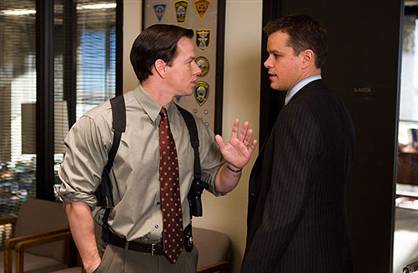
Shortly before losing his Mom and finding that strange note from Costello, Costigan was ejected from the Boston State Police Academy. He's not "Staties" material, apparently, what with his family's criminal background and underworld connections, and his own history of violence. However, Captain Oliver Queenan (Martin Sheen) and the hotheaded Staff Sgt. Dignam (Mark Wahlberg in his best performance to date) see an opportunity in this damaged young man, who has spent his entire young life straddling the middle-class world of the North Shore with his father's neighborhood of South Boston.

They want to send him undercover into Costello's gang, first by sending him to prison to establish his scumbag credentials. What Queenan and Dignam don't know is that Costello has a mole of his own, the brand-new Staff Sgt. Colin Sullivan (Matt Damon), who has kept his close childhood connection to the gangster successfully under wraps.

It's an ingenious set-up that allowed Lau to mine territory similar to the old Hong Kong classics of John Woo. The duality of law enforcement, how the cops spend so much time working with and observing criminals that the distinction between the two groups becomes hopelessly blurred, looms large over both the Hong Kong and American films. (In an early monologue, Costello wonders aloud whether one's affiliation matters when one is staring down the barrel of a gun. He seemingly concludes that it does not.)

Scorsese works with a much larger canvas, using the cat-and-mouse game of Costigan and Sullivan to explore the vagaries of organized crime in the city of Boston. (We even get a nice little history of urban conflict in Beantown before the opening credits.) The FBI, the Irish mob, the Italian mob, the families of South Boston and all the individual cops and divisions have their roles to play, and their own loyalties, and even if they are on the same side, the ultimate goals are not neccessarily compatible.

In the service of this complicated and sizable undertaking, Scorsese has enlisted a tremendous ensemble of actors, easily the best cast of any major film this year. Because many of these characters get only a few scenes to make an impression, he frequently falls back on typecasting, which ends up working rather well. Ray Winstone, as Costello's right-hand man, has shown in films like Sexy Beast that he's capable of charm and sensitivity in addition to hulking menace, so it only takes him a few moments as the psychotic Mr. French to establish his place in this universe.

Similarly, Alec Baldwin just absolutely nails Ellerby, Sullivan's superior in the organized crime task force. It's a role that seems like it must have been written specifically for Baldwin, the same speedy, gregarious geniality with flashes of buried rage that has cropped up in his performances countless times, from Malice to State and Main. Even Glengarry Glen Ross, really, although the rage isn't quite as buried.

Vera Farmiga, who first impressed me in a surprisingly well-developed role as Paul Walker's wife in Running Scared, expertly inhabits the film's lone female character. Usually, both roels would be completely thankless, particularly the concerned wife part in Running Scared, in which she would sit around the house frantically calling Paul Walker and weeping, desperate in the hopes that he would soon return safely to her side. But Farmiga turned that character into a steely adventuress rising to the formidable challenges faced during a crazed late-night search for her neighbor's missing child. It was great work in an above-average 2006 film that's been thus far overlooked.

If that was a nice introduction, her work here is award-worthy. As the sexy but not-terribly-professional police psychiatrist Madolyn (I forget the character's last name and it's not on IMDB), romantically involved first with Sullivan and then Costigan, she manages to subtly project fear and doubt throughout the film without ever bringing these emotions to the surface. At least, not until the very end.

Unfortunately, she's denied one final scene that's implied but not shown, and it would really have wrapped up her character's arc nicely and provided the actresses with a great close-up moment. A film that already clocks in at 160 minutes should be able to make room for a powerful 2-minute-or-less moment near the end.

There are some difficult scenes to navigate with her and Damon, where we're not sure exactly how much she suspects about his odd cell phone calls and suspicious excuses. Even when we know she's being lied to and decieved, Farmiga never comes off as a victim or a simpleton. Maybe she has swallowed some of the bullshit Sullivan's been spreading around, but she's not exactly an easy mark.


Sullivan has been telling Madolyn some fairly considerable lies, after all, but it's eventually the smaller, personal ones that reveal his true nature. After their first night together, Madolyn wants to set his mind at east about his erectile dysfunction - she insists it's not a problem, but he clams up and refuses to discuss the issue. Later on, Ellerby makes a joke about the usefulness of having a spouse - it lets other women know "that your dick works and that you know how to use it."

Rather than just laugh at this off-color bit of humor, Sullivan feels the need to over-compensate. "Oh, I use it. All the time," he responds. It's a bit of an awkward moment, all in all, just one of many scenes in The Departed examing the effectiveness and practicality of deceit.

Obviously, the plot concerns a variety of lies piled on top of one another. Neither Sullivan, a crook pretending to be a cop, nor Costigan, a cop pretending to be a crook, are being up-front about their real identities. Costigan comes to define his mission in the end not as one of seeking justice or getting revenge, but of getting his identity back. If he can stop lying, he can become himself again. And in the course of finding himself, and Sullivan, he will peel back the curtain on all manner of other lies - unexpected informants, inter-agency secrets, secret alliances and just plain corruption.

But Scorsese also implies that these are two men who are lying to themselves about their true nature. Sullivan spends so much time pretending to be a nice guy, particularly with Madolyn, he's come to believe that this is the dominant side of his personality. He describes to her all activities relating to the cops and to Costello as "my work," and this is probably how he compartmentalizes his dual nature within his own mind. There are the things he does for his boss, which are conniving and brutal and villainous, but they no more define him as a person than the brave, honorable cop character he pretends to be during the day.

Costigan thinks he has a score to settle, the impulse that drives him to the police academy in the first place. But he'll discover over the course of the film that he has no stomach for life in the streets. DiCaprio falls back on some of his favorite acting tricks in some of these scenes - furrowing the middle of his forehead and he slugs Oxycontin to forget the gruesome horrors he has witnessed under Costello's tutelage - but his performance works almost in spite of itself.

(In general, I find him overly mannered as an actor, kind of a male version of Jennifer Jason Leigh. Both are capable of doing great work but they also tend to turn in ornamental performances, in which exaggerated body language and far-out accents stand in for actual emotional resonance.)

Thankfully, in The Departed, his occasionally less-than-convincing Boston accent makes sense in the context of the film - splitting his time between two different neighborhoods has given him a muddled, unclear sense of geographical and social identity.

Which, of course, brings us to Nicholson's Costello, the only person in the movie who does not feel conflicted about his place in the world. He opens the film by describing to a group of assembled children exactly who he is and where he fits in. He's the alpha dog, the guy who sees what he wants and takes it unapologetically, and that's how he was able to take this neighborhood away from the black and Italian gangs. (Though he doesn't use nomenclature as polite as "black" or "Italian".)

When Costigan points out that he should leave the life, that he no longer needs any of the money he's earning from crime, Costello retorts that he has never really needed the money. He doesn't even need the thrill. He does it because he can. At 70 years old, he's still the man in charge and no one can touch him, and every time he organizes the coke deal or sells a bunch of smuggled microchips to the Chinese, he's reasserting his dominance over the entire city of Boston over and over again. Our first glimpse of Costello, before we've even seen his face, is of him shaking down a small business owner for $25 and then sexually harrassing the man's adolescent daughter. He doesn't need that money nor is he actually going to fuck that girl (at least, for a few years). He just likes to remind everyone who's in charge.

Nicholson takes the role about as far as any actor on Planet Earth could have. I could see critics calling him out for overacting, even scenery-chewing, and again Scorsese chooses to have him play directly into his persona rather than creating an original character from whole cloth. But he's just so dynamic in this kind of a role. Depraved and murderous, sure, but so damned affable and nonchalant about it, the result is irresistable. This is definitely his best performance since The Pledge, another criminally underappeciated film, and it certainly looks like the most fun he's had making a movie in a very long time.

It has been rumored that Jack made up much of his own dialogue, but much of the credit for the entire film's success must go to the incredibly dense, layered, nuanced and fall-down funny script by William Monahan.

His only other produced screenplay was for Ridley Scott's Kingdom of Heaven, and though that wasn't really a bad film, it didn't show off this guy's flair for dazzling crudity. There's a Mamet-esque quality to some of the writing here, particularly the hilariously aggressive Bad Cop manner of Wahlberg's Dingam. Seriously, this guy is among the most unrelenting assholes in modern cinema. Conceiving of a character like this is every cop movie writer's dream.

In the hands of a rank amateur, Monahan's script would have still made for a solid film. In the hands of Martin Scorsese, with expansive if unusually subdued cinematography by Michael Bauhaus, it's a good deal better than that. There are a few missteps. The final shot, in which an actual rat crawls along the railing of Sullivan's patio, gets a laugh at exactly the wrong moment. Some of the classic rock musical cues, long a Scorsese trademark, are equally ill-conceived. I mean, what's with using The Stones' "Gimme Shelter" in two inappropriate places in the film? He already used that song in Goodfellas anyway. In fact, there's entirely too many overplayed, famous classic rock tracks in the film, to the point where a lot of the music serves as a distraction.

I'm also not certain what the deal is with this version of "Comfortably Numb" that plays over a sex scene (already an odd choice), whether it's Roger Waters live or some other band, but it kind of sucks and just doesn't work with the context of the scene at all.

There were a few key soundtrack selections I liked. John Lennon's "Well Well Well" perfectly compliments a funny/disgusting back-and-forth between Costigan, Mr. French and Costello and the Celtic punk of The Pogues fits ideally into the film for obvious reasons.

Minor nitpicks aside, this is a remarkable, invigorating late-career success for arguably America's greatest living actor and arguably its greatest living director. Easily, EASILY, my favorite film of 2006 thus far.

Wednesday, October 04, 2006

Why Don't Congressmen Use Bookmarks?

Because they just like to bend over the pages.

Hi-o!

[If that's not enough Foley-related comedy gold for you, here's a photo of the Indistinguished Gentleman from Florida receiving the "Rough Rider" award. You're welcome.]

Tuesday, October 03, 2006

She Blinded Me With Bias

Every once in a while, I check in with Andrew Sullivan, even though he annoys the hell out of me. He has one of the most popular blogs on the Intar-Web, and even though he's a conservative scumbag, he nonetheless agrees with me on most of the major issues of the day - Bush is an idiot, torture is wrong. You know, traitorous cut-and-running, that sort of thing. This is the result of having a crazed radical like Bush in the White House. People who never agree on anything can unite in the spirit that the President is a complete asshole.

Anyway, Sullivan is in kind of a tough spot these days. He's basically admitted that a small minority of Democrats and a vast majority of left-wing bloggers, typically his sworn enemies, were right all along about the Iraq War being a huge miserable fucking mistake. See, Sullivan was for the war at first, and went so far as to imply that those who opposed the war were un-American appeasers. Now he's on our side, that is the side of Americans with any lingering morsel of common sense, but still can't really admit that he's on our side, so he regularly invents new and increasingly ludicrous reasons why liberals are wrong even when they are clearly right.

Thus, he gets to have it both ways...Conservative who mocks fluffy, hippie-inspired lib'rul thinking, but also rational thinking man of the political center. It's lame.

I've seen him make all manner of twisty, convoluted arguments for why liberals don't get to be right about Iraq even though they were totally right. (Check out this post, where I discuss one of his more retarded assertions - that Dick Cheney was more right about WMD's in Iraq than Al Gore is right about global warming, even though we already know Dick Cheney was completely wrong and the verdict is still out on Gore's conclusions.)

Today's patently ridiculous paragraph may just take the prize for Stupidest Andrew Sullivan Post. Of the month thus far. (No, there's no actual prize. There wasn't any such thing as a Braffy either. Deal with it.) His punditry has come loose from even a semblance of rationality. It's utter nonsense. He might as well have typed a blog post suggesting that President Bush take a bite of the Caterpillar's mushroom before challenging the Queen to a game of croquet.

The weirdest part is, Andrew didn't even write the bulk of the post. It's a quote from a Washington Post story about a researcher looking into "hindsight bias." Yeah, "hindsight bias." Can you tell where this is going?

"Liberals' assertion that they 'knew all along' that the war in Iraq would go badly are guilty of the hindsight bias. This is not to say that they didn't always think that the war was a bad idea. It is to say that after it was apparent that the war was going badly, they assert that they would have assigned a higher probability to that outcome than they really would have assigned beforehand," - Hal Arkes, a psychologist at Ohio State University, who has studied "hindsight bias" and how to overcome it.

So, liberals such as myself, who said that the Iraq War was a huge mistake from the very beginning didn't really think it was likely to be a huge mistake. We only think that we did now because of "hindsight bias." Ah, I see. Perhaps this is why the albums that I think are my favorites at the end of the actual year never wind up being the ones I continue to like the best well into the future.

"You may have thought that Fiona Apple album was the recording of the year," I think to myself, "but be honest...You haven't put 'Extraordinary Machine' on in months and you still listen to Wolf Parade and The National all the time."

Now, finally, I can udnerstand this phenomenon! Thanks, Dr. Arkes.

What I'm saying is, this idiocy is not 100% Andrew Sullivan's fault. But please do note the fact that he finds it blog-worthy. He will grasp at any argument, no matter how lame, to try and equate the sins of liberals with the sins of conservatives (and more specifically, neo-conservatives.)

Of course, this mission is, at its very core, irrational. Not only because no influential members of the Left are as insane as the cabal currently in power (although that's true.) But because no one in the Left has been able to do anything that significant in our government for 6 years now. They are shut out of every decision and every policy. Sure, they can occasionally raise a stink and get some mention in a newspaper, but obviously the crimes of Republicans as of late will be worse than the crimes of Democrats. Republicans are the only ones in charge!

Okay, I'm done with Andrew. He's kind of an idiot, but he's an amusing idiot. Let's take a closer look at this Washington Post article to which he favorably linked.

Antiwar liberals last week got to savor the four most satisfying words in the English language: "I told you so."

I hate this article already. No one I know who was against the war in 2003 is "savoring" anything now. We don't feel "satisfied." We're all fucking miserable. This past six years has resembled a car accident (and I've been in a car accident). You can see the center divider coming, you're spinning out of control, you know impact is imminant, and time kind of slow sdown for a second. It's a horrible, horrible feeling to know you're about to crash into something, hard, and that's how I've felt for a long time.

I'm not savoring being right. Of course, I wish I had been wrong. I wish the war took three days and Bush got to feel better about himself and he coasted through the rest of his term and then everyone got sick of him, because he's an idiot, and voted for the next criminal Republican goober asshole with enough money to run a national campaign. Seriously. I'm right about stuff all the time, it's not that big of a deal to me. I'd much rather thousands of Americans and even more Iraqis were still untortured and fucking alive, asshole.

Only a goddamn warmongering right-wing fucktard would even be thinking about the Iraq War in these kinds of terms. Focusing on who has fucking bragging rights? Writer Shankar Vidantam, are you serious? This is the Washington Post! How about a little decorum? How about you just tell the news without making it into some kind of fucking role playing game!

This was after a declassified National Intelligence Estimate asserted that the war in Iraq was creating more terrorists than it was eliminating. For millions of people who opposed President Bush's mission in Iraq from the start, this was proof positive that they had been right all along. Yes, they told themselves, we saw this disaster coming.

Only . . . that isn't quite true.

Um...yes, it is.

Trust me. I mean, Shankar didn't interview me for this article. I can't imagine why. I could have told him that, as a regular but casual newspaper reader with no actual international relations or foreign policy experience, I knew in early 2003 that this entire war would be a huge disaster. A lot of people knew that. A LOT. Mainly, I was just hearing it from them, and the arguments made sense so I listened attentively.

The thing was, everyone ignored these people. Newspapers, cable television, talk radio, Congress. For those sources, it was The Bush Line ALL THE TIME, so I could see how an intellectually lazy and fundamentally disinterested person might think that everyone agreed that the conflict would go swimmingly. But we all didn't. Take my word for it.

Shankar does put himself in kind of a tight spot, rhetorically speaking. How can you prove that no liberals had a clear and accurate sense of how the war would go before it started? (A better question might be...what is the point of such a discussion, but since Shankar has brought it up in one of the nation's leading newspapers, I'll ignore this point for now.)

Accordingly, he doesn't even try to back up this assertion, but moves right into discussing a tangentially-related psychological phenomenon. Yeah, that's more in the spirit of true journalism...Just drop an inflammatory suggestion in there with no evidence, then move on. William Randolph Hearst would be very proud. Remember the Maine!

One of the most systematic errors in human perception is what psychologists call hindsight bias -- the feeling, after an event happens, that we knew all along it was going to happen. Across a wide spectrum of issues, from politics to the vagaries of the stock market, experiments show that once people know something, they readily believe they knew it all along.

It's not unlike deja vu, that strange feeling we sometimes get...that we've lived through something before.

Now, what was I going to say? Oh, I'm sorry...I've just had the strangest feeling of hindsight bias. But it seems to have passed for now.

This is not to say that no one predicted the war in Iraq would go badly, or that the insurgency would last so long. Many did.

Exactly. Wait, but ...Shankar...didn't you just say that liberals didn't really see the Iraq disaster coming? Or am I just experiencing some more of that hindsight bias stuff?

But where people might once have called such scenarios possible, or even likely, many will now be certain that they had known for sure that this was the only possible outcome.

Hindsight bias clearly exists. When really good or really bad things happen, we all get a sensation of inevitability. As if this were the only way things could have turned out, even though it was more likely just a random confluence of events.

For example, about a year ago, I had been having some sporadic car trouble, but I decided to make a late night trip to the video store anyway, just because I was bored and wanted to grab some new rentals. As I'm leaving the store, driving down Pico Boulevard, the car just stalled out. Just stopped dead in its tracks. And as I'm pushing it to the side of the road and getting out my phone to call AAA, I'm just furious with myself. "Why would I take the car out at night? I knew this was going to happen!"

Of course, I had no idea the car would choose that moment to break down. But still, my immediate regret caused me to have the fantasy that this had been a forseeable, and therefore preventable, occurance rather than just unfortunate timing.

Clearly, this would apply to some people's feelings about the Iraq War. People who had no real opinion about it at the time, or who felt that it was probably a mistake but weren't sure what would actually happen, might very well feel now that our failure was predictable. This is not the sort of thing that could be analyzed statistically, but I'm sure it occurs.

However, it's not only unfair but nonsensical to apply this standard to everyone in the anti-war camp. Yes, hindsight bias exists. What's your point?

Here's Shankar's essential argument:

Even though many liberals were right about the Iraq War, they didn't have 100% absolute certainty all along that they were right, thus decreasingly their overall level of correctness. Go Bush.

Sound reasonable to you?

Next up in the article comes the Arkes quote that Sullivan excerpts. Is an OSU psychology professor really qualified to make blanket declarations about a group as massive and diverse as "liberals"? I mean, "liberals are guilty of a hindsight bias"? How does he know? To make an accurate scientific survey of liberals and their attitudes on the Iraq War, you'd need one hell of a large, random sampling of left-wing Americans. Somehow, I doubt Prof. Arkes has gone to this much trouble.

The hindsight bias plays an important role in public debate, because it gives people a false sense of certainty. When people convince themselves that they knew something would happen, what they effectively ignore is how much that outcome may have been unpredictable.

In place of accuracy, what the hindsight bias seems to offer is a form of comfort. It is easy to be confident about the past, because one cannot be proved wrong.

Welcome to Fantasyland, where even when you are 100% right, YOU'RE STILL WRONG! Shankar's stating that liberals, who were right about the Iraq War, are taking solace in a hindsight bias, because it means that they cannot be proved wrong! Awesome!

Maybe it's me, but shouldn't psychologists be focusing their attention on the large number of delusional Americans who can't bring themselves to admit that this entire Iraq debacle has been and will continue to be a monumental disaster for both of our nations? If you had a choice between psychoanalyzing a group of people who may be acting a bit smug after their attitudes had been proved repeatedly correct or a group of people who sadistically continue to send waves of their own troops into battle ill-equipped and with no clear-cut mission because of abstract concepts like "Spreading Freedom"...oh, never mind...It's not even worth it.

I'd also like to pause to note that this is supposed to be a news article, not an editorial. The top of the page announces that it's a DISPATCH FROM THE DEPARTMENT OF HUMAN BEHAVIOR, like I'm going to read about ACTUAL BEHAVIORAL SCIENCE and not some weasels attempt to blame me for actually having some sense of what the fuck I'm talking about some of the time.

Look, I'm not saying I'm some Middle-East expert who predicted everything that has happened since 2003. That's my whole point! If I knew better all this time, why didn't anyone actually running the country? How was it that our President thought the mission was accomplished 3 years ago? And how is it that, in a country with leadership that fucked up, the Washignton Post is reporting about how all the anti-war people weren't correct enough in their pre-war disaster assessments?

The article goes on for a while describing hindsight bias and giving non-Iraq examples, as if proving that the phenomenon exists will magically make it applicable to this situation. It's not even remotely convincing.

But check out this part (on the second page, of course, after you click through and wait for a pop-up ad to load):

In yet another experiment, Baruch Fischhoff, a psychologist at Carnegie Mellon University and a pioneer in the field of hindsight bias, found that Americans who made estimates about their danger after the Sept. 11, 2001, attacks recalled having made much lower estimates of risk a year later, after their fears failed to materialize.

Fischhoff testified about psychological factors in judgment at a meeting of the House intelligence committee last week.

While hindsight bias in the context of the Iraq war was real, the psychologist cautioned in an interview against misuse of the idea -- the argument by many supporters of the Bush administration that it was impossible to know ahead of time how the war would turn out.

I mean...wow...wow...That is bullshit on an almost admirable level.

First off, this study does not discuss hindsight bias in the context of the Iraq War. That's proof that hindisight bias existed in the context of the 9/11 attacks! Which, as the past several years of grinding and pointless conflict have continually affirmed, had nothing at all to do with the fucking war in Iraq, idiot!

Secondly, he's forced...in the article...to admit that his thesis is fundamentally flawed. "THE PSYCHOLOGIST CAUTIONED IN AN INTERVIEW AGAINST MISUSE OF THE IDEA!" That means, "bringing this topic up in the context of the Iraq War will most likely be misleading and should be avoided." Oh, Shankar...He's telling you it's not news, and then you write a news article including his quote that it's not news.

Folks, this is straight-up propaganda. No doubt about it. This is a plant. A story designed to make people distrustful of anyone speaking out against the war. "Sure, if may seem like they were right all along, but they just got lucky. No one knows anything about the future, it's all a murky unknowable mystery. Even people who know some things about what might happen are retroactively ignorant because of this here hindsight bias. So why not continue to support the President and his cruel war machine?"

And, of course, it wouldn't be authoritarian right-wing propaganda without a dig at bloggers:

Indeed, research by both Fischhoff and Arkes show that people can fight the hindsight bias only when they honestly and systematically try to explain how different outcomes are possible. Such self-doubt is the exact opposite of how modern politics works: In the age of the blogosphere, certitude is king.

PROJECTION ALERT! Blogs are an interactive medium. If you get something wrong, and you have comments open (and most anti-war bloggers do), people will come and tell you when you're wrong. Blogs can also be edited easily, at any time, and are often written in a casual, conversational, stream-of-consciousness manner. They are absolutely not about certainty. Maybe half of the blog posts I read begin with, "I might be crazy but..." or "This looks to me like..." You know who always sounds 100% certain about every ridiculous assertion they make...Writers for the Washington Post!

There's more to the article, but I'm actually so angry I can't continue to blog about this right now. Just go read it for yourself and maybe drop Shankar an e-mail and let him know that you think he's a soulless shill. That's what I did.

Sunday, October 01, 2006

The Manchurian Masturbate

I am dismayed but not surprised at recent revelations that Congressional Republican leaders looked the other way while a colleague sexually harrassed (one or more) underage boy(s). If this isn't completely symptomatic of the direction in which this country is headed...Our young people can't even apprentice in Washington and learn the business of government without being subjected to crude and inappropriate perversity from our elected officials. I say this without hyperbole - we are being led right now by the absolute worst men of their generation. The good, resopnsible individuals of my parents' age went into the private sector and left the job of governing to the irreponsible, the vacant, the prejudiced, the incurious and the corrupt.

Pier Pasolini's controversial film Salo reinterprets a Marquis de Sade story, a satire of the aristocracy, as a critique of Italian fascism. It tells the story of a group of privileged, elite men - a President, a Magistrate, a Duke and a Bishop - who kidnap a large group of poor chidlren, take them to a remote country manor and spend several weeks torturing and sodomizing them, subjecting the kids to every disgusting cruelty they can devise. It's literally sadistic. Literally.

The film's almost impossible to watch - let's not even discuss the banquet scene - but it does have a lot to say about the nature of power. Because so much of their wealth and privilege has been inherited rather than earned over the course of their lifetime, Pasolini implies that these men have not neccessarily been corrupted by power. Instead, they are endlessly seeking power in order to realize their depraved impulses.

In other words, it's not that a normal man finds himself suddenly empowered over others and then wants to start raping and murdering children. Obviously, giving one man power over another creates a psychological response, as in the infamous Stanford Prison Experiment. But does it lead neccessarily to gross perversions (like, say, sexually harrassing teenage boys who are in your employ)? Or is it that the people who get off on power, who seek it out by, say, running for Congress in league with a corrupt, theocratic majority party, are also frequently perverts.

I'm inclined to believe the latter. I think men like Rep. Mark Foley (R-NEVERLAND) crave power, both in their personal and professional lives. Just as he wanted to boss people around via legislation (particularly anti-gay legislation) in the public sphere, he wanted to have sex with submissive children whom he could dominate completely. I mean, we're talking about a Congressman hitting crudely on his 16 year old interns! This is not merely a disgusting, illegal and inappropriate fetish. (Although it is all those things.) This is a serious psychological disorder.

As for the fact that all the other Republicans who knew about it covered it up, for fear of losing the seat and their majority, I'd say they should be ashamed of themselves...But who am I kidding? These men are incapable of shame. They are also perfectly willing to steal an election, which I'm becoming convinced will be mandatory if they want to retain their power for much longer. Americans don't seem to care very much about torture or civil rights or wars or floods, but they do love a nice, disgusting sex scandal.

So this will probably be in the news for a while, which is significant not just because it makes Republicans look like the perverts that they are, but because it eats up valuable time they'd be using the slam Democrats. This was the week they were hoping to hit hard on national security, the victory lap after John McCain's Grand Torture Compromise, which allows Bush to define torture and then decide who will be tortured and how they will be tortured. It was quite a compromise.

Instead, they'll have to spend the whole week lying about when they first found out their colleague Mark sometimes asked young boys about their favored masturbatory techniques. Hey, he liked to rap with the kids! Isn't connecting with the young people on the issues that matter to them what being an elected Representative is all about? It's less than ideal one month before an election.

It's just strange to me that authoritarian assholism and twisted sex offenderism always go together like this. If only we could isolate the exact factors that cause a person to become power-mad, sanctimonious, narcissitic, attracted to kids and gleefully immoral all at once, there might be a way to devise a cure! Now that they've mapped the Human Genome, can such solutions really be that far off?

Saturday, September 30, 2006

Two With William H. Macy

The masculine half of celebrity couple Filliam H. Muffman stars in two low-budget indies coming to DVD this Tuesday. Only one of them, the Stuart Gordon-David Mamet collaboration Edmond is worth your valuable time. The alternative, Thank You For Smoking, did in fact make me want to take up smoking...black tar heroin. Anything to escape the wrenching pain of this insipid attempt at "satire."

Edmond


Depressed businessman Edmond (Macy) leaves the office bound for home, but stops for a moment to visit a psychic. This is not normally the sort of thing Edmond would think to do, we gather, but he's feeling restless and out of sorts. The psychic does a tarot card reading, replete with ominous music and ambiguous symbology, and then tells Edmond:

"You are not where you belong."

Edmond seems to have already known that, yet the news leaves him deeply troubled. He goes home and breaks it off with his wife of seven years (Rebecca Pidgeon) , who seems more than a little taken aback by the news. He chats with a philosophical, charming racist (Joe Mantegna). Then he goes out looking to pay for sex.

David Mamet's screenplay adapts one of his earliest theatrical works for the screen and comes up with a lurid fantasy of a timid middle-class everyman's descent into madness. Think of it as a thinking man's Falling Down, with an existential crisis in place of that film's limp socio-economic critique.

Director and so-called "Master of Horror" Stuart Gordon trades in the schlocky gore theatrics of his most famous work (Re-Animator), save for one particularly brutal sequence, but nonetheless infuses this film with the best aspects of his previous films - gallows humor, lurid saturated color and actor Jeffrey Combs (who pops up in one scene as a clerk in a dirtbag motel.) Edmond is surprisingly cinematic for an adaptation from the stage, zipping around multiple locations and employing a large ensemble.

Many of these small, supporting turns go to celebrities, which can at times get distracting. George Wendt taking a few lines as a pawn shop owner of questionable morals works really well, as does Mena Suvari's very funny turn as a high-class prostitute with a quick temper. But I'm not as sure about Denise Richards, whose presence in the film serves no purpose other than getting her on to the DVD box.

Edmond encounters all these peculiar eccentrics on his late-night quest for female companionship but he can never seem to get the procedures down. He constantly argues over how much he will have to pay, offering a variety of opening prices and then growing frustrated with the ensuing negotiation. Other times, he rejects the very format of pornographic entertainment that he seeks, wondering aloud why strippers won't have sex with him or pimps need to charge for their services. In one scene, he has a temper tantrum when he realizes that a peep show dancer (Bai Ling) will remain behind a glass partition.

He grows increasingly alienated and paranoid by his failure to find a willing woman. He pawns his wedding ring and buys an old knife, and the film transitions from a drama about the emptiness that hides behind the mundane activity of daily life into a psychological horror film. As in some of his later works, when the pressures of modern life and work push rational men over the edge and into insanity, Mamet sketches Edmond as a person who has always had rage and resentment bubbling under a facade of calm, but who managed to somehow keep these emotions in check for years.

Unfortunately, when he tries to free himself from the rut that his life has become, when he opens himself up to new experiences, all of these suppressed urges are suddenly released into his ill-prepared mind. He can't grow as a person without regressing.

The bittersweet and unexpected conclusion also says a lot about fate. Just as the psychic predicted, Edmond was not where he really belonged, and maybe all of the terrible things that happened to him were neccessary for him to find some sense of security and well-being. I'm not sure David Mamet nor I actually believe in the implications of that interpretation of the film - that everything happens so that people can wind up in the place where they belong - but it's certainly a nice thought.

Thank You For Smoking

I'd call the pseudo-satirical Thank You For Smoking "toothless," but that would be an insult to professional hockey players and Mountain Dew fans everywhere. A woeful combination of flimsy libertarian blather and cynicism, Smoking clearly yearns for the incisive bite of Alexander Payne's Citizen Ruth or Election, but also tries to work in a lazy Jerry Maguire story about a slick suit who discovers a void in his personal life. These two types of filmmaking don't go together. At all. But writer/director Jason Reitman's script also lacks the wit or the perspective on Big Tobacco to make any of his lame critiques actually count for anything. His films gives up on even taking a position on the Tobacco Industry, cigarette warning labels or any of the other issues raised, opting to make the story about one boring ficitonal character's journey from self-satisfied loudmouth asshole into even more self-satisfied loudmouth asshole.


It's not like there isn't ample material available for a satire on cigarettes in America. In one corner, you have massive, greedy corporations who not only produce a product that they know kills millions around the world but who purposefully make it more dangerous and addictive to increase their profits. In another, you've got weepy martyrs who secretly desire a Nanny State to tell them exactly who to live their lives, insisting that the private vices of others are somehow their own personal business. Finally, you have opportunistic politicians who pretend to care about public health issues but really just want to get on television as much as possible. All of these real circumstances could be exploited in a sharp, funny comedy.

That's just not this comedy. Instead, Reitman (working from a book by Christopher Buckley) bases his film around the rather odd conceit that tobacco lobbyists are ingenious dynamos who manipulate everyone around them for the benefit of greedy tobacco executives. The entire Tobacco Industry is really an extension of lobbyist Nick Naylor's (Aaron Eckhart) ego, and the movie treats it as such.

Thus, no aspect of the cigarette business and the way it is conducted gets anything but a cursory, superficial examination. We meet the head of the Tobacco lobbying association (J.K. Simmons) and his boss (Robert Duvall), who goes back to the old days when Big Tobacco first became Big, but combined they get maybe 10 minutes of screen time. Likewise, a Democratic Vermont Senator (Macy), the only politician featured in the film, is a mean-spirited doofus who doesn't know what he's talking about. Surprise, surprise. This is about as deep as the movie digs for laughs. A self-serving Senator who pretends to care about people but is actually really mean. Wow, what insight into the way business is conducted in our government!

Even more fatal than its willingness to trade in trite cliche, though, is that none of these characters are funny and yet the movie clearly thinks they are all incredibly funny. It's that combination of smarmy self-satisfaction and mock-bravery with an utter lack of actual humor that's the toxic cocktail bringing down Thank You For Smoking.

At the center of the Suck is the Nick Naylor character himself, despite the talented Eckhart's best efforts. In the odious and unneccessary voice-over, Naylor constantly brags about his abilities as a professional liar. He's the best in the business, the ultimate talker. What Charles Manson is to killing, Nick is to bullshit. He says, "You know that guy who always gets all the chicks? I'm that guy...on crack."

So we naturally expect him to be really clever, to constantly outwit his opponents with flashy rhetorical tricks and logic traps. Instead, over and over, he makes lame arguments of the kind you'd expect from an amateur high school team debater. It's actually kind of embarrassing that the movie finds Naylor clever and sly, when nothing he says even makes sense.

In one scene at a theme park or something, Naylor explains to his son (Cameron Bright, who by my estimation played every male child in every film released this year) why it's more important to win an argument than to be right. He proceeds to give him a lesson in that patented talking-head tactic, the Strawman Argument. We get a long painful scene where Naylor and his argue chocolate vs. vanilla, before Naylor shifts the conversation to whether or not his son would want chocolate every day for the rest of his life with no further variety.

"But I'm not convinced," his son reasonably replies. "I'm not trying to convince you," Naylor smirks. "I'm trying to convince them." He then points out to all the people milling around the park who aren't listening to him. This scene makes no sense. The point originally was that Naylor is going to teach his son how to win an argument, but in the end, all he's doing is explaining a useful device for going on Bill "Gentle Warrior" O'Reilly's show. The real point is, in terms of argumentation, he didn't convince his son that vanilla was better than chocolate, and thus doesn't "win" or prove anything.

Even more ludicrous examples of Naylor's "talent" abound. At one point, he has a moment fo sheer inspiration, devising the argument that is going to save his life and career. So he goes in front of a Senate sub-committee and argues that cigarettes shouldn't have warning labels because we don't put warning labels on artrery-clogging cheese.

I mean, are you fucking kidding me? That's a Homer Simpson argument. "I saved your life, Lenny! That egg would have killed you by cholesterol!" This guy's supposed to be the greatest tobacco lobbyist of all time?

So, okay, the movie has no insight into its choice of topic and its not funny. Normally, that would be cause for a bad review but not a total smackdown. What made me really hate the film was its cocky, smarmy attitude, the fact that the movie seems to delight in ridicule, human misery and death, and how frequently Reitman gloats about how no one or nothing can ever make a dent in corporate corruption and greed. Coming from the rich white son of a famous director (Ivan Reitman), based on a book by the rich white son of a famous writer (William Buckley), both of whom got to make the film because of family connections and inherited wealth and status, this kind of apathetic, snide approach, which essentially argues for an easy but corrupt status quo for lack of any "better" options, is just plain unappealing.

Nick meets up every week with his friends from the alcohol and gun lobby. Together, they call themselves the Merchants of Death, or the MOD Squad. Maria Bello and David Koechner, as the respective alcohol and gun proponents, give the film's only two likable performances, because they are honest and self-effacing. Bello can play this kind of laid back, one of the guy's career gal in her sleep, and Koechner's made an entire career now out of playing awkwardly macho wannabe alpha males, but these scenes with the lobbyists are really the only times when the movie slows down, stops trying to prove how smart and insightful it is and focuses on a few semi-realistic human beings in a funny, real-world situation.

Katie Holmes has the complete opposite assignment, a shrill and highly unpleasant role as an ambitious young journalist. This entire subplot, in which Nick becomes romantically involved with a reporter and discloses some of his personal feelings on his job, is both offensive unrealistic to the point of farce. We're supposed to believe a successful female reporter gets her subjects to talk to her by fucking them. We're supposed to believe the most powerful tobacco lobbyist in Washington would tell a reporter his secrets in bed. We're supposed to believe said lobbyist would then have a chance of keeping his job. It's utter, utter nonsense.

(Not to mention the conclusion of this plotline. How come the "happy ending" means that Nick gets to keep his job and status after it's disclosed that he slept with a reporter while Holmes' Heather has her career ruined? Weren't they equally culpable in any irresponsible behavior?)

It all really comes back to this lazy, bullshit laissez-faire attitude. Everything's fucked up permanantly, and there's nothing you can do about it, so just shut up and let rich people continue making their money. The Holmes storyline is a perfect illustration - this uppity bitch reporter shouldn't be making problems for Nick by using her slutty feminine wiles, cause he'll just turn it around on her and destroy her in the process. So she should just shut up and take it like everyone else. Likewise Macy's Senator. Yes, Big Tobacco is knowingly killing people, but so what? That's how they make money and that's how the world works! Get out of their face! Ugly, nihilistic stuff...

I'm not even in favor of increased warnings on cigarettes or smoking bans or anything like that. I say, if it's legal then it's legal and people should be able to smoke freely in public. (I'd make exceptions for enclosed spaces like airplanes and movie theaters, but I think restaurants and bars should be able to choose if they want to allow indoor smoking.) So I'm open to a harsh critique of the anti-smoking lobby. Likewise, I'm anti-corporate enough to enjoy any satire of greedy executives. Thank You For Smoking needed to choose a side. Just hanging out with the cold, calculating and essentially unconcerned lobbyists and goofing (badly) on everyone doesn't make you seem cool. It makes you seem terrified to make a statement.

This is easily one of the least enjoyable and obnoxious films I've seen all year. (I'm not so sure about worst, though. That's already kind of a tight competition.)