Saturday, October 07, 2006

The Departed

When South Boston native Billy Costigan (Leonardo DiCaprio) loses his mother to cancer, local ganster Frank Costello (Jack Nicholson) leaves a memorial card by her grave. It reads "May God give a place in the Kingdom of Heaven to the Faithful Departed." Or something close to that - I wasn't taking notes in the theater.

He's not asking God to give everyone a place in Heaven, everyone who is dead. You get the feeling that Frank doesn't really give a shit if most of the people he has killed got to Heaven or not. No, only the "faithful" departed, the ones who remained true to their God and to themselves, deserve a place at his divine table. It's a question of loyalty. Are you one of the chosen or ain't you?

Martin Scorsese's epic cop thriller The Departed spends a lot of time contemplating loyalty and how, in the end, it really boils down to honesty. We are truthful with those to whom we are loyal, which for most poeple is no one at all, especially not themselves. All the other people, the ones with whom we spend our lives, get whatever side of us that is most expedient and effective for that given moment.

A far superior adaptation of Andy Lau's enjoyable Hong Kong hit Infernal Affairs, The Departed provides yet another opportunity for Scorsese to apply his considerable gifts to a gritty story about crime in an American metropolis. Like the giddy autobiographical whirlwind of Goodfellas or the behind-the-scenes Mob History of Casino, the individual struggles of a few central characters stand in for the incomprehensible complexity of an entire community of thieves, murderers, cops and informants.

Unlike those films, a more detached and quiet approach has kind of removed Scorsese's presence from every moment of the film. Though intense and brilliantly executed, the action sequences and shootouts recall the films of Michael Mann more than anything by Scorsese, especially held up against the comparatively clunky action choreography in Gangs of New York. Mann's Heat was probably the last American cop movie made with this level of intelligence and sophistication. Again, as he does every few years, Martin Scorsese has directed one of the best American films of the year, and if that's not enough good news, this time it's a riveting return to the genre of blood on the pavement, broken noses and brain-smeared warehouse walls. I, for one, couldn't be more pleased.


Shortly before losing his Mom and finding that strange note from Costello, Costigan was ejected from the Boston State Police Academy. He's not "Staties" material, apparently, what with his family's criminal background and underworld connections, and his own history of violence. However, Captain Oliver Queenan (Martin Sheen) and the hotheaded Staff Sgt. Dignam (Mark Wahlberg in his best performance to date) see an opportunity in this damaged young man, who has spent his entire young life straddling the middle-class world of the North Shore with his father's neighborhood of South Boston.

They want to send him undercover into Costello's gang, first by sending him to prison to establish his scumbag credentials. What Queenan and Dignam don't know is that Costello has a mole of his own, the brand-new Staff Sgt. Colin Sullivan (Matt Damon), who has kept his close childhood connection to the gangster successfully under wraps.

It's an ingenious set-up that allowed Lau to mine territory similar to the old Hong Kong classics of John Woo. The duality of law enforcement, how the cops spend so much time working with and observing criminals that the distinction between the two groups becomes hopelessly blurred, looms large over both the Hong Kong and American films. (In an early monologue, Costello wonders aloud whether one's affiliation matters when one is staring down the barrel of a gun. He seemingly concludes that it does not.)

Scorsese works with a much larger canvas, using the cat-and-mouse game of Costigan and Sullivan to explore the vagaries of organized crime in the city of Boston. (We even get a nice little history of urban conflict in Beantown before the opening credits.) The FBI, the Irish mob, the Italian mob, the families of South Boston and all the individual cops and divisions have their roles to play, and their own loyalties, and even if they are on the same side, the ultimate goals are not neccessarily compatible.

In the service of this complicated and sizable undertaking, Scorsese has enlisted a tremendous ensemble of actors, easily the best cast of any major film this year. Because many of these characters get only a few scenes to make an impression, he frequently falls back on typecasting, which ends up working rather well. Ray Winstone, as Costello's right-hand man, has shown in films like Sexy Beast that he's capable of charm and sensitivity in addition to hulking menace, so it only takes him a few moments as the psychotic Mr. French to establish his place in this universe.

Similarly, Alec Baldwin just absolutely nails Ellerby, Sullivan's superior in the organized crime task force. It's a role that seems like it must have been written specifically for Baldwin, the same speedy, gregarious geniality with flashes of buried rage that has cropped up in his performances countless times, from Malice to State and Main. Even Glengarry Glen Ross, really, although the rage isn't quite as buried.

Vera Farmiga, who first impressed me in a surprisingly well-developed role as Paul Walker's wife in Running Scared, expertly inhabits the film's lone female character. Usually, both roels would be completely thankless, particularly the concerned wife part in Running Scared, in which she would sit around the house frantically calling Paul Walker and weeping, desperate in the hopes that he would soon return safely to her side. But Farmiga turned that character into a steely adventuress rising to the formidable challenges faced during a crazed late-night search for her neighbor's missing child. It was great work in an above-average 2006 film that's been thus far overlooked.

If that was a nice introduction, her work here is award-worthy. As the sexy but not-terribly-professional police psychiatrist Madolyn (I forget the character's last name and it's not on IMDB), romantically involved first with Sullivan and then Costigan, she manages to subtly project fear and doubt throughout the film without ever bringing these emotions to the surface. At least, not until the very end.

Unfortunately, she's denied one final scene that's implied but not shown, and it would really have wrapped up her character's arc nicely and provided the actresses with a great close-up moment. A film that already clocks in at 160 minutes should be able to make room for a powerful 2-minute-or-less moment near the end.

There are some difficult scenes to navigate with her and Damon, where we're not sure exactly how much she suspects about his odd cell phone calls and suspicious excuses. Even when we know she's being lied to and decieved, Farmiga never comes off as a victim or a simpleton. Maybe she has swallowed some of the bullshit Sullivan's been spreading around, but she's not exactly an easy mark.
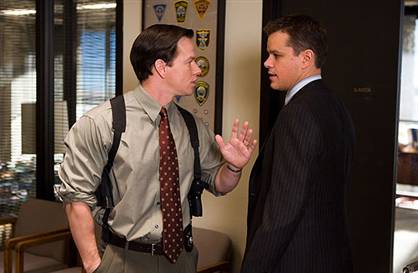


Sullivan has been telling Madolyn some fairly considerable lies, after all, but it's eventually the smaller, personal ones that reveal his true nature. After their first night together, Madolyn wants to set his mind at east about his erectile dysfunction - she insists it's not a problem, but he clams up and refuses to discuss the issue. Later on, Ellerby makes a joke about the usefulness of having a spouse - it lets other women know "that your dick works and that you know how to use it."

Rather than just laugh at this off-color bit of humor, Sullivan feels the need to over-compensate. "Oh, I use it. All the time," he responds. It's a bit of an awkward moment, all in all, just one of many scenes in The Departed examing the effectiveness and practicality of deceit.

Obviously, the plot concerns a variety of lies piled on top of one another. Neither Sullivan, a crook pretending to be a cop, nor Costigan, a cop pretending to be a crook, are being up-front about their real identities. Costigan comes to define his mission in the end not as one of seeking justice or getting revenge, but of getting his identity back. If he can stop lying, he can become himself again. And in the course of finding himself, and Sullivan, he will peel back the curtain on all manner of other lies - unexpected informants, inter-agency secrets, secret alliances and just plain corruption.

But Scorsese also implies that these are two men who are lying to themselves about their true nature. Sullivan spends so much time pretending to be a nice guy, particularly with Madolyn, he's come to believe that this is the dominant side of his personality. He describes to her all activities relating to the cops and to Costello as "my work," and this is probably how he compartmentalizes his dual nature within his own mind. There are the things he does for his boss, which are conniving and brutal and villainous, but they no more define him as a person than the brave, honorable cop character he pretends to be during the day.

Costigan thinks he has a score to settle, the impulse that drives him to the police academy in the first place. But he'll discover over the course of the film that he has no stomach for life in the streets. DiCaprio falls back on some of his favorite acting tricks in some of these scenes - furrowing the middle of his forehead and he slugs Oxycontin to forget the gruesome horrors he has witnessed under Costello's tutelage - but his performance works almost in spite of itself.

(In general, I find him overly mannered as an actor, kind of a male version of Jennifer Jason Leigh. Both are capable of doing great work but they also tend to turn in ornamental performances, in which exaggerated body language and far-out accents stand in for actual emotional resonance.)

Thankfully, in The Departed, his occasionally less-than-convincing Boston accent makes sense in the context of the film - splitting his time between two different neighborhoods has given him a muddled, unclear sense of geographical and social identity.

Which, of course, brings us to Nicholson's Costello, the only person in the movie who does not feel conflicted about his place in the world. He opens the film by describing to a group of assembled children exactly who he is and where he fits in. He's the alpha dog, the guy who sees what he wants and takes it unapologetically, and that's how he was able to take this neighborhood away from the black and Italian gangs. (Though he doesn't use nomenclature as polite as "black" or "Italian".)

When Costigan points out that he should leave the life, that he no longer needs any of the money he's earning from crime, Costello retorts that he has never really needed the money. He doesn't even need the thrill. He does it because he can. At 70 years old, he's still the man in charge and no one can touch him, and every time he organizes the coke deal or sells a bunch of smuggled microchips to the Chinese, he's reasserting his dominance over the entire city of Boston over and over again. Our first glimpse of Costello, before we've even seen his face, is of him shaking down a small business owner for $25 and then sexually harrassing the man's adolescent daughter. He doesn't need that money nor is he actually going to fuck that girl (at least, for a few years). He just likes to remind everyone who's in charge.

Nicholson takes the role about as far as any actor on Planet Earth could have. I could see critics calling him out for overacting, even scenery-chewing, and again Scorsese chooses to have him play directly into his persona rather than creating an original character from whole cloth. But he's just so dynamic in this kind of a role. Depraved and murderous, sure, but so damned affable and nonchalant about it, the result is irresistable. This is definitely his best performance since The Pledge, another criminally underappeciated film, and it certainly looks like the most fun he's had making a movie in a very long time.

It has been rumored that Jack made up much of his own dialogue, but much of the credit for the entire film's success must go to the incredibly dense, layered, nuanced and fall-down funny script by William Monahan.

His only other produced screenplay was for Ridley Scott's Kingdom of Heaven, and though that wasn't really a bad film, it didn't show off this guy's flair for dazzling crudity. There's a Mamet-esque quality to some of the writing here, particularly the hilariously aggressive Bad Cop manner of Wahlberg's Dingam. Seriously, this guy is among the most unrelenting assholes in modern cinema. Conceiving of a character like this is every cop movie writer's dream.

In the hands of a rank amateur, Monahan's script would have still made for a solid film. In the hands of Martin Scorsese, with expansive if unusually subdued cinematography by Michael Bauhaus, it's a good deal better than that. There are a few missteps. The final shot, in which an actual rat crawls along the railing of Sullivan's patio, gets a laugh at exactly the wrong moment. Some of the classic rock musical cues, long a Scorsese trademark, are equally ill-conceived. I mean, what's with using The Stones' "Gimme Shelter" in two inappropriate places in the film? He already used that song in Goodfellas anyway. In fact, there's entirely too many overplayed, famous classic rock tracks in the film, to the point where a lot of the music serves as a distraction.

I'm also not certain what the deal is with this version of "Comfortably Numb" that plays over a sex scene (already an odd choice), whether it's Roger Waters live or some other band, but it kind of sucks and just doesn't work with the context of the scene at all.

There were a few key soundtrack selections I liked. John Lennon's "Well Well Well" perfectly compliments a funny/disgusting back-and-forth between Costigan, Mr. French and Costello and the Celtic punk of The Pogues fits ideally into the film for obvious reasons.

Minor nitpicks aside, this is a remarkable, invigorating late-career success for arguably America's greatest living actor and arguably its greatest living director. Easily, EASILY, my favorite film of 2006 thus far.
Wednesday, October 04, 2006

Why Don't Congressmen Use Bookmarks?

Because they just like to bend over the pages.

Hi-o!

[If that's not enough Foley-related comedy gold for you, here's a photo of the Indistinguished Gentleman from Florida receiving the "Rough Rider" award. You're welcome.]

Tuesday, October 03, 2006

She Blinded Me With Bias

Every once in a while, I check in with Andrew Sullivan, even though he annoys the hell out of me. He has one of the most popular blogs on the Intar-Web, and even though he's a conservative scumbag, he nonetheless agrees with me on most of the major issues of the day - Bush is an idiot, torture is wrong. You know, traitorous cut-and-running, that sort of thing. This is the result of having a crazed radical like Bush in the White House. People who never agree on anything can unite in the spirit that the President is a complete asshole.

Anyway, Sullivan is in kind of a tough spot these days. He's basically admitted that a small minority of Democrats and a vast majority of left-wing bloggers, typically his sworn enemies, were right all along about the Iraq War being a huge miserable fucking mistake. See, Sullivan was for the war at first, and went so far as to imply that those who opposed the war were un-American appeasers. Now he's on our side, that is the side of Americans with any lingering morsel of common sense, but still can't really admit that he's on our side, so he regularly invents new and increasingly ludicrous reasons why liberals are wrong even when they are clearly right.

Thus, he gets to have it both ways...Conservative who mocks fluffy, hippie-inspired lib'rul thinking, but also rational thinking man of the political center. It's lame.

I've seen him make all manner of twisty, convoluted arguments for why liberals don't get to be right about Iraq even though they were totally right. (Check out this post, where I discuss one of his more retarded assertions - that Dick Cheney was more right about WMD's in Iraq than Al Gore is right about global warming, even though we already know Dick Cheney was completely wrong and the verdict is still out on Gore's conclusions.)

Today's patently ridiculous paragraph may just take the prize for Stupidest Andrew Sullivan Post. Of the month thus far. (No, there's no actual prize. There wasn't any such thing as a Braffy either. Deal with it.) His punditry has come loose from even a semblance of rationality. It's utter nonsense. He might as well have typed a blog post suggesting that President Bush take a bite of the Caterpillar's mushroom before challenging the Queen to a game of croquet.

The weirdest part is, Andrew didn't even write the bulk of the post. It's a quote from a Washington Post story about a researcher looking into "hindsight bias." Yeah, "hindsight bias." Can you tell where this is going?

"Liberals' assertion that they 'knew all along' that the war in Iraq would go badly are guilty of the hindsight bias. This is not to say that they didn't always think that the war was a bad idea. It is to say that after it was apparent that the war was going badly, they assert that they would have assigned a higher probability to that outcome than they really would have assigned beforehand," - Hal Arkes, a psychologist at Ohio State University, who has studied "hindsight bias" and how to overcome it.

So, liberals such as myself, who said that the Iraq War was a huge mistake from the very beginning didn't really think it was likely to be a huge mistake. We only think that we did now because of "hindsight bias." Ah, I see. Perhaps this is why the albums that I think are my favorites at the end of the actual year never wind up being the ones I continue to like the best well into the future.

"You may have thought that Fiona Apple album was the recording of the year," I think to myself, "but be honest...You haven't put 'Extraordinary Machine' on in months and you still listen to Wolf Parade and The National all the time."

Now, finally, I can udnerstand this phenomenon! Thanks, Dr. Arkes.

What I'm saying is, this idiocy is not 100% Andrew Sullivan's fault. But please do note the fact that he finds it blog-worthy. He will grasp at any argument, no matter how lame, to try and equate the sins of liberals with the sins of conservatives (and more specifically, neo-conservatives.)

Of course, this mission is, at its very core, irrational. Not only because no influential members of the Left are as insane as the cabal currently in power (although that's true.) But because no one in the Left has been able to do anything that significant in our government for 6 years now. They are shut out of every decision and every policy. Sure, they can occasionally raise a stink and get some mention in a newspaper, but obviously the crimes of Republicans as of late will be worse than the crimes of Democrats. Republicans are the only ones in charge!

Okay, I'm done with Andrew. He's kind of an idiot, but he's an amusing idiot. Let's take a closer look at this Washington Post article to which he favorably linked.

Antiwar liberals last week got to savor the four most satisfying words in the English language: "I told you so."

I hate this article already. No one I know who was against the war in 2003 is "savoring" anything now. We don't feel "satisfied." We're all fucking miserable. This past six years has resembled a car accident (and I've been in a car accident). You can see the center divider coming, you're spinning out of control, you know impact is imminant, and time kind of slow sdown for a second. It's a horrible, horrible feeling to know you're about to crash into something, hard, and that's how I've felt for a long time.

I'm not savoring being right. Of course, I wish I had been wrong. I wish the war took three days and Bush got to feel better about himself and he coasted through the rest of his term and then everyone got sick of him, because he's an idiot, and voted for the next criminal Republican goober asshole with enough money to run a national campaign. Seriously. I'm right about stuff all the time, it's not that big of a deal to me. I'd much rather thousands of Americans and even more Iraqis were still untortured and fucking alive, asshole.

Only a goddamn warmongering right-wing fucktard would even be thinking about the Iraq War in these kinds of terms. Focusing on who has fucking bragging rights? Writer Shankar Vidantam, are you serious? This is the Washington Post! How about a little decorum? How about you just tell the news without making it into some kind of fucking role playing game!

This was after a declassified National Intelligence Estimate asserted that the war in Iraq was creating more terrorists than it was eliminating. For millions of people who opposed President Bush's mission in Iraq from the start, this was proof positive that they had been right all along. Yes, they told themselves, we saw this disaster coming.

Only . . . that isn't quite true.

Um...yes, it is.

Trust me. I mean, Shankar didn't interview me for this article. I can't imagine why. I could have told him that, as a regular but casual newspaper reader with no actual international relations or foreign policy experience, I knew in early 2003 that this entire war would be a huge disaster. A lot of people knew that. A LOT. Mainly, I was just hearing it from them, and the arguments made sense so I listened attentively.

The thing was, everyone ignored these people. Newspapers, cable television, talk radio, Congress. For those sources, it was The Bush Line ALL THE TIME, so I could see how an intellectually lazy and fundamentally disinterested person might think that everyone agreed that the conflict would go swimmingly. But we all didn't. Take my word for it.

Shankar does put himself in kind of a tight spot, rhetorically speaking. How can you prove that no liberals had a clear and accurate sense of how the war would go before it started? (A better question might be...what is the point of such a discussion, but since Shankar has brought it up in one of the nation's leading newspapers, I'll ignore this point for now.)

Accordingly, he doesn't even try to back up this assertion, but moves right into discussing a tangentially-related psychological phenomenon. Yeah, that's more in the spirit of true journalism...Just drop an inflammatory suggestion in there with no evidence, then move on. William Randolph Hearst would be very proud. Remember the Maine!

One of the most systematic errors in human perception is what psychologists call hindsight bias -- the feeling, after an event happens, that we knew all along it was going to happen. Across a wide spectrum of issues, from politics to the vagaries of the stock market, experiments show that once people know something, they readily believe they knew it all along.

It's not unlike deja vu, that strange feeling we sometimes get...that we've lived through something before.

Accordingly, he doesn't even try to back up this assertion, but moves right into discussing a tangentially-related psychological phenomenon. Yeah, that's more in the spirit of true journalism...Just drop an inflammatory suggestion in there with no evidence, then move on. William Randolph Hearst would be very proud. Remember the Maine!

One of the most systematic errors in human perception is what psychologists call hindsight bias -- the feeling, after an event happens, that we knew all along it was going to happen. Across a wide spectrum of issues, from politics to the vagaries of the stock market, experiments show that once people know something, they readily believe they knew it all along.

It's not unlike deja vu, that strange feeling we sometimes get...that we've lived through something before.

Accordingly, he doesn't even try to back up this assertion, but moves right into discussing a tangentially-related psychological phenomenon. Yeah, that's more in the spirit of true journalism...Just drop an inflammatory suggestion in there with no evidence, then move on. William Randolph Hearst would be very proud. Remember the Maine!

One of the most systematic errors in human perception is what psychologists call hindsight bias -- the feeling, after an event happens, that we knew all along it was going to happen. Across a wide spectrum of issues, from politics to the vagaries of the stock market, experiments show that once people know something, they readily believe they knew it all along.

It's not unlike deja vu, that strange feeling we sometimes get...that we've lived through something before.

Now, what was I going to say? Oh, I'm sorry...I've just had the strangest feeling of hindsight bias. But it seems to have passed for now.

This is not to say that no one predicted the war in Iraq would go badly, or that the insurgency would last so long. Many did.

Exactly. Wait, but ...Shankar...didn't you just say that liberals didn't really see the Iraq disaster coming? Or am I just experiencing some more of that hindsight bias stuff?

But where people might once have called such scenarios possible, or even likely, many will now be certain that they had known for sure that this was the only possible outcome.

Hindsight bias clearly exists. When really good or really bad things happen, we all get a sensation of inevitability. As if this were the only way things could have turned out, even though it was more likely just a random confluence of events.

For example, about a year ago, I had been having some sporadic car trouble, but I decided to make a late night trip to the video store anyway, just because I was bored and wanted to grab some new rentals. As I'm leaving the store, driving down Pico Boulevard, the car just stalled out. Just stopped dead in its tracks. And as I'm pushing it to the side of the road and getting out my phone to call AAA, I'm just furious with myself. "Why would I take the car out at night? I knew this was going to happen!"

Of course, I had no idea the car would choose that moment to break down. But still, my immediate regret caused me to have the fantasy that this had been a forseeable, and therefore preventable, occurance rather than just unfortunate timing.

Clearly, this would apply to some people's feelings about the Iraq War. People who had no real opinion about it at the time, or who felt that it was probably a mistake but weren't sure what would actually happen, might very well feel now that our failure was predictable. This is not the sort of thing that could be analyzed statistically, but I'm sure it occurs.

However, it's not only unfair but nonsensical to apply this standard to everyone in the anti-war camp. Yes, hindsight bias exists. What's your point?

Here's Shankar's essential argument:

Even though many liberals were right about the Iraq War, they didn't have 100% absolute certainty all along that they were right, thus decreasingly their overall level of correctness. Go Bush.

Sound reasonable to you?

Next up in the article comes the Arkes quote that Sullivan excerpts. Is an OSU psychology professor really qualified to make blanket declarations about a group as massive and diverse as "liberals"? I mean, "liberals are guilty of a hindsight bias"? How does he know? To make an accurate scientific survey of liberals and their attitudes on the Iraq War, you'd need one hell of a large, random sampling of left-wing Americans. Somehow, I doubt Prof. Arkes has gone to this much trouble.

The hindsight bias plays an important role in public debate, because it gives people a false sense of certainty. When people convince themselves that they knew something would happen, what they effectively ignore is how much that outcome may have been unpredictable.

In place of accuracy, what the hindsight bias seems to offer is a form of comfort. It is easy to be confident about the past, because one cannot be proved wrong.

Welcome to Fantasyland, where even when you are 100% right, YOU'RE STILL WRONG! Shankar's stating that liberals, who were right about the Iraq War, are taking solace in a hindsight bias, because it means that they cannot be proved wrong! Awesome!

Maybe it's me, but shouldn't psychologists be focusing their attention on the large number of delusional Americans who can't bring themselves to admit that this entire Iraq debacle has been and will continue to be a monumental disaster for both of our nations? If you had a choice between psychoanalyzing a group of people who may be acting a bit smug after their attitudes had been proved repeatedly correct or a group of people who sadistically continue to send waves of their own troops into battle ill-equipped and with no clear-cut mission because of abstract concepts like "Spreading Freedom"...oh, never mind...It's not even worth it.

I'd also like to pause to note that this is supposed to be a news article, not an editorial. The top of the page announces that it's a DISPATCH FROM THE DEPARTMENT OF HUMAN BEHAVIOR, like I'm going to read about ACTUAL BEHAVIORAL SCIENCE and not some weasels attempt to blame me for actually having some sense of what the fuck I'm talking about some of the time.

Look, I'm not saying I'm some Middle-East expert who predicted everything that has happened since 2003. That's my whole point! If I knew better all this time, why didn't anyone actually running the country? How was it that our President thought the mission was accomplished 3 years ago? And how is it that, in a country with leadership that fucked up, the Washignton Post is reporting about how all the anti-war people weren't correct enough in their pre-war disaster assessments?

The article goes on for a while describing hindsight bias and giving non-Iraq examples, as if proving that the phenomenon exists will magically make it applicable to this situation. It's not even remotely convincing.

But check out this part (on the second page, of course, after you click through and wait for a pop-up ad to load):

In yet another experiment, Baruch Fischhoff, a psychologist at Carnegie Mellon University and a pioneer in the field of hindsight bias, found that Americans who made estimates about their danger after the Sept. 11, 2001, attacks recalled having made much lower estimates of risk a year later, after their fears failed to materialize.

Fischhoff testified about psychological factors in judgment at a meeting of the House intelligence committee last week.

While hindsight bias in the context of the Iraq war was real, the psychologist cautioned in an interview against misuse of the idea -- the argument by many supporters of the Bush administration that it was impossible to know ahead of time how the war would turn out.

I mean...wow...wow...That is bullshit on an almost admirable level.

First off, this study does not discuss hindsight bias in the context of the Iraq War. That's proof that hindisight bias existed in the context of the 9/11 attacks! Which, as the past several years of grinding and pointless conflict have continually affirmed, had nothing at all to do with the fucking war in Iraq, idiot!

Secondly, he's forced...in the article...to admit that his thesis is fundamentally flawed. "THE PSYCHOLOGIST CAUTIONED IN AN INTERVIEW AGAINST MISUSE OF THE IDEA!" That means, "bringing this topic up in the context of the Iraq War will most likely be misleading and should be avoided." Oh, Shankar...He's telling you it's not news, and then you write a news article including his quote that it's not news.

Folks, this is straight-up propaganda. No doubt about it. This is a plant. A story designed to make people distrustful of anyone speaking out against the war. "Sure, if may seem like they were right all along, but they just got lucky. No one knows anything about the future, it's all a murky unknowable mystery. Even people who know some things about what might happen are retroactively ignorant because of this here hindsight bias. So why not continue to support the President and his cruel war machine?"

And, of course, it wouldn't be authoritarian right-wing propaganda without a dig at bloggers:

Indeed, research by both Fischhoff and Arkes show that people can fight the hindsight bias only when they honestly and systematically try to explain how different outcomes are possible. Such self-doubt is the exact opposite of how modern politics works: In the age of the blogosphere, certitude is king.

PROJECTION ALERT! Blogs are an interactive medium. If you get something wrong, and you have comments open (and most anti-war bloggers do), people will come and tell you when you're wrong. Blogs can also be edited easily, at any time, and are often written in a casual, conversational, stream-of-consciousness manner. They are absolutely not about certainty. Maybe half of the blog posts I read begin with, "I might be crazy but..." or "This looks to me like..." You know who always sounds 100% certain about every ridiculous assertion they make...Writers for the Washington Post!

There's more to the article, but I'm actually so angry I can't continue to blog about this right now. Just go read it for yourself and maybe drop Shankar an e-mail and let him know that you think he's a soulless shill. That's what I did.

Sunday, October 01, 2006

The Manchurian Masturbate

I am dismayed but not surprised at recent revelations that Congressional Republican leaders looked the other way while a colleague sexually harrassed (one or more) underage boy(s). If this isn't completely symptomatic of the direction in which this country is headed...Our young people can't even apprentice in Washington and learn the business of government without being subjected to crude and inappropriate perversity from our elected officials. I say this without hyperbole - we are being led right now by the absolute worst men of their generation. The good, resopnsible individuals of my parents' age went into the private sector and left the job of governing to the irreponsible, the vacant, the prejudiced, the incurious and the corrupt.

Pier Pasolini's controversial film Salo reinterprets a Marquis de Sade story, a satire of the aristocracy, as a critique of Italian fascism. It tells the story of a group of privileged, elite men - a President, a Magistrate, a Duke and a Bishop - who kidnap a large group of poor chidlren, take them to a remote country manor and spend several weeks torturing and sodomizing them, subjecting the kids to every disgusting cruelty they can devise. It's literally sadistic. Literally.

The film's almost impossible to watch - let's not even discuss the banquet scene - but it does have a lot to say about the nature of power. Because so much of their wealth and privilege has been inherited rather than earned over the course of their lifetime, Pasolini implies that these men have not neccessarily been corrupted by power. Instead, they are endlessly seeking power in order to realize their depraved impulses.

In other words, it's not that a normal man finds himself suddenly empowered over others and then wants to start raping and murdering children. Obviously, giving one man power over another creates a psychological response, as in the infamous Stanford Prison Experiment. But does it lead neccessarily to gross perversions (like, say, sexually harrassing teenage boys who are in your employ)? Or is it that the people who get off on power, who seek it out by, say, running for Congress in league with a corrupt, theocratic majority party, are also frequently perverts.

I'm inclined to believe the latter. I think men like Rep. Mark Foley (R-NEVERLAND) crave power, both in their personal and professional lives. Just as he wanted to boss people around via legislation (particularly anti-gay legislation) in the public sphere, he wanted to have sex with submissive children whom he could dominate completely. I mean, we're talking about a Congressman hitting crudely on his 16 year old interns! This is not merely a disgusting, illegal and inappropriate fetish. (Although it is all those things.) This is a serious psychological disorder.

As for the fact that all the other Republicans who knew about it covered it up, for fear of losing the seat and their majority, I'd say they should be ashamed of themselves...But who am I kidding? These men are incapable of shame. They are also perfectly willing to steal an election, which I'm becoming convinced will be mandatory if they want to retain their power for much longer. Americans don't seem to care very much about torture or civil rights or wars or floods, but they do love a nice, disgusting sex scandal.

So this will probably be in the news for a while, which is significant not just because it makes Republicans look like the perverts that they are, but because it eats up valuable time they'd be using the slam Democrats. This was the week they were hoping to hit hard on national security, the victory lap after John McCain's Grand Torture Compromise, which allows Bush to define torture and then decide who will be tortured and how they will be tortured. It was quite a compromise.

Instead, they'll have to spend the whole week lying about when they first found out their colleague Mark sometimes asked young boys about their favored masturbatory techniques. Hey, he liked to rap with the kids! Isn't connecting with the young people on the issues that matter to them what being an elected Representative is all about? It's less than ideal one month before an election.

It's just strange to me that authoritarian assholism and twisted sex offenderism always go together like this. If only we could isolate the exact factors that cause a person to become power-mad, sanctimonious, narcissitic, attracted to kids and gleefully immoral all at once, there might be a way to devise a cure! Now that they've mapped the Human Genome, can such solutions really be that far off?

Saturday, September 30, 2006

Two With William H. Macy

The masculine half of celebrity couple Filliam H. Muffman stars in two low-budget indies coming to DVD this Tuesday. Only one of them, the Stuart Gordon-David Mamet collaboration Edmond is worth your valuable time. The alternative, Thank You For Smoking, did in fact make me want to take up smoking...black tar heroin. Anything to escape the wrenching pain of this insipid attempt at "satire."

Edmond


Depressed businessman Edmond (Macy) leaves the office bound for home, but stops for a moment to visit a psychic. This is not normally the sort of thing Edmond would think to do, we gather, but he's feeling restless and out of sorts. The psychic does a tarot card reading, replete with ominous music and ambiguous symbology, and then tells Edmond:

"You are not where you belong."

Edmond seems to have already known that, yet the news leaves him deeply troubled. He goes home and breaks it off with his wife of seven years (Rebecca Pidgeon) , who seems more than a little taken aback by the news. He chats with a philosophical, charming racist (Joe Mantegna). Then he goes out looking to pay for sex.

David Mamet's screenplay adapts one of his earliest theatrical works for the screen and comes up with a lurid fantasy of a timid middle-class everyman's descent into madness. Think of it as a thinking man's Falling Down, with an existential crisis in place of that film's limp socio-economic critique.

Director and so-called "Master of Horror" Stuart Gordon trades in the schlocky gore theatrics of his most famous work (Re-Animator), save for one particularly brutal sequence, but nonetheless infuses this film with the best aspects of his previous films - gallows humor, lurid saturated color and actor Jeffrey Combs (who pops up in one scene as a clerk in a dirtbag motel.) Edmond is surprisingly cinematic for an adaptation from the stage, zipping around multiple locations and employing a large ensemble.

Many of these small, supporting turns go to celebrities, which can at times get distracting. George Wendt taking a few lines as a pawn shop owner of questionable morals works really well, as does Mena Suvari's very funny turn as a high-class prostitute with a quick temper. But I'm not as sure about Denise Richards, whose presence in the film serves no purpose other than getting her on to the DVD box.

Edmond encounters all these peculiar eccentrics on his late-night quest for female companionship but he can never seem to get the procedures down. He constantly argues over how much he will have to pay, offering a variety of opening prices and then growing frustrated with the ensuing negotiation. Other times, he rejects the very format of pornographic entertainment that he seeks, wondering aloud why strippers won't have sex with him or pimps need to charge for their services. In one scene, he has a temper tantrum when he realizes that a peep show dancer (Bai Ling) will remain behind a glass partition.

He grows increasingly alienated and paranoid by his failure to find a willing woman. He pawns his wedding ring and buys an old knife, and the film transitions from a drama about the emptiness that hides behind the mundane activity of daily life into a psychological horror film. As in some of his later works, when the pressures of modern life and work push rational men over the edge and into insanity, Mamet sketches Edmond as a person who has always had rage and resentment bubbling under a facade of calm, but who managed to somehow keep these emotions in check for years.

Unfortunately, when he tries to free himself from the rut that his life has become, when he opens himself up to new experiences, all of these suppressed urges are suddenly released into his ill-prepared mind. He can't grow as a person without regressing.

The bittersweet and unexpected conclusion also says a lot about fate. Just as the psychic predicted, Edmond was not where he really belonged, and maybe all of the terrible things that happened to him were neccessary for him to find some sense of security and well-being. I'm not sure David Mamet nor I actually believe in the implications of that interpretation of the film - that everything happens so that people can wind up in the place where they belong - but it's certainly a nice thought.

Thank You For Smoking

I'd call the pseudo-satirical Thank You For Smoking "toothless," but that would be an insult to professional hockey players and Mountain Dew fans everywhere. A woeful combination of flimsy libertarian blather and cynicism, Smoking clearly yearns for the incisive bite of Alexander Payne's Citizen Ruth or Election, but also tries to work in a lazy Jerry Maguire story about a slick suit who discovers a void in his personal life. These two types of filmmaking don't go together. At all. But writer/director Jason Reitman's script also lacks the wit or the perspective on Big Tobacco to make any of his lame critiques actually count for anything. His films gives up on even taking a position on the Tobacco Industry, cigarette warning labels or any of the other issues raised, opting to make the story about one boring ficitonal character's journey from self-satisfied loudmouth asshole into even more self-satisfied loudmouth asshole.


It's not like there isn't ample material available for a satire on cigarettes in America. In one corner, you have massive, greedy corporations who not only produce a product that they know kills millions around the world but who purposefully make it more dangerous and addictive to increase their profits. In another, you've got weepy martyrs who secretly desire a Nanny State to tell them exactly who to live their lives, insisting that the private vices of others are somehow their own personal business. Finally, you have opportunistic politicians who pretend to care about public health issues but really just want to get on television as much as possible. All of these real circumstances could be exploited in a sharp, funny comedy.

That's just not this comedy. Instead, Reitman (working from a book by Christopher Buckley) bases his film around the rather odd conceit that tobacco lobbyists are ingenious dynamos who manipulate everyone around them for the benefit of greedy tobacco executives. The entire Tobacco Industry is really an extension of lobbyist Nick Naylor's (Aaron Eckhart) ego, and the movie treats it as such.

Thus, no aspect of the cigarette business and the way it is conducted gets anything but a cursory, superficial examination. We meet the head of the Tobacco lobbying association (J.K. Simmons) and his boss (Robert Duvall), who goes back to the old days when Big Tobacco first became Big, but combined they get maybe 10 minutes of screen time. Likewise, a Democratic Vermont Senator (Macy), the only politician featured in the film, is a mean-spirited doofus who doesn't know what he's talking about. Surprise, surprise. This is about as deep as the movie digs for laughs. A self-serving Senator who pretends to care about people but is actually really mean. Wow, what insight into the way business is conducted in our government!

Even more fatal than its willingness to trade in trite cliche, though, is that none of these characters are funny and yet the movie clearly thinks they are all incredibly funny. It's that combination of smarmy self-satisfaction and mock-bravery with an utter lack of actual humor that's the toxic cocktail bringing down Thank You For Smoking.

At the center of the Suck is the Nick Naylor character himself, despite the talented Eckhart's best efforts. In the odious and unneccessary voice-over, Naylor constantly brags about his abilities as a professional liar. He's the best in the business, the ultimate talker. What Charles Manson is to killing, Nick is to bullshit. He says, "You know that guy who always gets all the chicks? I'm that guy...on crack."

So we naturally expect him to be really clever, to constantly outwit his opponents with flashy rhetorical tricks and logic traps. Instead, over and over, he makes lame arguments of the kind you'd expect from an amateur high school team debater. It's actually kind of embarrassing that the movie finds Naylor clever and sly, when nothing he says even makes sense.

In one scene at a theme park or something, Naylor explains to his son (Cameron Bright, who by my estimation played every male child in every film released this year) why it's more important to win an argument than to be right. He proceeds to give him a lesson in that patented talking-head tactic, the Strawman Argument. We get a long painful scene where Naylor and his argue chocolate vs. vanilla, before Naylor shifts the conversation to whether or not his son would want chocolate every day for the rest of his life with no further variety.

"But I'm not convinced," his son reasonably replies. "I'm not trying to convince you," Naylor smirks. "I'm trying to convince them." He then points out to all the people milling around the park who aren't listening to him. This scene makes no sense. The point originally was that Naylor is going to teach his son how to win an argument, but in the end, all he's doing is explaining a useful device for going on Bill "Gentle Warrior" O'Reilly's show. The real point is, in terms of argumentation, he didn't convince his son that vanilla was better than chocolate, and thus doesn't "win" or prove anything.

Even more ludicrous examples of Naylor's "talent" abound. At one point, he has a moment fo sheer inspiration, devising the argument that is going to save his life and career. So he goes in front of a Senate sub-committee and argues that cigarettes shouldn't have warning labels because we don't put warning labels on artrery-clogging cheese.

I mean, are you fucking kidding me? That's a Homer Simpson argument. "I saved your life, Lenny! That egg would have killed you by cholesterol!" This guy's supposed to be the greatest tobacco lobbyist of all time?

So, okay, the movie has no insight into its choice of topic and its not funny. Normally, that would be cause for a bad review but not a total smackdown. What made me really hate the film was its cocky, smarmy attitude, the fact that the movie seems to delight in ridicule, human misery and death, and how frequently Reitman gloats about how no one or nothing can ever make a dent in corporate corruption and greed. Coming from the rich white son of a famous director (Ivan Reitman), based on a book by the rich white son of a famous writer (William Buckley), both of whom got to make the film because of family connections and inherited wealth and status, this kind of apathetic, snide approach, which essentially argues for an easy but corrupt status quo for lack of any "better" options, is just plain unappealing.

Nick meets up every week with his friends from the alcohol and gun lobby. Together, they call themselves the Merchants of Death, or the MOD Squad. Maria Bello and David Koechner, as the respective alcohol and gun proponents, give the film's only two likable performances, because they are honest and self-effacing. Bello can play this kind of laid back, one of the guy's career gal in her sleep, and Koechner's made an entire career now out of playing awkwardly macho wannabe alpha males, but these scenes with the lobbyists are really the only times when the movie slows down, stops trying to prove how smart and insightful it is and focuses on a few semi-realistic human beings in a funny, real-world situation.

Katie Holmes has the complete opposite assignment, a shrill and highly unpleasant role as an ambitious young journalist. This entire subplot, in which Nick becomes romantically involved with a reporter and discloses some of his personal feelings on his job, is both offensive unrealistic to the point of farce. We're supposed to believe a successful female reporter gets her subjects to talk to her by fucking them. We're supposed to believe the most powerful tobacco lobbyist in Washington would tell a reporter his secrets in bed. We're supposed to believe said lobbyist would then have a chance of keeping his job. It's utter, utter nonsense.

(Not to mention the conclusion of this plotline. How come the "happy ending" means that Nick gets to keep his job and status after it's disclosed that he slept with a reporter while Holmes' Heather has her career ruined? Weren't they equally culpable in any irresponsible behavior?)

It all really comes back to this lazy, bullshit laissez-faire attitude. Everything's fucked up permanantly, and there's nothing you can do about it, so just shut up and let rich people continue making their money. The Holmes storyline is a perfect illustration - this uppity bitch reporter shouldn't be making problems for Nick by using her slutty feminine wiles, cause he'll just turn it around on her and destroy her in the process. So she should just shut up and take it like everyone else. Likewise Macy's Senator. Yes, Big Tobacco is knowingly killing people, but so what? That's how they make money and that's how the world works! Get out of their face! Ugly, nihilistic stuff...

I'm not even in favor of increased warnings on cigarettes or smoking bans or anything like that. I say, if it's legal then it's legal and people should be able to smoke freely in public. (I'd make exceptions for enclosed spaces like airplanes and movie theaters, but I think restaurants and bars should be able to choose if they want to allow indoor smoking.) So I'm open to a harsh critique of the anti-smoking lobby. Likewise, I'm anti-corporate enough to enjoy any satire of greedy executives. Thank You For Smoking needed to choose a side. Just hanging out with the cold, calculating and essentially unconcerned lobbyists and goofing (badly) on everyone doesn't make you seem cool. It makes you seem terrified to make a statement.

This is easily one of the least enjoyable and obnoxious films I've seen all year. (I'm not so sure about worst, though. That's already kind of a tight competition.)

Friday, September 29, 2006

General Morons

As part of its "You're a Great American" sweepstakes, GM will be enhancing its brand by associating with none other than radio talk icon Sean Hannity.

Wait, Sean Hannity? The guy who says that voting for Hillary Clinton is the same as voting for Hezbollah? George Bush's cabana boy? Why would an established brand like General goddamn Motors want to connect itself in people's minds to such a third-tier bloviating propagandist?

I mean, okay, if they hired Rush Limbaugh, I'd be disgusted, but it least it would make some sense. He's a divisive figure, but he's also hugely popular. I know Sean has a lot of listeners, but those who aren't listeners either haven't heard of the guy or think he's a fecund, hairy asshole. (The disgusting/colonically-inclined among you will note that an extended metaphor would make Alan Colmes one of the following: hemerrhoid, a fissure, a cyst or the taint.)

GM needs way more customers than Sean Hannity has listeners. So, to my rudimentary non-corporate, grad-school degree in management mind...that doesn't sound like double-plus good strategy for GM.

To stimulate consumer interest in its line of American-built cars, General Motors has turned to radio and Sean Hannity. … Hannity will serve as the spokesperson for GM’s You’re A Great American Car Give-Away, offering radio listeners the chance to pick and win one of five GM vehicles.

Then, Sean's listeners will vote on what form of minority will be run over with the new car. Will it bethe lazy, shiftless black victim of Hurricane Katrina? The dirty broder-jumping Mexican? The wild-eyed kill-crazy Arab? The limp-wristed lisping queer? GM's leaving that part up to you, Good Americans!

Perhaps you think I'm overstating my case. I mean, the guy's a nationally-syndicated radio personality and one of the faces of the once-dominant Fox News Channel. Why shouldn't he get an endorsement deal like anyone else?

Let's just take a quick look at Media Matters for the retort to this fictional challenge I have presented just now to myself...

- August 30th, 2006: Hannity says that keeping Democrat Nancy Pelosi from becoming Speaker of the House is "worth dying for."

- August 24th, 2006: Hannity claims that a Democratic victory in November would be a victory for "terrorists."

- March 26th, 2006 (this is when they start to get really good): Hannity argues that the media's not reporting on all the good news from Iraq!

- March 6th, 2006: Hannity argues that there are no innocent prisoners being held at Guantanamo Bay. Because, you know, he would know.

- November 21st, 2005: Hannity repeats false rumor about Democrats throwing Oreos at Maryland's black Republican lieutenant governor. (This story is so awesome. This guy, Michael Steele, and some Republican pundits claimed that young liberals threw a massive barrage of Oreos at him during a debate while he was still on the campaign. A little research, however, shows that no news reports of the debate included any information about Oreos. Which would be strange, you know, were he actually pelted with cookies. I don't remember where I read this, but a few months later, when he was asked about the incident, Steele actually claimed that it wasn't a lot of Oreos being actually thrown at him, and that in fact he didn't see any airborne Oreos at all, but that as he left the stage, he notices some Oreos lying at his feet. Hilarious.)

- October 12th, 2005: Hannity repeats ludicrous, impossible-to-prove Republican claim that 70% of al-Qaida have been captured as fact.

- September 27th, 2005: Sean and Ann Coulter dispute a claim that Pat Tillman was a Noam Chomsky fan made in print by the boy's own mother.

- June 21st, 2005: Sean invites to his program author Edward Klein, whose scathing and, of course, largely fictional book about Hillary Clinton was deemed unworthy of Bill O'Reilly's show. He likewise pledges that keeping Hillary from becoming President will heretofore be a major function of his show.

- June 8th, 2005: As part of an ongoing series of editorials and debates, Sean defends prisoner abuse and torture at Guantanamo Bay and Abu Ghraib.

- March 16th, 2005: Hannity says guns "are only dangerous in the hands of a criminal."

- February 15th, 2005: Hannity doesn't imply but boldly states that he doesn't believe John Kerry actually saw combat in Vietnam.

- February 2nd, 2005: Hannity admits to having close ties to the Reverend Jesse Lee Peterson, including his position on the board of Peterson's Brotherhood Organization of a New Destiny (BOND).

Let's take a look at some of Peterson's thoughts...

Last week, I wrote in this space that it was the lack of moral character and dependence on government that cost blacks when Hurricane Katrina hit New Orleans, not President Bush or racism. Since then, I've been deluged by e-mails – overwhelmingly positive – repeatedly making the same point: I said what white Americans know to be true, but are afraid to say.

This confirmed what I've known for a long time: Everyone knows most of black America is screwed up – immoral, dependent, weak – but so few are able to say so. Unfortunate as that is, it is reassuring that we all know the truth. With this in mind, I would like to make the case that all Americans – black and white – should tell the truth when it comes to race and morality.

Yikes.

It should come as no surprise that the homosexual lobby has launched a campaign to use black America for its pernicious purpose of promoting same-sex "marriage." Blacks have proven time and again to be a useful tool in promoting the sick desires of black leaders, the Democratic Party and the elite white feminist movement (yes, most feminists are upper-class angry white women) – why shouldn't radical homosexuals continue the trend?

If we fail at this time to expose the homosexual movement and its malicious goals, then its agenda will carry the day.

Here's the best thing I've read written by noted whackjob Peterson. It's an article for FrontPage.com called, and this is really honestly true, "Kwanzaa: Racist Holiday from Hell."

He spends most of the article villifying the admittedly-bizarre creator of Kwanzaa, UCLA professor Ron Karenga, before launching into a list of reasons no one shoudl celebrate Kwanzaa. Here's an example of the guy's airtight logic.

First of all, as we’ve seen, the whole holiday is made up! You won’t find its roots in Africa or anywhere else. Second, Kwanzaa’s “principles” are straight from Hell. Third, and most importantly, Christians who celebrate or incorporate Kwanzaa are moving their attention away from Christmas, the birth of our Savior, and the simple message of salvation: love for God through his Son. To add or subtract from that message is evil.

Yeah, people! Don't celebrate made-up holidays EVER! It's ungodly. From now on, only enjoy fanciful pretend celebrations of make-believe that are, you know, real. Like Labor Day and Memorial Day and President's Day and stuff.

And this guy is Sean Hannity's close friend and like-minded colleague. I never thought I'd say this, but GM should stick to the commercials they already have, with the trucks and the rocks and the bad CGI. It's not much, but it has got to be better than a ringing endorsement from this guy. You'd be better off signing just about anyone else in the world as a spokesman. What about Kevin Federline! He really should start pulling his own weight in that family anyway!

Seriously, though, if GM is going to go ahead and make Sean Hannity the face of their brand, they ought to go all out and get Peterson and Hannity together as some kind of package deal! I can see the ad now!

"Hey! Are you sick and tired of being a useful tool in promoting the sick desires of the Democratic Party and the elite white feminist movement full of upper-class angry white women? Then come on down and try out our new '07 Saabs!"

[Think Progress likewise points out that the Sean Hannity promotion is playing out in tandem with a series of ads highlighting GM's "American-ness," which include images of Rosa Parks and the victims of Hurricane Katrina. You know, the same victims that Sean's buddy thinks deserved to drown for being immoral.]

Wednesday, September 27, 2006

LONS: Ludicrously Obvious News Service

Welcome back. Coming up later this hour, in our "News You Can Use" segment, Alisha Williams will let us all know how we can illuminate our home, thus making it far easier to see things, just by flipping switches that are already located on the wall. Then, entertainment reporter Sheldon Sheldrake will give us the inside scoop on the 5th anniversary of that big Dungeons and Dragons movie...Was this high profile adaptation ultimately a crowd-pleasing success or a disappointing waste of everyone's time and the nadir of Jeremy Irons' once-promising career? That's all coming up later on this hour, along with last week's weather.

But now, here's our latest headines...

Senator George Allen Somewhat Less Than Fond of the Blacks

Shocking news tonight as we discover that Senator George Allen, a man who while serving as a District Attorney displayed both a Confederate flag and a noose in his office, may in fact...be a racist.

Mr. Allen, a Virginia Republican whose re-election campaign has been knocked off balance by the accusations, said Monday that he did not remember ever using the term and that “it is absolutely false that that was ever part of my vocabulary.”

Mrs. Hawkins, who described herself as a rural Virginia housewife and an active Democrat, said in an interview Tuesday that she heard Mr. Allen use the slur repeatedly at a party on election night in 1976. She said Mr. Allen used the term while deprecating the intelligence of the black players on the Washington Redskins football team, which Mr. Allen’s father coached. Recalling remarks about its star running back, Larry Brown, Mrs. Hawkins said that Mr. Allen “started in effect bad-mouthing him, saying what a shiftless you-know-what” he was.

She said she remembered the conversation because she was a big fan of the team and was shocked. She said Mr. Allen’s statement on Monday was “just plain a lie.”

This update comes on the heels of a Salon expose that indicated George theoretically might have the potential possibiliy of holding some racist attitudes, based on his appreciation for the Ku Klux Klan, his frequent use of the crude racial epithet "nigger" throughout his life and the fact that he once left a severed deer's head in the mailbox of a black family.

Shelton played football with Allen in the 1972 and 1973 seasons, according to the team media guides from those years. Shelton remembers Allen's attitudes about race surfacing early in their relationship. At one point, Shelton says, Allen nicknamed him "Wizard," after United Klans imperial wizard Robert Shelton. "He asked me if I was related at all," Shelton remembers. "I knew of that name, and I said absolutely not." Several former teammates confirmed that Shelton's team nickname was "Wizard," though no one contacted by Salon could confirm firsthand knowledge of the handle's origin. "Everyone called me 'Wizard' that knows me from those days," said Shelton. "My nickname stuck."

Shelton said he also remembers a disturbing deer hunting trip with Allen on land that was owned by the family of Billy Lanahan, a wide receiver on the team. After they had killed a deer, Shelton said he remembers Allen asking Lanahan where the local black residents lived. Shelton said Allen then drove the three of them to that neighborhood with the severed head of the deer. "He proceeded to take the doe's head and stuff it into a mailbox," Shelton said.

And now, to provide a balanced perspective on the murky issue of whether or not George Allen has ever given any indicating of possibly disliking or pre-judging certain people on the basis of race, here's Tucker Carlson.


Thanks, Lons. Now, in the interest of fairness, I think you have to weigh the context of Allen's behavior and remarks.

Now, hanging a noose in one's office can simply serve as a demonstration of one's affinity for movies of the Western genre, in which predominantly white outlaws were often strung up with nooses, sometimes escaping if their crackshot partner-in-crime managed to free them with a precision bullet at the exact right moment.

As for the nickname "Wizard," this is not a reference to a noted KKK leader at all. In fact, Senator Allen is simply a big fan of the classic Fred Savage adventure film The Wizard, in which he must escort his creepy younger brother to a big Nintendo tournament. (On a personal note, Allen bases all his nicknames on classic '80s films. Just as his favorite and most trusted aide, Remo Williams, or his chief spokesman, Mouth.)

I should also mention that, because no one can prove that Robert Shelton has personally donated any money towards Allen's presidential run, then clearly no connection between the two men exists and the entire subject should be closed.

Finally, as for the so-called "prank," it has not been widely publicized by a biased media intent on destroying this fine man's career that Allen once worked in the employ of the Deer Head of the Month club, and accidentally delivered a fresh deer head to the wrong address. A mistake, to be sure, but hardly one that proves a person to be a racist.

Oh, and in the interest of fair even-handed and appropriate public discourse, I should note that, even though I am not a psychiatrist or a medically-trained expert, I can tell that Al Gore is certifiably insane.

Thanks, Tucker. Now, more of our top stories.

Some Don't Care for Rick Santorum

A new poll indicates that voters in Pennsylvania don't really like Rick Santorum, their representative to Congress who compared homosexual relationships to bestiality and argued on the Senate floor for legislation that outlaws touching one's self in an impure manner.

Democrat Bob Casey appears to have doubled his lead over Sen. Rick Santorum in Pennsylvania’s Senate race, according to a poll released Tuesday.

Casey had a 14-point lead in the Quinnipiac University Poll, with 54 percent of likely voters saying they planned to vote for him compared to 40 percent for Santorum. One percent said they wouldn’t vote and 6 percent said they didn’t know. Casey had a seven point lead among likely voters in a match up between the two in the same poll on Aug. 15.

For the record, 87% of those polled would agree to make Rick Santorum "dogcatcher" were the election actually held to day. So some good news and some bad news for the Santorum campaign.

Christians Generally Confused About Own Religion

As part of a lrager recent trend, large numbers of self-identified Christians support policies, ideas and legislation that directly conflict with their own stated beliefs. With more on this developing story, here's Chief Sarcastic Correspondant Bill Mayhew:

Yeah, thanks a lot. Okay, so, here's the thing...Jesus was totally all about torture. I mean, sure, he was tortured himself, and one possible interpretation of his life story might be that because God has taken the form of a man and insisted that man has been created in His own image, anything you do to another man is a crime against God. So, therefore, torturing a man would be like torturing God, which would be wrong regardless of the circumstances leading up to the torture.

But, hey, that's stupid. No, these Christians who loudly and vocally support the torture of people who are guilty of the crime of living far away and being generally swarthy and unsettling know what they're doing. They've managed to read between the New Testament's lines, around all those parts where Jesus tells you to turn the other cheek and embrace your enemies. They have seen through all that crap to the real deal, the actual message:

Kill 'em all and let me and my Dad sort 'em out.

Oh, also, fuck all them fags.

Thanks, Bill.

A recent Time Magazine cover story asked, "Does God Want You To Be Rich?" The obvious answer (and we love those here at LONS) for a Christian would be, "No, of course not. Christ said that rich people most often don't get into heaven, and demanded that those who serve him cast away their Earthy possessions. Plus, he had some kind of problem with the entire idea of lending people money as opposed to just giving it away. So he'd probably rather you just give all your money to the needy and live a simple life without excessive material comforts."

Some American Christians, however, aren't so sure...

But for a growing number of Christians like George Adams, the question is better restated, "Why not gain the whole world plus my soul?" For several decades, a philosophy has been percolating in the 10 million--strong Pentecostal wing of Christianity that seems to turn the Gospels' passage on its head: certainly, it allows, Christians should keep one eye on heaven. But the new good news is that God doesn't want us to wait. Known (or vilified) under a variety of names--Word of Faith, Health and Wealth, Name It and Claim It, Prosperity Theology--its emphasis is on God's promised generosity in this life and the ability of believers to claim it for themselves. In a nutshell, it suggests that a God who loves you does not want you to be broke.

Its signature verse could be John 10: 10: "I have come that they may have life, and that they may have it more abundantly." In a TIME poll, 17% of Christians surveyed said they considered themselves part of such a movement, while a full 61% believed that God wants people to be prosperous. And 31%--a far higher percentage than there are Pentecostals in America--agreed that if you give your money to God, God will bless you with more money.

Yes. A Christian organization called Name It and Claim It. We'd discuss this further, but our Chief Unintentionally Appropriate Organizational Namimg Correspondant, Ned Pseudonym, has just shot himself in the face.

If he were here, he'd probably point out that the idea that God loves you and does not want you to be broke inevitably leads to the conclusion that those who are, in fact, broke, are unloved by God. Which seems to reflect pretty accurately the apparent mindset of the average American.

And they see in it a happy corrective for Christians who are more used to being chastened for their sins than celebrated as God's children. "Who would want to get in on something where you're miserable, poor, broke and ugly and you just have to muddle through until you get to heaven?" asks Joyce Meyer, a popular television preacher and author often lumped in the Prosperity Lite camp. "I believe God wants to give us nice things."

There you have it. God wants to give us nice things. He's a lot like Santa Claus in that way. So, just an update for all your Christians living in crushing cyclical poverty here in America, and the other Christians in all the other slums all around the world, your nice things have been lost in the mail, but God totally promises to get them to you, like, really really soon. If he really loves you. If you don't get your nice things, I'd probably take that as a sign that God's not too happy with your broke ass, so perhaps a guy like Allah or Buddha will feel a bit more generous. Let's just move on.

New Theory: Bill Clinton Not Solely at Fault for 9/11

Contrary to conventional wisdom, an odd new theory suggests that Former President Bill Clinton may not shoulder 100% of the blame for the attack of 9/11, and that in fact the administration in charge of the nation at that time may also be partly responsible.

"We were not left a comprehensive strategy to fight al Qaeda," Rice told a reporter for the New York Post on Monday. "Big pieces were missing," Rice added, "like an approach to Pakistan that might work, because without Pakistan you weren't going to get Afghanistan."

Rice made the comments in response to claims made Sunday by former President Bill Clinton, who argued that his administration had done more than the current one to address the al Qaeda problem before the September 11, 2001 terrorist attacks. She stopped short of calling the former president a liar.

However, RAW STORY has found that just five days after President George W. Bush was sworn into office, a memo from counter-terrorism expert Richard A. Clarke to Rice included the 2000 document, "Strategy for Eliminating the Threat from the Jihadist Networks of al-Qida: Status and Prospects." This document devotes over 2 of its 13 pages of material to specifically addressing strategies for securing Pakistan's cooperation in airstrikes against al Qaeda and the Taliban in Afghanistan.

That article, of course, refers to the Former President's slanderous suggestion Sunday that he and other presidents may share responsibility for an attack on America, rather than Clinton and Clinton alone. This conclusion, of course, was made in the absence of any evidence...aside from the 9/11 Commission Report, the account of recognized terrorism expert Richard Clarke, numerous corroborating reports from the time and everyone's memory of these actual events only a few years ago.


Chris Wallace exhibits here that popular old journalistic trick of which we're so fond here at LONS, the "blame it on the viewers" technique. "Mr. Clinton, I would never ever want to ask you this offensive and loaded question, but darn it, my viewers insisted and I'm just not man enough to stand up to them. So, I have to ask, does it make you sad to know that you directly caused 9/11?

But does this allegation, that someone aside from Bill Clinton, even possibly the current president who was president when 9/11 happened, bears some of the blame for 9/11, hold any water? Here to comment is our Chief White House Responsibility Correspondant, White House Press Secretary Tony Snow. Tony, welcome to the show.


"Hey, folks, it's me, Fair and Balanced Tony Snow. Before I begin my actual remarks, I'd just like to invite everyone to my big Bonfire Beach Party to celebrate the end of all racism. It's gonna be this Saturday, um, at the beach. And it will be BYOB cause I don't know how many of you former racist party animals are gonna show up, and I don't make as much as you might think being a press secretary. At least, I don't make as much as I thought I would. Maybe I should write a book about the End of Racism. Or the War on Lent. That'd be a good one.

"Anyway, about this whole Clinton not wanting to take all the blame thing. The fact is, he never caught Bin Laden, and he had many many years in which to do so. By 1996, Bin Laden's first (and best, in my opinion) taped message made him a major player in the World Terrorism Scene. Itwas a major breakthrough moment. From then on, he was like the 50 Cent of the terrorism world.

"And sure, Clinton was called 'obsessed' with bringing down Bin Laden, and was accused of 'wagging the dog' by Republicans when he considered going after the guy militarily, but the fact remains that he failed to ever catch the guy after 4 years of trying.

"George W. Bush, on the other hand, started a failed war in Iraq. And that's all I'm really at liberty to say at this point in time. Go Bush."

Thanks, Tony. More on this story hopefully never because it's stupid and pointless.

And now here's Sheldon Sheldrake with the Movie Minute.

Here's all the obvious movie news you need in just a minute...

Jackass 2 contains scenes and stunts that some might find distasteful.

All the King's Men features a variety of silly accents, which is good, but it should not be attended anyway because Sean Penn thinks George Bush is worse than Osama bin Laden.

Success of the documentary Jesus Camp has already spawned a number of imitators:

  • Ernest Goes to Jesus Camp, with Jim Varney's scenes made possible through animated motion capture technology
  • Jesus Camp of Montreal, in which a group of enthusiastic youngsters put on a controversial Passion Play
  • Sleepaway Jesus Camp, featuring a hermaphroditic child camper ruthlessly slaughtering a camp full of nubile Christian soldiers in training
  • Jesus' Son's Camp, starring Billy Crudup as an unconventional drug addict who starts a religious-themed camp along with a deranged orderly, played by Jack Black
  • Jesus' Fat Camp, in which the personified God descends from Heaven in order to help a group of mean-spirited, unmotivated fat children lose weight and develop some self-esteem, culminating in a Battle Royale against the kids from the Eating Disorder Camp run by Satan's son Damien just across the pond. (This one sounds good!)

I'm Sheldon Sheldrake with the Movie Minute.

This has been the Ludicrously Obvious News, repeating every 10 minutes on the 10 minutes here on the Ludicrously Obvious News Service. Now, get the hell out of my face.

Tuesday, September 26, 2006

Lady Vengeance

Park Chan-wook completes his trilogy of revenge-themed films in idiosyncratic fashion with Lady Vengeance, a darkly comic exploration of the idea that sometimes, revenge can double as redemption.

This is a strange way to conclude a triptych of films about the nature of vengeance. The first film, Sympathy for Mr. Vengeance, sees all acts of violence as part of one large cycle of revenge. Most people only wrong one another and commit evil acts, Park's film suggests, because someone has in some way wronged them. Characters who desire payback against one another for all kinds of labrynthine reasons eventually deal out retribution yet feel no satisfaction, and instead only perpetuate a series of increasingly brutal, violent conflicts.

The second and best film in Park's trilogy (and career thus far), the epic Oldboy, presents an act of vengeance so elaborate, so surreal and so thoroughly unwarranted, it explodes any notion of morality. The lead character, a mainly-innocent man jailed in a hotel room for 15 years before being released into a hostile world with even more horrors in store, is senselessly brutalized, punished for a relatively minor indiscretion because of the delusional whims of a wealthy and tortured rival.

The film's gory, visceral and grandiose conclusion in the villain's modern glass-encased loft suggests the essential nature of the revenge act - it is a demonstration of power, an encapsulation of the endless, unspoken struggle between the weak and the strong. A man who was once weak, who suffered a bruised ego and a deep-seated feeling of humiliation, seeks to flaunt his newfound power and its attending control over others. What better way to demonstrate your superiority than elaborately seeking remuneration for old, forgotten debts?

And now here's the sleek, flashy Lady Vengeance, an exercize in style about a good-natured, religious ex-convict who plots the demise of her old lover while making peace with the daughter she's never known. The film's gripping, occasionally quite funny, crisp, clever, densely-plotted and impeccably shot, but it's just not quite up to the level of Mr. Vengeance, and it's certainly not as entertaining, clever or intense as Oldboy, still among my favorite films of this current decade.


Can an act of cold-blooded revenge ever be justified? Park sets out in Lady Vengeance to make this case. Right off the bat, you kind of have to take issue with his thought process. Why is it that, in the two films in which male characters take revenge, the act is seen as heartless and morally questionable, whereas a woman taking revenge is seen as righteous, prudent and even matronly? It sounds for a moment like reverse sexism - holding men to an unfair double standard - but it's actually just good old fashioned regular sexism. Women are inherently weaker, so a man who takes advantage of one of them lowers himself to a sub-human level, thus making him a fair target for torture and homicide.

Also, revenge is seen as somehow intertwined with basic female nature. This is nowhere clearer than in a late scene in Lady Vengeace, when a couple is invited to torture a man who has killed their child. The man wants no part in it, thinking that causing this man pain will only make his own pain worse, but his wife insists on taking part. Her motherly instinct drives her to commit depraved acts, and Park seems to find this acceptable in some way. Well, she's a woman and a mother so she's not in control of what she's doing.

This critique, though I think it's fair, doesn't really represent the full scope of Park's film. Like Kill Bill, it's also in some ways about creating the ultimate Female Pop Culture Icon of Tough Yet Sexy Cool. Everything from Geum-ja Lee's (Yeong-ae Lee) red eyeliner, which she wears because she's tired of looking friendly and good natured, to her leather jacket to her tastefully bandaged finger to her antique dual-barrel revolver has been designed to catch the eye and look slick on camera. It works sometimes, in a self-conscious way, but also dates the film and gives it a generic quality that's highly disappointing for a filmmaker as thoughtful and distinctive as Park.

Honestly, there have probably been 20 films so far this year with cool, sexy leather-clad tough grrrls kicking ass in a heavily-stylized manner filmed with breakneck editing and oversatured color. Did we really need one more?

As in Oldboy, Park makes the initial half-hour of the film purposefully disorienting, putting the audience in a victimized state of mind. Startling acts of violence occur without any coherent sequence. Jump cuts present a skewed or incomplete version of past and present events. Explanations are provided through voice-over narration but don't seem to synch up into a single unifying narrative. The technique works brilliantly in the former film, providing nothing but a lone point of view, without any context, before instigating a complex plot filled with double-crosses and sudden revelations.

In Lady Vengeance, the entire opening hour serves as little more than a sporadically amusing diversion, linking up to the far-superior second half exclusively through a cheap, tacked-on narrative device. At 19, Geum-ja Lee is arrested for the kidnapping and brutal murder of a 5 year old boy she did not even know. She confesses to the heinous crime and is sent to prison for 14 years. Once inside, she meets a variety of other convicts, whose back stories all play out in fanciful set pieces eerily reminiscent of (I swear) Wes Anderson films.

For real. You get bouncy classical music, elegant tracking shots, split screen effects, inserts of handwritten letters on cutesy personal stationary, even freeze-frame shots with characters looking directly into the camera with captions underneath them giving you their name and the length of their prison sentence. Wes can't ever make a Women in Prison movie because Park's stolen his thunder here.

It's clear he's trying to take the series in a more fanciful, imaginitive direction with a more elaborate visual palette, but some of these flourishes just don't make a lot of sense or fit in with the rest of the movie. In addition to Anderson, some moments are clearly influenced by French fantasist Jean-Pierre Jeunet, particularly a scene in which one of Lee's fellow inmates sees her face lit up with an irridescent glow. (Another shot, where we see the outside of an office building before swooping in through the window to spot an executive behind a desk, serves no purpose other than showmanship. "Hey, look! We got CGI over here! Check me out!") Oldboy was accused of being overly Western and MTV-influenced, but at least all of its stylish diversions nominally attempted to enhance the storytelling in some way rather than simply impress the viewer through expensive trickery.

Once all the prison material has been dispensed with and Park actually goes about telling the revenge story, things improve significantly. Just as Dae-Su Oh's (Min-Sik Choi) mysterious imprisonment left him a monster with little connection to his previous self in Oldboy, an initial act of violent retribution on behalf of her fellow inmates proves damaging to Lee's psyche and her conscience. She no longer feels secure in her salvation as a good Christian, even though her "crime" was well-intentioned, in the service of her friends. This provides the moral conflict at the center of her story - suffering from guilt for her sins even as she must plan an even more outsized and gruesome act of bloody violence.

Within Lee's dilemma, we find the thread that runs through all three films. These characters believe that acting out their revenge fantasies will magically right the wrongs of the past. If not to actually turn back the clock, bringing loved ones back to life and such, they want to correct mistakes for posterity, to reset the universe's memory of how things played out. Unlike the heroes of Mr. Vengeance or Oldboy, who knowingly seek revenge for their own personal edification, Lee comes to see her quest as redemptive in the strictly religious sense. Getting satisfaction for herself and her enemies' other victims, even at the risk of her own suffering, will prove her devotion to God and Goodness and purity, will wipe her soul clean and allow her to start anew. (The frequently-invoked symbol of smooth, white tofu continually reiterates this point, too plainly in the film's largely unneccessary final scene.)

14 years before, Lee had not acted alone, and now that she is freed, the decision to get back at the old teacher whom she holds responsible (Choi from Oldboy) seems intractible. She speaks frequently about the intricate "plan" she's been working on for all her time in prison, but actually there's not that much strategy involved. Certainly nothing on the scale of the villain's meticulous work in Oldboy. Surprisingly from Park, the conclusion's violence is muted, possibly in deference to the entire film's overall lighter tone. (Well, most of the film. It gets heavy towards the very end.) In fact, the most disturbing scene doesn't include a single act of violence. A group must clean up a warehouse after coating the floors and themselves with blood, an ideal visual metaphor for the grisly and ultimately unsatisfying aftermath to the revenge act.

These final few scenes are so good, it almost makes the mediocre stuff that came before feel permissable. Park casts a nearly-silent cameo role of great importance with actor Ji-tae Yu who played the demented and anguished villain in Oldboy. The connection is clear - the perpetrator who saw himself as a victim in that film has become the despondant victim of this film, wishing for an opportunity at revenge that can never come. Brilliant, brilliant stuff.

Unfortunately, you have to wade through an hour that's only so-so to get there. I'd say it's worth the wait, but it's the only film in this collection where that's even debatable. All in all, this is definitely a step down from Mr. Vengeance and Oldboy. Too bad.

More Adventures with the Clenis

I kind of feel like the previous post makes my feelings about America right now pretty clearly. I agree with Chuck...It's probably one of the more tight, concise and amusing things I've written recently.

But even on my best day, even on the best minute of my best day, I couldn't dream of topping Keith Olbermann. This guy has been on fire lately. He's the bravest, most outspoken man on television right now. (What have you done for me lately, Stephen Colbert?)

Here's Keith summing up this Bill Clinton nonsense from "Fox News Sunday." Although, can I just ask, why would Bill Clinton submit to an interview with a muppet like Chris Wallace on "Fox News Sunday"? That's like the Queen Mother showing up on a very special episode of "Sesame Street" to have a serious hour-long discussion with Elmo on the nature of the recent allegations that the figurative head of the British nation "loves hugs." To borrow a favorite wingnut phrase, Chris Wallace and "Fox News Sunday" are fundamentally unserious news organizations, and therefore are beneath the level of a real discussion with a former president.

Here's Keith...


Keith zeroes in on my favorite fallacy of this entire Path to 9/11 argument...Suddenly, the Republicans want us to think that Clinton was too distracted by the Lewinsky scandal to focus on catching Osama bin Laden. But it was their fault that nothing happened in the country for two years, not Bill Clinton's. He would have been perfectly willing to forget the whole thing about go after terrorists.

In fact, in the months before the Lewinsky scandal consumed Clinton's second term, he was actively pursuing an anti-terrorist agenda. I remember because I thought it was stupid and pointless at the time, yet another lame attempt to fight terrorists with massive bombing campaigns. Which is like dealing with your kitchen's cockroach problem using surface-to-air missiles.

And you know what? A lot of Republicans agreed with me, as Keith points out. It was a strange feeling, one that I have yet to feel for a second time. Now they want to pretend not only that they have always wanted to fight terror, not only that 9/11 is all Clinton's fault instead of the guy who was actually President for the previous 8 months, but that the Lewinsky scandal/distraction is the fault of someone other than themselves. It boggles the mind.

[Thanks, as always, to the extremely utile Crooks and Liars for the video.]

Sunday, September 24, 2006

Mr. October

Wrap your mind around this noodle-scratcher...If we all know it's coming, can it really be called an "October surprise"?

Karl Rove will pull out something crazy this October in order to mess with the Mid-Term Congressional election. Guaranteed. He does it every single election. This is the October surprise, of course, a big news story that sways voters right before an election. Not to be confused with the November surprise, which is when we're all surprised to find out that the vote-counting is fucked and we're stuck with the same group of useless babboons for another four long years.

That's becoming less surprising all the time. In fact, "November Surprise" is kind of an unfortunate misnomer.

Anyway, I've been thinking that the October Surprise this year (hey, I'm a Jew, I don't have Christmas to look forward to) would have something to do with Osama bin Laden. You notice how Bush wouldn't mentioned him at all for months at a time? Who could blame him? It would be like constantly mentioning to people that you owe them $20.

Or, to use another anecdotal metaphor, it's like when you brag about getting a cool new job and then you quit right away because it actually sucks but you've already told everybody about it, so you clam up and get awkward whenever anyone brings it up, which is all the time because people like to talk about when their friends get new jobs. Or is that just me?

So occasionally reporters would ask Bush about Osama bin Laden. Typically, the topic would come up on VH1 comedian-based nostalgia shows with names like "I Heart Five Years Ago!" Michael Ian Black and Ant for "Celebrity Fit Club" are hanging out on a futon:

"Hey, that guy who actually is the one who attacked us and stuff? Osama bin Latke or whatever?"

"Hey, yeah! What ever happened to that guy?"

And whenever it came up, Bush would get pissy and say that Osama bin Laden didn't matter because this was a War on Terror and he was only the world's most infamous and successful terrorist. I mean, who cares, right? We liberated Kuwait! No, hang on a sec...

It went on like that for a while, but of course with the fifth anniversary of 9/11 this year, the guy's name started popping up again. Even Bush re-affirmed his determination to actually catch the guy. You know this has to make him, personally, feel like a fuck-up. You're the Leader of the "Free" world, Commander-in-Chief of the world's largest army, the rootinest, tootinest, shootinest, most executingest governor in the history of Texas...You've had five years to catch one gangly Middle-Aged Saudi Arabian guy with severe kidney problems and you can't manage it.

I mean, this is downright Clouseau-esque. We even know the general world area in which the guy's hiding! We've got it down to not just one specific country, but a mountain range! That's more info than the give you at the beginning of "Where in the World is Carmen Sandiego" and that's a game for 10 year olds!

But I digress. My point is, Bush has absolutely no reason to bring up Osama bin Laden. I would think that topic is radioactive for him, just generally putting him in the uncomfortable position of having to explain why he's such an idiot who's so horrible at everything he tries to do. (He's not even a good drunk.)

Yet here he is, bringing OBL up in speeches and interviews like he's just appointed the guy Iraqi Minister of Making Us All Look Like Assholes 24-7. And it's not just Bush. The media at large has developed Osa-mania, what with the outcry over Path to 9/11 and now these Fox interviews where Klinton goes Krazy*&@#^*! What gives?

My theory was that Osama was already caught (or proved dead) and that the White House has known about it for a little while, but is saving it up as a big October reveal. "We got him, here's his photo as proof, he's safely being tortured at one of our exemplary, state of the art and soon-to-be Congressionally-approved torture facilities. (Each one is personally inspected by Senators John McCain and Harry Reid to ensure a constant level of luxury, feng shui, cleanliness and lemon-scented freshness that is above reproach). Okay, everyone vote Republican, remember to tip your wait staff and have a good evening!"

I still might be right. These rumors being circulated by a French newspaper aren't really doing that much for me. A friend suggested that it might be French intelligence attempting to steal Bush's thunder, to spread a rumor that Osama was already dead of natural causes to ensure Bush couldn't use the death as propaganda.

I'm a bit skeptical. I just don't see how Osama being dead, no matter how it happened, hurts Bush. He can always say that the real reason Osama is dead is because of the pressure placed on him by an American-led manhunt. These guys are weasels, and they will say anything, and it's not all that absurd to say that Osama died painfully and hopelessly while hiding in a cave, a rich man who spent the last several years of his life hiding from the stern hand of Bush's justice. Okay, it's absurd, but the yokels will buy it! At least, enough of them to win some tight elections in Gaptooth County, U.S.A.

And, as Sol Rosenberg might say, I can't have that!

Another possibility occurs to me of late. War with Iran. Americans always back the President when there's a fresh war on. That's really the problem with Iraq. We keep having to chew the gum but it's lost all of the zesty flavor we once enjoyed.

The thing was kind of exotic back in 2003. "Hey, today we're in Basra! Now it's Tikrit! They're toppling statues! We found Saddam in a hole! With a huge spider, apparently! Just like in Lord of the Rings!" Now, it's like, the troops are coming back all crazy and we're finding out that all these greedy companies had been scamming us and we're totally losing the actual war and it's like a big wad of flavorless mush that you just want to spit out in your little sister's hair.

Now, Iran! That's like Mega-Eclipse Triple-Spearmintberry with Effervescent Action Crystals. A tingly taste sensation that it will take several weeks to get tired of and/or grossed out by. But, hey, that's long enough to pick up some seats up there in Gaptooth County (home of the Outlet Mall Outlet Mall, where the extra clothes that they don't want at the regular Outlet Mall are sold at considerable discounts!)

It would be completely disgusting to actually start a war for no better reason than to cling to power for 2 measly stinking more years. Which is exactly why I think the Bushcovites will go for it. These guys have a tendency to sniff out the least efficient, most dastardly course of action and plow into it at full steam, calling everyone who isn't rushing to keep up with the insanity a cowardly traitorous pig-dog. Hey, all I'm saying is that I heard their new Transportation Secretary is Snidley Whiplash. That's all I'm saying.

What can you say about the gentlemen who re-introduced America to torture? Americans have always had a love-hate relationship with torture. Sure, the "witches" in Salem might have been treated shabbily, but George Washington had insisted that British and Hessian POW's were not to be tortured. Indians may have been mowed down and butchered by the thousands, but when white guys shot at one another, they tried to just shoot the gun out of their opponents hand to avoid any excess blood spray. And, yes, okay, fine, maybe the entire economy initially depended on capturing, enslaving, torturing, raping, beating and eventually murdering black people. If you want to split hairs.

But we'd been working on a nice little run of not intentionally going out of our way to torture people. I mean, it still happened all the time in America (unless you think racist cops who arrested civil rights protestors were taking them back to the jailhouse for Dr. Pepper and Carvel ice cream cakes). But not as, you know, open official policy. Until now.

So, yeah, George Bush, Dick Cheney and the rest of the Little Rascals will try anything. If it will take a War with Iran for George to get his groove back, then goddammit, let's bomb the shit out of those Persian bastards! They're throwing off the Boy-King's chi!