Wednesday, May 11, 2005

Star Wars Prequels Reconsidered, Part 1

I'm hard on the Star Wars prequels. Too hard, some have said. There is a notion out there that criticism of Episode I: The Phantom Menace and Episode II: Attack of the Clones is an insult to George Lucas, coming from a undue sense of ownership. Lucas owns Star Wars, this reasoning goes. He's spent 30 years of his life working on it, and the films have delighted audiences around the world ever sense. The man doesn't owe his fans anything - he should be free to complete his story as he sees fit.

That's all well and good, I suppose. It's essentially the opposite view of filmmaking from my own, though. I think of a man like George Lucas as incredibly lucky. He has crafted a story that has touched millions, and the fame and fortune from his initial work has entitled him to fashion a six-volume body of work unparalleled in film history. No, he doesn't "owe" his audience anything, in the way that your roommate might owe you $5, but you'd think he'd be guided by a sense of immense humility. To be given the job of storyteller to the world has to be a heady experience.

So, anyway, this is a roundabout way of saying that, though I bear George Lucas the man no ill will, and though I enjoy his initial three Star Wars films a great deal, I have been intensely disappointed in his present work and have felt no need to remain silent on the matter.

It occured to me recently that I have not seen either of the two prequels in quite some time. I saw Phantom Menace on its opening night, along with several thousand other people at the Fox Village Theater in Westwood. It was a midnight show, and the place was so full of energy, so crowded and vibrant and exciting, it was hard to concentrate on the movie as a movie. The whole thing felt more like an event. So I chalked up my intiail disappointment to a distracting environment, and went back to the theater two weeks later (or so) to formulate a real opinion on the film.

My reaction the second time around was no better. In fact, it was worse. Aspects of the movie that had felt merely irritating during the first go-around now felt ludicrously out of place, amateurish at best and insulting to the intelligence at worst. What's more, I found the pacing deathly dull. This was supposed to be an adventure movie, after all, so why did it feel like sitting through an economics lecture? Where was the fun, the zeal, the exuberance that had defined A New Hope and Empire Strikes Back? Who were the new icons of Star Wars? Please tell me it's not the calypso-talking fish guy and ponytailed Liam Neeson...

Anyway, I never bothered to see Episode I: The Phantom Menace again. I just stopped caring. I figured George hadn't actually directed a film since 1977, with the release of Episode IV: A New Hope, and he'd stumbled coming out of the gate. No matter...if Episode II ruled, this unpleasant opening would be quickly forgotten.

Regrettably, Attack of the Clones hit in 2002 and provided little hope for the future. I knew once again during an opening night screening that it was not up to snuff. It was overlong, tedious, based around a love story with no personality or chemistry whatsoever, and it was intentionally vague and obtuse. I hated the feeling all through the film of Lucas holding back, of waiting forever to reveal small details and never getting around to paying anything off, because he wanted the final chapter to be a surprise. I knew Episode III is coming, sure, but did that mean that I had to sit through two movies merely as a teaser? Why not just make one prequel if there isn't enough quality material?

And that was the only time I have ever seen Attack of the Clones. Seriously. I never went back, I have not rented the film, nothing. It has been 3 years.

So, I currently own a ticket to the Pacific Culver 12 Theater for a screening one week from tonight. The film will be Star Wars: Episode III: Revenge of the Sith. I have heard that this film is all the things the other two were not: gripping, exhiliarating, solemn, intense, satisfying. I am more than a bit excited.

I felt it would be unfair, however, not to revisit the previous two episodes. Mainly, I am concerned that I will have forgotten something significant that is paid off in Sith, as Lucas I'm sure considers his fanbase to be up-to-snuff on their Star Wars minutae. Also, I'm hoping to see something that I missed before, during those emotionally-charged first-time viewings. Certain movies definitely improve with repeat viewings, and it seemed churlish of me to insist that Lucas' new Star Wars films must be taken strictly at face value.

So, this will be the first of two columns, revisiting and reconsidering the two Star Wars prequels, leading up to a review of Episode III that will appear on the blog in about a week. In Part I, we'll look at 1999's Star Wars: Episode I: The Phantom Menace.
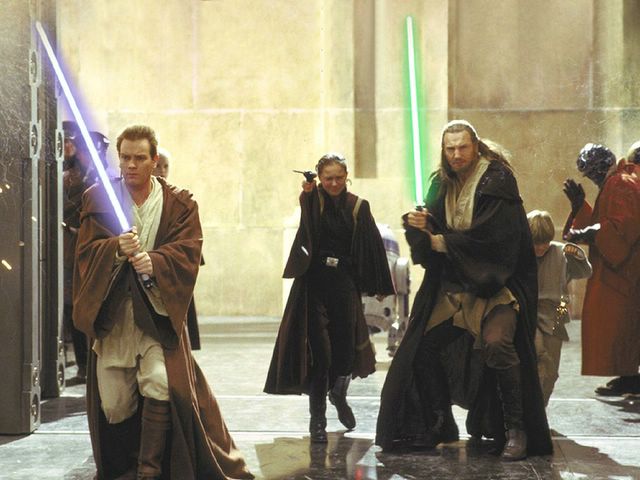


In this entire project of making a three-movie trilogy to explain the backstory to the 70's and 80's Star Wars trilogy, one of the hardest decisions must have been where to begin. From the original three movies, we get a good deal of the actual plotting of the prequels, but what we don't get is a distinct starting point. There was a Clone War, that we've heard, and Obi Wan trained Anakin, we knew that also. Plus, Anakin had to have twins with some girl, and then he had to turn evil, and Yoda had to end up on a swamp somehow.

But when does the story actually start? What is the origin of Star Wars? It's almost an unanswerable question. Lucas wisely evaded it in 1977 by starting his movie in the middle of an ongoing saga. I think the major problems in Phantom Menace, and there are many, probably started with the decision to make Anakin a child in the story.

Mainly, it robs him of a personality. The original Star Wars trilogy was filled with likable, colorful characters, from Han the hotshot smuggler to Chewbacca to Princess Leia, Darth Vader and R2D2. In the prequels, our heroes are mainly Jedi, solemn, monklike men for whom levity and, well, humanity is discouraged.

Now that might have worked out fine if our Anakin was an exciting protagonist. If we watched a brash adolescent come into conflict with these uptight defenders of an ancient power, there might have been some spark to Episode I. It might have some of the original films' outlaw spirit. Remember, they are movies about young people attempting to violently overthrow the galactic government.

But in Phantom Menace, look at the heroes George has given himself to work with. There's Qui-Gon Jinn (Neeson) and Obi-Wan Kenobi (Ewan McGregor), two stone-faced Jedis of the monotone variety. Then there's Queen Amidala (Natalie Portman), a monarch who appears in pancake make-up and speaks like Vicki from TV's "Small Wonder." Then, there's the spazzy 8 year old Anakin (Jake Lloyd). Lloyd gives a treacly, over-rehearsed "child actor" performance, and it basically killed his burgeoning career dead, but it's not his fault. There's not enough material there to make him the focal point for an epic 2 hour science fiction adventure. He may grow up to be a powerful Jedi, and finally the Right Hand of Imperial Doom, but in Phantom Menace, he's just a kid, and a rather irritating one at that.

And then look at the conflict he's placed these characters in. Because Anakin's just a kid, and we can't deal with any material about the formation of the Empire (because the film is set too early in the Star Wars timeline), the story centers around a dry trade negotiation dispute.

Now, I have read long, well-conceived defenses of Lucas' films as political metaphor. I know people who think of these films as adult thrillers, struggling with issues of government, fascism and the nature of control. I don't really see the depth here. To me, it feels like a filler kind of plot, a random notion Lucas came up with to explain away a few battles and instigate a conflict he had no intention of resolving for two more movies. Again, he couldn't deal head-on with the most interesting interpersonal material in the trilogy (like the love of Anakin for Padme, the internal conflict in the Senate driving Palpatine to power, the rise of the Imperial Army, the turning of Anakin) because he had made the hero too young.

So, in order to keep his movie entertaining in the least, Lucas is forced to overplay his hand, to fashion some sort of "comic relief" to take the dour edge off his film. And it's here that he makes his most greivous errors. And I'm not just talking Jar Jar Binks (although I am talking about him). I'm talking about all the ethnic stereotypes, which I suppose are meant to be funny and engaging but which are only childish and mildly offensive. (The trade federation's officials are so obviously pained Asian stereotypes, it's utterly unbelievable to me that Lucas even tried to get away with it. Aren't there any Asian people at LucasFilm who could have alerted him to this problem?)

I'm also talking about the droids, C3PO and R2D2. In the original film, they are humorous characters, but they are also characters dealt with in a sincere manner. They are beings, they have feelings and emotions, they are "friends" with the heroes and not possessions.

Think of the scene in Jabba's Palace at the opening of Return of the Jedi. This is a sequence I come back to a lot in discussing Star Wars, because I feel the Jabba sequence in Jedi is among the entire original trilogy's best and most iconic mateiral. Anyway, in that scene, the hologram message from a newly Jedi-ed out Luke informs Jabba that he presents Threepio and R2D2 to the crime boss as "gifts."
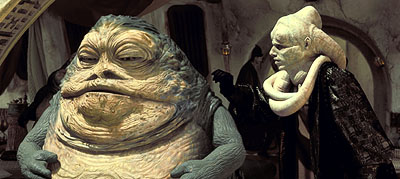


And Threepio seems genuinely hurt by this news. He's taken to a junkyard where Jabba's droids are refitted and reprogrammed, and he's afraid, dejected, miserable. There's pathos in this scene. And that's the power of Star Wars - it's pure imagination and fantasy, and the level of compassion, personality and detail is unrivaled. We're asked to sympathize with a robot who has been given away.

Now think of how that same robot is depicted in Phantom Menace. As a sideshow, as a joke, as a deliverer of cheesy one-liners. I understand Lucas' intention - he needed something to lighten up his movie, which is a few set pieces and quips away from being a thoroughly dreary, maudlin affair about imminant worldwide war.

Okay, so that's my take on where the movie goes wrong. As I said, all based around one initial decision to make Anakin a kid. You start with Anakin as a troubled teen, already studying to be a Jedi, you open up an entirely new world for the movie. Episode I would have been like Episode II, which in its own way felt like a gear-up, prologue kind of movie itself. Episode II would have been the material currently found in the Cartoon Network Clone War cartoon series, about how Anakin becomes simultaneously more powerful and more dangerously angry during the conflict. Finally, you'd have the same Episode III, with Anakin turning and a dark cloud passing over all that is good and hopeful in the universe.

But this article is called "prequels reconsidered," and I do have some reconsideration to explain. Upon first seeing Star Wars: Episode I: The Phantom Menace, I declared it a bad film, and have stated this as fact ever since. In truth, after rewatching it the other day, I don't think it's a terrible movie at all. In fact, it's rather enjoyable, for what it is, when given some distance from the emotional connection I feel towards the original trilogy.
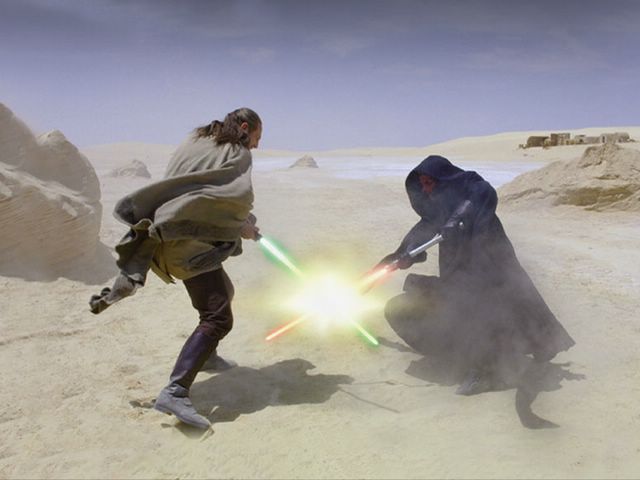


For one thing, it looks terrific. It's colorful, detailed, polished and stylish. When I first saw the movie, I found the final battle between CG Gungan warriors and CG battle droids cold and unengaging, but on DVD, the entire sequence kind of came alive. Sure, the lame attempts at comedy still don't play, but it is kind of interesting to see this battle, which feels like Star Wars and yet is so unlike anything else in any of the other movies. It's rural, for one thing, and it involves no humans whatsoever, which is fairly unprecedented. If not for the intrusion of the lame device involving Anakin destorying a space station on accident, this battle might rank as one of the prequel's best.

Another set piece that worked better for me this time around was the pod race. I still feel that the excuse for getting Anakin in a pod race feels labored and overlong, but once the action really gets going, it's quite exciting. And the other racers do provide brief glimpses of the kind of far-out sensibility Lucas used to employ all the time, particularly the villainous, four-armed Sebulba.

Finally, the character of Palpatine (Ian McDiarmid) comes across fantastically well in this initial chapter. I can't believe I didn't pick up on this more during my first encounters with the film. McDiarmid is playing the Man Who Would Be Emperor as not just fiendishly clever or mysterious, but as defiantly, enthusiastically evil. He doesn't toy with the Jedi and plot against them as a way of seizing power - he genuinely enjoys lying, cheating and ordering out death.

A scene with him and his apprentice, the underutilized Darth Maul, sets up the dynamic of the remainder of the prequels exceptionally well. We see that these are not simply madmen who have discovered a way to unseat the center of power. They are creatures of darkness who have waited in the shadows for literally hundreds of years, setting up an intricate web that will at some undetermined point ensnare the forces of good. Seeing this material makes me very excited to see what Lucas and McDiarmid can put together for Episode III.

So, there you have it, Phantom Menace reconsidered. I'll rent Attack of the Clones and review it in a few days. I work tomorrow, so maybe then, if there are any copies left in the store.

One final thought: In Phantom Menace, we learn that Anakin's mother has no idea who fathered her son. In fact, she says "there is no father." There was no mention of this at all in Attack of the Clones. Is Lucas really going to leave such a blatant and cheesy Jesus reference unexplained at the end of the trilogy? If you have read the script or seen Sith, don't bother answering, as I've attempted to avoid spoilers, but I have a hard time with leaving this plot point open. But I can't imagine any satisfying way to explain it. Could it be that Qui-Gon is secretly Anakin's father? Or Palpatine? Or Dooku? Or Anakin was a product of The Force, manifested within Shmi Skywalker's womb?

Knowing GL's fondness for twist endings dealing with paternity, should we expect some late-in-the-game turnabout in Revenge of the Sith? I kind of hope not...


Monday, May 09, 2005

I Am a Fugitive From a Chain Gang

There is only one mode in this movie, and that mode is despair. Things don't ever get better for our hero, James Allen, a hard-working and forthright young man who has just returned from the front lines of WWI. They get progressively worse and worse, driving him from one hopeless situation to another. Even a lucky turn only sets him up for a greater fall.

This nihilism, I suppose, reflected the audience's similar desperation. I Am a Fugitive From a Chain Gang debuted in 1932, a scant three years after the stock market crash, at a time when many formerly successful, stable people were plunged into economic turmoil. But it's not just social problems that attack Allen; he's getting it from all sides. He's harshly judged by his brother, mistreated by a friendly stranger, set-up by negligent cops, poorly advised by his attorneys, and even blackmailed by his girlfriend. And at the end of every road, the only future he can see is a life on the chain gang, a life of endless toil, torture and inhumanity.


It sounds depressing, and it is. Shocking, too. This film is widely credited with the abolition of the chain gang as an institution in Southern punishment. Though this level of influence is certainly questionable, the movie does make a strong case for forced labor as a cruel and unusual form of punishment, and likewise one that's unfairly and randomly applied.

Allen (Paul Muni), unlucky bastard that he is, winds up on the chain gang merely by accident. Returning from WWI, he expresses to his preacher brother and mom a desire to become an engineer, to achieve something greater than the factory job which satisfied him before the war. But, unable to find work, he eventually becomes a drifter, and after that a hobo. One night, while following a fellow drifter around in the hopes of a hamburger, he unwittingly takes part in an armed robbery, and winds up sentenced to 10 years of hard labor.

The scenes that follow are the film's most powerful. For a middle-class man like Allen to suddenly find himself shackled to convicts, breaking down rocks in a blazing-hot valley while being berated and even whipped by guards, is a stunning turnaround and Muni's very effective at expressing a kind of hopelessness mixed with a bit of dazed bemusement. It's utterly incomprehensible to him that he must ask permission to wipe the sweat from his brow, or that he's asked to eat grease and hog fat for breakfast.

The film moves along at a brisk pace, and this sense of gallows humor really helps to maintain interest and build an affection for Allen. And you'll need it, because this movie really puts him through the wringer. There's a thrilling escape sequence in which Allen employs a clever trick that would be borrowed by a generation of Looney Tunes creators. (Okay, I'll tell you...he slips underwater and breathes fresh air clandestinely through a reed). There's the sham marriage to the evil golddigger who has found out James' little secret. And there's even a trial and the promise of a lenient sentence that goes horribly awry.

The idea here isn't just that chain gangs are a social evil (although that concept is quite clearly expressed). There's also the notion of an entire society getting together to punish one man. Allen quite clearly hasn't done anything wrong, but protestations of his innocence only seem to make the authorities more angry. Now, they're upset not only that he escaped the chain gang, but that he had the gall to complain about the style of his imprisonment. And more complaining will only cause him more grief.

So what's the answer? The only way out for James is to "take it on the lam," run away and drop off the map entirely. The final sequence finds him a desperate man once again, constantly on the run from the law, unable to settle or work or love or live his life.

What are we to make of such a story? I Am a Fugitive From a Chain Gang is based on the true biography of Robert Burns, a man who really did get sent to a Georgia chain gang for 10 years, who escaped and fled to Chicago and started a new life as a businessman, only to be recaptured and sent back to the chain gang. Burns' story has been altered in two major ways.

1) Muni's character in the film doesn't want to steal the hamburger, whereas Burns in real life did steal $5 from a diner in order to obtain food.

2) Burns was eventually pardoned with the help of several lawyers, and went on to write the book that became this film.

So, Hollywood changed the ending to make it...less hopeful. They took a story about a man who had risen up above a crooked system and eventually aided in its downfall, and made a movie about a man who is driven to homeless, insanity-fueled criminality by a corrupt and unfair social system. It's certainly atypical.

Interesting, as well, that Chain Gang was directed by Mervyn LeRoy, who's also responsible for the harsh Little Ceaser. Both films share downbeat conclusions, but whereas Ceaser alters history to make it more palatable (evil is punished in an immediate and clear sense, when Rico dies in the street), Chain Gang changes the verifiable truth to make a more resonant movie for a dire age. It's an interesting choice, and one that provides the film with some really taut, gripping material in its second act.

This is a film not to be missed, full of intrigue, surprises and even comedy. Muni's just an enjoyable, charismatic presence, and he thankfully has infused Allen with a wry sense of humor that makes some of the film's more unpleasant passages easier to take. Though he gets a little hammy in the final moments (the image on the cover of Warner Brothers' new DVD depicts him bugging his eyes out like Peter Lorre), it's overall an exceptionally strong, unmannered central performance.

Whacking My Flak

You may not know this, but in addition to a published blogger, I'm also a published unpaid writer of brief articles for an unknown Internet entertainment and news website. That would be Flak Magazine. You may find my first article for Flak here. It's about the TV show "South Park."

Basically, I have been reading a lot online about theories tying the TV show "South Park" to the neoconservative movement in America, and have noticed myself that the show seems to lean more to the right than it did at one time. So, I wrote a brief little piece about it for Flak. It's called "Is South Park Right?" (Ha ha!)

Now, no offense to Flak, which is a nice little magazine kind enough to print something written by yours truly, spelling errors and all. But I didn't really think it had what you'd consider a high level of readership. So I was quite surprised to receive an e-mail today from my friend Jason, informing me that my article was being reviewed rather unkindly on the blog Scrubbles.Net.

Here's what main Scrubster mhinrichs had to say about my writing:

This article amounts to making something out of nothing (or, if your're feeling generous, very little). It appears the author of a new book wants to make the phrase "South Park Conservatives" into a byword for a certain kind of political body, like the Silent Majority or Soccer Mom Voters. That's a stretch.

Okay, okay, Hinrichs, let me stop you right there. And let me also note that your vaguely German screen ID makes me slightly uncomfortable.

You start off by saying that my article tries to make something out of nothing. Then, you proceed to reply to the main issue raised by my article ("Is there a right-leaning philosophy behind TV's 'South Park'"?)

By actually taking that idea and providing your own opinion about it in an article, aren't you in fact simply repeating what I have already done? Therefore, wouldn't it be fair of me to say that your blog post "makes something out of nothing"? After all, if I start with nothing, and then you reply to nothing, aren't you still left with nothing?

The fisking continues:

I'd characterize the SP episodes from the new season as vaguely right-leaning in the same way The Daily Show skewers ever-so-leftward, but essentially both are equal opportunity offenders.

Here, hinrichs continues to critique and comment on my article that had nothing to say. He also ends up essentially agreeing with my viewpoint, that "South Park" leans to the right in the same way as "The Daily Show" leans to the left.

What they don't mention in the article is how South Park's writing staff includes Norman Lear, who is far from politically conservative. I can't picture Trey Parker and Matt Stone as conservatives, so whatever.

What? TV legend Normal Lear writes for "South Park"? Really?

Um, no. The reason I didn't include this information is because it's totally not true. Here's a quote from a real newspaper, The New York Times, about Lear's involvement with the "South Park" guys:

It was Mr. Lear who came up with the idea for the giant talking taco and the reality television theme during a three-day retreat for the show's writers in February in Scottsdale, Ariz., a session that Mr. Lear said was unlike any writers meeting he had ever been to.

"These guys are nuts," Mr. Lear said during a conference call with Mr. Parker and Mr. Stone. "But they're also very, very smart. They throw out a lot in very little time."

Okay, so Norman Lear hung out with Matt and Trey for 3 days and imparted some of his wisdom. That's cool. He respects them, which is great. I, too, greatly respect them. In fact, the whole reason I wrote the article in the first place is because I care so much about "South Park." I think it's a great show, a classic, even, and so I think it is worthy of discussing as political satire, not just as an amusing cartoon show.

But does Lear's 3-day stint as mentor to Matt and Trey mean that they neccessarily share his politics? Of course not. And does he have any real involvement with the subject matter and tone of the show? No, no, clearly no. At the end of every episode of "South Park," there's always a credit: Written by Trey Parker. So, there you go.

You've got to love hinrichs closing out with a "...so whatever." You've got to finish strong! That's the secret of good blog writing.

But if only that were all, dear readers! Mr. Hinrichs had a comment on his post! A guy who had this to say:

The Flak Magazine article about SOUTH PARK is strange and schizophrenic.

It starts out as an attempt to thrash the show with snide phrases like "narcissitic apathy"(sic)...
But then it ends up calling SOUTH PARK "among the bravest, most outspoken and most politically aware shows on television."


Earth to Flak: Make up your minds already!

Okay, the spelling error? He got me. I'd love to blame Flak's copy-editors, but I'm sure that's an original Lons typo. It happens. Oops.

Everything else, though, is totally stupid. Did this guy even read my article?

First off, it's not schizophrenic, it's balanced. Now, I know that in today's media, an article that doesn't stridently take one side and then make up arguments out of thin air to support that side doesn't really have any place. But, what can I say, that's the kind of journalism I dig.

I begin by presenting my view of "South Park" - that the only solid philosophy presented is one of essential apathy and disregard for current affairs. Then, I provide a counterargument, that "South Park" aligns with a youth movement in conservatism, one that is pro-war and anti-PC. Then, I provide a possible compromise position - that the show is too complex and nuanced to summarzie as right or left-wing.

I think it makes total sense. Maybe you find it convoluted. That's fair enough. But schizophrenic? It's written like I have multiple personalities?

Also, I dig the little Earth to Flak comment. As if the article was written by some creature named Flak with his own magazine. My name's right there under the headline, jagoff.

Sunday, May 08, 2005

Happy Mom's Day


That's the weird thing about Moms...Everybody has one...

Saturday, May 07, 2005

The Last Shot

This movie barely lasted a week in theaters, despite a well-rounded cast of familiar actors and the writing and directing talents of Jeff Nathanson, who frequently collaborates with a guy you may have heard of named Steven Spielberg.

So I figured it had to be really bad. I mean, why else would a Matthew Broderick and Alec Baldwin movie get the shaft, essentially going directly to DVD?

Well, the good news is, it's not a horrible disaster. In fact, there a lot to like about The Last Shot, a very dark comedy that isn't afraid to get, well, dark. It just doesn't hold together well, sacrifices a lot of believability in favor of some pretty weak gags, and kind of falls apart at the end. But, you know, other than that...it's alright.


I think the biggest problem facing Nathanson (who makes his directorial debut with this film) is the essential familiarity of the storyline. What we have here is a wacky, satirical Hollywood insider comedy. It's a well-worn genre, and even though the remarkable story behind The Last Shot is true, the movie is still weighed down by its formula like the proverbial albatross.

In fact, you could basically say the movie is Frank Oz's winning 1999 comedy Bowfinger in reverse. In that film, maverick no-budget indie filmmaker Steve Martin knows that he has no real budget or actors for his movie, but he convinces an entire cast and crew of friends otherwise in a wacky attempt to get a film made. In The Last Shot, FBI man Alec Baldwin gets to government to finance a phony film production in an attempt to ensnare a distant, forgotten cousin of John Gotti (ably played by Tony Shalhoub).

But while Bowfinger was a free-wheeling farce, one of Steve Martin's over-the-top, classic kind of comedies, The Last Shot is far more muted, dry and cynical. Which is fine. Great, even. I mean, I like silly, broad comedies, and Bowfinger was a lot of fun (particularly Eddie Murphy's multiple roles), but I have no problem with bringing a bit more edge to the table.

Unfortunately, any grit or edge Nathanson may have developed is undermined by the ludicrous nature of the film's action.

There's the movie within the movie, the film naive Steven Schats (Matthew Broderick) believes he's directing. It's called Arizona, based on the true story of his sister's struggle with breast cancer. In his screenplay, his sister Charlotte makes a journey on foot through Arizona, eventually settling in a Hopi Indian spirit cave at the bottom of the Grand Canyon to die.

First, Baldwin's undercover agent Joe Devine must convince perennial loser Schats that he's a real film producer, despite having no actual knowledge about moviemaking at all. Then, he must convince Schats to film his movie (called Arizona and set at the Grand Canyon) in Rhode Island, because that's where Gotti's cousin has been stationed.

Think about that for a second. Why would Devine choose a script called Arizona when he knows the film needs to be made in Rhode Island. Surely in Los Angeles, he could find a script that could theoretically be made in a New England location. The reason is, Nathanson can squeeze a cheap gag out of making the town of Providence, Rhode Island into the Arizona desert. (Also, I should mention that this same e is pulled off better in David Mamet's similar State and Main, where screenwriter Philip Seymour Hoffman is asked to remove references to an old mill from his script entitled "The Old Mill.")

When you do a joke like that, you're sacrificing the movie's integrity. We're supposed to believe in Devine as a capable, clever agent, a man who could think up and execute this complicated and intricate scheme. Yet he seems unable to function undercover on even the most basic level.

You get a sense with The Last Shot that Nathanson really wants to skewer some familiar Hollywood types, and though his film is pretty brave about troubling, dark or morbid content, he's kind of unwilling to really take the jokes as far as they need to go.

Take Toni Collette's character, box office sensation Emily French. She's extremely similar to the other "ditzy superstar" characters we've seen in a lot of showbiz satires in the last few years - like Sarah Jessica Parker's neurotic leading lady in State and Main (which also featured Alec Baldwin), or Anna Faris' Cameron Diaz take-off in Sofia Coppola's Lost in Translation.

Collette's pretty good in the role (except for one really unnecessary and humiliating scene requiring her to pee in a cup in a crowded restaurant...more on that later...), but I wish we could have seen Nathanson lampoon starlets with a bit more bite. He's been around them for a few years now, what with writing big-budget flicks like Catch Me If You Can. Surely he's had a few insights into their character.

This actually leads me into my single largest bone of contention with The Last Shot. In almost every other way, the movie is a genial and likable comedy. It's really about friendship more than sending up show business, and I genuinely liked the way Baldwin and Broderick play off one another. But what ruins this tone, and comes pretty close to wrecking havoc on the entire film, is a kind of vague but over the top mysogeny.

All of the women appearing everywhere in the film are violent, narcissistic and, on some level, mentally unbalanced. In a glorified cameo appearance, Joan Cusack plays a frenzied, neurotic, unhinged production executive. She relates a harrowing story of domestic abuse to Baldwin in a monologue that's supposed to be funny, I suppose, but which comes off as decidedly crass, mean-spirited and not at all amusing, despite Cusack's best efforts.

Then there's Calista Flockhart, who is in the movie only to be debased, ridiculed and mocked. She plays the wannabe actress who's been schtupping Schats for many years in the hopes of making the big time. When it doesn't happen for her, she becomes vindictive. The running joke about her character is that she hates dogs, and is always threatening them with bodily harm. (Seriously.)

And finally Collette, the oversexed, imbecilic, self-involved movie star who is forever taking her clothes off and urinating in public. I still don't get that scene at all. She's having dinner with Devine and Schats, trying to convince them to give her the role, and then, as a way of insisting she's over her drug problem, she slips a wine glass under her dress and takes a leak right there at the table.

It's not funny. It's shocking, I suppose, and crude, but it makes her character out to be an insane person, which I don't think was the point. Again, Nathanson prefers to go for the cheap laugh than to maintain the integrity of the character he'd written.

Plus, there are constant jokes at the expense of breast cancer victims. Honestly, I can't recall seeing a film that found violence towards women so utterly amusing. The character in Broderick's film not only dies in a cave of cancer, but she's bitten by a snake as well, spurning Flockhart's desperate actress to stab herself in the thigh with a fork in order to simulate a limp.

Ho ho. It is to laugh.

So, yeah, the film just derails. Plus its abrupt and nearly nonsensical ending, in which Ray Liotta comes in Deux Ex Machina-style as the head of the FBI, who also happens to be Joe Devine's brother, really dampens the momentum. This is a movie that starts off well with some good ideas and then just runs out of steam. I'm still puzzled by its lack of theatrical release, as I enjoyed it more than a lot of other mainstream comedies that remain in theaters for weeks.

Say WHAT?

I found this Maine Today article on that repository of all things amusing and offbeat, FARK. If you haven't been, do visit them.

Anyway, it's nominally an article about this police robot that goes in to help defuse intense situations where it's too dangerous to send in cops. Like hostage stand-offs where heavy-duty firepower is involved, or something like that.

It's not a terribly interesting article, mostly focusing on a behind-the-scenes look at the hostage negotiation process. But check out this brief anecdote, related by Maine Detective Adam Kelley, about the first time they made use of the device known as the Andros.

Shortly after state police bought the $150,000 robot in May 2003, they were called into a dangerous domestic situation in the greater Bangor area.

"It involved two deaf people in the residence, and their (text-based) phone was off the hook," Kelley said. "One had a weapon."

In the wide-open space around the residence, troopers would have been vulnerable to an armed and unstable attacker.

In went the Andros, with a sign that asked the armed person to come out and surrender. It worked.

Okay, there's no more background on that story...None...I'm afraid I'm going to need closure on this anecdote, Maine Today.

Can you imagine the sort of bizarre (yes, bizarre in the Lacanian sense...) events that have to go down to cause one deaf person to pull a gun on another deaf person? I mean, no offense to the deaf, who I understand can have interpersonal conflict just like anyone else.

But think about this as a logistical situation. The deaf couple's phone didn't work properly...How did police even find out one of them had a gun pulled on the other? Why would a deaf person take a hostage anyway, if they were essentially unable to communicate with people on the outside?

In other words, if a deaf guy takes a hostage, and there's no one around to see it, does he get a ransom?

I Hear New Zealand Is Rather Nice This Time Of Year

I hope so, cause I don't know how much longer us reasonable people can hang out in this bass-ackwards nation. Every time I turn on my Internets, it's the same damn thing. Websites full of insane, self-aggrandizing wingnuts declaring war on everything decent, reasonable and tolerant in American society. Seriously. It's getting depressing. I had to stop doing those John Gibson-Idiocy columns because I couldn't stand reading his inane blather any longer.

And now here's possibly the worst of the bunch. Seriously. If this wasn't linked by reputable blog The Poor Man, I wouldn't believe it's real.

It's a group calling themselves Little Geneva, who are self-described "Reformed Confederate Theocrats." What does that mean, exactly? It means...well, I'll let them tell you themselves...

A Christian Reconstructionist believes God's Law is found in the Bible. It has not been abolished as a standard of Righteousness. It no longer accuses the Christian, since Christ bore its penalty on the cross for him. The Law is a description of God's Righteous character. It cannot change any more than God can change.

God's Law is used for three main purposes:

First, to drive the sinner to the truth in Christ alone, the only perfect Lawkeeper.

Second, to provide a standard of obedience for the Christian, by which he may judge his progress in sanctification.

And third, to maintain order in society, restraining and arresting civil evil.

The problem for the unconverted is not lack of evidence, but a lack of submission. The Christian Reconstructionist begins and ends with the Bible. He does not defend "natural theology", and other inventions designed to find some agreement with covenant-breaking, apostate mankind.

Get it? These guys know for sure that their religion is right. Why? BECAUSE THEY JUST KNOW. And they think my problem isn't that I find God an irrational concept. It's that I refuse to submit to God. And that's why they need to start making laws which force me to do so.

A Christian Reconstructionist is a Dominionist. He takes seriously the Bible's commands to the Godly to take dominion in the earth. This is the goal of the Gospel and the Great Commission. The Christian Reconstructionist believes the earth and all its fullness is the Lord's - that every area dominated by sin must be "reconstructed" in terms of the Bible. This includes, first, the individual; second, the family; third, the church; and fourth, the wider society including the state. The Christian Reconstructionist therefore fervently believes in Christian civilization. He firmly believes in the separation of church and state, but not the separation of the state - or anything else - from God.

Yikes...scary...

And just in case you're reading this and not thinking about how retarded and evil this organization is, let me alert you to the fact that they are also blatant and open racists.

In addition to referring to magazine The National Review as The National ReJew (which, you gotta admit, is kind of clever), on their front page, there are all kinds of nuggets of non-wisdom to be found on this site. Here is a random sampling of dumb sentences:

It still remains to be proved that God has created all men with equal capacities.

In case it needs to be stated plainly, we do not advocate retaliation against anyone for anything. We are reporting on what we believe to be dangers to our way of life, but we do not encourage harrassment.

This one really pisses me off. They have an entire website telling people that non-whites and non-Christians are inherently inferior, and then they have this little tagline hidden in the middle of an article that totally cops out. "Oh, yeah, Jews are horrible, hateful, ignorant people who are condemned to Hell...but I'm just saying...you know, don't bother them or anything." What tripe.

Rushdoony adds that colonizers quickly discovered an important difference between white and black men. The black man, he said, only came to appreciate authority if it was imposed by brute force.

I mean, can these guys be so blind? They find it compelling that colonizers commented on how blacks only responded to brute force? I mean...you know, I can't even talk about this particular quote any more...It's too stupid. I'm afraid I'm going to get dumber just by acknowledging it.

Anyway, this stuff is really really out there. These people are genuine in their beliefs. This is not an entertainment website.

So, just how long a flight is it to Wellington?

Batman: The Animated Series Vol. 2

I bought this at the Big Red One screening, for Mark Hamill to sign. He does the voice of The Joker, and other voice work for this terrific cartoon show. He signed it "Jokingly Yours, Mark Hamill," which is pretty cool. But I kind of had buyer's remorse afterwards. Money's tight these days, and would I really watch a cartoon show enough to warrant a $25 purchase? ($30 without my tight employee discount).

It turns out, I was delightfully wrong. I haven't stopped watching these DVD's since I got them home last night.


I knew this show was really good. They were still running them all the time on Cartoon Network until recently, although even then they'd show stuff from the inferior later seasons. This box set is made up of the second season, and it's probably the most consistant group of episodes in the show's catalog.

What makes the show so great is a combination of factors, which I'll elaborate on below, in order of importance.

1) The Animation

This is arguably the best-looking American animated show ever made. (Obviously, I haven't seen enough Japanese televised anime to make this statement international). I'd say "Futurama" probably comes in second, but I far prefer the visual style in "Batman." I also love how they went period with the animation style, but didn't bother to write the dialogue in an antiquated style. We get that old-school 40's feel - art deco lettering, bad guys with tommy guns and fedoras, classic cars - but the writing feels contemporary.

There's some cool insidery stuff about the animation, like it was drawn with a black background instead of white, giving it a grittier, darker feel, but I dont' really understand exactly how that stuff works. All I know is that with Bruce Timm's designs and a large group of outstanding artists, this "Batman" feels more true to the character and tone of the comics than any other TV series, movie, anything based on the character.

2) The Storytelling

They didn't try to jazz up the "Batman" saga or make it easier for young kids to digest. Amazingly for a weekly network TV cartoon show, the writing team (headed by the marvelous Paul Dini) was allowed to stay true to the gloom-and-doom tone that has always defined "Batman." The show takes its time, develops themes, bothers to give the villains personalities and motives, instead of just cool new weapons. Rewatching these episodes, I'm frankly astonished by the maturity of the storytelling.

I saw an entire episode today, called "Perchance to Dream," in which the Mad Hatter straps Batman into a mind control device that causes him to have an episode-long dream in which his parents never died, and he's marrying Selena Kyle (who has never heard of Catwoman). That's weird, trippy, heavy stuff to lay on a young audience, and the episode handles the material so nimbly, it's like a revelation.

This season also contained the Emmy-winning two-part episode "Robin's Reckoning," that introduces the Robin character in about the freshest way possible. Shrewdly realizing that audiences already know the outline of the Robin origin, that his trapeeze-artist parents were murdered by gangsters, causing him to move into Wayne Manor as Bruce's boy ward. So writer Randy Rogel tells this story briefly, in flashback, while relating an entirely different adventure in the present. It comes off beautifully, and lends this portion of the show an epic kind of feel.

3) The Voice Talent

A lot of the "Batman" cast is made up of regular voice-actors who aren't really famous. But just about everyone does an incredible job, in terms of character. Timm's drawings and Dini's writing certainly did a lot of the heavy lifting, but man, some of these voices are perfect. Obviously, Hamill's Joker ranks as the show's most enduring, popular character, and he does fantastic stuff here with the part (particularly that eerie, screechy laugh that neither Ceaser Romero or Jack Nicholson ever actually nailed). I liked Nicholson a bunch in Tim Burton's Batman, but Hamill at this point kind of owns the role.

And Kevin Conroy is terrific as Bats. He doesn't really do anything terribly different than Keaton, Kilmer or Clooney. He speaks in a warm, casual, friendly tone as Bruce Wayne and gets deep and gravely as Batman. But the guy just plain sounds like a superhero. And I have no idea what he looks like in real life, so his voice exists for me only as Batman, which I'll admit helps a bunch.

Also of note are Arleen Sorkin as Harley Quinn, who first appears in the Season 2 episodes and went on to become one of the show's most beloved villains, Richard Moll, who absolutely inhabits Two-Face in a way Tommy Lee Jones could never dream, and David Warner as Ra's Al Ghul.

And that brings us to our CRUSHED BY INERTIA WEIRD COINCIDENCE OF THE DAY:

My brother mentioned Zach Galligan's classic 80's film Waxwork in the comments section on the Paris Hilton article just yesterday. That film featured a supporting turn from Mr. David Warner. Coincidence? I think so!

So, there you go, my take on why these "Batman" episodes rule, and why I haven't been able to turn this DVD off in two days. Seriously. I've watched only one movie in the last two days because of these cartoons (the mediocre The Last Shot, the review of which will probably pop up tomorrow, if I get around to writing it).

NPR You Kidding?

I don't really listen to a lot of National Public Radio. Oh, sometimes I turn it on, like when I'm hoping KCRW is playing the new Architecture in Helsinki album, but usually it's some dry report from Belgium about the ongoing Dull Tiny European Nation's Third Annual Log-Tossing Competition and Bake Sale, and I turn it off right away.

But I did hear a report on NPR's Morning Edition a while back by a lady named Barbara Bradley Hagerty that struck me as somewhat peculiar. She was talking about that Alabama idiot Judge Moore from who built that monument to the Ten Commandments outside his courthouse. Which is clearly not only in violation of the Constitution, but of the Ten Commandments! And this guy is a judge! Not only did she fail to mention the obvious "graven images" thing, but she didn't really challenge any of Moore's ideas directly.

I wish I could find a transcript online, but alas, I cannot (and besides, it's after 2 in the morning...I'm only one man...) Anyway, it was one of those Fox News kind of jobs, where she makes it sound like both sides make equal logical sense and have equal support, whereas in reality one side has the only reasonable argument and the other side is filled with sputtering inbred yokels whose idea of a sound, well-crafted line of argumentation is "Get Your Hands Off Of My GOD!!!!!"

But I never really thought more of it. I just assumed Ms. Hagerty or NPR were striving to make their coverage as fair as possible, and maybe gave Moore a little more leeway than neccessary to appear unbiased.

But now that the truly wonderful resource Media Matters has really done a complete workup on Ms. Hagerty, I see my idle observation was not unfounded. She's one o' them wacky religious half-wits after all.

Here's the incident that brought her to their attention in the first place, from a report Hagerty filed yesterday:

In a May 5 report about religious conservatives who believe that separation of church and state is inconsistent with the principles espoused by the country's founders, National Public Radio (NPR) religion correspondent Barbara Bradley Hagerty concluded by intoning: "While many Americans may travel a middle road, they are caught in the crossfire between those who believe that asserting Christian values is the greatest hope for America's future and those who see it as a threat."

They go on to explain that, in the report itself, Hagerty featured a number of Christian interviewees who see the theocratic agenda of the religious right as a threat to democracy and personal freedom. Which, of course, it is. So how can she frame the debate as "Christians" vs. "those who see Christianity as a threat"?

Obviously, that's not what the debate is about. I only see Christianity as a threat in so far as crazy-ass Christians want to impose its laws and concepts on me. I don't happen to subscribe to Christian beliefs. In fact, I think they are, for lack of a better word, really dumb. But that doesn't mean I don't want you to subscribe to them, if that's what you're into. So, it's not about wiping out Christianity or abhorring Christian values (although I do abhor their self-righteousness, fear of sex and feelings of domination over other cultures and the environment). It's about abhorring theocracy and mandatory worship.

So, yeah, that was an error in judgement. But it still could be a case of sloppy writing instead of inherent bias. But there are lots of posts linked on Media Matters to a variety of articles where Hagerty makes pretty outrageous statements about her religion and its intersection with politics. The real kicker is this item, reporting on Hagerty's comments to the 2003 Baptist Press National Student Journalism Conference.

Hagerty, religion correspondent at National Public Radio, told students that Christian journalists, by committing to truth, excellence and selflessness, can set themselves apart from their secular colleagues.

"When you or I as Christ-followers go to work each day, we have to perform our jobs in a fundamentally different way from other people because our employer is Christ and everything we do has to be run through the filter of this question: How does Jesus Christ view my performance? It raises the bar higher than the most demanding editor or supervisor could possibly do," she said.

Um...well...She doesn't say anything that's actually wrong here, I guess, although the tone makes me uncomfortable. I'd rather reporters working for National Public Radio felt that their employer was the public, rather than a dead Jew. I mean, "how does Christ view my performance"? With one hell of a magical fucking radio, I can promise you that, lady.

I'm going to go on an anti-religion tangent for a moment. Feel free to skip this paragraph if you're sick of reading me write that stuff. Okay, you're still here. Good. Why the hell do these Christians always have to relate everything having to do with religion in personal terms? That expression, "Personal relationship with God," that's a metaphor, okay, buddy? Religion is about getting in touch with the infinite, not gaining a magical, invisible friend up in the clouds who helps you out when you're on a reality show or playing in a big football game. So, Ms. Hagerty, did it ever occur to you that Christ might not be listening every single time you file a report? That maybe he had someone else more important to watch over, like a starving kid or a picture of his mother appearing on a tortilla in Juarez? Jesus already died for you sins; he's got to follow your career progress like a caring parent as well? You people are too demanding.

End rant. Here's some more insanity from Hagerty.

Christian journalists must decide to make God their primary audience.

Journalists will experience a conflict between seeking to glorify themselves and seeking to glorify God, she said. Christian journalists may have to perform difficult assignments without receiving commendations, but the desire to please God should drive them to complete those assignments with diligence, Hagerty said.

Can people really live this way? I mean, really? Can you go on for an entire lifetime working hard every day to please someone you've never met, someone you assume is real only because you've been told about him by authority figures you trust? I mean, I won't work hard if my boss is watching me from the same room. And I know he's real because he has instructed me to clean a toilet, and that's not the sort of thing you put up with from fictional characters.

I mean, she's telling young journalists that it's okay if you don't get any credit for your hard work as long as it makes God happy? What?

She concluded, "Early in my career at National Public Radio, I decided that being true to my God had to be the nonnegotiable. If it meant loosing my job, so be it. ... In the long run I had to think, is a story or even is a career ... more valuable than my relationship with God and eternal treasure in heaven? And I think the answer is no, and the decisions we make count for eternity."

Yup, that's the clincher. See, Barb, you're a reporter. That means something. It means that your whole job, the whole pint of you being on the radio, is to tell people what's true. Not what you think, not what you think God would want them to hear, but what actually happened, in as straight-forward and uncontaminated a manner as humanly possible.

This would be like your surgeon before an operation telling you that he hopes God doesn't tell him to stop the procedure halfway through, because God's will is more important than his job, so he'll have to let you die in the OR.

And what if you take in your hard drive to be fixed and they find pornography on there. God wouldn't want you to have porn on your computer, so placing religion over career, you'd have to get it fixed at some heathen electronic store.

Or what if you got on a bus on Halloween wearing a devil costume, and the bus driver refused to let you on because God wouldn't approve of your outfit?

Yeah, I'm exaggerating, but only kinda sorta. When you say, as a public servant (and that's exactly what a journalist for National Public Radio is), that your allegiance is to your own private faith and not to the best interests of your audience, well...I say, don't let the door hit your Pocket-Size Bible on the way out.

Friday, May 06, 2005

With Apologies to Ken Campbell

Last night, we had the big Big Red One autograph signing, and I'd say it came off rather well, all things considered. There was an unfortunate appearance by a particular Los Angelino who shall remain nameless, a man who tends to show up at film-related events and regale anyone within shouting distance, in a false English accent mind you, with tales of his made-up voice acting career. Really...this guy exists. Here's a sample quote:

"You may recognize my voice, I do a terrific amount of voice acting work. I will be appearing in the new PIXAR film, it's called Razzamatazz, it hasn't been made yet. That will appear in 2007."

That guy is hilarious, and waited in line to get a DVD signed by the cast of Big Red One not once, but twice. I thought we were going to have to kick him out.

But other than that, everything went off pretty well.

Oh, yeah, except for me totally making an ass out of myself in front of the cast and crew of Sam Fuller's 1980 war film The Big Red One.

And what's worse than making a stupid mistake in front of your boss and several Hollywood personalities? Why, having the moment captured on film, of course.


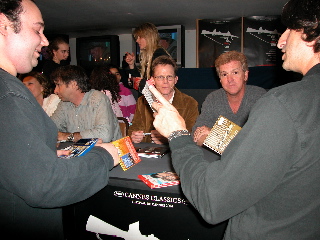
Okay, I shall set the scene for you. That's Laser Blazer's owner and operator, Ron, there on the far right. Behind him at the table, going from right to left, are Big Red One stars Ken Campbell, Kelly Ward and Robert Carradine. That jowly, beet-red guy who seems to have just messed himself? Yeah, that's me.

I always look beet-red in pictures, as if I'm always on the verge of spontaneous combustion whenever photographic equipment is nearby. This (and this alone) pretty much kept me out of the modeling game.

But anyway, back to me being humiliated. As I said, one of the stars on this autograph panel is a man named Ken Campbell. Here is his highly misleading IMDB page, which will figure in quite a bit to this story.

As you can clearly see on the IMDB page, Mr. Campbell appeared in both The Big Red One and A Fish Called Wanda. So, as we wanted to have many copies of all of the stars' movies available for purchase at the event, I went ahead and suggested the ordering of several copies of A Fish Called Wanda.

We put it out on a special display over this past week, and Fish Called Wanda actually sold pretty well. And why not? It's a terrific movie, and hey, one of the film's stars is going to be signing movies at our store.

So, it's the event, and I'm up at the front with my boss getting our store's rental DVD's signed. There's a Long Riders and Revenge of the Nerds for Carradine, a Comic Book: The Movie and even, yes, Star Wars Episode IV: A New Hope for Mark Hamill, Grease for Kelly Ward and...here we go...A Fish Called Wanda for Ken Campbell.

So, here's how the conversation in that above picture went down.

RON: Oh, Mr. Campbell, we've got a Fish Called Wanda for you to sign.

KEN: I wasn't in that. That's a different Ken Campbell.

ME: Ooooohhh, really?

RON (to me): A different Ken Campbell, huh...

KEN: Yeah.

KELLY WARD: It's a good movie, though.

Oops.

Once again, I maintain that this entirely the fault of IMDB. Look at that page! It says it's the same Ken Campbell.

The thing is, I knew I should have rewatched Fish Called Wanda. I mean, I own it, it's a fabulous movie. And when I saw him (as Lemchek) in Big Red One, I didn't recognize him.

But, alas, it was not to be. So I looked like the befuddled moron you see pictured above.

Other than that, I'd say the event worked great. My co-worker (and fellow Cinegeek) Ari got himself a signed Original Star Wars trilogy Laserdisc set signed (Hamill wrote "Force Yourself!," which is undeniably cool, even if it doesn't quite make sense). Now that, my friends, is a keepsake worth having.

Thursday, May 05, 2005

It's Pretty Much the Best Interview of All Time

Seriously. Check out this Associated Press interview with Paris Hilton, as part of the marketing blitz for her major Hollywood motion picture debut, One Night in Paris.

No, it's House of Wax! Sorry, sorry, House of Wax.

AP: So how would you describe your occupation?

Hilton: I don't know. I'm an actress, a brand, a businesswoman. I'm all kinds of stuff.

AP: If you had to pick just one...

Hilton: An actress.

I can't be sure on this, but I think this might be the first time I've ever actually heard someone refer to themselves as a "brand." I mean, clearly, Paris Hilton makes money off of her name in the same way as "icons" like Donald Trump - by plastering their famous name on everything they do. So we get Paris Hilton jewelry, clubs named Paris, Paris: The Perfume, The Stupid Spoiled Whore Playset...You name it, she'll stick her "brand" on it. (Also, her "vagina").

But, really people...she's an actress first. Sure, a full 50% of her resume at this point is taken up with a homemade porno film cannily released by her ex-boyfriend...but you probably didn't know that's how Helen Mirren got her start.

AP: Do you read what's written about you? Do you pick up the tabloids?

Hilton: I don't read any of it. I just look at the pictures to see what I was wearing last week and if it was cute.

Do I even need to comment after this stuff? You people get the joke without my going to the trouble of pointing it out, right?

AP: Do you read blogs?

Hilton: What's that?

AP: Um, they're these things on the Internet where people write about news and stuff.

Hilton: No, I don't really read anything on the Internet except my AOL mail. I don't like people who sit on computers all day long and write about people they don't know anything about.

Yeah, it is kind of pathetic, I guess. Now I feel all bad about myself. If it makes any difference to Paris, I don't actually sit on a computer all day long. Sometimes, I get up to make myself a sandwich.

AP: What did you want to be when you were a little girl?

Hilton: A veterinarian, but then I realized I could just buy a bunch of animals.

And isn't that what being a vet is all about anyway? Owning a bunch of animals? Of course it is.

AP: So let's talk about the movie. I'm sure you've had a gazillion scripts on your doorstep. Why do "House of Wax"?

Hilton: It's a fun summer movie about teenagers. When I got the script, I went out and got the original and thought it was creepy and fun.

I'm actually going to go ahead and call this a total fabrication. I doubt strongly that Paris Hilton has ever bothered to watch the original Vincent Price House of Wax. And even if she did make the commitment to staying indoors and not being photographed for the 90 minutes it takes to watch the film, I doubt she'd enjoy it.

House of Wax isn't among the more inspired Vincent Price movies. I mean, it's okay, but it would hardly appeal to Cokehead McGee over here. Plus, it was shot in 3D, and the DVD transfer is a simple 2D print, so the movie's filled with unneccessary scenes where objects would have been flying at you in the theater, but which now just feature a lot of stuff being thrown into the camera.

AP: You do a lot of kissing in this movie. What was that like?

Hilton: It was hard because I've never done anything like that before. My boyfriend — not my boyfriend now (shipping heir Paris Lastis) — got really jealous about it, but then he realized it's just a movie.

So, gossip-heads love this sort of thing, because they realize she's referring to her ex-boyfriend and former Backstreet Boy Nick Carter, who allegedly beat her up.

But I'm just entertained by the idea of two people named Paris dating. Is it egotistical to go out with someone who has the same name as you? I kind of can't tell...It seems like it would be.

AP: So are you really a ditz?

Hilton: That's just for the show.

AP: Is the "Simple Life" scripted?

Hilton: Not really. That's what we're trying to do to freshen it up. I mean, not like the first season.

And since this interview is publicizing the show, I guess she's just pretending to be incredibly stupid and lame for our entertainment here as well. In fact, pretty much any time you see Paris Hilton or hear her speak or read about anything she has said, you can just assume that she's in "fake ditz" mode, in the hopes of masking her true identity, nuclear chemist and world backgammon champion Abigail Pittsford Willowdangle IV.

AP: What's hot right now in entertainment? What TV shows do you watch? What music are you listening to?

Hilton: I only watch "The Simple Life." I don't have time to watch anything else. I like 50 Cent, Maroon 5, Britney Spears.

She only watches her own show. How adorable. And her publicist is in the room, okay, people? I want to stress that this is not some off-the-cuff blurted-out sentiment that Paris is going to regret later. This is her marketed brand, her persona - a self-involved, shallow heiress who dreamed of being a vet until she realized she could just buy animals.

Also, full disclosure, back in my UCLA days I had the opportunity to meet some of the guys of Maroon 5, who then were in a local band called Kara's Flowers. Anyway, I'd love to get a chance to talk to those guys again, just because I bet after their massive explosion in popularity and fame, they have some fantastic stories.

But I'd also like to ask them..."what's it like to be Paris Hilton's favorite band?" I mean, that's when you know you have really arrived - when your band's name is synonmous with Top 40 Radio.

AP: Where do you see yourself in 10 years?

Hilton: I don't know. Married to my boyfriend with two kids and a house. Still acting and doing stuff.

Yeah, it is important to occasionally do stuff. That's what I see myself doing in 10 years. Stuff.

AP: Why are you so popular?

Hilton: I don't know, because of who I am. I'm not like anybody else. I'm like an American princess.

I know I said this is a terrific interview, but that's just because Paris Hilton is such an obnoxious piece of crap. I think this interviewer is clearly not getting the job done. "Why are you so popular?" You know PH isn't going to have a good answer for that question.

If I were doing the interview, I think I'd be tempted to alternate asking Paris fawning, publicist-approved questions and easy trivia. So, it would be something like this.

Me: So, Paris, tell me about designing your own fragrance. That must have been exciting.

Paris: Oh, it was great. I went to this factory and everything smelled so nice!

Me: And the state capital of Pennsylvania?

Paris: What?

Me: You were just saying, you know the name of Pennsylvania's state capital.

Paris: Um, Pittsburgh.

Me: Oooohhhh, no, Harrisburg. Harrisburg, PA. So, tell me about your new beau. He's super-cute!

Paris: Yeah, we have a good time. We both like to talk about things, and stuff, so we have, you know, lots of stuff to talk about.

Me: Sounds romantic. So, what was the year they finally sunk that Spanish Armada?

I'm going to end this little "bit" now, but just for your edification, it was 1588.

Wednesday, May 04, 2005

Kung Fu Hustle

This movie has been overhyped. For about a year now, I've been hearing buzz online for this new film from the guy who did Shaolin Soccer, Stephen Chow. A violent, special-effects laden martial arts extravaganza. And now that Stephen Chow's Kung Fu Hustle has hit America, I find myself wondering what all the hype has been about.

I'll grant you right up front: I am not the biggest fan of the kung fu genre. I mean, I like it alright, and there are plenty of martial arts movies that really work for me. In fact, earlier this year, I immensely enjoyed the physics-defying Muay Thai antics of Tony Jaa in Ong-Bak, and I dig a lot of the movies Tarantino referenced in Kill Bill, the old-school Bruce Lee and Shaw Brothers classics.

But speaking in general terms, there is a lot about the kung fu formula that I don't much care for. Specifically, I tend to find the sense of humor in these films to be a bit off. It's always very broad, very slapstick and very juvenile sorts of comedy. When done extremely well, as in early Jackie Chan features, it doesn't really bother me, but most of the time I find the "wacky supporting characters" distracting rather than funny.

And Kung Fu Hustle is a film that's all distraction and no film. It has really impressive fight choreography, and terrific special effects. And the cast is appealing, and it's fast-paced and visually interesting, so I really wanted to get into it. But it's just not funny. It's too goofy and self-aware to be funny. It's just very silly, which isn't the same thing, and gets very tiresome very quickly.


Things start off pretty well. We open in pre-Revolutionary China, a place where mobs run the major cities. We're introduced to the vicious Axe Chain gang as they murder some other mobsters, while performing something of a soft-shoe musical number.

This will set the pattern for the rest of the film. We follow a typical kung fu storyline - a gang violates the social code by invading a peaceful village, a group of heroes try to defend the innocents but are thwarted, and the day can only be saved by a special warrior (played by Chow) with a unique gift for martial arts. But this action unfolds in an almost Naked Gun style.

There are lots of action scenes, filled with impossible or gravity-defying stuntwork. And in between these are outrageous "comedy" scenes, some of them filled with references to other movies. While it's interesting to note the impact of American movies on other cultures (I mean, here is a Chinese film with references to The Shining and Gangs of New York), these are more allusions than actual jokes.

You really have to admire Chow's energy and commitment. This can't have been an easy film to conceptualize, and the level of detail of his work is impeccable. I just don't find the guy all that amusing. It was the same case with Shaolin Soccer. He started with a great high-concept premise (in that film, a soccer team made up of kickass kung fu monks), he fills the film with color, tremendous energy and fun cartoonish special effects, and then he kills the entire enterprise with lame jokes and asides.

Kung Fu Hustle is more of the same. Some of the comedy bits work. One in which Chow himself is accidentally and repeatedly stabbed by his partner-in-crime made me laugh out loud, the one and only time I actually laughed during the whole movie. But for the most part, the jokes fall flat. In particular, one character (the guy featured in the photo above) is an egregious gay stereotype, flailing about and crying at a moment's provocation.

But, really, the constant failed attempts at hilarity grew old really fast. There's nothing really to latch on to in this movie. It's an empty exercize, there's no soul. Maybe if it expressed Chow's own love for martial arts films, and the inspiration he derives from watching them, I'd like it more. But as it is, he's really just sending them up without showing any real affection for the genre.

And I do think Chow could probably make a really kickass martial arts film, if he just put the goofball character aside for a film or two. The action here is really terrific, aided in part by stunt choreography by the legendary Yuen Woo-Ping, best known in the States for his work on The Matrix and Crouching Tiger, Hidden Dragon. I really dig Chow's use of special effects. He's not one of these guys chasing the photo-real, that James Cameron wet dream of one day being able to manipulate realistic photogrpahic images with computers, producing something so lifelike, people can't tell if it's an actual image or a computer simulation.

Chow makes movies that intentionally look fake, like live action Looney Tunes. He emphasizes this aspect to the style here with cartoon sound effects. When a woman crashes into a wall at top speed, she doesn't slump down like a real person, she holds in mid-air for a moment before sliding down slowly, making a squeaky noise.

For a bit, it's a lot of fun, and I'd like to see a real movie make some use of this sort of imagery. But here, it's all done in the service of lame comedy. I guess I'm just disappointed that this movie is nowhere near as fun as it should be. I mean, it features a dancing group of mobsters who throw axes at people squaring off against an elderly slum lord and his shrewish wife, both of whom are mystical kung fu warriors. What's not to like about that?

A whole lot, as it regrettably turns out.

Los Angeles "Big Red One" Event!

I try not to use the blog here to shill for stuff too much. But sometimes things are going on that are simply too cool to leave my readers in the dark. Things like a Ventriloquists concert, or a woman pretending to find a finger in her chili at Wendy's that turned out to have been her friend's finger, severed long ago during an incident with an illegally-housed jungle cat.

And like a major portion of the cast and crew of Sam Fuller's 1980 war classic The Big Red One reuniting for an autograph signing at my video store.

No, really, this is true. Tomorrow night, Thursday, many many people from Big Red One are going to autograph copies of the new 2-disc special edition DVD (enthusiastically praised by yours truly here and here).

It includes a lot of cool, if underutilized, actors from the film, like Robert Carradine. He's terrific in Big Red One, and of course was very memorable in Walter Hill's The Long Riders and that revered 80's masterwork Revenge of the Nerds. Also present will be Kelly Ward, who was Putzie in Grease, and Ken Campbell, who plays a character named Bartlett in A Fish Called Wanda, although I can't remember Bartlett's significance to the plot. (I should really rewatch that DVD, as I love the movie, and if Campbell has a memorable line or scene, it would probably be worth getting him to sign something for me).

And there are a bunch more guys, like Perry Lang and Joe Clark, who didn't have large parts in the movie, but just want to show up and do their part for this terrific movie and for the memory of the legendary Sam Fuller. Which is pretty cool. Plus, TIME Magazine critic Richard Schickel's expected to show, and a bunch of guys who produced the movie and this reconstructed, restored version, and the guy who wrote the score. And even family members of Sam Fuller and the movie's late great star, one of my favorite action stars of all time, Mr. Lee Marvin.

Oh, and there's one more guy who's gonna show up for the signing. A certain Mr. Mark Hamill.

Some of you may remember him as the simple farm boy who must face a chilling secret from his past on his way to restoring order and balance to the galaxy. The movie is, of course, 1991's The Guyver.

NO! I'm speaking of the Star Wars trilogy of films. Now Mark has insisted that he doesn't sign Star Wars stuff any more, and of course this event is all about the new Big Red One, so I'm not saying you should show up at Laser Blazer tomorrow with your light saber and your sweet Stormtrooper standee, because we don't want to see that sort of thing.

I'm just revelling in the idea that tomorrow night, on the eve of the release of the very last Star Wars film, I will get the chance to meet Luke Skywalker in person. I mean, I've met a lot of celebrities, and I don't often go all gooey around them. But there are cases where I kind of lose my shit, I'll admit it. Meeting Terry Gilliam was a huge thrill. Talking briefly to Warren Beatty was pretty exciting. Shaking hands with Al Pacino is the kind of thing that sticks with you. And Tim Burton and Guillermo del Toro signing DVD's for me at the store was extremely gracious...Those are two stand-up guys.

And, I mean, come on, this is freaking Mark Hamill, people. That's just cool.

So if you want in on all this goodness, stop by Laser Blazer tomorrow from 7 to 9 pm. Pick up a few DVD's, meet the stars, try not to irritate your humble blogger, forcing him to ban you for life from the video store in a shcoking abuse of authority. I mean, me. Did I just refer to myself in the third person? How gauche!

Click me for more details!!!

Or click here to read Aint It Cool News' write-up about the event!!!!!

Tuesday, May 03, 2005

Ku Klux Cookies and Cream

It's actually really hard to think of racist ice cream flavors. It's one of those things that should be easy to turn into a pun, but that turns out to be quite difficult. I think there are two problems: (1) there aren't really as many famous and iconic ice cream flavors as you'd think and (2) I'm kind of shy about putting a really offensive word in the heading of a post.

So, you know, I could have gone with "Mint Chocolate Nip" or "Pistachi-guido" or "Rum Redskin," but a lot of people are gonna see that sort of thing. I don't want to get a bad reputation.

I needed to think of a racist ice cream flavor, by the way, because this post is about a real product that is now available in Germany. It's a dessert treat similar to the American Klondike bar - vanilla ice cream inside a delicious chocolate coating. Mmmm...Sounds good to me. Although I have to say I've never been a huge fan of the ice cream bar. It's complicated. I like a dessert that's simple, that I don't have to think about the whole time I'm eating it.

With a Klondike bar, you're trying to rush through it so it doesn't start to get melty and drip down your hands. And then there's the constant repositioning of the foil wrapper so as to prevent brown chocolate leavings on your fingers. Because once you have that, you can either wipe your chocolatey hands on whatever clothes you're wearing at the time, or lick your fingers clean, which I've never found to be a particularly appetizing or attractive option.

But I digress. I bring this up not because I hate Klondike bars, or even Germans who enjoy Klondike bar-type treats. But because the Krauts have chosen to call their tasty frozen dessert The Negerkuss.

Do I really have to translate "negerkuss" for you? Remember, it's vanilla (white) ice cream covered by choclate (black) candy...Oh, come on...You can figure it out. Okay, let's say that "neger" roughly translates to "person of darker complexion, originally of African ancestry." And "kuss" means kiss.

Ha ha! Those wacky Germans. What a hilariously offensive name for a delicious ice cream-filled confectionary!

But wait! It gets better. Not only did they call their product, um, "Black Person Kiss," but they decorate the advertising and promotional material with minstrel-type images of Sambo-esque black people!

From a first-person account of the Negerkuss in Slate Magazine, by reporter Marc Fisher:

In Germany, the top-selling ice cream novelty is a chocolate-covered vanilla ice cream pop, which is advertised with placards that stand on the sidewalk outside each shop showing an almost entirely naked African boy with an imbecilic grin, a huge bone jammed through his nose and every vicious stereotype of black facial characteristics ever used by the Nazis or any other hate group.

Believe it or not, this isn't the first Slate story to deal with racially insensitive ice cream names. This is the kind of bold reporting we need more of in America.

Check out this article, about a Swedish ice cream treat known as Nogger Black. Oh, come on, now! That's ridiculous. For real?

"Nogger" is apparently an existing ice cream product, an ice cream bar previously available in vanilla encased in chocolate, with a nougat center. Nogger Black substitutes toffee for the nougat and encases the vanilla ice cream in "crispy salty licorice."

Okay, okay...Hold on...This product consists of vanilla ice cream, encased in salty licorice, with a hidden toffee center.

That's arguably the most revolting "dessert" ever devised. I hate black licorice, but even if you like black licorice, you want it served crispy? Atop vanilla ice cream? And toffee? And you want it called Nogger Black?

Even more bizarre is the Nogger Black logo. Yo, yo, check it:


See, it's all ghetto fabulous style, with the graffiti text and whatnot. Sigh...

Here's the company's response to the very reasonable and logical charge that this shit is totally offensive.

"Even if the word 'black' in the logo is inspired by graffiti, we don't see anything wrong with that, nor about alluding to black culture or hip-hop," a GB Glace spokeswoman told Reuters.

Oh. Well, that sets me straight. There's nothing wrong with alluding to black culture. And there's nothing wrong with referring to black people as Noggers, if you want to get technical about it. But I still wouldn't try it, particularly in a loud environment where you might be misheard.

Cut Me Some Flak

If you read this blog with any frequency, you know by now that I'm desperately trying to kickstart some sort of writing career. I mean, I've already conquered the world of DVD retail clerking, so now it's time to move on to even bigger things (if that's even possible...)

It's a bumpy road, and I haven't really gotten any paid work to speak of, but I do have an article that's just been published in Internet magazine Flak. Check it out right here.

It's an article about the possible links between South Park and a sort-of disaffected conservatism. Check it out. Hopefully, I'll get some more stuff printed in Flak in the coming weeks. I'm working on a piece right now about HBO's "Deadwood," and its unique conflagration of the Western, gangster film and Japanese yakuza picture. Stay tuned for more...

Monday, May 02, 2005

Hot, Steamy Kurdish Action

It's not often that I have the opportunity to write something uplifting about the situation in the Middle East. It had become such an unthinkable quagmire, reading the news about the region resembles reading a Stephen King novel - it's gripping, a bit frightening, and you just know the ending's going to be incredibly lame.

But lo and behold, today, thanks to alert blogger PSoTD, I have read some good news about Iraq. The citizens there are discovering the joys of dirty movies!

Movies featuring sex scenes and nudity are becoming more popular across Iraq because of the end of Saddam-era censorship, when officials would regularly visit cinemas to make
sure they were not showing porn and other banned films.


But because Sulaimaniyah is free of religious extremists and other militants - who target liquor stores and other “immoral” commercial enterprises in other parts of Iraq - business is even more brisk.

Okay, granted, this particular news item deals with movie theaters in Kurdish-controlled territory, which is a lot more cool and laid back than the rest of Iraq. The Kurds are like the Fonzie to the Sunni Triangle's uptight Richie Cunningham. Or, failing that, Tom Bosley.

But still, this is good news. It proves once again that Arab people, despite the fiery, anti-infidel image they've gotten on TV, are really just like everyone else. After a long day of goat farming, they just want to relax by going to their town's lone movie house and watching a poorly-subtitled vaguely dirty movie in the desperate hope that some crazed religious nut doesn't blow up the place with a homemade fertilizer bomb. You know, just like anyone.

Ahmed Abdul-Hussein, a Baghdad resident, is in Sulaimaniyah looking for work in construction. In his free time, he sometimes goes to see movies featuring sex scenes.

"I'm here for 15 days, away from my wife,” said Abdul-Hussein, 40, who has four children. “I come to the cinema to see these films to satisfy a few of my sexual desires."

Hey, that's awesome! Iraqis have discovered the joys of public masturbation! We'll globalize these suckers yet, just you wait. Give it a few years, and everyone in Tikrit will be watching Tera Patrick blowing some guy in digital quality on their new Sony PSPs.

Dilshad Mustafa, who is responsible for media in Iraqi Kurdistan’s ministry of culture, said there’s real demand for these movies and the government allows them so as not to be accused of censorship.

"Yes some cinemas in Sulaimaniyah only show sex and seduction films,” Mustafa said. “The reason is that a large number of young people turn out to watch these films, increasing profits for the cinema owners.”

Dilshad sounds genuinely surprised that young Iraqi guys prefer porno to other kinds of films. That's a touch naive, no? In America, porn outgrosses traditional films, publishing and the music industry combined, people! And these Iraqis haven't really been exposed to this kind of thing before. It's almost amazing the entire adolescent male population of Iraq hasn't spontaneously combusted from over-stimulation at this point. We could show them dirty American movies from 40 years ago and it would seem outrageous. The sight of Rita Hayworth showing off her calves could send them into epileptic fits.

The fashion for pornography, though, often angers other cinema-going audiences. “Families can not go to the cinemas nowadays because the movies are immoral, and because the audiences are mostly drunk,” said Baghdad resident Kareem al-Nedawi, reflecting a widely-held view.

Immoral? Full of drunk people? Sounds like most American family activities to me. Americans take their kids to baseball games, and those have more alcoholism on display than an afterparty at Errol Flynn's house.

I'd also just like to say that, before I die, I'd like to attend a porno screening with a theater full of drunk Iraqis. And when I say "before I die," I mean it literally, because I'm fairly certain a roomfull of drunk Iraqis would attempt to murder my Jew ass as soon as the feature ended.

The Neverending Story

No, I'm not reviewing the film The Neverending Story, dimwit! Man, I do too many reviews. Every time I want to repurpose an old movie title as a post headline, I'm afraid people will think I've gone and reviewed some random-ass 80's kids fantasy movie. I haven't even seen Neverending Story since I was in its target age range, which I figure halts at approximately 15. Once you get older than that, a story about flying dogs who transport children to a magical realm located inside a book, threatened by a creature known as The Nothing begins to seem a little immature.

Instead, I'm using the phrase "neverending story" to describe the NBA Playoffs.

Allow me to explain.

In March, there's a little athletic competition of which you heard that's called March Madness. It has been so named because it drives otherwise-sane male individuals from 13-70 into a crazed, basketball-obsessive frenzy. This even happens to guys who normally don't care about basketball. Suddenly, watching five basketball games in a single day doesn't seem excessive. Elongated, repetitive conversations about 18 year olds you've never met named D'Fontenelle seem riveting. And minor physical achievements, like successful lay-ups, begin to take on roughly the same personal significance as the North Korea nuclear arms talks.

I, for some strange reason, am without the Basketball Gene. March Madness has no effect on me, save perhaps for a slight irritation at the amount of constant, enthusiastic cheering that eminates from neighboring apartments.

All the yearly event means to me is a week or so without access to the television in my living room, a time when I'm forced to hole up in my bedroom and watch old movies as a way of blocking out the outside world.

But now that the NBA has extended its playoff season, the games begin a bit less than one month after March Madness. This is not nearly enough of a break between idiotic, excessively overtelevised sports rituals. I need at least a six month gap to work up the courage to face another post-season.

I can understand extending the NBA post-season indefinitely from an economic standpoint. You have more games that are seen as "important," so fans have to buy more post-season tickets, networks get to broadcast more post-season games, and the whole vast moneymaking operation that is major league sports gets to charge ahead for a few extra weeks. So that makes sense. I'm surprised there's not popular professional basketball year round, to be completely honest.

And I guess I understand it from a fan perspective. More "important" games means more opportunities to watch tall guys inserting balls into hoops, which apparently is the whole objective. It does seem to me to operate on something of a faulty logic - you can't really make more games important, you can just make all the important games somewhat less important by adding additional games.

For example, let's say that you're playing a five-game series against another team to decide the championship of the West Coast. If I then add two more games, making it a best-of-seven series instead of five, it doesn't mean there are an additional string of equally important games. It means each game has taken on less significance. Whereas before, a lost game meant that only one other loss ends the seaon, in a best-of-seven series, you get two more opportunities to lose games while still winning the series.

That's a fairly straightforward concept, and yet no one seems to care at all. I'm making valid points here, dammit! So, anyway, sports fans on the whole have swallowed the bait and now enthusiastically watch additional games, extending the playoff season to roughly 8 times the length of the rest of the NBA's competitive year.

Seriously. It takes the NBA more time to wrap up a season than it takes George Lucas to wrap up a trilogy. I'm already two weeks behind on "Deadwood" episodes because of this thing, and that just doesn't work for me.

And, yes, yes, I know, I'm totally gay for not liking sports, and I shouldn't judge people just because they're sports fans, and a lot of guys have used sports as a way of relating to their otherwise emotionally distant fathers and all that crap. I've heard it a million times. I've even been told that athletic competition like basketball is an art form equivalent to filmmaking, painting or music, so when I complain about how dull and stupid it is to watch four hours of guys putting balls into hoops, that's as ignorant as a guy saying Bach and Kubrick were wasting of time.

I can't really say as I buy that particular argument. But then again, I clearly have no idea what I'm talking about, because I don't find sports appealing in the least. The desire to watch them is utterly lost on me, and I can't relate to it, so I'm at a loss to describe what impulse in people (men and women) drives them to follow closely the athletic prowess of strangers. I just wish they could find a way to do it quicker, so I could leave my bedroom for a few minutes. Because the AC doesn't work and it's kind of hot in here.

The Hitchhiker's Guide to the Galaxy

Some novels are seemingly designed to work well as movies. Take Jurassic Park, for example. If ever a story begged to be projected onto a massive screen, it's the story of a theme park filled with dinosaurs run amock. I mean, that's the kind of book that's frustrating just to read, because you don't want to hear about how big the fucking Tyrannosaurus is; you want to see it mauling some children whilst they scream bloody murder from the inside of a mud-encrusted, overturned jeep.

But literature and cinema are such different formats that most of the time, work doesn't translate well from one to the other. I mean, a book that's really fabulous is really fabulous for a reason, and that reason usually has to do with the writing. And though great writing is important to make a good movie, it's only one of many, many ingredients.

And this brings us to Douglas Adams' comic sci-fi classic "The Hitchhiker's Guide to the Galaxy." It's a terrific, fast, fun read, a book I have enjoyed for many years, since I first read it early on in high school. But it's essentially a conceptual novel, a book of ideas, mostly humorous (and, yes, mostly harmless). No movie could really try to capture the idiosyncratic "voice" of Douglas Adams, and director Garth Jennings thankfully doesn't try.

Instead, he takes the bare bones story of "Hitchhiker's Guide," fits in some of the more abstract concepts into brief set pieces, adds in some old-fashioned formula bits like a love triangle and a quest for a firearm, and calls it a day.

The result is a zippy, highly entertaining, decidedly strange and regrettably disjointed adventure movie. And nothing more. It's hardly a classic adaptation, but it's certainly a passably enjoyable science-fiction comedy, and it's likely the best cinematic adaptation of Douglas Adams we're going to get.


If I had to describe the movie in one word, that word would be "faithful." Sure, Jennings and screenwriter Karey Kirkpatrick have made some adjustments to the narrative. They pad the role of the female lead, giving her more to do and more motivation. They add in an entire subplot involving John Malkovich as a cult leader that doesn't appear in the novel. And they breeze by a whole lot of philosophical or conceptual material that just wouldn't translate well to the screen.

But for the most part, this is a slavishly faithful translation of Adams' book. If it occasionally feels more like a recreation of a novel rather than a confident and independent feature film, that's probably less a fault of the filmmakers and more an overall difficulty of reworking such iconic and singular material.

The action begins with the destruction of Earth by a horrid race of creatures known as the Vogons (the foul beasts are gorgeously brought to live by Jim Henson's Creature Shop, and are some of the best-looking effects in the movie). Mild-mannered toady Arthur Dent (Martin Freeman) is saved at the last moment by his pal Ford Prefect (a delightful Mos Def, in his most likable and warm performance to date), whom he has just learned is an alien.

Prefect has been hiding out on Earth as a reporter for a book known as "The Hitchhiker's Guide to the Galaxy," which serves as the repository for all knowledge about our vast universe and its inhabitants. So Ford and Arthur proceed to hitchhike around for a while, somewhat aimlessly as it happens, and it's exactly here that the film runs into a problem.

See, movie audiences demand forward motion. They like to see a narrative. And Douglas Adams books are just not about storytelling. As I said, they are about ideas. Very entertaining ideas, yes, and expressed in a funny way, but abstracts nonetheless. Jennings cannily tries to work some of this material into the film by animating selections from the "Hitchhiker's Guide" itself (wonderfully narrated in the film by Stephen Fry). It's a great technique, and it works for a while, but after a time it becomes more of a distraction. Unfortunately, though they're well animated and funny (most of these asides are taken directly from the original novel), again they just aren't cinematic.

So, as I said, this lends the movie a disjointed air. Things become even more haphazard when Arthur and Ford encounter Zaphod Beeblebrox (Sam Rockwell), the President of the Galaxy, who has stolen a state-of-the-art spaceship known as the Heart of Gold. The introduction of the Heart of Gold, and the complex device on board that renders the impossible possible, requires a good deal of exposition, and the introduction of Trillian (Zooey Deschanel), a human whom Arthur first met on Earth, further complicates the film.

At this point, the proceedings start to get bogged down and the film's energy never really recovers. I understand why the filmmakers and producers felt the need to establish a romantic relationship between Arthur and Trillian (and romantic complications with Zaphod), but this thin and underdeveloped material takes time away from what was really the heart of Adams' book, which was all about gaining an understanding of the absurdity of the natural world.

There are very interesting and nuanced concepts at play here, ideas about the nature of infinity and the limitations of human understanding, but these concepts are sped past to make way for a more conventional romantic adventure storyline. And that's to be expected. It would take a far more experimental film to do justice to all of Adams' far-out metaphysics, and that sort of movie would never be able to get a budget together to make these sort of visual pyrotechnics possible.

The movie really is a visual wonder. I mentioned the Henson Shop's terrific work on the Vogons, but really all the design in the film is pretty much breathtaking. Of particular note are sequences featuring the Infinite Improbability Drive, which has the power to transmogrify the human characters into couches or animals or balls of yarn. And a late sequence in which Arthur gets a tour of a prototype for the new model of Planet Earth is extremely well-realized. These are not easy concepts to get across using visuals, so the fact that it comes off and works within the reality of the film is a credit to the entire crew.

If I sound disappointed, I'm not, really. This is about all anyone could expect from a movie of this material. It's not like Lord of the Rings, a novel everyone said was unadaptable but which turned out surprisingly well. That was difficult to conceive as a film because of its massive scale. But Hitchhiker's Guide confronts a different problem entirely, the problem of taking a specific author's voice and odd ideology and transforming it into a mainstream, fun piece of light entertainment. It works fairly well, except when it totally doesn't work at all, and I'm not sure the film will have any real longevity. I will admit to enjoying it while it was on, and I'm sure one day I'll want to revisit it to confirm my feelings.