Tuesday, April 12, 2005

Hotel Rwanda

I couldn't believe it when I first looked at the DVD box for Hotel Rwanda. Rated PG-13? It's a movie about genocide, a film set against the backdrop of a massacre that took 1 million lives. I'll type that again, for emphasis. The genocide in Rwanda at the heart of this story took the lives of 1 million people. It's totally unfathomable destruction and cruelty.

And they made a movie about it. A movie that's PG-13.

Don't get me wrong. Hotel Rwanda is a good movie, a worthwhile movie, a film that uses traditional Hollywood techniques to tell an important story. There's nothing original about the filmmaking in Rwanda, but it's well-crafted enough to get the point across. 1 million people died for no good reason, and the wealthy nations of the West stood idly by and allowed it to happen.


For a major Hollywood film to take that kind of stand is significant enough, really. There are always films that come out dealing with tragic events in recent world history. But usually these films focus on the immediate horror of the situation, and they always feature brave Europeans and Americans to offset any potential critique. Think Black Hawk Down, a film that dealt with the Battle of Mogadishu and the surrounding instability in Somalia by focusing entirely on American military tactics and casualties.

But Rwanda gets right in your face about the moral failure of the Western government and press. At one point, Nick Nolte (playing a general for the UN) gets one of his trademark frothing-at-the-mouth monologues, this time decrying Westerners for their racism in choosing to ignore the ongoing violence in Rwanda. Good for writers Terry George and Keir Pearson. Though much of the actual violence itself is muted in the movie, probably to preserve that PG-13 rating, the social commentary is extremely frank for a change.

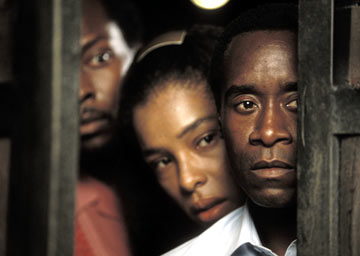
Like most films about unbearable tragedy, Rwanda chooses to focus on a real event near to but not neccessarily central to the conflict. In this case, it's the story of hotel manager Paul Rusesabagina (Don Cheadle), a savvy capitalist who has made many important connections in his years running an exclusive Rwanda hotel. By 1994, a conflict that had brewed for years in Rwanda between warring tribes tribes that we learn in the film were created randomly by the Belgians during their colonization of the country. One tribe, the Hutu, are slaughtering the Tutsis by the thousands. Unfortunately for Paul, a Hutu, his wife and extended family are Tutsis, and therefore their lives are in danger. So Paul brings his family and their neighbors to stay within the safety of his hotel.

If this plot sounds familiar, that's probably because it's the exact same story as Schindler's List. A wealthy man with connections in the military and government uses his influence to save the lives of refugees, while making it appear on the surface that he's simply running a business. What's even more amazing is that both of these stories are true. Tragedy, I suppose, tends to breed similar kinds of heroism.

The Spielberg film attempted to understand the heroism of Oskar Schindler, a man who seemed, before the Holocaust, content to live as a war profiteer and social Nazi. What could have suddenly motivated him to come to the rescue of so many strangers? Hotel Rwanda kind of takes its protagonist's sacrifice as a given - faced with the savagery of the Rwandan massacre, what good man could refuse to help his neighbors?

Director Terry George seems more interested in the how's than the why's, in the methods used by Paul to keep himself and his family alive. What George really brings out of this story is the use of language, how the right words at the right time could make all the difference. Paul often finds himself with a gun in his face, and only his mouth can save him, time and again.

Cheadle's always been good at playing verbal characters, people who live by their wits and speak intelligently. This is rare in films, where even intelligent characters don't actually speak very intelligently. But Cheadle has a way of indicating that a lot of thought has gone into every word he's about to say, and as Rusesabagina, he's constantly negotiating.

Most of this material is handled exceptionally well, clear and concise, save for one scene near the end of the film finds Rusesabagina negotiating with a general (Fana Mokoena, in a terrifyingly cold turn) for protection. Rusesabagina actually manages to convince the general to keep him alive so he can later testify at a potential war crimes trial. Would this really work? Wouldn't a general who has faced a good deal of success shrug off this kind of offer, feeling that he was too powerful to be tried in the Hague for war crimes? The whole scene has kind of the feel of a bad "Hogan's Heroes" episode, where Hogan convinces Klink to let him form a softball team in exchange for a favorably worded letter to Der Fuhrer?

But other than that minor misstep, Rwanda is a considerably powerful film. It's probably the most disturbing PG-13 film ever released, but hey, it's about a horrible massacre. Those are the breaks.


Monday, April 11, 2005

Suspect Zero

I'm not going to take too long dismissing this one. I want to watch Hotel Rwanda in a little bit here, so I don't have all day.

There was a time, years ago, when the script for Suspect Zero was kind of a hot commodity in Hollywood. The high concept says it all: a government agent finds himself hunting a serial killer who kills other serial killers.

Bum-dum-dum, da-duuuuuuuuuuuuuuum. What will happen? If you kill serial killers, are you yourself a serial killer? Or a hero? Oh the possibilities!

So, I can only assume the movie has been made much dumber in the translation from script to movie. In screenwriting circles, by the way, I've often heard a theory bounced around that the best scripts don't always make the best movies. Sometimes, a script works so perfectly in its own right, as reading material, it winds up disappointing once it's made into a finished film.

I don't know...Anyway, the movie Suspect Zero really stinks. It's an incredibly unsatisfying formula film without an original or interesting concept to add to its genre. I like serial killer movies, but they have grown incredibly stale. Someone needs to make another Silence of the Lambs or Seven or Man Bites Dog and pump some life into this genre.


For example, here's a conversation I had recently at Laser Blazer...why do serial killer movies always have to approach the material in the same way. Always. Every single one. It's always about the duality of good and evil, about how the cop and killer are mirror images of one another. The evil that the cop dwells in all day begins to rub off on him, to affect his life outside of work, and he becomes haunted. And the killer reminds him all the time about how similar they are, and about how they are inextricably tied.

So the killer keeps baiting the cop, leading to some final confrontation where either (1) the cop is forced to face the truth, that he is no better than the criminals he chases or (2) the cop kills the serial killer, reaffirming his or her place as a societal authority and arbiter of justice. It's usually #2 in Hollywood movies.

Anyway, that's the plot of Suspect Zero. And every other movie in this genre from the past decade. Even the good ones, like Silence of the Lambs, basically adhere to it. As near as I can tell, it comes from all these Hong Kong films from the late 80's and early 90's that so influenced American directors. Guys like John Woo always made films about the dual nature of law enforcement - about how hanging out with criminals and studying their behavior changes the outlook and personality of police officers.

But, seriously guys, enough is enough. Why not make a movie about a cop who loves busting serial killers, and who isn't bothered by the gruesomeness of his profession at all? Or about a guy who busts serial killers, but who otherwise is a charming, affable guy with a great personality. Like if Walter Matthau ever made a serial killer movie...his cop would just be a regular guy with a weird job.

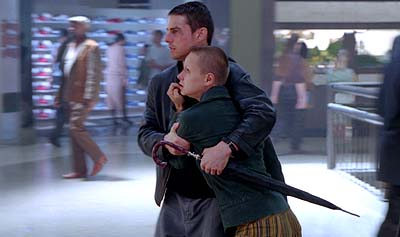
Anyway, back to the movie at hand. Ben Kingsley plays your serial killer. He's methodical, brilliant, disturbed and possibly delusional. He likes to strangle people with wire until their eyes bug out of their head. And he's sending messages and taunting a federal agent (Aaron Eckhart). Then Carrie-Anne Moss shows up as Eckhart's unwilling partner, and the movie limps into auto-pilot.

I think the biggest problem here is that the movie's set-up leaves us waiting for some big reveal, some deeper reason to maintain interest in this flat story. It's pretty obvious from about 15 minutes in that Kinglsey's character is going around killing other serial killers, so when it takes the cops nearly an hour to figure this out, we assume there's a reason. Why give the game away to us so early unless it's a red herring, some misdirection keeping us from seeing the real truth?

But there is no deeper truth that I could detect. The movie basically goes where you expect, leads to the confrontation you expect, and winds up right back where it started. This is a story with absolutely no forward momentum, a collection of events that aren't particularly interesting, nice to look at or even clearly explained. There were several whole chase sequences I found it difficult to follow, several scenes in which I couldn't really tell what the characters were talking about or why it was important, and in particular, the appearance and disappearance of the Carrie-Anne Moss character was jarring. I thought for a while she might be the killer, simply because her presence is never adequately explained.

Oh, and then there's the concept of a "Suspect Zero." This might be considered a "spoiler," I guess, if you want to go in to the movie totally fresh, but it's not the sort of thing that would ruin the experience to know about. Plus, the movie sucks, and I'm very trustworthy, so why would you see it now that you've read this review?

Anyway, Kingsley believes that there is a serial killer who defies any and all categorizations. He avoids any of the behavior we associate with serial killers (no victim patterns, different techniques every time, he moves around a lot, etc.) Therefore, he's impossible to profile. So both the cop and killer wind up searching for Suspect Zero, hoping to encounter each other along the way.

I like the idea of a serial killer who can't be caught because he's too sane. These movies are always about figuring out the lunatic psychopathology of the killer so he can be caught. It might be fun to see a movie where the guy was purposefully random to throw everyone off track. Even make them think there were different killers for each victim.

But the movie refuses to have any fun with the concept. Once it sets up the existance of Suspect Zero, there's no attempt to explore the idea. It's just a name now that's been applied to an unseen antagonist. This is an example of a solid premise completely wasted, along with the talents of a few good actors.

The director is E. Elias Merhige, whose previous film was Shadow of the Vampire. That was a very nice-looking film with a great premise - F. W. Murnau makes his classic vampire film Nosferatu using a real-life vampire as an actor - that utterly failed to entertain, or even amuse. Suspect Zero is similar, except that it lacks the visual grace of Shadow of the Vampire, relying on overly dark photography to distinctly lesser effect.

Viva Maria!

Now here's a weird one. It's a French film directed by the legendary Louis Malle, who was a contemporary of the French New Wave giants like Truffaut and Godard, though his movies aren't usually lumped in with theirs. The Cahiers du Cinema crowd made films for the masses, whereas Malle's family was aristocratic, having made a fortune during Napoleon's reign.

But anyway...Malle usually made very heavy, weighty films, often dealing with deviant sexuality (as in Amats, the 1958 film that made his international reputation, or Damage, his 1992 art house hit starring Jeremy Irons).

But Viva Maria is one of the goofier movies I've seen in some time. It an action-comedy-western telling the story of two vaudeville performers who find themselves leading a Southe American revolution. It's like a sexy French girl version of Woody Allen's Bananas. Or, if you prefer 80's PG comedy references, it's like Three Amigos with subtitles and tits.


The aforementioned tits reside on the chests of Jeanne Moreau and Brigitte Bardot, two of the loveliest of French actresses. Their chemistry and charm really makes this film work. When it works, that is. Viva Maria is a movie with a ton of enthusiasm and sparkle, a light comedy realized on a massive scale with charismatic leads, well-staged action sequences and a charming sense of fun.

Unfortunately, it's not actually very funny. Or funny at all.

Which is strange, because the story is kind of darkly amusing. It's a morbidly comic fable about Marie, the daughter of an Irish revolutionary (Bardot) on the run from the law in Central America. Her father taught her everything he knew, you see, so she's grown up as a terrorist-in-training who's also strangely ignorant about the world of everyday, law-abiding adults.

Bardot eventually finds her way into the caravan of Mary (Moreau), a formerly great actress now paying the bills by singing in a touring circus. The two Marys hit it off, and start their own double act following the suicide of Mary's former partner (one of several oddly morbid touches littered throughout the movie).

After they inadvertantly invent the striptease during a cabaret act gone horribly wrong, the Mary's become Central American celebrities, and the real adventure begins. During their travels, they'll encounter a cavalcade of bizarre characters, many of them semi-offensive Latin stereotypes and caricatures, including a bug-eyed, homicidal fat cat, a corrupt clergyman, a handsome revolutionary (played by George Hamilton!), and a cowardly generalisimo who, at one point, runs head-on into the most fake-looking prop cactus I have ever seen.

So you get the idea. It's a rollicking musical comedy with lots going on and an almost spastic level of energy. It essentially just fails to bring the funny. It's corny, confusing and occasionally silly, but just not funny.

Viva Maria is, however, extremely strange, which manages to keep the thing entertaining. (An adorable performance from Bardot, a woman with undeniable magnestism and charisma on screen, doesn't hurt either).

Take the love scene between Moreau and Hamilton. He's been chained up when Mary gets the circus' strongman to break her into his cell. With his hands tied to a pole above his head, Hamilton looks unmistakably like Jesus. And Moreau's crouching down before him, almost in supplication. And she is, after all, playing a woman named "Mary." So the symbolism is obvious.

But what's the point? Why go out of your way to set up a Passion-inspired lovemaking sequence in the middle of your campy adventure movie? When you see that scene, you don't laugh because it's so clever. You laugh that anyone would actually put something like that in a movie.

I don't mean to come down on Viva Maria. It's a zippy little film, a movie that it would be hard to hate. Moreau and Bardot are delightful in their roles, even though the musical numbers they're saddled with during the film's midsection leave something to be desired.

And, as I said, Malle's staging of the action sequences never fails to impress. He used a lot of vintage locomotives in the film to very nice effect. The entire revolution sequence looks great, and I was particularly surprised by the scale of the production. This cannot have been a cheap venture for a French movie in the mid-60's. Which makes a lot of its eccentricities all the more bizarre.

But Who's Countering?

Technical glitches have got me down. You may have noticed The Inertia went completely offline today for a while, due to further difficulties down there at Blogger headquarters. To be honest, I'm always kind of surprised and delighted when Blogger works properly. I mean, think about it...this company (a division of Google, by the way) has charged me absolutely no fee for anything having to do with Crushed by Inertia at all.

So they're giving away web space for free, which most companies don't really like to do. And there's really no strings attached from what I can tell. I don't get annoying spam because of Blogger, they never hit me up for money or attempt to mess with my service...nothing...

So, I guess I shouldn't complain when something goes haywire down at the blogging factory.

But it does mean that today, when I returned home from the video store, I had to completely redo my blog's template. It didn't take too long, but I did lose the use of the hit counter I used to keep in the corner.

I had installed a hit counter at first just for a general idea of how many people visited the site every day, and now I know. On a slow day, around 20-30. On a normal day, around 50. And it's busted 150 before. Surprisingly, the days where I got mass amounts of traffic, over 100 hits lets say, were always on weekends. This goes against what I would have guessed.

I imagined that most people's blog-reading habits mirrored my own. I first got into reading blogs while working a dull office job in Hollywood. I would spend a good deal of my afternoon flitting around from one blog to another, occasionally posting comments if I thought of something appropriately pithy. Or if someone wrote something nice about Garden State, causing bile to rise to the back of my throat.

I figured most of my visitors would do the same.

But instead, I find I get a lot of, like, random Sunday afternoon traffic. This puzzles me. Who is sitting around at home in the middle of the day on a weekend looking at my blog? I mean, aside from my grandmother. It's just hard for me to imagine.

I figured, I've learned about as much from that hit counter as I ever will. In a few months, if I feel I've built up a larger audience, I may insteall another one to check up on my status. Who knows? Maybe people will stop coming to the site, but I'll keep on writing anyway without ever knowing, and this will become a large, wordy Internet echo chamber, where I type reams worth of insights for no one's benefit but my own.

Sunday, April 10, 2005

Call Northside 777

Can you believe, I couldn't find a single usable frame from this movie as illustration for this article? It has only happened with one other movie - The Life and Death of Colonel Blimp. And that one, I almost expected, because it's an old British movie that's remained somewhat obscure for Americans.

But Call Northside 777 is a classic film. It's an American noir from 20th Century Fox, starring James Stewart. Plus it's been released recently on DVD, along with Laura and Panic in the Streets, both of which I've reviewed already.

Anyway, Laura it ain't. While Call Northside moves along briskly and provides a solid amount of entertainment (along with some beautiful shots of old Chicago), it never really gathers sufficient momentum. The movie just didn't ever come alive for me - the ingredients of a good film are there, but it's too repetitive and dry.

Part of the problem arises from its genre. Though Call Northside clearly fits in the category of "film noir," it's also a "true crime" film done in the style of a re-enacted documentary. The action in the film is based on a real Chicago murder case, and Jimmy Stewart's character is based on a real reporter.

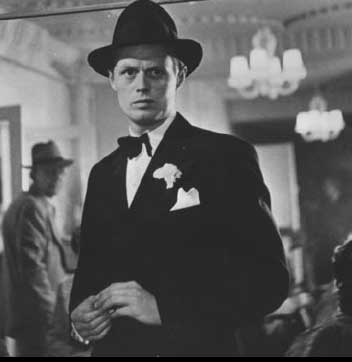
In the opening montage, we're given a brief history of Prohibition-Era Chicago, and how quick arrests protected the reputation of the police force. Then we meet Frank Wiecek (Richard Conte) and his friend Tomek Zaleska (George Tyne), two Polish immigrants arrested falsely for the murder of a police officer in a speakeasy. The police are desperate for a conviction, so they rush the case to trial, and the two friends are sentenced to 99 years in prison each.

10 years later, reporter McNeal (Stewart) stumbles on to the story while working on a fluff piece about Wiecek's mother, who scrubs floors every day hoping to earn enough money to win Frank and appeal. At first, he resists the idea that Wiecek might be innocent, but when Frank passes a lie detector test, he starts to change his mind.

And, of course, by the end he's not only become convinced of Wiecek's innocence, but enraged at a justice system that can allow a man to be railroaded in this way.

At the time, these sort of turnabouts may have seemed fresh and exciting, but today it plays like your average episode of "Law and Order." So many films and TV shows have borrowed this format that it has been run into the ground, and any more, I tend to feel that the best true crime films are actual documentaries. For example, often during Call Northside, I was reminded of Errol Morris' The Thin Blue Line, a better film about a similar case, in which an overzealous police department accused and incarcerated an innocent man. (Morris' film actually won wrongfully accused Texan Randall Adams his freedom. Adams then turned around and sued Morris for stealing his life story.)

Also, I was reminded of Clint Eastwood's underrated thriller True Crime, which is essentially a remake of the Call Northside 777 story. One interesting divergence between the films: Call Northside implies in a sidelong way that Wiecek's Polish background may have played into the police's decision to declare him the culprit, whereas Eastwood's film focused on racism much more explicitly.

You can't fault Call Northside 777 and films of its ilk for inspiration several generations of filmmakers. That's unfair. But I will say that the format kind of mutes any tension or excitement the movie's story may inspire. Take the scene featuring the lie detector. It's a suspenseful scene, and it's the first time Wiecek's claims of his innocence will be put to the test in any meaningful way.

But director Henry Hathaway obviously worried audiences wouldn't understand how the lie detector worked, so he includes an extended and very full sequence in which the operator explains to McNeal in detail how the machine worked and what it can do. Again, this film was made in 1948, when lie detector technology was not the old cliche it has become today. Now lie detectors figure into probably 40% of all movies, and we don't need any explanation for how they work.

But still, the scene just stops the film dead in its tracks. By the time Wiecek starts actually answering questions, we've had long enough to figure out what's going to happen, and the scene has become completely flat.

As well, Hathaway's unable to establish any interesting relationships. Wiecek at first distrusts McNeail, asking him at one point to stop writing any more articles about him or his family, and then comes around for no apparent reason. McNeal's given an attractive and supportive wife (Helen Walker) who doesn't have any role to play in the film whatsoever. Lee J. Cobb plays his editor, who at first seems like an interesting character before devolving into a placeholder at around the hour mark.

Even Wiecek's mother, the kindly old lady who scrubs floors for the benefit of her son, fails to make much of an impression. We meet her early on in the film and then don't see her again until the end.

One more complaint before I get to the good stuff; Stewart's character isn't really depicted as much of a reporter. For one thing, he writes several stories about Wiecek's case before ever meeting the man or even talking to him. He has to be convinced by his editor to go interview the man's ex-wife. It doesn't occur to him to speak to Wiecek's friend, the man who was arrested along with him, until nearly halfway through the movie.

Also, he's apparently a news writer, but often we see him typing opinionated column-type pieces. At one point, he refers to an old lady who refuses to testify on Wiecek's behalf, as an "evil, heartless woman." Oh, and before he interviews Wiecek or finds out any of the facts of the case, he's already decided about the man's guilt.

See what I mean? Woodward and Bernstein, this guy ain't.

Okay, now on to what's good about Call Northside. Obviously, there's Jimmy Stewart, who provides the film with a solid center without overshadowing the action. There's a lack of actors like Stewart these days. When he wanted to, he was capable of commanding an audience's attention, but he also knew how to hang back and invest himself in the story. There are many films like Call Northside where he doesn't stand out, but you realize only after the movie's over that he's been the backbone, his character's presence has been holding the entire enterprise together.

I'm reminded, as well, of a film like Rope. You think of it, or at least I do, as Hitchcock's film, a tour-de-force of directing. But you need to have Stewart in there to maintain the audience's interest. If Hitchcock is the film's raging id, Stewart is the always self-aware ego, keeping the narrative on an even keel.

Also, no review of Call Northside 777 would be complete without a mention of Joseph MacDonald's wonderful location photography. This was the first film ever to be filmed on location in Chicago. Seriously. And MacDonald managed to capture the city's variety and character brilliantly. There are many, many breathtaking black and white cityscapes, and it's a rare treat to see such expansive location photography in a movie from this era. Chicago itself is practically a star in this movie, and the cinematography was the highlight of my entire experience with the film.

I'm continuing to work my way through Laser Blazer's extensive noir collection, so I'll be featuring many more films like Call Northside 777, many of them likely better. This ranks along with Panic in the Streets as a noble effort with much to recommend, that nevertheless falls short of the genre's real benchmarks.

That Man Bolton

What's that? You want to read a column written by the Internet's dumbest man? A man who makes Bill O'Reilly seem measured and reasonable? A man whose notion of nuanced cultural analysis is Wally George interviewing Ann Coulter? Well, look no further. I give you Fox News' very own John Gibson.

John Bolton isn't a household name yet, but the end of "yet" is just around the corner.

That's his lead-off sentence this week. There's something about Gibson's prose style I can't quite put my finger on...It's clumsy, yes, and indicates a baffling lack of insight. But there's something else. His writing appears to break several rules of grammar and syntax, yet I think his word usage is technically correct. "The end of 'yet' is just around the corner," though...who writes like that?

Now, some might argue that the only thing a U.S. ambassador to the U.N. should do is drop by to deliver our resignation letter and a demand to get out of the United States. But that's not why Bolton is going to the U.N.

He's, of course, going for the world-class buffet.

Please note that Gibson once again uses the old Fox News "some have said" trick. This trick is so old, Robert Greenwald has already made a documentary explaining its usage (the film is Outfoxed), but Gibson hopes we're not savvy enough to have seen the movie. Basically, instead of coming out and offering a dumb, lunatic theory as his own (such as "the US should resign from the UN, an organization it functionally controls), John can make it sound like he's simply reporting news.

"Some have argued..." whatever you want. He still gets to say the fringe, idiot theory that Fox News wants you to know about, but he gets to later backtrack and say he never really believed it in the first place.

Sean Hannity does this all the time. "Senator, some have said that Bill Clinton was actually a zombie working under the control of Communists acting on behalf of George Soros. What do you think of that idea?"

But back to the Gibson article. He's about to tell us what John Bolton does plan to do with his newfound influence in the United Nations.

He's going there to give the 190 other nations in the U.N. a dose of reality that goes like this:

We're sick of this organization operating as an anti-American one-upmanship club.


Sorry, what?

You'd think, from reading that sentence, that the UN had prevented the United States from doing something important. In fact, the United Nations did nothing to stop our invasion of Iraq or Afghanistan. They didn't send their own troops, but it's not like there were UN forces opposing us.

All that happened was that foreign diplomats used the United Nations as a platform to tell the world they thought the United States was wrong. And, folks, the United States was wrong. It's sad but true. Americans fell hook, line and sinker for a massive whopper of a lie, a lie that was funded and propogated by the executive and legislative branches of the government, the mass media and corporations with a financial stake in the war's outcome.

That's what happened.

But John Gibson wants you to think it's wrong for the United Nations or any members therein to say anything negative about the United States. Our country already controls the organization that's supposed to stand for international cooperation. But that isn't enough for J.G. He wants them to grovel and beg for our favor, he wants them to bow down to us and accept our total domination. He wants diplomats and ambassadors to silence themselves when their views don't line up with the power-hungry lunatic in the White House.

We're sick of paying the bills and getting trashed by every tin pot dictator the U.N. can invite into its midst.

It's very useful to follow John's logic carefully here. The United States "pays the bills" for the United Nations. So, he agrees, we control the organization that's supposed to stand for international cooperation. That's good, we're getting somewhere.

Therefore, since the US pays the bills, it's wrong for "tin pot dictators," whatever he means by that bizarre, confused slang, to say bad things about the United States. By extension, since the US pays the bills, they should get to determine who is and who is not a "tin pot dictator."

Because John's not suggesting we kick out every country from the UN that has what could be considered a dictatorship. He's not saying "trashed by every dictator," but "every tin pot dictator." That's hardly an exact term. So, of course, it's up to America to decide which dictators can stay and which can go.

We're sick of the U.N. acting as if the world — or the U.N. — can get along without the U.S.

And we're sick of all of you working against good ideas just because they come from the U.S. or from President Bush.

John is so pleased with America. He's constantly delighting himself with little paragraphs about how great the United States is and how much everyone needs us. I think he relates too personally to the idea of his nation. In other words, I think he's come to actually identify himself with "America," so he sees America's international diplomatic relationships and personal relationships in his own life.

"The world can't get along with me because I am so great. France is so mean for saying mean stuff about me, I hate him. Forget France, they're icky and gross and I'm not their friend any more. Iran just made a face at me!"

To be honest, I think a lot of people, okay a lot of conservatives, have this problem. Particularly hawk-ish kind of people, the kind of people who always think we should go to war. Allow me to explain.

There are certain experiences we have, particularly as children, that shape the way we think about interpersonal relationships. Life lessons, like "never back down when someone threatens you." That's an important lesson, because if you never stand up for yourself, you'll be repeatedly picked on and victimized.

But these principles don't apply to international relations. When you're speaking about countries and their diplomatic negotiations, you're talking about discussions that affect the lives of literally billions of people. So it's horribly irresponsible to apply interpersonal communication rules to diplomacy.

And yet that's what most Americans do when they think about American foreign policy. "Oh, North Korea said some bad shit about us? We should send a battleship there!" "Iraq broke this rule we told them never to break again! Let's bomb them."

That's what you'd do if it was a problem with another person. If you lent Toby $500 and he never paid you back, and then you found it he was telling everybody about how he ripped you off for $500 and about how he totally has the money but he's not going to give it to you ever, you'd be pretty much in the right going to Toby's apartment, roughing him up and taking the money.

But if Norway did that same thing to Finland, Finland might just have to take it to avoid further conflict. I'm not saying the old rules and manners never apply; I'm just saying there are more things to consider than pride.

But back to John Gibson's expert UN analysis:

Somebody has got to tell them. The Brits won't; the French won't because they're the worst offenders; and that vast collection of fat kleptocrats — so-called diplomats — from Third World countries won't either.

Told you..."Ooooooooohhhh, those French....they make-a me so maaaaad!"

I also like that he has to explain the kleptocrats joke. He knows this ain't exactly a New Yorker kind of audience he's reaching...

That latter group includes a huge number of so-called nations — really little more than spots on the map — that would get invaded, taken over, subsumed, eliminated from memory except no one wants to get stuck with their problems of poverty and disease and corruption. So by benefit of their sorry state, they get to maintain their independence and membership in the U.N. and their right to bitch out the U.S.

This man is so ugly inside. He really is. And he's so blissfully unaware of the blackness of his soul. He thinks evil is just common sense.

I mean, seriously, this is a paragraph written by a smarmy American who is reveling in the horror of life in the Third World. He first callously dismisses them as "spots on the map," as if the geographic size of a country had anything to do with the value of the human life therein. That would be like saying "Who cares if everyone in Newport News dies...Rhode Island is, like, totally small."

But that's not mean enough. He goes on to fantasize about how these countries could be vaporized (along with their native population, one can only assume). And as if musing unassumingly about the utter destruction of the Third World weren't enough, he goes on to comment that the only reason this hasn't yet happened is because these countries are so horrible, no one thinks they are worth invading.

John Gibson's telling the people of the Third World that, in his opinion, they are so insignificant, they're not worth destroying. What a sweetie.

And because these countries are fortunate to even exist, they shouldn't be allowed to voice their opinion on America's massive and deadly war machine.

If you're poor, if you're not an American, if you don't like George Bush, John Gibson just plain doesn't like you.

Saturday, April 09, 2005

Bad Education

I couldn't get friends to go see this movie with me in theaters. You'd think an internationally known and respected guy like Pedro Almoldovar would have more admirers among the geeky film community of Los Angeles. Most often, it was the gay content that turned my potential movie mates off.

I don't mean to imply that my friends are homophobic. Okay, some of my friends are definitely homophobic. I have one friend in particular for whom "fag" is both a noun and a verb (as in, "why do you keep fagging me like this?")

I like to think jokes such as these highlight the absurdity of homophobia rather than the reality of it, but I may be deluding myself. Anyway, there were no takers for Almoldovar's homosocial psychological thriller Bad Education, so I had to wait to check it out on DVD. And I discovered that it's one of the Spanish icon's more entertaining and accomplished films, if not neccessarily the most amusing, charming or humane. While it's not an emotional masterpiece like the director's Live Flesh, Bad Education ranks among Almoldovar's most innovative and exciting narratives, a Hitchcock homage that covers a lot of territory in its tight hour and 45 minute running time.


As I mentioned, the film clearly echoes Hitchcock's mixture of dark comedy and high tension, and it also incorporates the Master's love of flashbacks and flashbacks within flashbacks. With its frank, unabashed sexuality and sensuous, fluid tracking shots, there are echoes of Brian De Palma's great 70's thrillers.

Ignacio and Enrique came of age in a Franco-era religious school full of bullying priests who sexually and physically abused the young boys, and thus formed a tight and enduring bond. One of the preists in particular, Father Manolo (Daniel Giménez Cacho) fell in love with young Ignacio, setting the tragic paths for all three of these characters lives throughout the next 20 years.

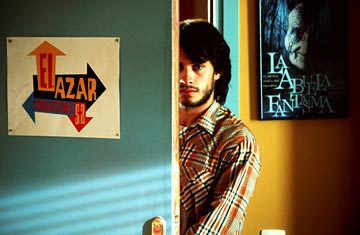
The action begins when a stranger appears at the office of notable Spanish director Enrique Goded (Fele Martinez). The young man (Gael García Bernal) claims to be Enrique's long-lost school chum, Ignacio, even though he looks nothing like the boy he was and doesn't remember key events in their young lives. "Ignacio" has written a story, based in part on the tragic circumstances of his and Enrique's situation, and as the director reads it, we see it enacted.

And it's here that the film gets complicated and far more interesting. In the fantasy/story sequence, Bernal portrays the hero, a coke-addled drag queen named Zahara who confronts a priest who sexually abused him/her as a child. Then, within Zahara's story, we see yet another flashback to actual events in Ignacio and Enrique's life back at the religious school. The various infidelities, double-crosses and reversals get complicated but never confusing.

This all comes together so well because of Almoldovar's mastery of the form. He's been making films long enough to really demonstrate confidence and, yes, balls in organizing a story with this sort of imploding structure. Bad Education as a film is almost entirely backstory - explanations about why certain people behave as they do, and what traumatic events have altered their viewpoint - and yet it feels vital and energetic, like any good noir mystery.

Though the film holds together thematically, and contains many interesting ideas about fate, love and the lingering effects of childhood abuse, I think it works best as an elaborate puzzle. Like other satisfying noir-romance-mysteries about past trauma, works like Hitchcock's Marnie and John Brahm's woefully underseen 1946 masterpiece The Locket, Almoldovar's film glides along, always remianing intriguing without ever fully giving the game away.

One more thought about the central conceit of the film: in the flashbacks, because they are not quite reflections of reality, but rather a fictionalized version of reality, the characters have all morphed or shifted in some vital way. Obviously, Ignacio has turned into a transsexual, but other characters have been altered as well, including Enrique (who has become a drunken barfly who takes Zahara home for a little how's your father).

I'm reminded of the transsexual "South Park" episode of a few weeks back. It also seemed to argue that transsexuals were purposefully creating artifice, pretending to be something they're not and asking us to accept it anyway. I disagreed with this viewpoint and basically found the episode insensitive. But now here's Almoldovar in a way suggesting the same case - that Zahara's artifice (pretending to be a woman) blocks her from confronting the pain of her childhood abuse. The character has become a hiding place for Ignacio.

And, of course, later in the film, when we find out even more secrets about Ignacio's true identity and where he has been in the years since his childhood, the layers of artifice increase. By the end of the film, you've been confronted with a dizzying array of experiences and information, intersecting timelines that link up in a variety of puzzling and troubling ways. It's a lot to take in, and all the actors acquit themselves exceptionally well considering the difficulty of the material.

Bad Education was a film I not only enjoyed, but enjoyed more than I expected. As I said, it's among Almoldovar's most interesting, if not most accessible, work. Surprising that it's his first film strictly in the thriller genre, as he seems to handle its tropes and pace quite well.

Hot for Goddess

I tend to think all religions are ridiculous, but it occurs to me that I reserve blog mockery almost exclusively for Judaism, the religion of my ancestors, and Christianity, the religion of all the stupid Americans. This is unfair, as all religions are pretty equally stupid.

Yes, even Buddhism. Every time I declare all world religions to be stupid, someone has to try and offer Buddhism as a counter-argument, as if it's so perfect and obvious, it's beyond the pale of rational analysis.

A lot of the basic ideas of Buddhism, the "life is suffering" and "extricate yourself from a materialist existance," sure, that stuff is great. But Buddhism's filled with dumb mystical crap too, like fat guy gold statues everywhere and monks scanning the countryside for the latest incarnation of the all-knowing Buddha. And, like all ludicrous religions, it features silly hats. Always, always, with the silly hats.

Plus, that deep chanting gets really annoying really fast.

But the point of this post was not simply to mock Buddhism. Sure, that was part of the idea, but I'd like to move along to Hinduism now. Specifically, this Yahoo article, about a Bengali writer who has been arrested for defiling the goddess of learning, Saraswati.

A police complaint was lodged in the city against Bengali novelist Sunil Gangopadhayay by retired additional director general of Research and Analysis Wing (RAW) Bibhutibhusan Nandy.

Nandy has accused the writer of hurting religious sentiments by what he termed as obscene comments on the goddess in an autobiographical account, excerpts of which were carried by a Bengali daily.

Specifically, this novelist indicated that he won a literary award as a gift from Saraswati, in exchange for his physical desire for her. Also, he admitted in an autobiographical article to, ahem, pleasuring himself while fondling a clay statue of the goddess.

So, clearly, this guy has got some issues going on. Have you seen these Hindu goddesses? I mean, sure, some of them are kind of cute, when they don't have eight arms and aren't blue. But this is taking it a bit far.

It also makes me wonder if there are Christians out there anywhere with Virgin Mary fetishes? Surely there's got to be some Madonna porn out there somewhere. (No, not pop star Madonna...we all know there's pop star Madonna porn out there...)

The First Information Report (FIR) was filed under sections 295 and 295A of the Indian Penal Code (IPC) pertaining to defilement of sacred objects and insulting religious beliefs.

While police confirmed the news, Sunil Gangopadhayay said he was not aware of the legal proceedings.

"A report published in Bengali daily Ananda Bazar Patrika on March 28 quoted the writer saying that he was aroused by an idol of the goddess and had fondled the clay image for gratification. This is not only depravity and perversion of the person but also amounts to desecration of the goddess of learning," Nandy told IANS.

It's kind of comforting to hear that there's another country filled with loopy religious nuts out there. I sometimes feel so alone in the universe. But this is pretty wacky stuff...It's against the law in India to insult religious beliefs? Can you imagine? In Madras, this blog would be like the Unabomber Manifesto. I'd be the John Dillinger of Dehli.

What a silly law. You're not legally allowed to find an imaginary character...oh, I mean, a "goddess"...attractive? I mean, I agree, it's kind of weird and inappropriate, like falling in love with Bilbo Baggins or Wonder Woman. I'm recalling that scene in the documentary Crumb where R. Crumb admits to, in his formative years, finding Bugs Bunny sexually attractive. In America, that just makes you an oddity; in India, it makes you a felon.

Aloha Oy

My folks left today for a vacation in Hawaii. They've been there several times before, but never without me and my brother tagging along with them. (I want to use "my brother and I" there, but you wouldn't say "without I tagging along with them," so I think "me and my brother" is actually correct in this instance...it still looks wrong...)

This is probably for the best. I like Hawaii a lot (what's not to like?), but I always feel a bit out of place there. Let's face it - I'm an overweight bearded Jew. I have about as much business on a tropical beach as Nanook of the North. When in Hawaii, where the population is largely Polynesian and fond of saying "mahalo," I tend to stand out.

I far prefer vacations where I can blend in with the local population. In Hawaii, I'm so clearly a tourist that I don't get to really experience anything. Everywhere I go, it's "let me get you a towel, sir" and "here's another fish entree with a name that includes 20 vowels." Everyone in Waikiki's from Des Plaines or Fresno or Waxahatchie, Texas. It gets kind of weird after a while.

I'm reminded for whatever stream-of-consciousness reason of this one trip to Vegas with my friend and roommate Nathan. We stayed at the Frontier Inn on the Strip and I had to wake up extra early one morning to catch a cab to Henderson airport for a flight back to LA. So, I'm standing there on The Strip, and it's about 9 am, and for the first time, I really see the street for what it is. At night, there's so many people and lights and so much activity and noise and commotion, you get caught up in it, you kind of give yourself over to the illusion.

But in the morning, when the street's bare save for old people and hardcore gamblers, and all the lights are off, and the hot morning-in-the-desert sun is beating down on you, you really see The Strip for what it is: a dank patch of oversized buildings huddled together in the middle of nowhere, packed to the gills with strangers from various states sleeping off their collective hangovers.

So, that's not really like Hawaii, which would be a beautiful tropical paradise even if all the tourists and activity went away. But it's kind of how I feel about Hawaii after several weeks of being waited upon and treated like a visitor. I prefer visitng a culturally enriched major city to which I've never previously been. You get to check out the major urban centers, interesting museums and landmarks, and meet different kinds of people with different backgrounds.

Although Hawaii does have the benefit of those Volcano drinks with the eight different kinds of rum in them. Let's see Chicago try to top that one.

It's also good that my parents are taking this trip because they rarely leave comfortable environs of Southern California. My mother and I share a disaffection for travel, though for me it's more the actual transportation part that's a bummer. I hate long car trips, and I really hate commercial air travel, but once I get where I'm going, I enjoy myself immensely.

My mother, on the other hand, doesn't really relax from the moment she leaves the house until the moment she has returned, and this doesn't even include all the packing, unpacking and pre-arrangements that cause her strain and irritation.

Plus, once we get to the hotel, she always insists that we change rooms for some bizarre reason. Now, granted, sometimes there would actually be a slight problem with the room, such as not having enough beds or a faulty air conditioner or something. But sometimes we'd walk into rooms that seemed perfectly fine to me, and yet we'd still have to switch rooms. Sometimes more than once.

I think the idea was, you always assume that the hotel will want to put you in the cheapest, crummiest room they have available, so if you keep shifting rooms, eventually you'll get to one of the good ones. But it's hard to believe that every time you check in to a hotel, they're trying to foist you into some dismal, dank corner they reserve only for the suckers who accept the first room they're offered.

Part of the problem is, my parents share a strange obsession with having a "view." I don't get the need at all for a view from a hotel room window. I mean, okay, maybe, if you're staying somewhere with one clearly identifiable thing, maybe it'd be nice to see it from your hotel room. Like, if you're in St. Louis and your hotel is right near that Archway thing, you might want to be facing it if possible. Because what the hell else are you going to look at? St. Louis?

But some hotels just don't look out on to anything interesting. And how much time are you really going to spend sitting in your hotel room staring out at the horizon? I suggest that, if it's more than 10 minutes total for the whole vacation, you don't really know how to have a good time. Why not, instead of worrying about the view from your room, you go out and move around in the landscape, three-dimensionally? It kind of enhances the whole experience.

Now that I'm re-reading this post, I realize it could be seen as making fun of my mother, which she clearly would not appreciate. But I'm going to post it anyone because (1) I am something of an inconsiderate son, (2) it's a very gentle ribbing as opposed to a harsh critique and (3) she's off in Hawaii, and the wireless Internet remains a mysterious and futuristic concept to my parents, so I'm betting Moms will be incommunicado, cyberwise, for the next week or more.

Best of the BEST

So I just got back from taking the CBEST exam, the standardized test designed to determine whether or not I'm qualified to teach young children. I'm thinking that I passed, because the exam was for the most part spectacularly easy.

It's divided into three sections: Reading, Mathematics and Writing. You're given a staggering 4 hours to complete the test, which means that, even as I type this here from the comfort of my bedroom, there are people still in the testing room with an hour of spare time yet to go. Yowza.

The Reading section was the easiest. You're given a series of paragraphs and asked painfully obvious questions about them. It goes like this:

Please answer questions 1 through 3 based on the paragraph written below:

Lots of people drive cars. Some cars are bigger than others. It's a common stereotype that people who drive large, expensive cars are compensating for having a small penis, or in the case of female drivers, no penis at all. This stereotype is true.

1. Which of the following can you infer from this selection?
A. Big cars are safer than small cars
B. There are more big cars than small cars
C. More men than women drive big cars
D. The author lives in Los Angeles
E. Women don't have penises

2. What is the main idea of this paragraph?
A. Big cars are better than small cars
B. Small cars are better than big cars
C. Men drive better than women
D. Women drive better than men
E. Because everyone drives huge SUV's everywhere in Los Angeles, it's very difficult to see where you're going when driving a small car, so you will occasionally turn out of a parking lot and directly into a pedestrian, in which case you should probably speed up before the cops arrive

3. In this paragraph, the word stereotype could be replaced by which of the following?
A. archetype
B. phenotype
C. daguerrotype
D. genotype
E. appetite

It goes on and on like that. I don't really know how this determines whether or not you'd be a good teacher. It seems like it mainly tests your patience. Can you wade through these 20 really boring snippets taken out of textbooks and figure out what the hell they're talking about before passing out from boredom?

Then there was a math section. This is blatantly unfair, as I'm at a point in my life where it's been over a decade since I've had to do any of this math. It wasn't even the abstract concepts giving me trouble so much as it was doing the arithmatic in my head. You're not allowed to use a calculator on the CBEST, despite the fact that every math teacher I've ever had uses one. Why do they feel the need to prepare you to teach math without a calculator? In case you wind up with a teaching assignment in the distant past, say Ancient China, and they only have an abacus?

It's dumb, wasting time doing all this long division and stuff in your head. I swear to you, I found myself counting with my fingers more than once! I don't do this stuff...ever! I'm even starting to forget my multiplication tables.

It's true! At one point, I kept getting an answer I knew was wrong. It wasn't even one of the five lettered choices. I went back to discover that I had written the product of 8 and 6 as 46. Yikes. That's powerful stupid. You really shouldn't need a calculator for that one...just a central nervous system.

What can I say? I suck at math. Math was my worst subject in junior high and high school. Worse even than woodshop, and I nearly lost a limb in that class.

The last section on the CBEST is the writing section. So, yeah, I figured it would be a snap. After all, I write crap on this here blog near every day (when Blogger's not experiencing total meltdown, that is). But the writing topics themselves were fairly loopy, and I'm not sure I wrote exactly what they were looking for.

Question #1 asked me what one value I'd like to pass on to future generations. It's a hard question to answer in two handwritten pages, mainly because I don't really have any values. I mean, I've never killed a man, and I guess "don't murder people" is a value. But I didn't want to write that as my response - "I think we should teach the younger generation not to kill each other." It's kind of an obvious choice.

It was almost like the essay topic wanted me to come up with some kind of moral value, like "meat is murder" or "women connected to life support systems and feeding tubes are, like, so totally still alive." So I wrote that I'd like to pass on to our children intellectual curiosity, that I think kids are too complacent and willing to accept what they are told by authority figures and media. It's a truthful response, and I even got in some cutting remarks about Fox News and whatnot, but I'm not sure it's what the Board of Education will be looking for. Even as we speak, my response may be on its way to Porter Goss' office, so he can debrief his staff tomorrow about my traitorous and un-American philosophy of "education" and "media literacy."

So if this blog disappears tomorrow, you'll know the government has finally come in and shut me down.

Question #2 continued the warm, fuzzy essay style. It wanted to know about a goal I have accomplished in my life of which I was proud.

It immediately occured to me that a group full of hopeful teachers was the wrong crowd for this question. No offense to teachers, who have one of our society's most important and least respected jobs, but any room full of people hoping to be substitute teachers most likely includes its share of failures from other industries. I don't isolate myself from this category either, mind you. It just seems kind of insensitive, like asking people in the unemployment line for sound investment strategies.

So, yeah, I finished the test in just over 2 hours. It wasn't a race, but just so you know, that was second out of everyone in my assigned room, and I think the girl who finished first just kind of gave up halfway through. I'll let you know how I did whenever I get the results back, unless I failed the test, in which case I'll never bring this up again.

Friday, April 08, 2005

Fingering a Suspect

Sorry...I couldn't help it...

You've probably heard about the case of the Las Vegas woman who claimed she found a severed human finger in her Wendy's 99 cent cup of chili.

My first response is...they're charging 99 cents for a cup of chili. What did you think you'd fine in there? Beef?

Well, police remain baffled as to the identity of the finger's owner. All the employees of Wendy's have all their fingers, and none of Wendy's suppliers have reported an accident wherein someone lost a digit. There's even talk that the police may suspect the victim, Anna Ayala, of putting the finger in the chili in the first place.

"We are looking into every aspect in this case," San Jose police spokeswoman Gina Tepoorten said. "We are talking to people she knows as well as the finder of the finger. … We want to determine who this finger belongs to how and how it ended up in a bowl of chili."

I'm genuinely intrigued by this one. We know it wasn't a Wendy's employee who lost a finger, and we know it couldn't be the woman who found the finger. So who's left?

To my mind, there's only two reasonable explanations.

(1) Someone at a Wendy's ingredient warehouse lost a finger, and it's being covered up for fear of reprisals or a loss of business. Maybe the company cut a check to some wage slave in exchange for their silence, although once the police are involved, you'd think the victim would speak up anyway.

(2) Ayala convinced someone she knew to cut off their finger for a chance at a share of the winnings in a future lawsuit.

The cops have executed a search warrant for Ayala's home, so they're clearly keeping #2 in mind as a possibility. If this is true, Ayala might be the best saleswoman of her generation.

Think about that...You have to convince someone to actually cut off their finger at the knuckle, so you can plop it into your Wendy's chili and then collect the pay-off. How do you start that conversation?

"Okay, I have this idea. We'll be totally rich. I'm going to find someone's finger in my Wendy's chili!...Are you kidding? They'll pay through the nose! It'll be a national embarassment...No, I can't cut off my own finger. The cops will figure it out!...Well, I'm the only one who knows how to handle the media. Plus, it is my idea...Well, I was thinking maybe you could cut off your finger...I mean, it'll hurt a little...No, you can't reattach it. It will be entered into evidence...We're talking thousands of dollars here. Stop being such a baby...Yeah, you've got 9 more...So, you're in? Great! I'll bring the pruning shears, you get some green nail polish..."

C is for Cookie...

That's good enough for me.

But now, because America is on this anti-obesity kick, the Cookie Monster of "Sesame Street" fame will no longer be allowed a diet of exclusively cookies.

Seriously. They're taking away cookies...from the Cookie Monster.

Even politicians have gotten into the act, filming public service announcements with "Sesame Street" residents. In one taping, Senate Majority Leader Bill Frist taught Elmo to exercise -- jumping up and down. In another, Sen. Hillary Clinton and the small red monster discuss the various textures and tastes of foods.

"Even Cookie Monster is learning to control his cookie cravings," Frist told me by e-mail. "His sage advice opened our eyes to the simple joys of a tasty cookie and now reminds us that moderation is the key to healthy living."

Actually, Cookie Monster's sage advice taught us that the word "cookie" begins with the letter C, Senator Bill. I also recall one occasion where old Cook taught us about computers by using a magical device that made cookies magically appear on a monitor.

Surely there are better spokespeople for cookie-eating moderation than a blue, googly-eyed monster whose passion for baked goods is indicated right there in his name. He's a Cookie Monster! That's what he is. Asking him to enjoy cookies in moderation is like asking Dick Cheney to kill foreigners in moderation. That's not how monsters work. They're just not built that way.


I'd quote more from this CNN article about the Cookie Monster's newfound respect for nutirional guidelines and healthy moderation, but it's all written in this cutesy, folksy, first-person style that's really obnoxious. You know, kind of like this blog. To wit:

My beloved blue, furry monster -- who sang "C is for cookie, that's good enough for me" -- is now advocating eating healthy. There's even a new song -- "A Cookie Is a Sometimes Food," where Cookie Monster learns there are "anytime" foods and "sometimes" foods.

"Sacrilege!" I cried. "That's akin to Oscar the Grouch being nice and clean." (Co-workers gave me strange looks. But I didn't care.)

Ugh. Dave Barry, this girl ain't...

Anyway, I like this concept of "anytime" and "sometimes" foods. It's actually kind of, you know, reasonable. (But, for the record, a cookie is always food. Except those imitation cookies with carob or dried fruit bits in them...those are never food.)

When I was a young kid, the concept of eating balanced meals for good nutrition was already well in place, but the core concept was often obscured by the severity and frequency of the message. Sugar wasn't just a "sometimes" food but a silent killer that rots your teeth and gives you pimples and makes you fat and ugly.

And who could forget constant interruptions during Saturday Morning cartoons?

I remember one urging me to eat fish twice a week, another starring a hunk of cheese dressed as a cowboy, another one about how you should drink milk constantly, except when you're pouring water down your gullet, and even one telling me to eat five fruits or vegetables a day. Fucking A, I'm trying to watch "The Great Space Coaster."

As a kid, that "fruits and vegetables" thing seemed particularly bizarre. Could the television really be urging me to eat five whole vegetables a day? I liked some fruits as a kid (particularly bananas, still a favorite...), but not really the veggies.

Not much has changed.

So the thought of trying to force feed myself an entire head of broccoli, of cramming five full servings of green beans into my stomach when they're intended as a side dish...well, I think it might have done more harm to my understanding of nutrition than good.

Personally, if there's one aspect of the Cookie Monster's personality we should alter for the well-being of children, it's his abhorrent butchering of the English language. How many kids have grown up thinking it's proper to use the phrase "me want cookie." Instead of life lessons about the overall deliciousness of celery, how about getting CM a basic understanding of phonics and syntax? Me ask you, is that too much to ask?

Oh, and me want to thank Gorilla Mask for the link.

Mitch Alborn is a Liar

But you already knew that, right?

He's the sports columnist who wrote the treacly, somewhat embarrassing death memoir "Tuesdays with Morrie." It's about an old teacher he reconnected with, a free spirit named Morrie, who was dying. Mitch would visit him every Tuesday and learn valuable life lessons, life lessons that he apparently had never heard before, like "stop and smell the roses" or "how the courage to face the unknown with a smile" or "sometimes, when you get old and you're sick, you can't wipe yourself after doing #2, and someone has to do that for you, and it's kind of embarrassing".

And then Mitch wrote a book capitalizing on his friend's death. And it became a big best-seller, and he wrote some more books, and now this douchebag's a best-selling author. They even made a TV movie out of Tuesdays with Morrie, which would contain the final performance from the legendary Jack Lemmon, who really didn't deserve to go out that way. The basic theme of this story, as best I can recall, is the following: Death's really poignant provided it happens to someone else.

If it happens to you, though, it's less poignant and more, oh yeah, unpleasant and painful.

Alborn wrote another book after Morrie which I haven't read. It's called The Five People You Meet in Heaven. It's about an old man, Eddie, who dies saving a young girl at an amusement park and goes to Heaven. When he gets there, he discovers that Heaven's not really a place with clouds and angels and harps. It looks a lot like where you spent your life, and you meet people you knew when you were alive, and they tell you stuff about yourself.

Sounds like a riveting read, I know. I'm betting the final person Eddie meets in Heaven is the young girl he saved. Either that, or he meets Morrie, in an odd book-crossover technique that will really give the marketing department a much-needed boost. They made a bullshit movie out of this book as well, starring Jon Voight. Alborn's started this kind of TV-movie cottage industry. You find old actors who don't get much work any more and have them elaborately die on screen for two hours. Then you sit back and watch that advertising and DVD money roll in.

So, you might think this is why I've called Alborn a liar. Because he sugarcoats death, inserts deep meaning into situations that lack meaning, and pretends there's a Heaven, which there clearly is not.

But, no, the guy's just a liar.

Detroit Free Press columnist Mitch Albom wrote a bogus basketball column. Based on earlier interviews of two NBA players, he submitted a Friday piece about a Saturday event (as if it happened) for the Sunday edition. The game was up when the two players mentioned in the article failed to show.

Oops. This is why you shouldn't write a column about a basketball game before it has actually happened.

Now, yeah, yeah, I know...Mitch was under time pressure from his editor's and it was for the Sunday edition. And he was, like, super-tired. But come on! Why bother reading the sports page at all, if they're just going to make up what happens before the games are even played? Hell, I could do that. Why doesn't the Detroit Free Press give me some column inches?

This is an egregious ethical lapse. Prophesying the future should be clearly labeled as such. Columnists do not fabricate events or characters and pawn them off as truth. His sports column in question was not satire. Mitch Albom, a long time award winner and best-selling author, should understand these essential ethics better than most.

Mitch, and any professional journalist, should clearly understand why this was not appropriate behavior. I kind of think "ethical lapse" is too kind for this scenario. This is more like being exposed as a fraud.

It also explains why Mitch enjoys writing about the dead so much. They can't voice a rebuttal when he just starts making shit up about them.

Nothing but the Best

Tomorrow I'm taking the CBEST exam. It's a standardized test that doesn't do anything.

Well, okay, if you want to teach in California, you have to pass the CBEST examination. So it does something, but I still kind of can't figure out exactly what happens if you pass. I'd assume that, once you've passed, people will randomly call you and offer you teaching positions, but this apparently isn't the case. You just become licensed to teach. Which is kind of like being licensed to fly an airplane when you don't own one. A nice thing to have in case of airborne emergency but essentially useless.

I'm a little nervous. Generally, I do quite well on standardized exams. I aced the SAT and did well enough on the GRE to get into an (also useless) grad program at USC. So it's not the situation that gets me nervous. It's the fact that I'm being asked to perform algebra.

I'm no good at algebra. It's this collision of language and math, and those are two great tastes that don't neccessarily go great together. I can handle something like 2+2=4. Those are all numbers, so it makes sense. If I have two trampolines and I buy two more trampolines...I have 4 trampolines. Which I should sell, because no one needs four trampolines unless they're one of the Ringling Brothers.

Even the real basic algebra stuff, I can handle. 2+x=4. Okay, you see that, you know x has to be two. Because two twos make a four. Easy so far.

But once you start getting into fractions, or more than one letter in the equation, I get kind of mixed up. And then there are the word problems, where they express a question in paragraph form and you have to come up with the answer, even though it's more like a reading comprehension problem than a math problem.

Stuff like this:

Jim can do X amount of work in an hour. Jane can do that same amount of work in 90 minutes. Bill can do that same amount of work in 15 minutes. If they all work together, how quickly can they get X amount of work done?

To solve this problem, you have to make up a whole lot of fake numbers, like 3x or x-10 or -x/4 or some shit. It's stupid. How should I know how much Jim, Bill and Jane can get done? Maybe they don't work well together. Maybe there isn't any profit sharing at their company, so they don't give a shit how quickly X amount of work can get done. Maybe they've been doing X work for the past several years and are completely fed up with it, and today, instead of getting work done, they're going to march into their bosses office and shove their work directly up his X.

Maybe I'll just write that in on the Scantron.

The other thing that unsettles me about tomorrow's CBEST exam? It's being held at 8:30 in the goddamn morning, across town. This is clearly unfair, because not all of us function at our intellectual best at 8:30 am. Some of our brains don't really activate for a new day until noon, which is likely when the test will end.

What's the goddamn point of starting the test that early anyway? It seems kind of like a test on top of the test - first, they're seeing whether you'll bother to show up at 8:30 in the morning on a Saturday, thus ruining your entire weekend, and then they'll see if you can figure out that Bill/Jane/Jim algebra bullshit.

Also, it's unfair that I have to drive so far out of my way to get to the testing center. This is Los Angeles - that place may only be 5 miles away, but it's a massive drive to do in the morning when you're in a rush to go take a stupid standardized test. They might as well hold it in the Appalachians or Juarez or something.

When I signed up, they have to fill in a blank about where you'd like to take the test. I checked the bubble that said, I swear to you, the following: "West Los Angeles (Santa Monica)"

Which makes sense, because I am Santa Monica-adjacent. But no. We all get funnelled to Los Angeles High School near the corner of Highland and Olympic. So tomorrow, I'm facing a Frodo-like pilgrimage across Los Angeles at 7:30 in the morning. I'll be lucky if I can remember my own name when I get to the testing center. I'll probably miss the practice questions.

I guess the one good thing about having the test so early is I'll have plenty of day left by the time the test is over. Time which I can use for two activities - trying to catch up on all the sleep I'm going to miss in the morning and neurotically second-guessing all of my test answers.

In high school, whenever I'd get out of a test like this, a group of us would stand in a circle outside the testing center and gauge how well each of us did. I don't know how we did this, but my friends and I genuinely would recall almost all the difficult test questions and figure out what the answers were together, all in the course of a few minutes.

Man, I was so much smarter in high school! I could never do that now! When I exit from the test center tomorrow, I'll be totally out of it, in a complete daze. I'll be lucky if I remember what test I just completed, let alone what all the hard questions were and what I answered for them. So I'll have to wait 6-8 weeks to determine whether I'm a potential Los Angeles Unified School District teacher, or just some bum who works at a local video store.

Thursday, April 07, 2005

A Boy Named Jeb

George Herbert Walker Bush sired three children. One of them, George W., is currently serving a second term as the Worst President in American History. Another one, Neil, was a fine young man who became embroiled in that nasty Savings and Loan scandal a few years back which, while it pales in comparison to the nefarious schemes of George W.'s pals at Enron, was still a pretty large embezzled chunk of change.

And, regrettably, George H. W. Bush and his charming, not-at-all-manly wife Barbara didn't merely have two nitwit sons. They had three. They gave the world a boy named Jeb, a sweaty idiot with a face three times too small for his head that Floridians actually elected to run their entire state as governor.

Bear in mind, folks, I'm from California. We've elected a man to our state's highest office whose only prior experience in an executive position was co-ownership of Planet Hollywood. Who has a track record of sound decision-making that includes Junior, The Last Action Hero and Jingle All the Way. Why couldn't we have at least elected one of the villains from a good Batman movie. I could deal with Governor DeVito or Councilman Walken, or dare I even suggest...Mayor Nicholson?

But I digress. The point is, I come from a state with a totally stupid governor, and yet even I can look at Florida and laugh hyena-like at their public representative. First of all, the guy's name is Jeb. It's not like Poppa was mixing up some moonshine down by the creekbed when this kid was born. His father was already King Shit of Fuck Mountain by the time Jeb was in small pants. He couldn't give the kid a more appropriate name? Plus, he named his other sons George and Neil, which don't exactly fly off the tongue, but they're way more appealing than Jeb. It's just a name for a guy wearing overalls and missing, bare minimum, 8 teeth. It's not a Governor name.

He's got worse problems than the Jeb thing. Mainly, that he's a completely clueless and righteously indignant asshole with lame political aspirations that constantly cause him to pander to the worst, most vile, stupid, ignorant citizens of his backwards-ass podunk cesspool of a state.

You probably already know about the majorly dumb, incompetant or downright immoral things Jeb has done during his tenure. About how he and his cohort Katherine Harris oversaw the election results in 2000 for...his brother George! About how he attempted to legally adopt Terri Schiavo as a ward of the state to keep her husband from deciding how and when she could end her life. About how he opposes not only gay marriage, but gay adoption. Then there's that charming case from 2003, when he attempted to prevent a retarded woman who had been raped from getting an abortion.

But the winning Jeb Bush policy of the moment has got to be this unbelievable but true new bill he intends to sign when it reaches his desk.

Get this...The Florida State Legislature has passed a resolution allowing for "self-defense" in public settings. Oh, man, what a great idea. It's been called by the National Rifle Association their #1 highest legislative priority.

Allow me to break this down for you all. When you're in your home or your car, you already have certain rights to self-defense. If I come in to your home uninvited and seem to pose any possible physical threat, you're allowed to incapacitate me with no questions asked. This law would extend that privilege to any gun-carrying citizen no matter where they were, even on a city street.

Think about this...Any time you feel threatened and happen to have a firearm on your person in Florida, just feel free to use that sucker with complete and total abandon.

People attacked in their homes generally don't have to back off. But in public spaces, deadly force can only be used after trying to retreat.

"I'm sorry people, but if I'm attacked I shouldn't have a duty to retreat,'' said the bill's sponsor, Rep. Dennis Baxley, R-Ocala. "That's a good way to get shot in the back.''

Baxley said that if people have the clear right to defend themselves without having to worry about the legal consequences, criminals will think twice.

"Some violent rape will not occur because somebody will feel empowered by this bill,'' Baxley said. "Somebody's child will not be abducted ... you're going to prevent a murder.''

Folks, if Rep. Baxley is starting to make sense to you, seek help now!

He's attempting to argue that the only way to make Florida safer is to allow Floridians to kill each other in public without warning. Hmm...

See, self-defense as it applies to your home makes sense to me. If someone's in your home and you don't want them there, they're already kind of breaking the law. Either tresspassing or breaking and entering or whatever. And your home is your property, it's where your family lives, it's where everything in the world you'd need to protect would be kept.

But when you're just out on the street, it's a different ballgame. Maybe you're in a fight, or some other intense situation, and you feel threatened...You can't just kill someone in the heat of the moment. It's clearly obvious the right thing to do if you find yourself in a violent confrontation in a public place is to first try and avoid the use of a weapon. We now want to legislate that you don't have to take this crucial step? The Florida Legislature is adopting an official state policy of "Shoot first and ask questions later. Or don't ask questions. Just shoot. Right now!"

This law gets even more insane, if you can imagine:

But it also extends the right outside the home, saying that "a person who is not engaged in an unlawful activity and who is attacked in any other place where he or she has a right to be, has no duty to retreat.''

The bill says that person has "the right to stand his or her ground and meet force with force, including deadly force if he or she reasonably believes it is necessary to do so, to prevent death or great bodily harm to himself or herself or another.''

To prevent death or great bodily harm to himself...or another? Jesus Christ! What is Jeb trying to do? Start a state full of wannabe Batmans? It's vigilante justice he's after.

Think about how many ways you could apply that law. I'm allowed to kill someone in the street who I fear may cause great bodily harm to someone else? What if it's a guy who's going to drive drunk, and I'm afraid he'll hurt someone on the road? Can I kill that guy?

Remind me to never ever again even think about going to Florida.

One more note: the article makes passing mention of a great hypocracy that's intrinsic to this legislation. Certainly any bill that allows private citizens to dole out death so casually would seem to be the result of bloodthirsty politicians. Or at least politicians who don't mind seeing their citizenry killing one another en masse.

Yet these very same Florida representatives busted their asses not two weeks ago to save the life of a comatose woman who's life was comprised of moving her head around occasionally and sometimes moaning. Terri Schiavo had tried to kill herself, had told her husband she wanted to die instead of ending up like a vegetable, and Rep. Baxley was asking the Governor to kidnap her from a hospital in order to keep her feeding tube jammed down her throat.

So the life of a private citizen who might get gunned down in the street doesn't mean so much to Baxley, but the life of a woman who can't speak, move around on her own or feed herself is precious enough to be worth violating the Constitution and the will of the people he's representing.

Are these guys idiots or what?

Night and the City

I've been watching a lot of these old noirs lately, many of them featuring Richard Widmark. In the past few weeks, I've seen him as a pickpocket in Pickup on South Street, a government health official in Panic in the Streets, and finally a desperate low-level conman with dreams of something larger in Jules Dassin's unbelievably fantastic Night and the City. Turns out I saved the best for last. This isn't just the film with Widmark's finest performance; it's one of the all-time classic noirs, an incredibly dense story of bad luck, shady schemes, double crosses and, um, Greco-Roman Wrestling.


Widmark stars as Harry Fabian. He works part-time drumming up business for the sleazy gentleman's club owned by Francis Sullivan, where his part-time girlfriend (Gene Tierney) works as a singer. But he mostly spends his time running - from debtors, from responsibility, from the affections of his lady friend, from time itself.

Fabian's always in a hurry, and Widmark brings to the role a neurotic, almost unhinged demeanor. Fabian's a guy with a lot of great ideas but he lacks the patience to carry them out properly. He just can't see all the angles, so he's doomed to failure.

But this time, Harry's come up with his greatest scheme ever, a can't-miss proposition. He's befriended an old Greek fighter named Gregorius (real former Greco-Roman wrestling champ Stanislaus Zbyszko) who just happens to be the father of the hood/promoter that runs all the wrestling games in London.

That man is Kristo, and he's played by Herbert Lom years before the actor would gain international fame as Inspector Dreyfus in Blake Edwards' Pink Panther movies. He's absolutely note-perfect here, displaying next to no emotion when dispatching his enemies, but on the verge of tears whenever he speaks to his father.

And for a while, it seems that Harry's plan will work. He swindles Sullivan and his frigid trophy wife Helen (Googie Withers) out of seed money, sets up his own gym and begins promoting his first big-ticket fight, a grudge match between Gregorius' son Nikolas and local wrestling champ The Strangler. But, alas, Harry's success is not meant to be, and events spiral out of control, eventually leaving him destitute, alone and on the run for his life.

In John Huston's brilliant The Asphalt Jungle, the characters meet tragic ends because of some personal vice. For example, Sam Jaffe's Doc Reidenschneider is captured by police after lingering in a diner to watch a young girl do the jitterbug. Dassin's take on this material is decidedly more fatalistic. Harry fails through no real fault of his own. During the brawl that leads to the cancellation of his first and only big-ticket event, he tries to intervene and save everyone's hides, but The Strangler's manager holds him back. "There's no stopping it now," he says.

All through the film, people repeat to Harry his utter inability to alter the future. When he tells his girlfriend about his latest get-rich-quick scheme, she tells him to abandon his dreams. When he travels all around London begging his friends and underworld associates for a loan, they all refuse him. One man, who makes a living by running a ring of panhandlers, offers to set him up in the begging business but not to loan him money for anything else. As Sullivan relates to Harry in the film's most famous monologue, "You've got it all, Harry Fabian, but you're a dead man. You're a dead man, Harry Fabian."

Many other noirs have picked up this sort of nihilistic attitude. Even the currently-playing Sin City dabbles in fatalism, particularly during its final act. Characters at first struggle against the bad lot they've been cast, but eventually come to accept and even start to appreciate their lot in life. I was also reminded of something like Goodfellas or De Palma's Scarface, delighting in showing us the early successes of the lead characters just so their painful fall from grace will be even more cataclysmic and brutal.

And, of course, this sort of character-inundated London crime film has echoes in the work of guys like Guy Ritchie to this day. As in his movies, a vast variety of oddball criminal types are thrust together by chaotic circumstances, forced to ply their trade in some manner of cooperation with one another despite abundant mistrust and disrespect. The only difference is, Dassin doesn't fall back on snappy one-liners or music video trickery to entertain.

And there's just something about Widmark in the final act of Night and the City that outdoes any of its followers...He's sweaty, he's wild-eyed, he's scared but there's also a serenity to him. After a lifetime spent trying however he could to make a fast buck, to get out of the streets and earn a decent living, Harry finally accepts his place in the food chain. A born loser, he only escapes from the cycle of crime and cowardice by embracing it.

Dassin relates this powerful material through a mastery of cinema style rarely seen in 1950, when the film was released, or now. Just as Fabian is endlessly inventive with his plots and manipulations, so Dassin continually finds new and exciting ways to depict the seedy world of London criminals. In one amazing sequence, we follow a car as it motors around the city, informing stool pigeons to keep their eye out for a wanted man. In another, a bare-knuckled fight determines the fate of Harry's entire enterprise. In another, Lom's Kristo watches from a bridge as his henchmen scour London for any sign of Harry Fabian.

Night and the City is a movie filled with memorable imagery and dramatic intensity. It's one of the most engaging and impressive noirs I have ever seen.

Wednesday, April 06, 2005

Minority Report

I find myself coming to the defense of Minority Report frequently. It's one of those movies like Gangs of New York or Mulholland Drive that proved divisive among film fans, despite clearly being brilliant works by master filmmakers. It's particularly odd that, in terms of Minority Report and its success as an action/science-fiction hybrid, I find myself defending director Steven Spielberg.

Now, I like Spielberg movies, don't get me wrong. The Indiana Jones series, Close Encounters, Jaws, these all rank among my favorite films. And he's made many others, like Catch Me If You Can or A.I. or Empire of the Sun or Jurassic Park which I've greatly enjoyed as well. So, yeah, Spielberg's no slouch. But a lot of his more serious work, like Saving Private Ryan, I've found rather lacking. He's a sentimentalist, and a bombastic sentimentalist at that, and this doesn't really play to my tastes at all.

So how strange that the man finally delivers what I feel to be his best modern film, the best film he's made since Schindler's List and the most fun since Indiana Jones and the Temple of Doom, and the fanboy nation doesn't appreciate his work! I find myself the lone voice in the wilderness, telling people to let go of their silly qualms and embrace one of the best films from the most popular filmmaker in the world. It's a rough life...


I'll start with the shortcomings, because I'm man enough to admit that Minority Report does have a few. Firstly, the ending...We've probably all heard by now about how the tone of the end was brightened in the editing room. Was started as a harsh and ironic conclusion becomes a glossy, uplifting one. These are Spielberg's worst instincts coming in to play. He can't surpress his overwhelming instinct to entertain and please his audience. You're talking about a guy who, in strictly financial terms, may be the Biggest Director of all Time. He helped introduce American audiences to the idea that a director could be the "star" of a movie. So this is a guy who has honed his ability to "deliver" for his fans. And I feel that this instinct, while it has made him a very rich and powerful man, doesn't always serve his films.

So, okay, it kind of cops out in the end. Another problem that seems to really affect some filmgoers enjoyment of Minority Report - the straight-forward genre narrative. Spielberg and screenwriter Scott Frank have deliberately set out to make a future noir, and that's exactly what they come up with. This is just a pulp story set in a recognizably close future world. Sure, the story itself is based on Philip K. Dick, but it feels more like James M. Cain that Dick, really.

So, just like an old film noir, the movie isn't about the story. Anyone watching Minority Report wanting a surprise twist or an intriguing puzzle to solve won't find it. This isn't a movie about an innocent man on the run, or the details behind a bizarre crime. It's about future technology, how it shapes and influences our lives. In particular, I see it as a film about how gradual changes go unnoticed over time, changes such as infringements on the right to privacy, until they have eventually become large changes while no one was looking.

Okay, real quick plot synopsis to bring you up to speed. Tom Cruise plays John Anderton, a cop working out of a bureau known as the Pre-Crime Division. Through the use of three unconscious pre-cognitive psychic detectives, Anderton and his team can predict when someone will commit a crime and stop them before they get a chance to carry out their nefarious intentions.

Obviously, this sets up a paradox. Can someone be held responsible for an act they have not yet committed? If you believe in free will, surely there's a chance that a person will not commit a crime even if the detectives (known as pre-cogs) predict they will.

The action of the story kicks in when Anderton himself is accused by the pre-cogs of a crime. In a few hours, he will murder a man he has never met before named Leo Crow. So now it's a race against time to discover the circumstances surrounding Crow's death and either clear his name or prevent his crime from ever taking place.

I'm not sure Spielberg really has any interest in exploring the metaphysical ramifications of Dick's story. A filmmaker could make a great deal of challenging material out of this premise, and Spielberg does have some fun playing around with the logic of the situation. The opening sequence in particular, in which Cruise's team locates a potential murderer and prevents a homicide, builds tension on two levels simultaneously: we wonder if (1) the crime actually will be committed and (2) if Cruise and his team will be able to stop it.

But he also passes up many opportunities to explore the philosophical themes at play. Really, Minority Report isn't a thoughtful, realistic piece of sci-fi, but an intense full-throttle action-adventure-mystery set in the future. Spielberg's interest in the material seems two-fold: he gets to create whiz-bang action set pieces on a massive scale, and he explores how cultures shift and move around scientific and technological breakthroughs.

So, okay, first the action. The movie is filled with some of the best, most exciting, most visually breathtaking action sequences of the decade. This stuff is better than either Matrix sequel, better than any silly disaster movie, and better than anything Lucas has yet come up with for his prequels. And when I say action, I don't only meet visceral chase sequences like the one set on the magnetic highway (where cars linked to tracks whiz by Cruise as he escapes capture) or the one in the futuristic car factory (where Colin Ferrell, as a tenacious Internal Affairs officer, pursues murder suspect Cruise).

I also mean extravagantly well-realized ambitious set pieces. One extended sequence in particular comes to mind. Anderton has gone to an old underworld connection (Peter Stormare) for black-market surgery. See, in the future, everyone's identified at all times by retinal scanners, so the only way Cruise can continue to evade detection is by swapping out his eyeballs with someone else's. (More on this stuff later).

While he's waiting for his eyes to heal, cops arrive at the apartment building in which he's resting and send out little spider-like robot probes to search for him. In one unbroken shot, the camera rockets us around the building, looking in on everyone's rooms, watching the droids inspect their retinas. Cruise's only hope is to pour ice into a bathtub and hide beneath it, hoping the cold will cover up his body heat and the robots won't notice him.

The timing, pace and direction for this sequence are nothing short of astounding. It is carried off brilliantly. Spielberg should do movies like this all the time, because this is where his talent truly lies. One can only hope War of the Worlds this summer includes a few scenes as hair-raising.

Okay, now on to the more thoughtful stuff. I think Spielberg kind of shitcanned most of the science-fiction mumbo-jumbo to focus on more pressing social concerns. The future world of Minority Report is one fueled by the routine invasion of privacy, particularly as concerns advertising and marketing. Its world is one in which cereal boxes talk back to you, in which digital displays at department stores address you by your name when you walk inside. In which everyone knows where everyone else is at all times with no exceptions.

Late one night, Cruise ventures to a bad part of town to score some drugs. (He's a noir hero...of course he's tortued by memories that drive him to drug abuse!) His dealer has removed his own eyeballs to avoid being scanned constantly. He's been forced to blind himself to avoid being seen.

And of course this observation drives much of the action of the film. Cruise must save his old used-up eyeballs to gain admittance to his old office. He can't drive on the freeway because the auto-pilot system will redirect him back to the police station. He's not even in control of his own destiny, because psychics can see his future and determine what he will do before he's done it.

In Spielberg's future, what's most distressing isn't this constant, almost-fascistic invasion of privacy. It's the unconcerned attitude of the future citizenry. People aren't up in arms about the use of pre-cognitive detectives, because statistics show that it works to prevent violent crime. And people continue to shop in the stores where the displays read their eyescans and speak to them personally as if nothing strange had happened at all. In the aforementioned scene, where the robot droids scan the eyeballs of everyone in an apartment building, people don't run from the droids. They relent, relax and let the spiders crawl on to their face. They've been trained to find this ordinary, to not expect the government or corporations to leave them alone even in their own homes.

So, it's kind of a grim and dystopian future, even with the feel-good ending. As I said, by the last five minutes, I had so enjoyed Minority Report, no ending could have spoiled the ride. I repeat, this is one of Spielberg's best-ever films, a nuanced and resonant action film with brilliant special effects, unbelievably gorgeous cinematography by Janusz Kaminski, a terrific lead performance by Tom Cruise and great supporting work from Samantha Morton. A must-see.